
SUBSCRIBE TO OUR FREE NEWSLETTER
Daily news & progressive opinion—funded by the people, not the corporations—delivered straight to your inbox.
5
#000000
#FFFFFF
To donate by check, phone, or other method, see our More Ways to Give page.


Daily news & progressive opinion—funded by the people, not the corporations—delivered straight to your inbox.
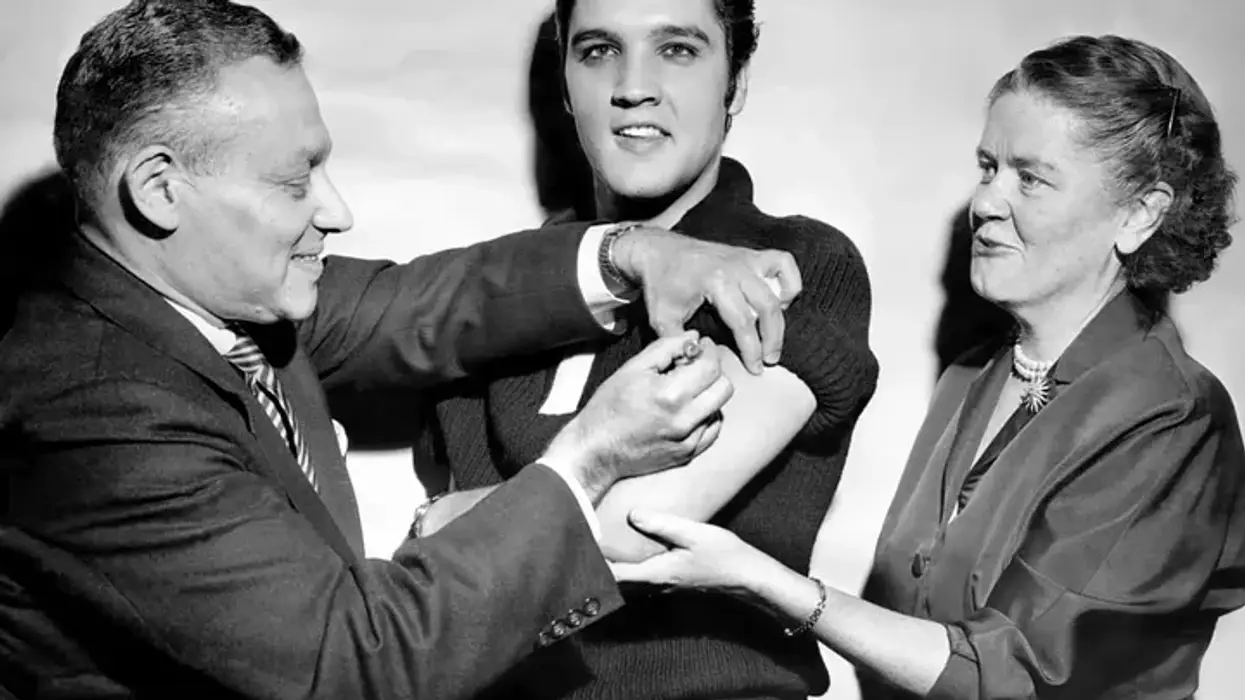
Those of us who lived through the polio era know something that is easy to forget today: Vaccines did not take freedom away, they restored it.
In recent conversations about vaccines, we often hear an argument framed around individual rights and personal choice. This perspective was echoed by Advisory Committee on Immunization Practices Chair Kirk Milhoan in his January 22 interview with STAT News, when he suggested that vaccine recommendations should place greater emphasis on individual autonomy and questioned whether longstanding vaccines, including polio, should continue to be viewed primarily through a public health lens.
As grandparents, we understand that instinct deeply. We raised children. We worried about their safety, questioned new information, and felt the weight of responsibility that comes with making decisions for someone you love more than yourself. Respect for individual liberty is not abstract to us, it is part of who we are as Americans.
But we also belong to a generation that remembers polio. And that memory changes how we see this debate.
Polio was not a distant or theoretical threat when we were children. It arrived quietly, spread easily, and struck without warning. One day a child was fine; the next, paralyzed. Parents kept their children out of swimming pools, movie theaters, and playgrounds. Summers were seasons of fear. Hospital wards filled with children in iron lungs, machines that breathed for bodies polio had left unable to do so.
Protecting public health does not mean erasing individual rights. It means recognizing that some choices carry consequences beyond ourselves.
Janice (Jan) Flood Nichols can attest to what life was like before vaccines. She and her twin brother Frankie were in first grade. It was fall, and they were excited to go trick-or-treating. A few days before Halloween, Frankie caught what seemed like a simple head cold, so their parents kept him home to rest. But the day before Halloween, he suddenly struggled to breathe. They rushed him to the communicable disease hospital in Syracuse.
Doctors performed a spinal tap and placed Frankie in an iron lung. By morning, the diagnosis was confirmed: polio. Jan was brought to the same hospital and given massive doses of gamma globulin, the only treatment doctors hoped might stop the disease.
Frankie’s condition worsened. Unable to control his breathing, doctors rushed him toward emergency surgery. He never made it. Frankie died on November 1, 1953, at 10:25 pm.
That same night, Jan developed symptoms of polio. Her condition deteriorated rapidly, and she was rushed back to the hospital where Frankie had died. Doctors told her parents they did not know if she would live or die. Jan did survive but spent months painfully rehabilitating and learning to walk again.
Jan’s story is why discussions about polio vaccination cannot be reduced to personal preference alone. Polio is not just a risk to one child or one family. It is a highly contagious virus that spreads silently, often through people who show no symptoms at all. That means individual decisions ripple outward, affecting newborns, pregnant women, immunocompromised individuals, and entire communities.
When we talk about rights, we must also talk about responsibility.
In America, freedom has never meant the absence of limits when others are placed in danger. We accept speed limits not because we distrust drivers, but because unchecked speed endangers everyone on the road. We require clean drinking water and food safety standards because one person’s contamination can harm thousands. Public health has always been a balance between individual liberty and collective protection.
Polio vaccination is no different.
Those of us who lived through the polio era know something that is easy to forget today: Vaccines did not take freedom away, they restored it. The widespread use of the polio vaccine didn’t just reduce disease; it gave families their lives back. Children returned to playgrounds and pools. Parents stopped holding their breath every summer. Communities could gather without fear that invisible danger lurked in everyday spaces.
It’s also important to say this clearly: Today’s parents are not reckless or uncaring. Vaccine hesitancy often grows from love, fear, and an overwhelming flood of conflicting information. Many parents have never seen the diseases vaccines prevent. That is a testament to how successful vaccination programs have been, but it also makes the risk feel abstract.
For grandparents, it is anything but abstract.
Many of us came together through Grandparents for Vaccines, a national grassroots organization formed to ensure that the hard-won lessons of the past are not forgotten. We speak not as politicians or policymakers, but as witnesses, people who saw firsthand what happens when diseases like polio are allowed to spread, and who now want to protect the children and grandchildren we love.
We remember classmates who never walked again. We remember neighbors who lived with lifelong disabilities. We remember funerals for children who should have grown old alongside us. These memories are not meant to frighten, they are meant to remind us what happens when a dangerous virus is allowed to spread unchecked.
Protecting public health does not mean erasing individual rights. It means recognizing that some choices carry consequences beyond ourselves. Infants cannot choose to be vaccinated yet. People undergoing cancer treatment cannot choose to have fully functioning immune systems. They rely on the rest of us to create a protective barrier around them.
That is not government overreach. It is community care.
As grandparents, our perspective is shaped by time. We have seen what happens before vaccines and after them. We have watched fear give way to relief, and tragedy replaced by prevention. When we advocate for polio vaccination, we are not dismissing freedom—we are defending a broader, deeper version of it.
The freedom for a child to grow up walking.
The freedom for families to trust public spaces.
The freedom for future generations to know polio only as a chapter in history books, not a living threat.
Our message is simple and heartfelt: We respect choice and we remember the cost of unchecked disease. Polio showed our generation that collective protection can increase freedom across an entire society. That lesson continues to matter for the health and well-being of our grandchildren.
"We don’t have a healthcare infrastructure to take care of a polio outbreak."
After the Trump administration official in charge of immunization policy suggested that childhood polio vaccines should be made optional, experts and survivors of the deadly disease are warning that it could make a furious comeback.
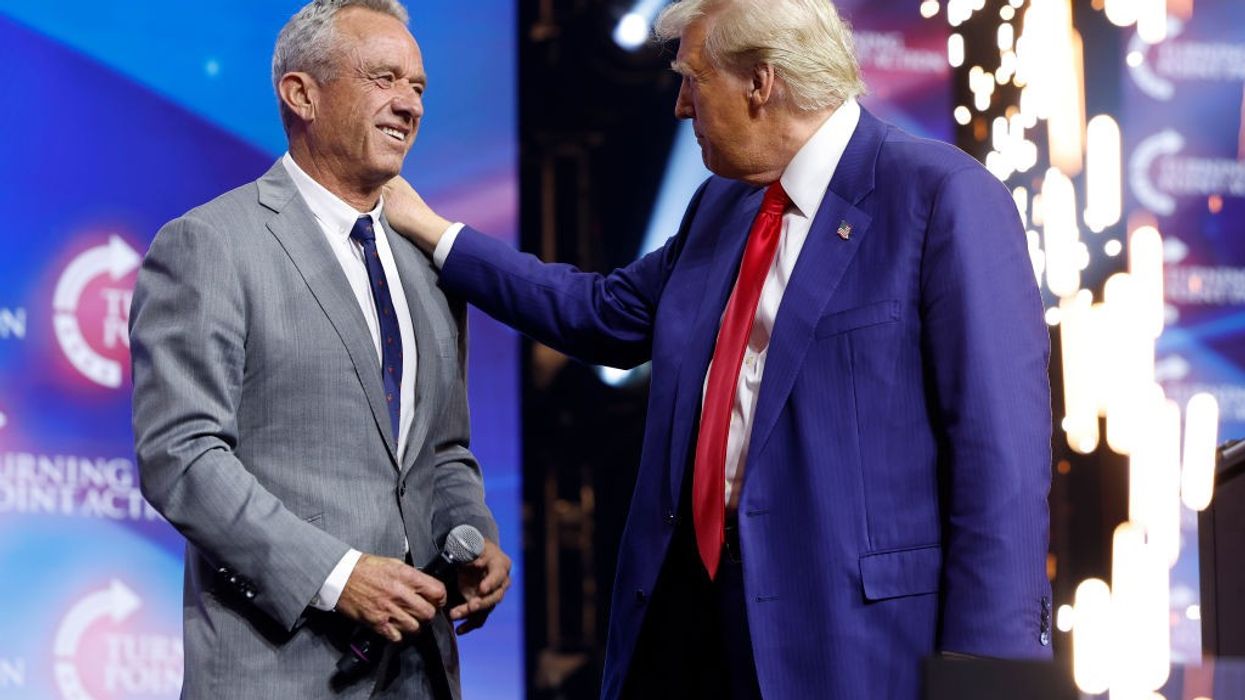
Dr. Kirk Milhoan, a pediatric cardiologist who is chair of the Advisory Committee on Immunization Practices, suggested on a podcast last month ending public schools' vaccine requirements for dangerous diseases, including measles and polio, which would be one of the most dramatic shifts in federal health policy in more than half a century.
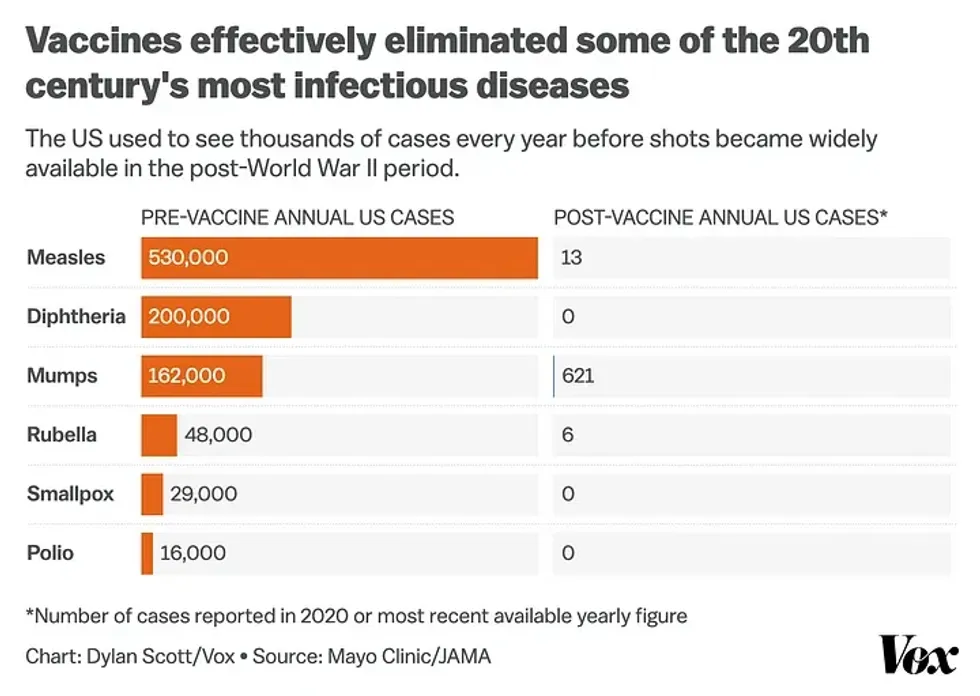
Where these diseases once infected millions of people each year, Milhoan noted their dramatic decline in recent years, suggesting they no longer pose the threat they once did and that vaccines were therefore less necessary. However, he ignored the fact that the near-total eradication of these illnesses was due to society-wide vaccination in the first place.
In the first half of the 20th century, tens of thousands of people (mostly children) suffered paralysis from polio. The first vaccine was introduced in the USA in 1955. Notice the trend afterwards.(by @ourworldindata)
[image or embed]
— Information is Beautiful (@infobeautiful.bsky.social) January 26, 2026 at 2:55 PM
The US is already at risk of losing its measles eradication status after drops in vaccination rates caused the highest number of cases and deaths in more than three decades last year.
Measles vaccination rates had already been dipping for years amid rising anti-vaccine sentiment. But it was shifted into overdrive after vaccination restrictions were narrowed by Trump's Secretary of Health and Human Services, Robert F. Kennedy Jr., who publicly spread doubt about the Measles, Mumps, and Rubella (MMR) vaccine's well-documented safety and efficacy.
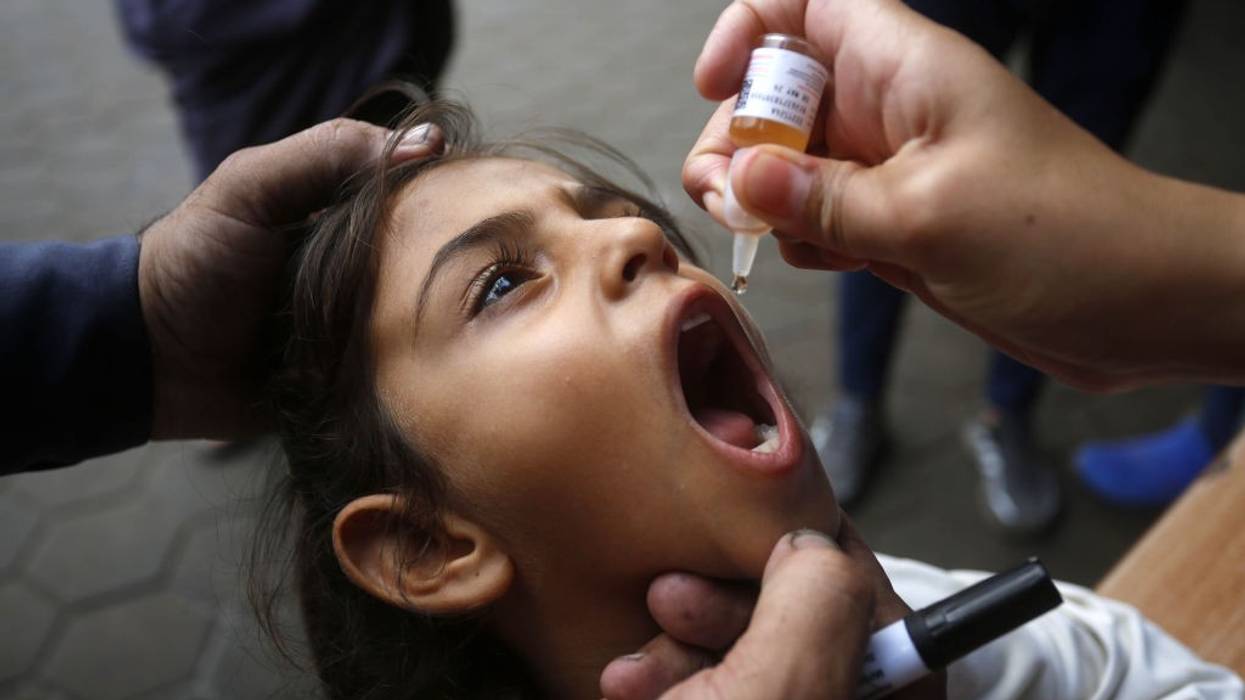
At its peak in 1952, nearly 58,000 people became infected with polio. Over a third of them became paralyzed, and more than 3,000 died. A vaccine was introduced for the illness in 1955. Within just two years, the number of cases had dropped by 90%, and the disease was declared eliminated in the US in 1979.
Childhood vaccination rates have dropped across the board over the past five years. Where about 95% of kindergarteners received the measles and polio vaccines in the 2019-20 school year, that number had plummeted to 92.5% in 2024-25.
But because polio is several times less infectious than measles, the current national average coverage still provides substantial protection, though localized outbreaks remain possible in undervaccinated communities.
If childhood vaccination is made optional, however, those who have treated and lived with polio fear it could also come back with a vengeance.
Survivors say US healthcare system not ready for new cases – ‘the only thing to fix polio is the polio vaccine’
[image or embed]
— Guardian US (@us.theguardian.com) February 23, 2026 at 2:13 PM
In an interview with the Guardian published Monday, Grace Rossow, an operating-room communications coordinator, whose leg remains paralyzed from a case of polio as an infant in India, said the vaccine had “absolutely been a victim of its own success."
“People aren’t scared of polio anymore,” she said. “People don’t really see the daily side of living with a vaccine-preventable disease. With polio, you’re never going to fix us, and that’s the problem. The only thing to fix polio is the polio vaccine.”
Polio's status as a thing of the past has not only diminished the public's understanding of why it's important to prevent, but also how to treat it. Rossow said, "We don’t have a healthcare infrastructure to take care of a polio outbreak."
Art Caplan, one of the last remaining survivors of the 1950s outbreak, who has struggled with lifelong weakness in his legs due to the disease, said he's watched as most of the medical professionals who understood how to treat it retired and died. "There’s nobody left. They don’t see it."
Gordon Allan, a surgeon who is the orthopedic residency director and the total joint reconstructive fellowship director at Southern Illinois University School of Medicine, said that in the event of a new polio outbreak, most people in his field would have little idea how to treat those suffering from the illness.
“Orthopedics has really changed a lot now from the people who trained me," he said, noting that even those doctors only had experience treating post-polio symptoms.
“No one practicing has first-hand experience," he said. "Orthopedics was quite different because of polio, and all that stuff just faded away."
The last polio case in the United States was detected in New York in 2022 in an unvaccinated adult who became paralyzed from the illness.
None have been diagnosed since. But as measles has shown, outbreaks can spread very quickly in communities with large unvaccinated populations, which are often insular and religious.
Caplan said he was "furious" at Milhoan's contention that childhood vaccine requirements should be reconsidered just because polio is no longer around.
"If you could gather up the kids I saw die or become really severely disabled from 50 years ago, they would want you arrested," he said. "It’s horrifying, and the height of irresponsibility to leave the door open even a crack."
Of all the actions Musk and President Trump set in motion, nothing will hurt more people around the world than their dismantling of the U.S. Agency for International Development (USAID).
Elon Musk is leaving the White House — and leaving a trail of destruction in his wake. But of all the actions Musk and President Trump set in motion, nothing will hurt more people around the world than their dismantling of the U.S. Agency for International Development (USAID).
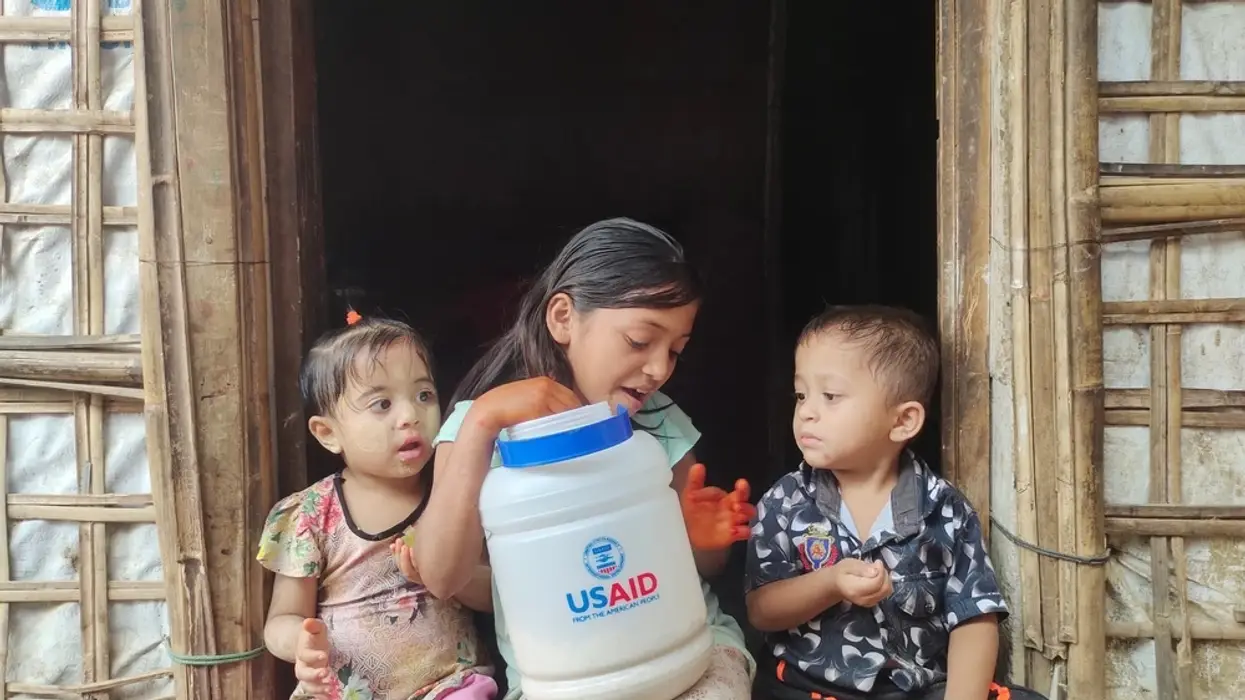
By making disease-stemming drugs, clean water, and food available to millions, USAID has probably saved more lives worldwide than any entity in history.
Since 2000, USAID’s programs have prevented the deaths of 58 million people from tuberculosis, 25 million from HIV/AIDS, and over 11 million from malaria. It’s given 70 million people access to safe drinking water and, working in concert with global vaccine initiatives, helped to nearly eradicate polio.
As the main funder of global health interventions, USAID served as a bulwark against diseases that don’t halt at national borders. Its programs identified emerging epidemics and minimized the spread of drug-resistant diseases that threaten Americans as well.
Although it’s commonly assumed to be much higher, foreign aid is just 1 percent of federal spending, so cutting it won’t begin to balance the budget. So instead Trump and Musk attacked USAID by slandering it, calling it a “criminal agency” (Musk) that’s “run by a bunch of radical lunatics” (Trump).
This, of course, was a lie. USAID was known for having rigorous oversight, with 275 investigators and auditors in its watchdog office.
Most USAID funding in low-income countries targets disease prevention, economic growth, and disaster relief. But DOGE and Trump made staggering false claims, like Trump’s that USAID was sending “$50 million to Gaza to buy condoms for Hamas.”
As a result, USAID was the first casualty in the Trump administration’s struggle to make the federal government subservient not to the Constitution but to one man. And Musk — the world’s richest man, whose income last year exceeded USAID’s entire budget — and his fellow billionaire President Trump withdrew medicines and food from millions of the world’s most vulnerable people. Afterward, Musk gleefully announced that they’d fed “USAID into the wood chipper.”
I’ve followed USAID since seeing its economic and agricultural programs in the African Sahel in the 1980s, and I’ve spent 40 years heading nonprofits working to provide clean drinking water internationally.
No organization I’ve led has received USAID funding, but over the years I’ve known scores of USAID staff who were hard working and conscientious about spending U.S. tax dollars. Trump owes an apology to USAID’s employees, now indiscriminately fired or coerced into early retirement.
Every federal agency can stand being streamlined. But what happened to USAID wasn’t reform — it was destruction. “They didn’t know what they were doing or care to find out, but I came to realize that cruelty is their purpose,” one senator told me in April. “Cruelty is how they think they demonstrate power.”
It’s fair to say American voters didn’t ask for this. USAID went unmentioned during the 2024 presidential campaign — and bipartisan majorities continue to say they oppose gutting the agency.
American entities which partnered with USAID — including corporations, faith-based organizations, foundations, universities, and civic groups like Rotary International — will continue to raise their own private funds. But by themselves they can’t replace USAID’s leadership abroad.
Now that Trump and Musk have eviscerated the agency, millions will suffer. The Center for Global Development estimates that U.S. foreign assistance has been saving 3 million lives annually. The journal Nature calculates that the loss of U.S. global health funding alone could result in 25 million additional deaths over the next 15 years.
For Americans — including Trump voters — feeling queasy over what’s been carried out in their name, it’s not too late to convey to Congress your support for life-saving foreign assistance.
Regardless of how they voted, Americans should be proud of how their foreign aid has reduced worldwide poverty, sickness, hunger, and thirst — all for 1 percent of the federal budget. The future cost to the United States, if it abandons its leadership in global health and development, will prove incalculable.