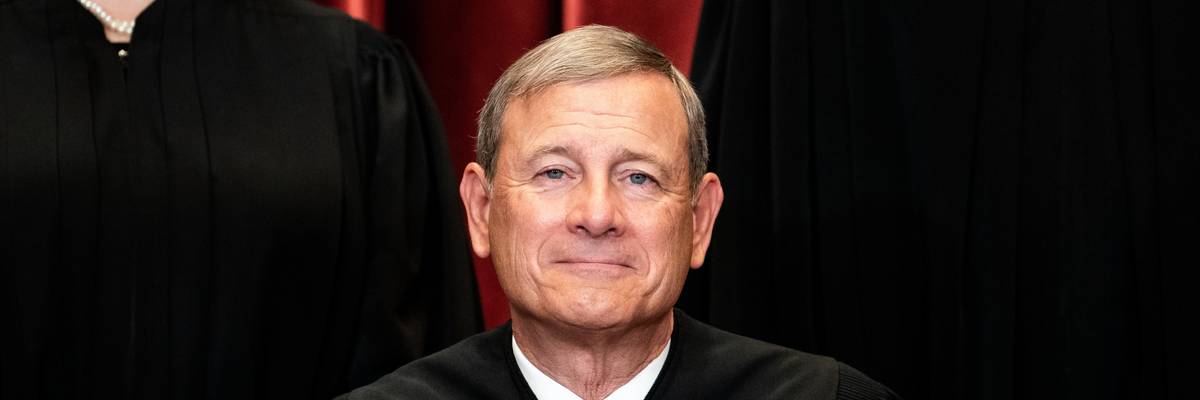
Chief Justice John Roberts sits during a group photo of the justices of the US Supreme Court in Washington, DC on April 23, 2021.
The Tariff Ruling Shows the Roberts Court Is More Pro-Corporate Than Pro-Trump
The mainstream media, and even much of the progressive media, is misinterpreting the tariff decision as demonstrating the Roberts Court's independence and judicial neutrality. Instead, it demonstrates the court's true masters.
The US Supreme Court's rejection of President Donald Trump's singular policy on tariffs is a reason for some celebration. During the past year, using the so-called "shadow docket," the Roberts Court had ruled in Trump's favor on an emergency basis 24 out of 28 times.
But the mainstream media, and even much of the progressive media, is misinterpreting the tariff decision as demonstrating the Roberts Court's independence and judicial neutrality.
For example, the New York Times lead article by its chief legal correspondent Adam Lipnick was headlined, "The Supreme Court's Declaration of Independence," and the article argued that SCOTUS's decision "amounted to a declaration of independence." One progressive blogger wrote, "It would be nice—and, in political terms, smart—if the left changes its tune about Roberts in the wake of his courageous stand." An article in the generally liberal Atlantic magazine was headlined, "The Supreme Court Isn't a Rubber Stamp."
But the Roberts Court is not independent. Rather, when there's a conflict between big corporations and Trump, it will side with the corporations.
Most of the media is getting the meaning of the tariffs case wrong.
The plaintiffs challenging the tariffs were represented by the New Civil Liberties Alliance funded by billionaire Charles Koch and former Federalist Society chief Leonard Leo who selected the right-wing Justices. Even The Chamber of Commerce filed an amicus brief opposing the Trump tariffs and asking the Roberts Court to overturn them.
In most cases that don't threaten corporate interests, the Roberts Court sides with Trump. However, as with the tariff decisions, in cases soon to be decided on whether Trump can fire a Federal Reserve governor without cause—which threatens business interests—oral arguments indicate they will probably side with the business interests and rule that the Fed is a special case and the president cannot fire a Fed governor without cause. But they will likely bend themselves into pretzels to hold that Trump can fire without cause the heads of most other agencies like the Consumer Protection Financial Bureau and the National Labor Relations Board, which regulate business and which corporate interests want kneecapped..
Most of the media is getting the meaning of the tariffs case wrong. It does not show that the Roberts Court is independent. Rather, it shows that the Roberts Court is pro-corporate.
We are at a crossroads
This country and this world are at a monumental crossroads. In a few short weeks, US voters will have an opportunity to beat back the forces of fascism and confront the billionaires who are rigging the economy, our media system, and our democracy, making it increasingly impossible for ordinary people to get by. We’re not just talking about the election. We’re talking about what must be done once these fascist elements are vanquished from power. We need a bolder set of solutions than what either major party has so far been willing to offer and a working-class movement ready to fight like hell for it. Trump didn't emerge from nowhere. The conditions that fueled MAGA authoritarianism were created by decades of radical neoliberal economic policies and a corrupt political system dominated by corporate interests. They slashed taxes on the super-rich, promising that the benefits would trickle down. They said giveaways to the corporate titans would make life more affordable for the rest of us. It was all bullshit. And when a bitter, betrayed populace searches for someone to blame, right-wing demagogues have little trouble finding scapegoats. People know when they're being lied to, but you won't hear any of this from the corporate media. Only independent journalism—powered and funded by people who believe in building a better world—can deliver truly trustworthy daily news. Our Fall Campaign is underway, and we need your help. To power our newsroom through the rest of the year, we need to raise $125,000 by midnight on October 31. So if you share our vision, please contribute whatever you can to sustain our work. |
The US Supreme Court's rejection of President Donald Trump's singular policy on tariffs is a reason for some celebration. During the past year, using the so-called "shadow docket," the Roberts Court had ruled in Trump's favor on an emergency basis 24 out of 28 times.
But the mainstream media, and even much of the progressive media, is misinterpreting the tariff decision as demonstrating the Roberts Court's independence and judicial neutrality.
For example, the New York Times lead article by its chief legal correspondent Adam Lipnick was headlined, "The Supreme Court's Declaration of Independence," and the article argued that SCOTUS's decision "amounted to a declaration of independence." One progressive blogger wrote, "It would be nice—and, in political terms, smart—if the left changes its tune about Roberts in the wake of his courageous stand." An article in the generally liberal Atlantic magazine was headlined, "The Supreme Court Isn't a Rubber Stamp."
But the Roberts Court is not independent. Rather, when there's a conflict between big corporations and Trump, it will side with the corporations.
Most of the media is getting the meaning of the tariffs case wrong.
The plaintiffs challenging the tariffs were represented by the New Civil Liberties Alliance funded by billionaire Charles Koch and former Federalist Society chief Leonard Leo who selected the right-wing Justices. Even The Chamber of Commerce filed an amicus brief opposing the Trump tariffs and asking the Roberts Court to overturn them.
In most cases that don't threaten corporate interests, the Roberts Court sides with Trump. However, as with the tariff decisions, in cases soon to be decided on whether Trump can fire a Federal Reserve governor without cause—which threatens business interests—oral arguments indicate they will probably side with the business interests and rule that the Fed is a special case and the president cannot fire a Fed governor without cause. But they will likely bend themselves into pretzels to hold that Trump can fire without cause the heads of most other agencies like the Consumer Protection Financial Bureau and the National Labor Relations Board, which regulate business and which corporate interests want kneecapped..
Most of the media is getting the meaning of the tariffs case wrong. It does not show that the Roberts Court is independent. Rather, it shows that the Roberts Court is pro-corporate.
- Siding With Corporate Power Over Worker Rights, Supreme Court Supports Company That Sought to Block Class Action Lawsuit ›
- John Roberts' Wife Made Millions From Elite Law Firms, Major Companies: Whistleblower Docs ›
- These Supreme Court Justices Have Personal Investments in Companies That Could Reap Billions in Upcoming Ruling ›
- Judging Justices in the Era of Trump ›
- A Message for Chief Justice John Roberts: Clean Up Your Court ›
- Trump ‘Won’t Forget’ the Roberts Court Helped Him Win—Neither Should We ›
The US Supreme Court's rejection of President Donald Trump's singular policy on tariffs is a reason for some celebration. During the past year, using the so-called "shadow docket," the Roberts Court had ruled in Trump's favor on an emergency basis 24 out of 28 times.
But the mainstream media, and even much of the progressive media, is misinterpreting the tariff decision as demonstrating the Roberts Court's independence and judicial neutrality.
For example, the New York Times lead article by its chief legal correspondent Adam Lipnick was headlined, "The Supreme Court's Declaration of Independence," and the article argued that SCOTUS's decision "amounted to a declaration of independence." One progressive blogger wrote, "It would be nice—and, in political terms, smart—if the left changes its tune about Roberts in the wake of his courageous stand." An article in the generally liberal Atlantic magazine was headlined, "The Supreme Court Isn't a Rubber Stamp."
But the Roberts Court is not independent. Rather, when there's a conflict between big corporations and Trump, it will side with the corporations.
Most of the media is getting the meaning of the tariffs case wrong.
The plaintiffs challenging the tariffs were represented by the New Civil Liberties Alliance funded by billionaire Charles Koch and former Federalist Society chief Leonard Leo who selected the right-wing Justices. Even The Chamber of Commerce filed an amicus brief opposing the Trump tariffs and asking the Roberts Court to overturn them.
In most cases that don't threaten corporate interests, the Roberts Court sides with Trump. However, as with the tariff decisions, in cases soon to be decided on whether Trump can fire a Federal Reserve governor without cause—which threatens business interests—oral arguments indicate they will probably side with the business interests and rule that the Fed is a special case and the president cannot fire a Fed governor without cause. But they will likely bend themselves into pretzels to hold that Trump can fire without cause the heads of most other agencies like the Consumer Protection Financial Bureau and the National Labor Relations Board, which regulate business and which corporate interests want kneecapped..
Most of the media is getting the meaning of the tariffs case wrong. It does not show that the Roberts Court is independent. Rather, it shows that the Roberts Court is pro-corporate.
- Siding With Corporate Power Over Worker Rights, Supreme Court Supports Company That Sought to Block Class Action Lawsuit ›
- John Roberts' Wife Made Millions From Elite Law Firms, Major Companies: Whistleblower Docs ›
- These Supreme Court Justices Have Personal Investments in Companies That Could Reap Billions in Upcoming Ruling ›
- Judging Justices in the Era of Trump ›
- A Message for Chief Justice John Roberts: Clean Up Your Court ›
- Trump ‘Won’t Forget’ the Roberts Court Helped Him Win—Neither Should We ›