

SUBSCRIBE TO OUR FREE NEWSLETTER
Daily news & progressive opinion—funded by the people, not the corporations—delivered straight to your inbox.
5
#000000
#FFFFFF
To donate by check, phone, or other method, see our More Ways to Give page.
Daily news & progressive opinion—funded by the people, not the corporations—delivered straight to your inbox.
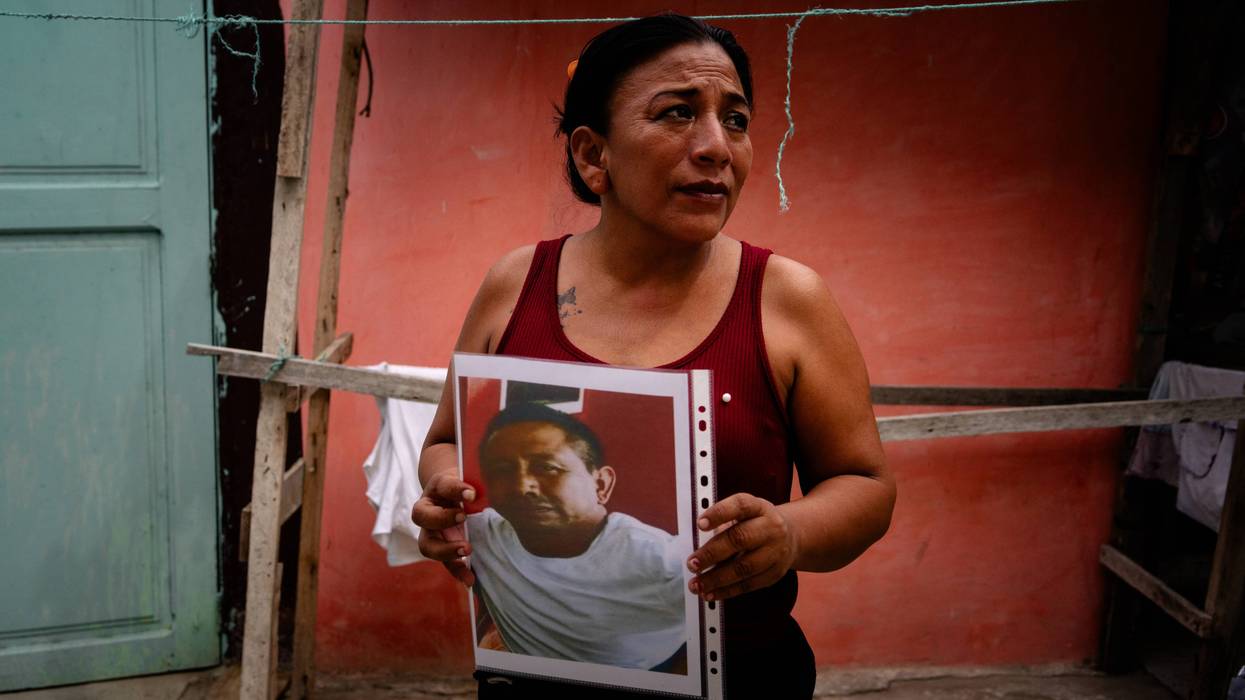
"How far does the 'war on drugs' go?" said a former Ecuadorian official. "Who is held accountable for the lives of Ecuadorian fishermen?"
The recently reported killing of the Ecuadorian prosecutor who had been investigating allegations that three boats from the country had been struck by the US and that dozens of survivors had been abducted and tortured by American forces, was "not a coincidence," said one congressman Friday as he called for a probe into the bombings.
"For almost a year, the US government has been illegally bombing fishing boats and killing people without evidence of wrongdoing," said Rep. Jesús "Chuy" García (D-Ill.). "And last month, Alexandra Bravo, the Ecuadorian prosecutor investigating boats that were attacked or disappeared, was murdered... There must be an independent investigation."
García's demand came a day after Drop Site News reported on Bravo's killing in the city of Manta on June 14.
Police say a hitman on a black motorcycle opened fire on Bravo and her sister at 11:00 am as they were leaving a cafe. Both women were killed and the prosecutor's driver was injured. There was "no sign of the police detail that had been assigned" to protect Bravo, leading the Police Directorate, which operates under the executive branch of President Daniel Noboa, a close ally of President Donald Trump, to investigate whether there had been an "internal security breach."
Bravo had been investigating the cases of three fishing boats—the Fiorella, the Negra Francisca, and the Don Maca—which were reportedly struck by drones in January and March.
The 36 surviving crew members of the latter two vessels reported that they were captured by US forces and subjected to torture before eventually being returned to Ecuador.
Eight fishermen went missing from the Fiorella, and their family members have reported that Ecuadorian authorities have provided little help to them as they look for answers, with the daughter of one missing fisherman saying an official had suggested the crew was involved in drug trafficking.
The three boats were hit with explosives as the Trump administration carried out "Operation Southern Spear," its campaign of boat bombings in the Caribbean and the eastern Pacific. The White House has insisted that the at least 66 strikes that have been carried out by US forces since last September were on boats that were carrying drugs, and the 221 people on board were involved in drug trafficking. Trump has claimed the US is in an armed conflict with Latin American drug cartels, but Congress has not authorized military force in the region.
Legal experts have said that even if the bombed vessels were ferrying illicit substances to the US, military attacks against civilians for their alleged involvement in drug trafficking is against international law.
According to Amnesty International, the Ecuadorian public prosecutor’s office has not submitted a formal request to the US for help with investigating the disappearance of the Fiorella and its crew.
Sources at the police department in Manta and at Human Rights Watch told Drop Site that Bravo had reported facing pressure from the attorney general's office regarding her investigation, with her superiors telling her to treat the alleged attacks on the boats only as "cases of disappearance" and to "close all lines of inquiry" after the 36 survivors of the Negra Francisca and the Don Maca returned, even though they showed signs of torture.
Meanwhile, as the US maintains it had nothing to do with bombing the three vessels, Drop Site reported that a US Coast Guard boat was detected near the Negra Francisca around the time of the bombing before the Coast Guard boat turned off its signal.
Two survivors of the Fiorella bombing, Christian Flores and Dimas Ignacio Álvarez, "corroborated seeing the Fiorella engulfed in smoke and surrounded by American assets."
"In their police statements, Flores and Álvarez described two US aircraft flying over the Fiorella on January 18; multiple grey American drones and a US-flagged patrol ship circling the vessel on January 19; and, on January 20—the day their crewmates disappeared—the large US-flagged patrol ship near the smoke," wrote Camila Lourdes Galarza at Drop Site.
Former Ecuadorian Minister of Foreign Affairs Guillaume Long said Thursday that US military presence in Ecuador as the two countries deepen their military partnership is "a clear violation of our people's sovereignty and popular will."
"Meanwhile, the families of Manta and Jaramijó wait for answers," said Long. "Eight families deserve truth and justice. How far does the 'war on drugs' go? Who is held accountable for the lives of Ecuadorian fishermen?"

The policy change means "we could have families separated for months or years," said one expert.
Critics are slamming the Trump administration for implementing a new rule that foreigners who apply for green cards must do so from abroad.
US Citizenship and Immigration Services (USCIS) on Friday announced that foreigners currently in the US who want to establish permanent legal residency must first return to their countries of origin to apply for a green card.
This announcement broke with decades of US immigration policy, which made it possible for immigrants in the US to obtain green cards without having to leave the country.
Doug Rand, a former senior advisor at USCIS under President Joe Biden, said in an interview with The Associated Press that "the goal of this policy is very explicit," which is to block a path to citizenship "for as many people as possible."
Sarah Pierce, a former USCIS policy analyst, told The New York Times that the rule change could have particularly dire consequences to foreigners who are married to US citizens and will now have to apply for permanent residency from overseas.
"Our consular processing system through which they would have to apply is already overburdened," Pierce explained. "So that means we could have families separated for months or years."
Aaron Reichlin-Melnick, senior fellow at the American Immigration Council, similarly noted that the new policy "could force people to leave their jobs, homes, and families for weeks or months, all at their own expense" just to stay in a country where they have already established roots.
Reichlin-Melnick said that the full scope of the policy isn't yet clear because there are several unknown details about how broadly it will be applied, but added that "in the meantime, hundreds of thousands of immigrants now have to worry about upending their lives to get a legal status that they are entitled to under our laws."
Drop Site News reporter Ryan Grim argued that the new policy rips the mask off Trump administration claims that they aren't opposed to all immigration, they simply want to reduce undocumented immigration.
"The talking point that we do want legal immigration, we just want people to get in line and follow the rules, is BS," Grim commented. "This is an attempt to blow up the line, blow up the rules, and make it insanely difficult to immigrate legally."
Rep. Chuy García (D-Ill.) echoed Grim's comments by pointing out that the new policy shows the Trump administration's disdain for immigration overall.
"This new policy will force thousands of LEGAL immigrants, including spouses of US citizens, to leave their homes, families, and jobs for weeks or even months to get their green card outside the US," said García. "This is an absurd and cruel policy."
Rep. Adriano Espaillat (D-NY), chairman of the Congressional Hispanic Caucus, condemned the new policy for targeting "students, scientists, entrepreneurs, spouses of US citizens, and other individuals following legal immigration processes."
"Aspiring lawful permanent residents are valued members of our communities, workforce, and economy," Espaillat emphasized. "I will continue fighting to protect the rights of aspiring green card holders and immigrant families."
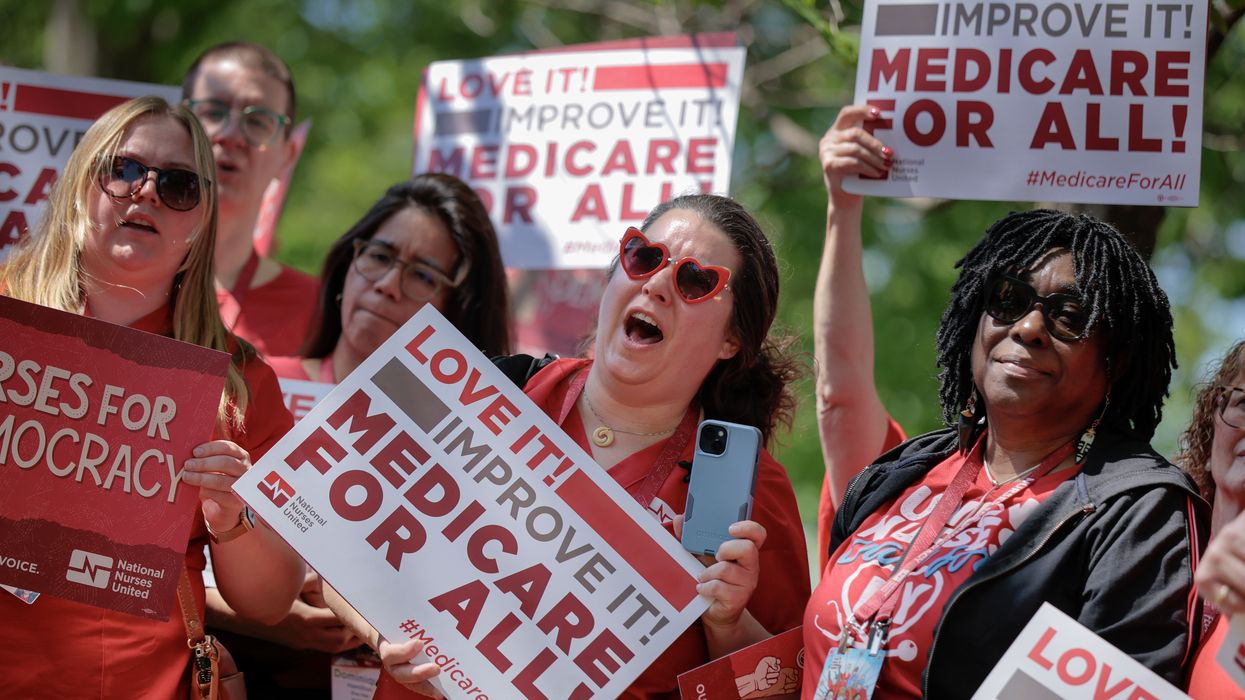
"Chicagoans and all Americans suffer from a healthcare system that is insanely complicated, medically unsound, and ruinously expensive for individuals, businesses, and the nation as a whole."
As Americans contend with skyrocketing health insurance premiums and a Republican congressional majority unwilling to extend even meager subsidies, the City Council in the third-largest US city—Chicago, Illinois—on Wednesday unanimously approved a resolution pressuring Congress to pass Medicare for All legislation.
Chicago's resolution from Alderwoman Ruth Cruz, a Democrat representing Ward 30, "enthusiastically" endorses the Medicare for All Act introduced last year by Sen. Bernie Sanders (I-Vt.) and Reps. Pramila Jayapal (D-Wash.) and Debbie Dingell (D-Mich.), and calls on federal legislators "to work toward its swift enactment."
The resolution notes that if passed, the congressional bill would cover "all necessary primary, preventative, and medical care; including hospital, surgical, and outpatient services, prescription drugs, mental health, and substance abuse treatment; emergency services; reproductive care; dental, hearing and vision care; and long-term care" for all Americans throughout lifetimes without without co-payments, deductibles, or other out-of-pocket costs.
Speaking at Wednesday's five-hour meeting, Cruz declared that "healthcare is a human right."
"Chicagoans and all Americans suffer from a healthcare system that is insanely complicated, medically unsound, and ruinously expensive for individuals, businesses, and the nation as a whole," Cruz said in a statement. "Medicare for All would put actual medical care back at the center of our healthcare system, leading to better outcomes and lower costs for millions of Americans."
"Every other developed nation on Earth—and some developing nations as well!—has figured out how to provide universal health coverage to their people," she continued. "It is long past time for Congress to do the rational, responsible thing and adopt Medicare for All in the United States."
Chicago has now joined dozens of US cities and counties that have, in recent years, formally supported replacing the nation's for-profit healthcare system with a public single-payer one. The Board of Commissioners for Illinois' Cook County—which includes Chicago—approved a similar resolution in 2019.
US Rep. Jesús "Chuy" García (D-Ill.), a cosponsor of the federal bill and "proud" supporter of the Chicago resolution, argued Wednesday that "Medicare for All is the right step toward addressing high costs and inequalities in the current system, which particularly affect underserved populations and minorities."
García, who plans to retire after this term, represents Illinois' 4th Congressional District, which spans parts of Cook and DuPage counties. He said that "my district in Chicago has a 14% uninsurance rate, and many cannot afford healthcare even though they work full time."
President Donald Trump's "cruel spending bill passed in 2025 will leave 10 million more people nationwide without health insurance by 2034, because of changes his bill made to the Affordable Care Act and Medicaid," he highlighted, referring to the One Big Beautiful Bill Act. "Passing the Medicare for All Act is more urgent than ever."
"At a time when people are struggling to pay for medications, groceries, and gasoline because of President Trump's policies, Medicare for All will guarantee that all Chicago and other US residents will be fully covered for healthcare anywhere in the United States, regardless of employment status, marital status, citizenship status, income, age, or geography," García concluded. "We owe it to America. We owe it to the hardworking people in our communities."
Physicians for a National Health Program, an organization that fights for a single-payer system at the federal level, pointed out on social media Wednesday that "this makes Chicago the biggest city in the country to endorse Medicare for All."
Breaking news: Chicago’s City Council has voted unanimously to pass a resolution in support of Medicare for All 🎉This makes Chicago the biggest city in the country to endorse Medicare for All, and sends a message to federal legislators that their constituents expect them to support single payer.
[image or embed]
— Physicians for a National Health Program (PNHP) (@pnhp.bsky.social) March 18, 2026 at 9:01 PM
The Chicago-based group's national coordinator, Dr. Claudia Fegan, retired as chief medical officer of Cook County Health in December 2024. While publicly advocating for the resolution earlier this month, she said that "I am reminded of a woman I admitted to the hospital one night a few years ago. Both of her breasts were rock hard. They were infiltrated with cancer with palpable lymph nodes in her axilla. She worked as a hairdresser, owned her own shop, but had no health insurance."
"She was sitting at home waiting to die," Fegan explained. "She believed she had no other choice. She knew she could not afford her care. Her daughter made her come in. Remarkably, we were able to get a dramatic response with treatment. No one should ever have to sit at home waiting to die in this country, when we have treatments that can be lifesaving."
Eagan Kemp, healthcare policy advocate at another national group, Public Citizen, said Wednesday that "the fragmentation of our healthcare system creates instability and inequity for Chicago residents every day."
"Right now, the situation is dire," Kemp acknowledged, "with the recent actions by the Trump administration and its MAGA allies in Congress to further unravel an already tenuous system that leaves tens of millions of Americans without coverage and even more without adequate coverage."
"But the federal government already has the capacity and funding to efficiently address this through a universal insurance program," the advocate emphasized. "Thankfully, we also have an excellent plan for how to accomplish that in the Medicare for All Act of 2025. This resolution ushers the solution into the spotlight as a key demand for Americans to voice to our government."
After the Chicago resolution's approval, Susan Hurley, executive director of the Illinois Single Payer Coalition, which organized communities to advance the measure, stressed that "our collective misery, suffering, and impoverishment is allowed to happen so that health insurance CEOs and others in our bloated, corrupt system can make hundreds of millions of dollars."
"The companies hoard billions in profits," Hurley said. "It is monstrous madness to allow this to continue for no other reason than satisfying greed beyond all comprehension at the expense of human lives."
The city's Wednesday move came on the heels of Illinois' primary elections, in which state residents chose Lt. Gov. Juliana Stratton, a supporter of Medicare for All, in a nationally watched race to run for retiring US Sen. Dick Durbin's (D-Ill.) seat in November, when Democrats aim to reclaim both chambers of Congress.
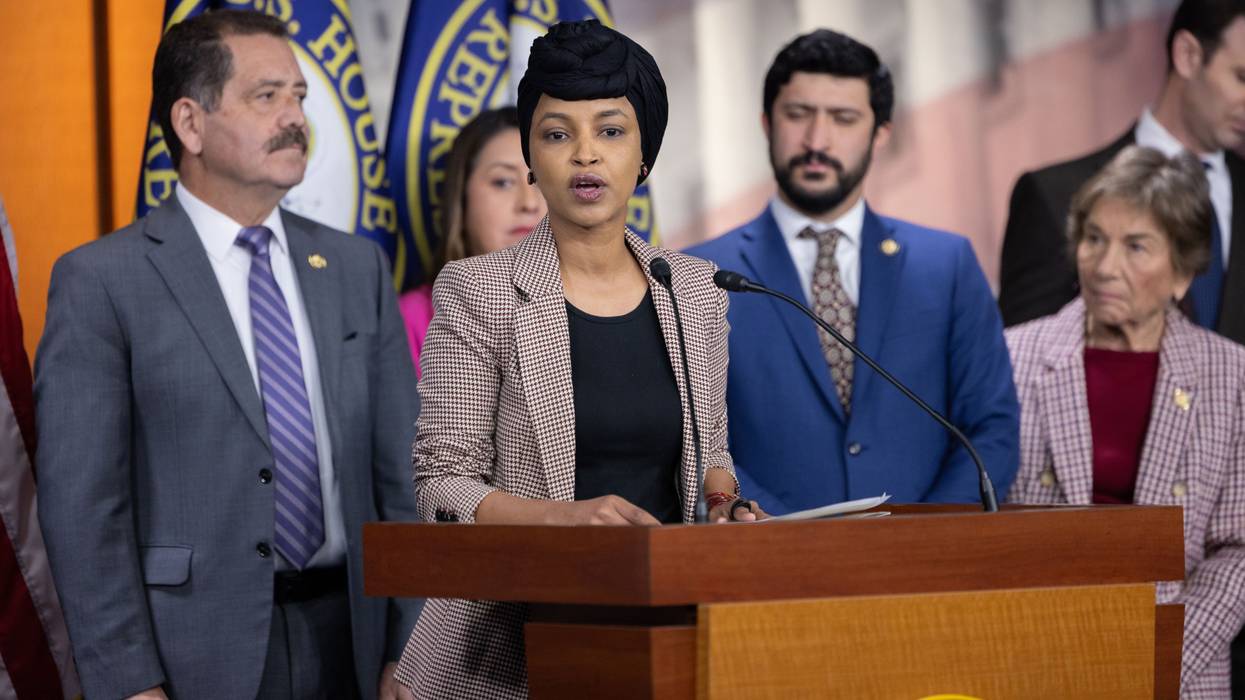
"Every US representative will face a simple, up-or-down choice on the House floor this week: Will you stand up for the Constitution and vote to stop Trump’s illegal warmaking or not?"
With floor votes expected this week, top members of the Congressional Progressive Caucus are urging fellow lawmakers in the US House to back a pair of resolutions aimed at preventing President Donald Trump from launching an unauthorized war on Venezuela.
“As Trump once again threatens ‘land strikes on Venezuela,’ every US representative will face a simple, up-or-down choice on the House floor this week: Will you stand up for the Constitution and vote to stop Trump’s illegal warmaking or not?" said Reps. Ilhan Omar (D-Minn.) and Chuy García (D-Ill.), respectively the deputy chair and the whip for the Congressional Progressive Caucus (CPC). "This is not a partisan issue: Three in four Americans oppose a regime-change war to overthrow the Venezuelan government, including two-thirds of Republicans."
Trump's belligerent rhetoric and recent military action in the Caribbean and eastern Pacific—including the illegal bombing of vessels and seizure of a Venezuelan oil tanker—are "driving us toward a catastrophic forever war in Venezuela," Omar and García warned, urging lawmakers to pass H.Con.Res. 61 and H.Con.Res. 64.
The first resolution, led by Rep. Gregory Meeks (D-N.Y.), would require Trump to "remove United States Armed Forces from hostilities with any presidentially designated terrorist organization in the Western Hemisphere, unless authorized by a declaration of war or a specific congressional authorization for use of military force."
The other, introduced earlier this month by Rep. Jim McGovern (D-Mass.), is explicitly designed to prevent a direct US attack on Venezuela.
"Congress hereby directs the president to remove the use of United States Armed Forces from hostilities within or against Venezuela, unless explicitly authorized by a declaration of war or specific statutory authorization for use of military force," reads the measure, which is co-sponsored by two Republicans—Reps. Thomas Massie (R-Ky.) and Don Bacon (R-Neb.).
In their statement over the weekend, Omar and García said that "both Democrats and Republicans must send a strong message to the Trump administration: Only Congress can authorize offensive military force, not the president."
"Trump is deploying U.S. personnel to seize Venezuelan oil tankers in international waters. He has launched double-tap airstrikes killing capsized and defenseless individuals. Trump declared a no-fly zone on Venezuelan airspace, deployed F-18 fly-overs in the Gulf of Venezuela, and refused to rule out troop deployments, while threatening to overthrow heads of state across the region," the lawmakers said. "These are illegal hostilities that could destabilize the entire region and fuel mass migration. Congress must stop this unconstitutional military campaign by passing these War Powers Resolutions."
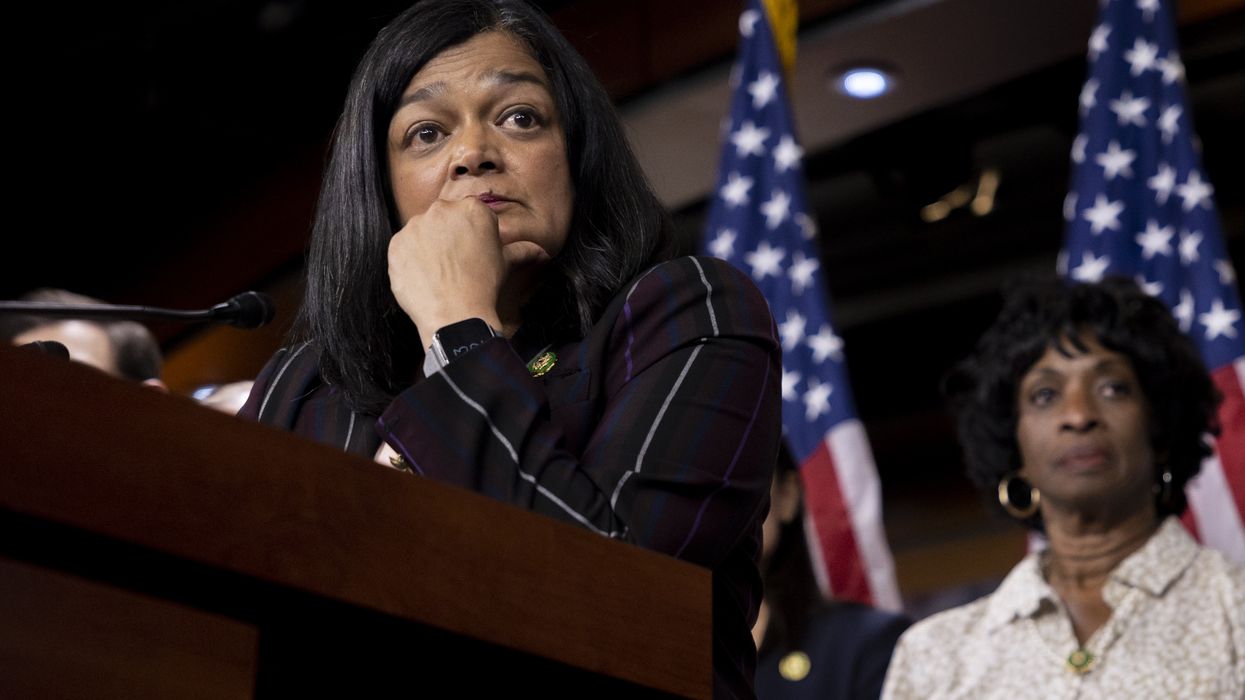
Top Republicans have claimed that calling Trump “fascist” or “authoritarian” is an incitement to “terrorism." But party leaders have said nothing about an explicit call for violence from one of their own.
It has now been almost a full week since a Republican Arizona state representative called for the execution of Democratic Rep. Pramila Jayapal. But top Republicans in Congress and the White House have remained silent, even as they blame the left for escalating "political violence."
On Wednesday, in response to an out-of-context clip from Jayapal's (D-Wash.) YouTube channel posted to social media, state Rep. John Gillette (R-30) wrote that the Washington state Democrat—who discussed how protesters could become "strike ready or street ready"—was calling for the overthrow of the federal government.
“Until people like this, that advocate for the overthrow of the American government are tried convicted and hanged... it will continue,” he wrote on X.
Video: Arizona's Family (3TV/CBS5)
But when the full video, published in March and titled "The Resistance Lab," was unearthed by the Arizona Mirror, it showed that Jayapal was discussing how to plan "nonviolent resistance actions." In fact, over the course of the hour-and-a-half training video, the words "nonviolent" and "nonviolence" were said a total of at least 18 times by Jayapal and other speakers.
"Getting strike ready," meanwhile, was a call for labor union members to prepare for work stoppages, which are legal.
Gillette has not apologized for his call to hang Jayapal. In fact, he doubled down, referring to the Mirror's reporting that he called for Jayapal's execution as "fake news," and reiterating the false claim that Jayapal "openly advocates for the violent overthrow of the US government."
On Friday, Jayapal issued a statement calling Gillette's comments "appalling, unacceptable, and dangerous from anyone, but particularly from an elected official."
Other Democratic lawmakers were quick to condemn the comments. Rep. Chuy Garcia (D-Ill.) said Gillette "must be held accountable for inciting violence against a member of Congress." Rep. Ro Khanna (D-Calif.) said Gillette's incitement "puts [Jayapal] and all active participants in our democracy in danger." Sen. Patty Murray (D-Wash.) called the comments "sick and wrong" and said that "Republican leaders need to condemn this heinous call for violence, and there needs to be real accountability."
As of Tuesday, not a single Republican in Congress appears to have publicly condemned Gillette's comments—a deafening silence at a time when top members of the party, including President Donald Trump and Vice President JD Vance, have attempted to blame Democrats' rhetoric for recent acts of violence, like the assassination of right-wing activist Charlie Kirk and last week's shooting at an Immigration and Customs Enforcement (ICE) facility in Dallas.
On Friday, as part of a new strategy to combat what it calls "left-wing domestic terrorism," Donald Trump directed law enforcement to "disrupt" individuals and groups “that foment political violence,” including “before they result in violent political acts.” Possible "indicators" of terrorism, the memo says, include "anti-capitalism," "anti-Christianity," and “hostility” toward traditional views on family or “morality.”
Top Trump ally Steve Bannon told the New Republic that he expects the government will begin to criminally investigate and prosecute groups and individuals that describe ICE as "authoritarian," agreeing with White House deputy chief of staff Stephen Miller that such First Amendment-protected criticism "incites violence and terrorism."
Following Kirk's assassination and the ICE shooting, liberal and leftist politicians, journalists, and activists across the board rushed to unequivocally condemn both acts of political violence, even while stating their disagreements with Kirk and with Trump's immigration policies.
Common Dreams contacted the offices of both Senate Majority Leader John Thune (R-SD) and Speaker of the House Mike Johnson (R-La.) to ask if they would publicly condemn Gillette’s comments and urge others in their caucus to do the same. At press time, neither had responded.
No public condemnations appear to have come from Trump, Vance, or any other members of the Trump administration.
The local news network Arizona’s Family (3TV/CBS5) said it reached out to the office of Arizona’s House Speaker Steve Montenegro (R-21) to ask if Gillette would face any discipline over his comments. The office did not respond.
Rep. Chris Deluzio (D-Pa.) harshly criticized their silence.
"Patriots don’t cower and meekly hide from condemning their political allies when they do stuff like this," he said. "Everybody should be condemning this call for violence. Period."

"Our caucus will make sure the Democratic Party stands up to corporate interests for working people," said Rep. Greg Casar.
The Congressional Progressive Caucus on Thursday elected its leaders for the next term, including Rep. Greg Casar as chair.
"The members of the Progressive Caucus know how to fight billionaires, grifters, and Republican frauds in Congress. Our caucus will make sure the Democratic Party stands up to corporate interests for working people," said Casar (D-Texas), who will replace term-limited Rep. Pramila Jayapal (D-Wash.).
"I'm honored to build on the legacy of Chair Jayapal," Casar continued. "I've fought back against extremist, egocentric autocrats in Texas for my entire adult life. The Democratic Party must directly take on Trump, and it'll be CPC members boldly leading the way and putting working people first."
Casar, who is currently the CPC whip and ran unopposed, will be joined for the 119th Congress by Reps. Ilhan Omar (D-Minn.) as deputy chair and Jesús "Chuy" García (D-Ill.) as whip.
"The Congressional Progressive Caucus has always served as an incredible vehicle for transformative change, justice, and movement building," noted Omar. "I am honored to have the support of my colleagues to serve another term as the deputy chair of the Progressive Caucus. Over the next term, we are going to fight to build an inclusive movement that meets the moment."
García said that "I am proud to join incoming Chair Casar, Deputy Chair Omar, and all members of the newly elected executive board as we prepare for the 119th Congress—in which I believe the role the CPC plays will be more critical than ever."
"We are a caucus that gives platform to ideas deeply popular across the political spectrum, and a caucus that builds diverse coalitions to get things done," he continued. "I look forward to working with my colleagues in Congress and partners across the country who believe in people-centered policies rooted in equity and justice for all."
The CPC, first led by Sen. Bernie Sanders (I-Vt.) in 1991, when he was still in the U.S. House of Representatives, has nearly 100 members. The new caucus leaders are set to begin their terms on January 3 and will face not only a Republican-controlled House and Senate, but also U.S. President-elect Donald Trump, who is set to be sworn in on January 20.
"It is my great honor to pass the torch to the next class of elected leadership of the Progressive Caucus: My dear friends and trusted colleagues Reps. Greg Casar, Ilhan Omar, and Chuy García," said Jayapal.
"I was proud to establish term limits when I became chair in 2018, and have full confidence in the abilities of our new class to lead this caucus in the fight against the worst of the incoming Trump administration while rebuilding our party with a focus on economic justice for working people," she added. "I will be cheering these three new leaders and our new vice chairs at every turn as chair emerita come next year, and my heart is very full knowing we will have them at the helm of the CPC."
Speaking with NBC News on Wednesday, 35-year-old Casar said that "the progressive movement needs to change. We need to re-emphasize core economic issues every time some of these cultural war issues are brought up."
"So when we hear Republicans attacking queer Americans again, I think the progressive response needs to be that a trans person didn't deny your health insurance claim, a big corporation did—with Republican help," he explained. "We need to connect the dots for people that the Republican Party obsession with these culture war issues is driven by Republicans' desire to distract voters and have them look away while Republicans pick their pocket."
According to NBC:
That means the Democratic Party needs to "shed off some of its more corporate elements," to sharpen the economic-populist contrast with Republicans and not let voters equate the two parties, he said. He predicted Trump and the Republican-led Congress will offer plenty of opportunities to drive that distinction, including when it pursues an extension of tax cuts for upper earners.
"The core of the Republican Party is about helping Wall Street and billionaires. And I think we have to call out the game," Casar said. "The Democratic Party, at its best, can hold people or can have inside of its tent people across geography, across race and across ideology. Because we're all in the same boat when it comes to making sure that you can retire with dignity, that your kids can go to school, that you can buy a house."
Others—including Sanders, who sought the Democratic nomination for president in 2016 and 2020—have issued similar calls since Democrats lost the White House and Senate in last month's elections.
"In the recent elections, just 150 billionaire families spent nearly $2 billion to get their candidates elected," Sanders said Saturday. "Our job in the coming months and years is clear. We must defeat the oligarchs and create an economy and government that works for all, not just the few."
On Thursday, both Sanders and Jayapal, who have led the congressional fight for Medicare for All, reiterated calls for a single-payer healthcare program in response to a social media post by Elon Musk, who is set to co-lead Trump's forthcoming Department of Government Efficiency with fellow billionaire Vivek Ramaswamy.

"It is now time for you to pass the torch to a new generation of Democratic leaders," four congressmen said in a joint statement. "We must defeat Donald Trump to save our democracy."
Seven Democrats in the U.S. House of Representatives and one senator on Friday added their voices to growing calls for President Joe Biden to step aside as the party's candidate to face former Republican President Donald Trump in the November election.
"Our country faces an existential threat this November," Congressman Sean Casten (D-Ill.) wrote in a Chicago Tribune opinion piece. "In the conversations I've had with the folks it is my privilege to represent, there is tremendous fear about this moment. People wonder whether our nation—and indeed, our world—can survive another Trump administration."
"If the upcoming election is a referendum on past performance, future promises, and character, I have every confidence Biden would win," Casten continued. "But politics, like life, isn't fair. And as long as this election is instead litigated over which candidate is more likely to be held accountable for public gaffes and 'senior moments,' I believe that Biden is not only going to lose but is also uniquely incapable of shifting that conversation."
"It is with a heavy heart and much personal reflection that I am therefore calling on Biden to pass the torch to a new generation," he added. "To manage an exit with all the dignity and decency that has guided his half-century of public service. To cement his legacy as the president who saved our democracy in 2020 and handed it off to trusted hands in 2024 who could carry his legacy forward."
Rep. Greg Landsman (D-Ohio) on Friday explained his new call for Biden to step aside in a series of posts on X, while Rep. Zoe Lofgren (D-Calif.) released a lengthy statement, which was dated for Thursday.
Four other House Democrats—Reps. Jesús G. "Chuy" García (Ill.), Jared Huffman (Calif.), Mark Pocan (Wis.), and Marc Veasey (Texas)—issued a joint statement urging 81-year-old Biden to withdraw from the presidential contest.
"Mr. President, with great admiration for you personally, sincere respect for your decades of public service and patriotic leadership, and deep appreciation for everything we have accomplished together during your presidency, it is now time for you to pass the torch to a new generation of Democratic leaders," they said. "We must defeat Donald Trump to save our democracy, protect our alliances and the rules-based international order, and continue building on the strong foundation you have established over the past few years."
"We must face the reality that widespread public concerns about your age and fitness are jeopardizing what should be a winning campaign. These perceptions may not be fair, but they have hardened in the aftermath of last month's debate and are now unlikely to change," they warned. "We believe the most responsible and patriotic thing you can do in this moment is to step aside as our nominee while continuing to lead our party from the White House."
Since the debate, Biden has faced public and reported private pressure to "pass the torch" from a growing number of Democratic lawmakers, public figures, and organizers. Many of the members of Congress have been white "moderates," while leading progressives including Sen. Bernie Sanders (I-Vt.) and Rep. Alexandria Ocasio-Cortez (D-N.Y.) have stuck with the president.
"Democrats have a deep and talented bench of younger leaders, led by Vice President Kamala Harris, who you have lifted up, empowered, and prepared for this moment."
Notably, García, Huffman, and Pocan are members of the Congressional Progressive Caucus. García is also part of the Congressional Hispanic Caucus—whose political arm formally endorsed Biden on Friday morning. Veasey is the first member of the Congressional Black Caucus to openly urge the president to step aside.
"Democrats have a deep and talented bench of younger leaders, led by Vice President Kamala Harris, who you have lifted up, empowered, and prepared for this moment," the four congressmen said. Polling released Friday by the AP-NORC Center for Public Affairs Research found that about 6 in 10 Democrats believe Harris would do a good job as president.
"Passing the torch would fundamentally change the trajectory of the campaign. It would reinvigorate the race and infuse Democrats with enthusiasm and momentum heading into our convention next month," they concluded. "Mr. President, you have always been our country and our values first. We call on you to do it once again, so that we can come together and save the country we love."
Sen. Martin Heinrich (D-N.M.) similarly argued in a Friday statement urging Biden to exit the race that "by passing the torch, he would secure his legacy as one of our nation's greatest leaders and allow us to unite behind a candidate who can best defeat Donald Trump and safeguard the future of our democracy."
After surviving an assassination attempt last weekend, Trump this week announced Sen. JD Vance (R-Ohio) as his running mate and formally accepted the GOP nomination in a long, rambly speech at the Republican National Conventional in Milwaukee, Wisconsin.
The Democratic National Convention is planned for August 19-22 in Chicago, Illinois, but the party is planning a "virtual roll call" among delegates to nominate Biden—who is currently isolating in Delaware due to a Covid-19 infection—before the event. Biden said Friday that he plans to be back on the campaign trail next week.
Heinrich is the third Senate Democrat to push Biden to withdraw, following Sen. John Tester (D-Mont.) on Thursday and Sen. Peter Welch (Vt.) last week. They are joined by over 20 other House members and various other current and former officials.
There is also the newly launched Pass the Torch campaign and fresh calls from the Step Aside Joe campaign sponsored by RootsAction.org, which started urging Biden to not seek reelection long before last month's disastrous debate.
"Twenty months ago, just after the 2022 midterm elections, we launched a campaign for Joe Biden to voluntarily be a one-term president, and the Step Aside Joe campaign has continued to urge that realism prevail over wishful thinking," the initiative said in a statement Friday. "As our country has faced the extremist Republican threat, we have persisted in pointing out that the Democratic Party needs a much stronger standard-bearer than Biden, someone capable of articulating a popular vision that could galvanize a solid electoral majority."
"It's sad, in fact tragic, that the party leadership has waited until just the last few days to publicly acknowledge what has long been apparent: Biden is unable to speak effectively or act decisively to counter the MAGA movement," the campaign added. "It shouldn't have taken a thoroughly disastrous debate performance to set off alarm bells. Long overdue, Biden's withdrawal from the 2024 race can open up vital possibilities that his candidacy has foreclosed."

"CO2 spewing from a ruptured pipeline can suffocate humans and animals without notice," more than a dozen House Democrats wrote to President Joe Biden.
Reps. Ilhan Omar and Chuy Garcia led a group of House Democrats on Tuesday in urging President Joe Biden to put a moratorium on federal permitting for new CO2 pipelines—infrastructure at the center of unproven carbon capture efforts—until robust safety regulations are finalized, warning that the current regulatory vacuum is a serious threat to public health.
"As an invisible and odorless asphyxiant, CO2 spewing from a ruptured pipeline can suffocate humans and animals without notice," Omar (D-Minn.), Garcia (D-Ill.), and 11 other lawmakers wrote in a letter to Biden. "Transporting CO2 under the extremely high pressure required to maintain a supercritical fluid state can cause ruptures that 'unzip' a pipeline over long distances, allowing CO2 to escape before the flow can be stopped."
The House Democrats called on the president to use his executive authority to place a moratorium on federal CO2 pipeline permits until the Pipeline and Hazardous Materials Safety Administration (PHMSA) completes work on safety regulations that the agency announced last year.
The lawmakers noted that "current regulations do not cover pipelines transporting CO2 as a gas or subcritical liquid, and are tailored to address the transport of hydrocarbon hazardous liquids, such as crude oil and refined petroleum products, which carry vastly different safety risks."
"New pipeline infrastructure will invariably put more communities in danger given the complexity of transporting CO2 thousands of miles."
There are currently around 5,000 miles of carbon dioxide pipelines in the U.S., according to the PHMSA, and analysts say that most of the existing pipelines are used for enhanced oil recovery—a process that involves pumping captured CO2 into oil wells in an effort to produce more oil.
But the Biden administration is pushing for an expansion of CO2 pipelines as part of what climate advocates say is a misguided and irresponsible buildout of carbon capture and storage infrastructure that's supported by the fossil fuel industry.
The bipartisan infrastructure law that Biden signed in 2021 boosts a tax credit that will incentivize the proliferation of CO2 pipelines, which have prompted major safety concerns and opposition from local communities. Jesse Jenkins, a professor of engineering at Princeton University, told NPR that the U.S. could have more than 65,000 miles of CO2 pipelines within the next few decades.
The Democratic lawmakers point to NPR's reporting in their letter, writing that their concerns about the safety of the carbon dioxide infrastructure "are exemplified by the 2020 rupture of a pipeline, operated by Denbury Gulf Coast Pipelines, transporting CO2 in Satartia, Mississippi."
Earlier this year, NPR documented the harrowing experience of Satartia residents impacted by the rupture. One emergency worker said the terrifying scene "looked like you were going through the zombie apocalypse."
On Feb. 22, 2020, a clear Saturday after weeks of rain, Deemmeris Debra'e Burns, his brother and cousin decided to go fishing. They were headed home in a red Cadillac when they heard a boom and saw a big white cloud shooting into the evening sky.
Burns' first thought was a pipeline explosion. He didn't know what was filling the air, but he called his mom, Thelma Brown, to warn her to get inside. He told her he was coming.
Brown gathered her young grandchild and great-grandchildren she was watching, took them into her back bedroom, and got under the quilt with them. And waited...
Little did she know, her sons and nephew were just down the road in the Cadillac, unconscious, victims of a mass poisoning from a carbon dioxide pipeline rupture. As the carbon dioxide moved through the rural community, more than 200 people evacuated and at least 45 people were hospitalized. Cars stopped working, hobbling emergency response. People lay on the ground, shaking and unable to breathe.
The lawmakers warned that "new pipeline infrastructure will invariably put more communities in danger given the complexity of transporting CO2 thousands of miles with what could create dozens of points of entry and exit for CO2."
"Since PHMSA has authority over the safety of CO2 pipelines, states confront preemption issues, restricting their ability to protect residents from the dangers CO2 pipelines pose," the lawmakers wrote. "The absence of strong regulations leaves urban and frontline communities at greater risk, as carbon capture and storage, which depends on CO2 pipelines to function, rises in prominence."
The PHMSA is expected to release its updated regulations next year.
Jim Walsh, policy director of Food & Water Watch (FWW), applauded the lawmakers' call for a moratorium, saying that "communities across the country are opposing these carbon capture pipelines because they understand the risks they pose to their health and safety." FWW is one of the more than 150 environmental justice groups that demanded a moratorium in May.
"President Biden needs to use his authority to immediately enact a moratorium on permits for these dangerous projects," Walsh said Tuesday.
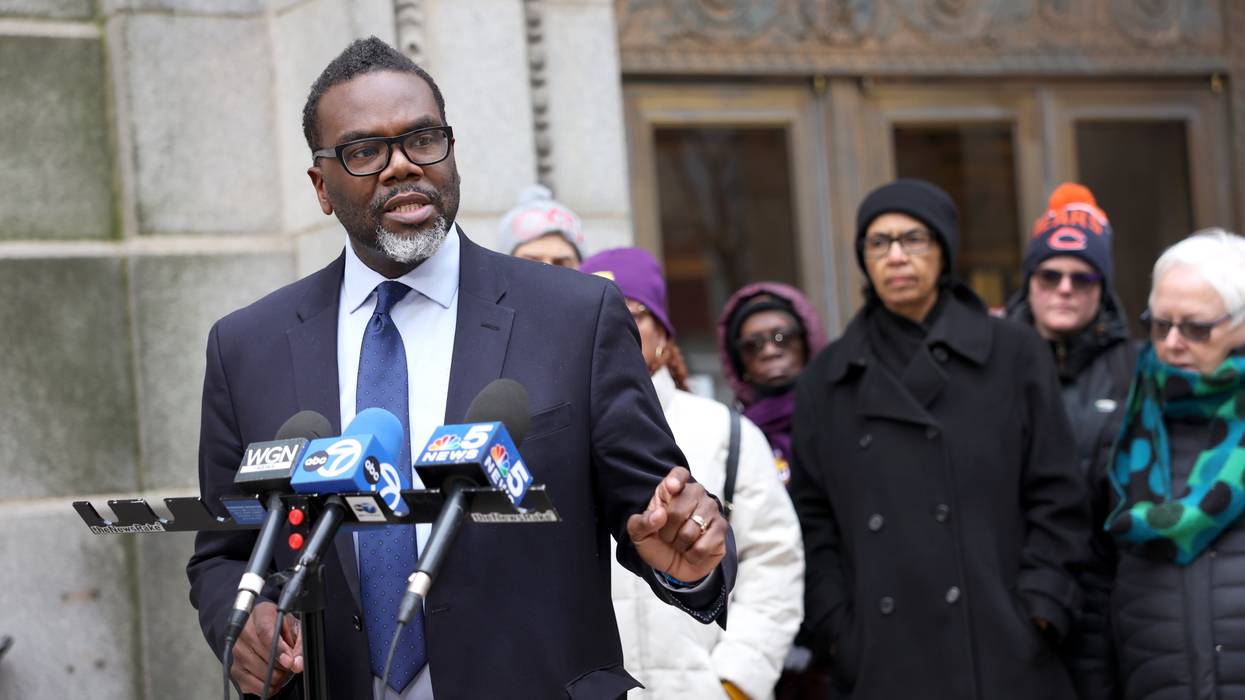
Progressive Brandon Johnson will take on conservative Democratic candidate Paul Vallas, who one advocacy group said "has never come across a public school he didn't want to gut."
Chicago voters rejected Democratic Mayor Lori Lightfoot's bid for a second term on Tuesday, elevating progressive Cook County Commissioner Brandon Johnson to face conservative candidate Paul Vallas—an ardent school privatization advocate—in an April 4 runoff.
Johnson, a longtime educator and organizer, advanced to the runoff with roughly 20% of the vote after a grassroots campaign centered on expanding resources for Chicago's public schools and taxing the rich to boost affordable housing, public transportation, healthcare, and other priorities.
"Today, we are on the verge of creating a new Chicago," Stacy Davis Gates, president of the Chicago Teachers Union, said in a statement applauding Johnson's campaign. "It's a Chicago for the many, not the few—a city where the unhoused can access affordable and sustainable housing, where our public schools are fully funded and provide the support students need, and where our young people can play in safe, welcoming, and thriving communities."
Vallas, though, is seen as the frontrunner, having received 34% of the vote on Tuesday in his second bid for mayor.
U.S. Rep. Chuy Garcia (D-Ill.) received less than 14% of the vote in Tuesday's contest, under Lightfoot's 17%.
The former CEO of Chicago Public Schools, Vallas is a longtime proponent of school privatization, having expanded charter schools and other privatization schemes in his home city as well as in Philadelphia and post-Hurricane Katrina New Orleans.
Far from shying away from his record—which has drawn vocal criticism from lawmakers and officials from the areas where he's attacked public schools—Vallas has pledged to build on it if elected mayor of Chicago.
Maurice Mitchell, national director of the Working Families Party—which is backing Johnson—said late Tuesday that "the contrast in this runoff could not be clearer."
"In one corner, we have a classroom teacher and union organizer with deep community roots," said Mitchell. "In the other corner, we have conservative Paul Vallas, who is backed by the Trump-supporting Fraternal Order of Police and has never come across a public school he didn't want to gut."
Following Tuesday's vote, Johnson—who has described his opponent's approach to education as "morally bankrupt"—tweeted that "if tonight is proof of anything, it's proof that anything is possible."
"It's proof that we can build a Chicago as big and generous as its promise," he continued. "And it's proof that City Hall can truly belong to the people. Tonight is just the beginning. Thank you, Chicago."
To defeat Vallas, Johnson will have to overcome a likely torrent of opposition spending from dark money organizations that have taken an interest in the race to lead the United States' third-largest city.
As the Chicago Tribune reported last month, groups spent "hundreds of thousands of dollars in the final weeks of the race for mayor" while "hiding where that money is coming from."
One dark money organization, the Chicago Leadership Committee, has "spent more than $165,000 on TV and digital ads for Vallas' mayoral bid," the Tribune reported.
"There's no question even more dark money will flood this election in the coming weeks," Mitchell warned. "The right wing sees our movement gaining momentum and will do everything possible to stop us. But tonight is more proof that organized people can beat organized money. Brandon Johnson has always had the backs of working families, and in April, we'll have his."

Progressive Congressman Jesus "Chuy" Garcia on Monday filed his nominating petitions for mayor of Chicago, submitting signatures from nearly 50,000 residents of Illinois' biggest city.
"I'm proud to officially start our journey towards a safer, more prosperous Chicago for all."
Garcia, a Democrat in his second term representing Illinois' 4th Congressional District, announced his second mayoral run earlier this month. In 2015, he forced a runoff with former Mayor Rahm Emanuel.
Democratic Mayor Lori Lightfoot, who is seeking another term, and 6th Ward Ald. Roderick Sawyer, the son of former Mayor Eugene Sawyer, also submitted signatures on Monday--meaning there are officially nine contenders.
"Our city is at a crossroads," Garcia said in a statement. "We have an opportunity to elect a trusted and experienced leader with a history of building coalitions and a vision for a brighter future for all Chicagoans. We deserve safe communities, equitable schools, affordable housing, as well as opportunities for economic and environmental justice--and that requires new, inclusive leadership that reflects the city of Chicago."
"That's why today, with the support of Chicagoans from every corner of our city, I'm proud to officially start our journey towards a safer, more prosperous Chicago for all," he added. "We have seen an incredible outpouring of support and we are hitting the ground running. We are ready to win this campaign."
According to the Chicago Tribune:
At Garcia's side Monday evening was labor fixture Clem Balanoff. In the crowd behind him were Ald. Mike Rodriguez, who holds Garcia's old 22nd Ward seat on the City Council, and Commissioner Alma Anaya, who replaced Garcia on the Cook County Board.
"This is a demonstration of the type of power and grassroots campaign that I will engage in," Garcia said, noting he had only officially been in the race for three weeks and had already raised substantial funds. "We plan to deliver a sharp message to Chicagoans about how we get Chicago back on track, make it work for everyone, make Chicago a safe city, a clean city, a prosperous city that ensures that everyone has the ability to achieve their full potential."
Though he did not name Lightfoot, Garcia said Chicagoans were ready for a change, and that he would focus on being a "good listener," a "collaborator," and "inclusive."
Asked if he could galvanize progressive voters, Garcia said his 40 years of public service were a "testament" to his values. "I don't change with the seasons, that is the record I will share and take to the people of Chicago. ...The filing today demonstrates that in a very short amount of time, we connected with Chicagoans all over this city. And that's what will lead us to victory."
Filing at the end of the day means Garcia could have a potential advantage--his name appearing at the bottom of the list on the ballot.
Lightfoot, meanwhile, filed more than 40,000 signatures Monday morning. Addressing her decision not to wait until later, the mayor told the Chicago Sun-Times that "it's not about the last spot, the positioning on the ballot, as if you are an unknown and people don't know you. They know who I am."
"And our voters are going to find us," she added. "So we wanted to get this done this morning, get our folks geared up and ready for the next leg of the journey. And I've actually got a city to run as well, so getting back to the business of the people."
While Lightfoot's 2019 runoff victory was met with cautious optimism, the Democrat--the first Black and openly gay woman to lead the city--has faced criticism throughout her first term, including from the powerful Chicago Teachers Union.
The other mayoral candidates are state Rep. Kam Buckner (D-26), activist Ja'Mal Green, Cook County Commissioner Brandon Johnson, 4th Ward Ald. Sophia King, former Chicago Public Schools CEO Paul Vallas, and businessman Willie Wilson.