

SUBSCRIBE TO OUR FREE NEWSLETTER
Daily news & progressive opinion—funded by the people, not the corporations—delivered straight to your inbox.
5
#000000
#FFFFFF
To donate by check, phone, or other method, see our More Ways to Give page.
Daily news & progressive opinion—funded by the people, not the corporations—delivered straight to your inbox.
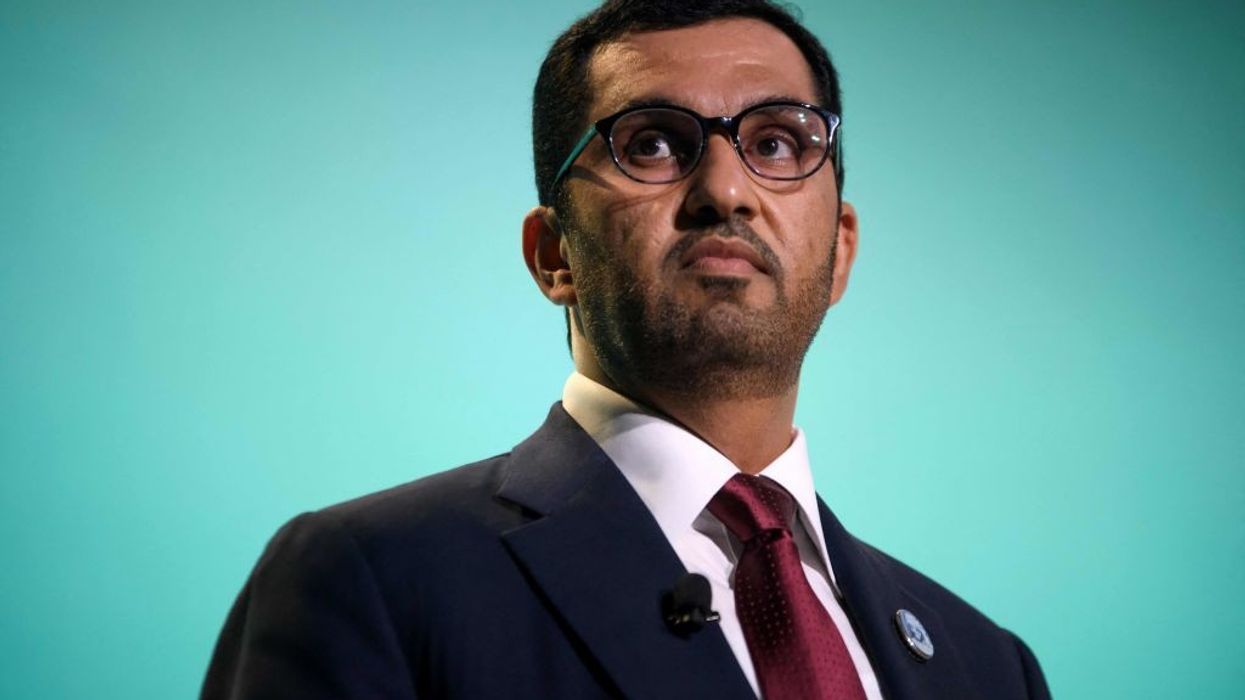
"Make no mistake, COP28 was hijacked by the interests of the fossil fuel industry," said one campaigner.
A new analysis released by human rights and anti-corruption group Global Witness on Wednesday left no room for doubt, said one campaigner, that the host country of last year's United Nations climate summit, the United Arab Emirates, prioritized fossil fuel interests over the planet.
"Make no mistake, COP28 was hijacked by the interests of the fossil fuel industry," said Patrick Galey, senior investigator for Global Witness, referring to the 28th Conference of the Parties of the United Nations Framework Convention on Climate Change (UNFCCC).
The analysis showed that the UAE's Abu Dhabi National Oil Company (ADNOC) used the COP28 presidency of its CEO, Sultan Ahmed Al Jaber, to seek deals worth nearly $100 billion with oil, gas, and petrochemical companies in at least 12 countries.
Fossil fuel firms, said Galey, "weren't content simply to block or stall genuine climate policy but used the opportunity to pursue more climate-wrecking oil and gas deals."
Al Jaber previously denied that ADNOC used COP28 to further its business interests after a leak of briefing documents that instructed the company to discuss fossil fuel deals with at least 16 states that were present at the talks.
According to Global Witness, the company sought deals with at least 11 of those countries and at least one other that had not been included in the leaked documents.
The group's investigation found that the UAE redoubled its investment in oil and gas in Egypt in 2023, the year Al Jaber presided over COP28. ADNOC finalized a deal with TotalEnergies Marketing Egypt, purchasing a 50% stake in the company for a reported $200 million—resulting in the UAE now jointly operating 240 service stations across the country and contributing to its record profits posted in 2023.
Other deals sought by ADNOC with COP28 participants include a joint venture with BP to buy a 50% stake in NewMed Energy in Israel and multiple bids for a stake in Braskem, the largest petrochemical producer in Latin America. The company is part-owned by Brazil's state-run oil and gas producer Petrobas.
ADNOC also finalized deals worth an estimated $17 billion with Lukoil in Russia and Wintershall in Germany to develop the Hail and Ghasha gas field in the UAE.
Global Witness' findings bolstered a report by the Center for Climate Reporting and the BBC in November, which showed Al Jaber used his position at COP28 to push for fossil fuel deals with foreign governments.
The report confirms the worst fears of climate campaigners, who were incensed in early 2023 when Al Jaber was named the president of the U.N.'s largest annual climate conference and warned of conflicts of interest due to his position at the helm of ADNOC.
As it turns out, said Galey, "the UAE knew exactly what it was doing and was not let down—COP28 seems to have been molded towards the benefit of its state oil company."
"As depressing as it is dystopian, climate talks must never be allowed to create more climate chaos," he added.
The analysis was released weeks after U.S. Sen. Jeff Merkley (D-Ore.) and Rep. Jan Schakowsky (D-Ill.) led 24 Democratic lawmakers in writing to Secretary of State Antony Blinken and White House Senior Advisor John Podesta, urging them to support conflict of interest guidelines ahead of COP29, which is scheduled to take place in November in Baku, Azerbaijan.
With Mukhtar Babayev, the country's ecology and natural resources minister who worked for a state-owned oil and gas company for more than 20 years, set to preside over the conference, Galey said that "COP28 seems to have provided other petrostates with a sinister playbook to copy and paste from."
"As the UAE passes the baton onto Azerbaijan, we are now looking at the possibility of consecutive COPs being hijacked for the interests of big polluters and their profits," said Galey, noting that scientists have warned the planet is "dangerously close" to heating that exceeds 1.5°C.
Global Witness pointed to recently announced plans to partially privatize the State Oil Company of Azerbaijan (SOCAR) ahead of COP29, "with its downstream and petrochemical subsidiaries made available to help attract foreign investments."
Rep. Rashida Tlaib (D-Mich.), who signed the letter spearheaded by Merkley and Schakowsky, said Global Witness' report "is a disturbing warning about the potential for further fossil fuel corruption at COP29, which incredibly will also be hosted by another fossil fuel executive."
"I will continue urging the U.S. and UNFCCC to adopt new policies to prevent these absurd conflicts of interest that frustrate the international community's work to address the urgent threats of climate change," she said.
Global Witness reached out to ADNOC, SOCAR, and COP29 for comment regarding its investigation, and was told that ADNOC is working to "secure, reliable, and responsible supply of energy to support a just, orderly, and equitable global energy transition and that allegations regarding Al Jaber's deal-making at COP28 are "false, not true, incorrect, and not accurate."
A COP29 spokesperson said Azerbaijan is "100% committed to bringing countries together with the ambition of keeping the 1.5° target within reach."
Rep. Barbara Lee (D-Calif.), said in a statement Wednesday that Babayev should be removed "from any leadership role at COP29."
"It is an absolute scandal that the UNFCCC has two years running put an oil and gas executive in charge of this event," she said, "thus putting foxes in charge of the henhouse."
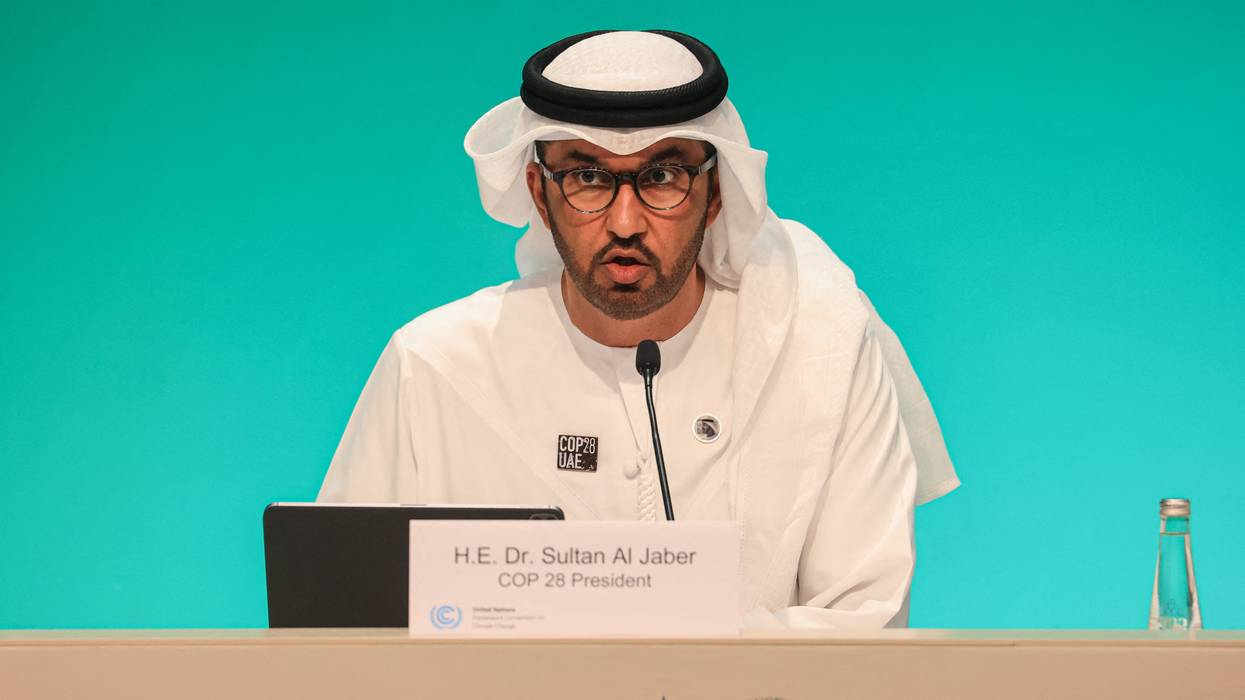
"This dismisses decades of work by IPCC scientists," said one expert. "Disgraceful."
Scientists and climate advocates responded with outrage Sunday to COP28 president Sultan Ahmed Al Jaber's claim that there is "no science" behind the push to rapidly phase out planet-warming fossil fuels, which Al Jaber's company is extracting on a large scale.
Al Jaber's comments, first reported by The Guardian on Sunday, came in response to questioning from Elders chair Mary Robinson during a virtual She Changes Climate discussion. Robinson told Al Jaber that "we're in an absolute crisis that is hurting women and children more than anyone... and it's because we have not yet committed to phasing out fossil fuel."
The COP28 chief and Abu Dhabi National Oil Company (ADNOC) CEO responded dismissively, saying he "accepted to come to this meeting to have a sober and mature conversation" and not to take part in "any discussion that is alarmist," according to audio published by The Guardian.
"There is no science out there, or no scenario out there, that says that the phaseout of fossil fuel is what's going to achieve 1.5°C," Al Jaber added. "Please help me, show me the roadmap for a phaseout of fossil fuel that will allow for sustainable socioeconomic development, unless you want to take the world back into caves."
That position runs directly counter to the outspoken stance of United Nations Secretary-General António Guterres, who said Friday that "the 1.5°C limit is only possible if we ultimately stop burning all fossil fuels," arguing that "the science is clear."
Joelle Gergis, a climate scientist and lead author of the Intergovernmental Panel on Climate Change's (IPCC) Working Group I contribution to the Sixth Assessment Report, called Al Jaber's remarks "disgraceful."
"This dismisses decades of work by IPCC scientists," Gergis wrote on social media.
"'Sending us back to caves' is the oldest of fossil fuel industry tropes: it's verging on climate denial."
The IPCC, which has synthesized the research of hundreds of climate scientists from around the world, has argued that any successful effort to prevent catastrophic planetary warming "will involve a substantial reduction in fossil fuel use."
"More than a century of burning fossil fuels as well as unequal and unsustainable energy and land use has led to global warming of 1.1°C above pre-industrial levels," the IPCC said following the release of its latest report earlier this year. "This has resulted in more frequent and more intense extreme weather events that have caused increasingly dangerous impacts on nature and people in every region of the world."
Other recent research has warned that rich nations must completely halt oil and gas production by 2034 to give the world a 50% chance of limiting warming to the 1.5°C target set by the Paris Agreement.
Bill Hare, chief executive of Climate Analytics, told The Guardian that Al Jaber's response to Robinson was "extraordinary, revealing, worrying, and belligerent."
"'Sending us back to caves' is the oldest of fossil fuel industry tropes: it's verging on climate denial," said Hare.
Al Jaber's comments, which he says have been misrepresented, were seen as further confirmation that he is ill-suited to lead a climate summit given his simultaneous role as the top executive at one of the world's largest fossil fuel firms. A Global Witness analysis released over the weekend found that ADNOC is on track to become the second-largest oil producer in the world by 2050, and Al Jaber has been accused of using his position as COP28 president to pursue oil and gas deals.
"ADNOC plans to produce more oil than any of the 'Big 5' supermajors—ExxonMobil, Chevron, Shell, BP, TotalEnergies," Global Witness found. "In fact, its projected output will positively dwarf that of the European majors; ADNOC's 35.9 billion barrels is 49% higher alone than the projected 24.1 billion barrels production of Shell, BP, and Total combined."
On Monday, the COP28 presidency published a summary of the World Climate Action Summit, a gathering of more than 150 heads of state aimed at facilitating coordinated climate action.
The document states that world leaders "highlighted the opportunities to cut emissions in every sector and to accelerate the technology innovation to address scope 3 emissions, as well as the phase-down of fossil fuels in support of a transition consistent with limiting warming to 1.5°C."
Romain Ioualalen, global policy lead at Oil Change International, said in a statement that "strong support from the leaders' summit to address fossil fuels in the final COP28 agreement is a promising sign, but it is just good enough."
"Leaders must raise their ambition above a phase-down, and agree to immediately stop new fossil fuel expansion, and build a fast, full, fair, and funded phaseout of all fossil fuels while rapidly phasing in renewables," said Ioualalen. "Contrary to the COP28 president's assertions, the science is abundantly clear that warming will continue as long as we keep producing and burning fossil fuels."
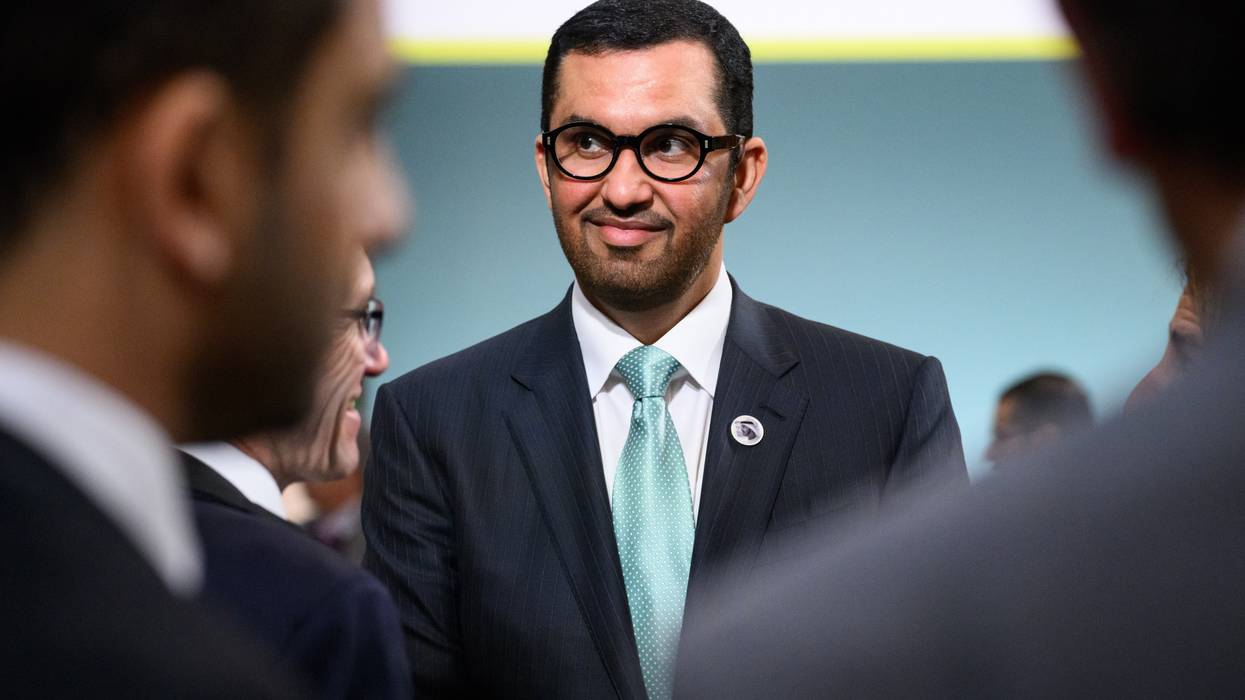
"This is exactly the kind of conflict of interest we feared when the CEO of an oil company was appointed to the role," said a Greenpeace campaigner.
Internal records leaked by a whistleblower show that Sultan Ahmed Al Jaber—who is simultaneously serving as CEO of Abu Dhabi National Oil Company and president of COP28—used meetings about the upcoming United Nations climate summit to push foreign governments for fossil fuel deals.
The documents, obtained by the Center for Climate Reporting (CCR) and the BBC, include meeting records, briefings, and emails that indicate Al Jaber's role as CEO of the United Arab Emirates' state-owned oil company has bled into his responsibilities as president of the critical U.N. climate talks, validating the fears of climate campaigners who opposed his selection to lead the summit that kicks off Thursday in Dubai.
"Al Jaber, who has continued his role as CEO of the Abu Dhabi National Oil Company (ADNOC) despite calls for him to step down during his COP presidency, has held scores of meetings with senior government officials, royalty, and business leaders from around the world in recent months," CCR said Monday, citing briefings it obtained. "The COP28 team has quietly planned to use this access as an opportunity to increase exports of ADNOC's oil and gas."
The investigative group found that "on at least one occasion a nation followed up on commercial discussions brought up in a meeting with Al Jaber" and that "ADNOC's business interests were allegedly raised during a meeting with another country."
Kaisa Kosonen, policy coordinator at Greenpeace International, said in a statement that "if the allegations are true, this is totally unacceptable and a real scandal."
"The climate summit leader should be focused on advancing climate solutions impartially, not backroom deals that are fueling the crisis. This is exactly the kind of conflict of interest we feared when the CEO of an oil company was appointed to the role," said Kosonen. "This summit is the world's most powerful forum to avert the biggest threat to the survival of humankind, and we urge the presidency to act accordingly."
"It looks ever more like a fox is guarding the hen house."
Advocacy groups and lawmakers have been urging Al Jaber to resign from the COP28 presidency since his appointment earlier this year, citing his glaring conflicts of interest as top executive of ADNOC—a company that is planning to expand fossil fuel production despite scientists' repeated warnings that no new oil, gas, and coal production is compatible with preventing runaway planetary warming.
Al Jaber, who has the support of the Biden administration and other world powers, has refused to step aside, casting further doubt on the prospects of concrete climate progress at COP28.
"Sultan Al Jaber claims his inside knowledge of the fossil fuel industry qualifies him to lead a crucial climate summit but it looks ever more like a fox is guarding the hen house," Ann Harrison, Amnesty International’s climate adviser, said in response to CCR's revelations. "The appointment of the chief executive of one of the world's largest fossil fuel companies to lead COP28 was always a brazen conflict of interests which undermines the meeting's ability to reach the outcome we desperately need."
"Documents suggesting he was briefed to advance business interests in COP meetings only fuel our concerns that COP28 has been comprehensively captured by the fossil fuel lobby to serve its vested interests that put the whole of humanity at risk," Harrison added.
Internal emails obtained by CCR show that COP28 staffers have been instructed to "always" include talking points for ADNOC and Masdar—the UAE's state-owned renewable energy company—in summit meetings.
"In statements to CCR and other media outlets, the team has repeatedly denied allegations of undue influence by the oil company," the group said. "For instance, a summit spokesperson told CCR in September that 'the COP28 staff are separate from any other entity' and that the presidency's 'operations are fully independent and autonomous.'"
"But the leaked briefings, emails, and meeting records paint a different picture," CCR continued. " After questions from CCR, a spokesperson also confirmed that one senior member of the summit team who has been deeply involved in diplomatic efforts, COP28's director of government affairs Mohammed Al Kaabi, works across Al Jaber's 'entire portfolio.'"
CCR previously revealed that Oliver Phillips, an adviser to Al Jaber at ADNOC, played a central role in public relations efforts for COP28, which the head of the U.N. has said must be the catalyst for "dramatic" climate action. In June, The Guardian reported that ADNOC was able to read emails from the COP28 office.
Whistleblowers told CCR that COP28 meetings are still "regularly held" at ADNOC headquarters.
Michael Jacobs, a professor at Sheffield University in the U.K. and an expert on climate politics, told CCR that Al Jaber's actions appear "breathtakingly hypocritical."
"The UAE at the moment is the custodian of a United Nations process aimed at reducing global emissions," said Jacobs. "And yet, in the very same meetings where it's apparently trying to pursue that goal, it's actually trying to do side deals which will increase global emissions.”
Kosonen of Greenpeace argued that "if the presidency wants to claw back credibility, it can only do so through actions."
"That means brokering a global agreement for a just and equitable phaseout of all fossil fuels, in alignment with science, and making polluters pay for the loss and damage they've caused to communities," said Kosonen.
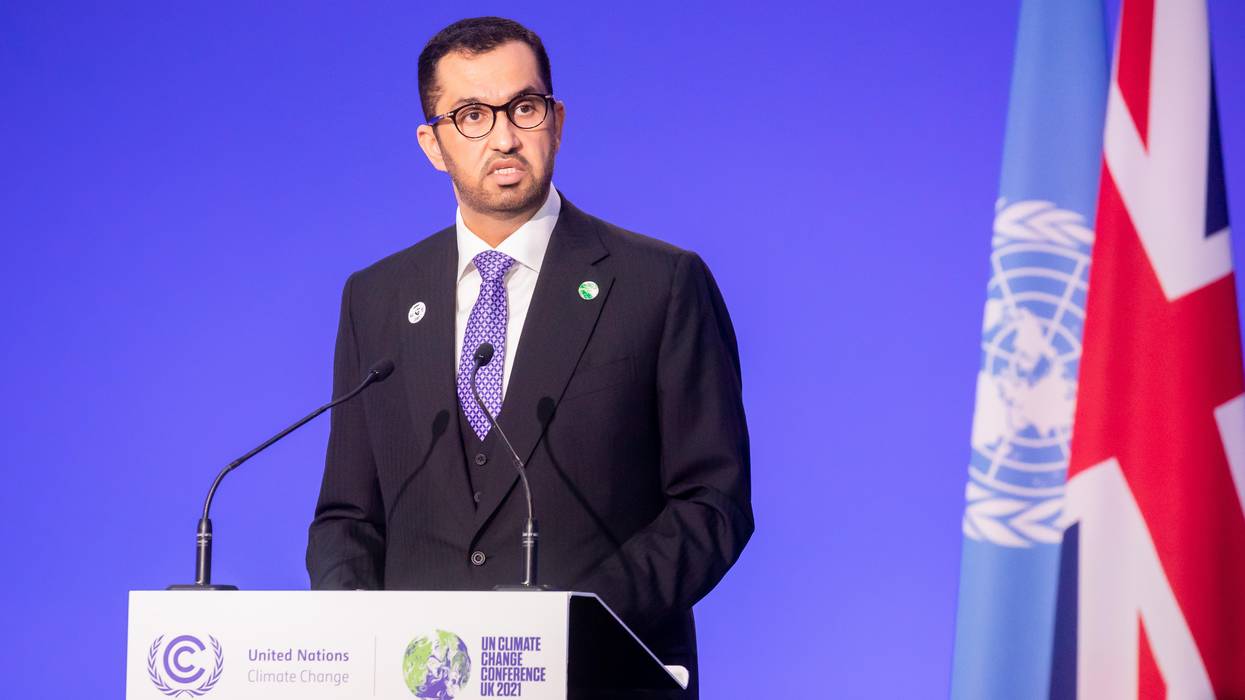
"This is an absolute scandal," said one lawmaker. "It is like having a tobacco multinational overseeing the internal work of the World Health Organization."
One of the world's largest fossil fuel corporations has been able to read emails to and from the United Nations climate summit office and was given advice on how to respond to a media inquiry, The Guardian reported Wednesday.
Sultan Ahmed al-Jaber, the CEO of the United Arab Emirates' state-owned Abu Dhabi National Oil Company (ADNOC), is also president-designate of COP28, set to be hosted this fall by the UAE.
"This is an absolute scandal," said Manon Aubry, a European Union lawmaker from France. "An oil and gas company has found its way to the core of the organization in charge of coordinating the phasing out of oil and gas. It is like having a tobacco multinational overseeing the internal work of the World Health Organization."
Aubrey, who co-led a recent letter in which 133 members of the United States Congress and the European Parliament called for al-Jaber to be replaced as chair of the U.N.'s upcoming annual climate conference, added: "The COP28 office has lost all credibility. If we care more about preventing a climate disaster than protecting the profits and influence of fossil fuel companies, we need to react now."
According to The Guardian: "The COP28 office had claimed its email system was 'standalone' and 'separate' from that of ADNOC. But expert technical analysis showed the office shared email servers with ADNOC. After The Guardian's inquiries, the COP28 office switched to a different server on Monday."
"If we care more about preventing a climate disaster than protecting the profits and influence of fossil fuel companies, we need to react now."
Bas Eickhout, a Dutch member of the European Parliament, called the newspaper's findings "explosive."
Eickhout, vice chair of the E.U.'s environment committee, said that "the [UAE presidency of COP28] is a merger of the economic interests of a fossil country with a fundamental transition agenda that should be away from this fossil industry—that will not go well, and [these revelations] already show that it's not going well."
Pascoe Sabido, a researcher at Corporate Europe Observatory and co-coordinator of Kick Big Polluters Out, noted that the UAE's selection of al-Jaber as COP28 leader in January was "a huge blow to the credibility" of the United Nations Framework Convention on Climate Change (UNFCCC).
"It's completely inappropriate that an oil corporation was consulted and it exposes just how influential it has been in shaping what gets presented to the outside world," said Sabido. "Until world governments accept that fossil fuels need to be left in the ground and their lobbyists are no longer allowed to write the rules of climate action, this will keep happening."
Last year's COP27 gathering was overrun by fossil fuel lobbyists. Like the 26 U.N. climate summits that preceded it, the meeting ended with no binding commitment to phase out the extraction and combustion of coal, oil, and gas, even as evidence mounts that the failure to do so is exacerbating deadly planetary heating.
Soon after the UAE picked al-Jaber to oversee COP28, Kick Big Polluters Out, a global coalition of more than 450 organizations led by Corporate Europe Observatory and Corporate Accountability, warned in a letter to U.N. Secretary-General António Guterres and UNFCCC executive secretary Simon Stiell that this year's climate conference is also destined to end in failure unless action is taken to crack down on the fossil fuel industry's corruption of international negotiations.
That marked the beginning of an ongoing effort to oust al-Jaber from the COP28 presidency and to eliminate fossil fuel industry interference in climate talks more broadly. On Wednesday morning, Kick Polluters Out protested Big Oil's obstruction of progress at the U.N.'s Bonn Climate Change Conference—a crucial precursor to COP28 currently being held in Germany.
The campaign to remove al-Jaber from his COP28 leadership position has gained steam since it was revealed that ADNOC, fresh off of a major profit surge in 2022, plans to expand its drilling operations in 2023 and beyond.
Despite years of warnings from the Intergovernmental Panel on Climate Change and the International Energy Agency that exploiting new oil and gas fields is incompatible with averting the climate emergency's most catastrophic impacts, ADNOC is one of several fossil fuel firms moving to ramp up dirty energy production in the coming years.
Notably, U.S. President Joe Biden's top climate diplomat, John Kerry, has faced criticism for supporting al-Jaber. More than two dozen progressive members of Congress have implored Kerry to advocate for the appointment of a new COP28 president who doesn't have connections to the industry most responsible for fueling the climate crisis.

"Big Oil interests have contaminated our climate for decades," said Democratic U.S. Sen. Ed Markey. "They shouldn't be able to control our climate negotiations for a livable future."
The ongoing campaign to oust Sultan Ahmed al-Jaber from his role as president-designate of COP28 picked up steam Tuesday when more than 130 lawmakers on both sides of the Atlantic published a letter calling for the oil boss to be replaced as chair of the annual United Nations climate summit, set to take place this fall in the United Arab Emirates.
The host nation's move "to name as president of COP28 the chief executive of one of the world's largest oil and gas companies—a company that has recently announced plans to add 7.6 billion barrels of oil to its production in the coming years, representing the fifth largest increase in the world—risks undermining the negotiations," says the letter signed by 133 members of the United States Congress and the European Parliament.
"For billions of people, the outcome of COP28 and ensuing international climate negotiations will make the difference between life and death, chaos and solidarity."
"Different leadership is necessary to help ensure that COP28 is a serious and productive climate summit," the transatlantic group of policymakers told U.S. President Joe Biden, European Commission President Ursula von der Leyen, U.N. Secretary-General António Guterres, and Simon Stiell, executive secretary of the United Nations Framework Convention on Climate Change (UNFCCC).
Notably, Biden's top climate diplomat, John Kerry, has faced criticism for celebrating al-Jaber's selection. More than two dozen progressive members of Congress have pushed Kerry to advocate for the designation of a new COP28 president who doesn't have ties to the industry most responsible for fueling the climate emergency.
In addition to urging the four addressees of the new letter to "engage in diplomatic efforts" to pressure the UAE to withdraw its appointment of al-Jaber—head of the country's Abu Dhabi National Oil Company—as president-designate of COP28, signatories implored the executive leaders of the U.S. and the European Union as well as UNFCCC leadership to "take immediate steps to limit the influence of polluting industries, particularly major fossil fuel industry players whose business strategies lie at clear odds with the central goals of the Paris agreement," at all U.N. climate talks.
"Current rules," the lawmakers wrote, "permit private sector polluters to exert undue influence on UNFCCC processes." They continued:
We request that you institute new policies for corporate participation at COPs and UNFCCC processes more broadly, including requiring participating companies to submit an audited corporate political influencing statement that discloses climate-related lobbying, campaign contributions, and funding of trade associations and organizations active on energy and climate issues. These statements should be reviewed, publicly disclosed, and scrutinized prior to any engagement in UNFCCC climate policymaking processes.
The UNFCCC should also consider additional measures to establish a robust accountability framework to protect against undue influence of corporate actors with proven vested interests that contradict the goals of the Paris Agreement; such a framework was proposed last year with broad-based international support from over 450 organizations around the world and five UNFCCC constituencies representing thousands of organizations and millions of people. These reforms would bring much-needed transparency to corporate climate-related political influencing activities around the world, and would help restore public faith that the COP process is not being abused by companies as an opportunity to greenwash.
The demand to crack down on corporations' open corruption of international climate meetings comes as government representatives prepare to gather in Germany next month for the U.N.'s Bonn Climate Change Conference—a crucial precursor to COP28, which is scheduled to begin in late November in Dubai.
"It is essential that we seize the opportunity to take actionable steps to address and protect climate policy from polluting interference by adopting concrete rules that limit the influence of the fossil fuel industry and its lobbyists in the UNFCCC decision-making process," says the letter. It was endorsed by Kick Big Polluters Out, a global network of more than 450 organizations led by Corporate Accountability and Corporate Europe Observatory, which made a similar appeal to Guterres in January.
" Big Oil interests have contaminated our climate for decades—they shouldn't be able to control our climate negotiations for a livable future," U.S. Sen. Ed Markey (D-Mass.) said in a statement. "As leaders from around the world come together to envision a world that promotes clean energy and climate justice, not pollution and profiteering, we must shut the door on the fossil fuel industry and keep COP28 free from their influence." Markey was one of six Senate Democrats to sign the letter. He was joined by Sen. Bernie Sanders (I-Vt.), 27 House Democrats, and 99 European MPs.
The ongoing failure to confront the fossil fuel industry and other highly polluting sectors has yielded life-threatening results so far, as the lawmakers explained in their letter:
Last year, many of us attended or followed COP27 in Sharm-al-Sheikh, Egypt. While we applaud the United Nations for bringing tens of thousands of delegates together, leading to a historic agreement that will help developing countries deal with losses and damages from the impacts of climate change, the conference ultimately failed to secure consensus from Parties to cut greenhouse gases in line with the agreed global goals.
It did not escape our attention that at least 636 lobbyists from the oil and gas industries registered to attend last year's COP—an increase of more than 25% over the previous year. When the number of attendees representing polluting corporate actors, which have a vested financial interest in maintaining the status quo, is larger than the delegations of nearly every country in attendance, it is easy to see how their presence could obstruct climate action.
There is no time to waste in sharply cutting carbon pollution on a global scale. The latest Intergovernmental Panel on Climate Change (IPCC) Report states that, to limit warming to 1.5 °C, global emissions must halve by 2030. The planet has already warmed over 1.2°C, and our ability to reach the 1.5 °C goal is moving fast out of reach, with the IPCC pegging the current probability at just 38%. Maintaining the status quo would lead to a catastrophic 2.8°C temperature rise by the end of the century.
"In this moment of great urgency, we must unblock the barriers that have kept us from advancing strong global collaboration to address climate change," the lawmakers wrote. "One of the largest barriers to strong climate action has been and remains the political influence and obstruction of the fossil fuel industry and other major polluting industries. We have seen their negative influence in our home institutions; oil companies and their industry cheerleaders have spent billions of dollars lobbying both the European Parliament, other European institutions and member states, and the U.S. Congress in order to obstruct or water down climate policy for years."
"Since at least the 1960s, the fossil fuel industry has known about the dangers of climate change posed by its products and, rather than supporting a transition to a clean energy future, has instead chosen to promote climate denial and spend millions of dollars to spread disinformation," they continued. "Over a half-century later, not one of 39 major global oil and gas companies, with collective market capitalization of $3.7 trillion, has adopted a business strategy that would limit warming to safe levels. Several independent analyses agree that the sector is still not taking meaningful action to avoid the worst impacts of the crisis."
"The fossil industry must give way if there is to be any chance of survival for humanity and this planet."
"Even more outrageous, the global oil and gas industry is expanding amid blockbuster profits to the tune of $4 trillion last year," they added. "The sector has poured $160 billion into exploration for new fossil reserves since 2020, even as the IEA has stated that no new fossil fuel projects are compatible with limiting warming to 1.5°C. In short, in the words of U.N. Secretary-General António Guterres, 'We seem trapped in a world where fossil fuel producers and financiers have humanity by the throat.' It is time to alter this dangerous course."
E.U. lawmaker Manon Aubrey, who co-organized the letter alongside her U.S. counterpart, Sen. Sheldon Whitehouse (D-R.I.), said that "for billions of people, the outcome of COP28 and ensuing international climate negotiations will make the difference between life and death, chaos and solidarity."
" Corporate greed and lobbyists' lies have led us into this climate crisis," said Aubrey. "We must prevent private commercial interests from interfering in politics and regain ownership of our future."
Aubrey's colleague, Michael Bloss, likewise stressed that "to make progress on climate protection, we need to limit the power of the fossil lobby."
"Instead of letting the fox guard the henhouse, the fossil lobby must be expelled from the conference," said Bloss. "Oil states and fossil industries have always prevented anything that could mean an end to coal, oil, and gas, and put the brakes on global climate protection for destructive profits. The fossil industry must give way if there is to be any chance of survival for humanity and this planet."
Pascoe Sabido, co-coordinator for Kick Big Polluters Out, said that "these upcoming U.N. climate talks are our best chance at tackling the problem head-on, with hundreds of decision-makers on both sides of the Atlantic and both sides of the aisle backing our call for a conflict-of-interest policy."
"So far, the U.S. and E.U. have proven to be major blockers, siding with the fossil fuel industry," Sabido added. "If they want to walk the talk of being a climate leader, it's time to switch sides and back a policy not just at the U.N. but also at home."