

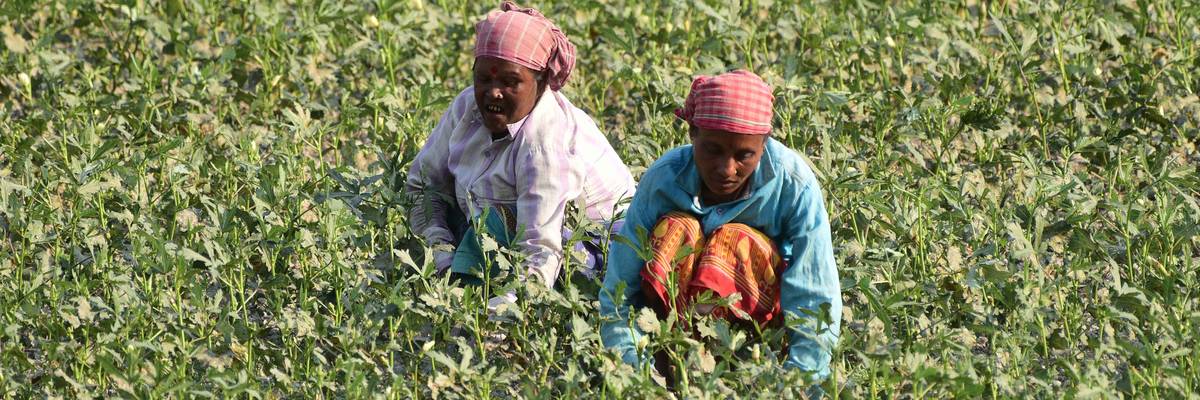
Women work in their okra field in Nagaon District, Assam, India, on March 8, 2024.
Women’s Land Rights: The Missing Key to Climate Action
This year’s International Women’s Day theme, #AccelerateAction, calls on the world to address the structural barriers slowing progress. If we are serious about climate, we must start at the root of the problem: land access.
Land is not just a means of survival; it is one of our most powerful tools to combat climate change and nature loss. Healthy soil sequesters carbon, retains water, supports biodiversity, and—crucially—underpins food production. When land is degraded—through deforestation, overexploitation, or poor management—it shifts from being a carbon sink to a source of emissions, disrupting local water cycles, accelerating desertification, and sparking food insecurity. This degradation has direct consequences, such as the catastrophic flooding that hit Valencia last year, where altered landscapes and poor land stewardship exacerbated extreme weather impacts.
Without land security, women farmers remain locked out of decision-making, deprived of resources, and forced to fight climate change and nature loss with one hand tied behind their backs.
The link between land health, food security, and climate resilience is clear. But the role of women—who form the backbone of food production globally—is often overlooked. Women have extensive ecological knowledge and are key stewards of land, particularly those in rural and Indigenous communities. Women produce up to 80% of the world’s food, consumed by families and communities worldwide, and account for between 30-40% of the agricultural workforce. Yet, fewer than 20% of landowners are women—and, in half of the world’s countries, they have little to no rights or decision-making power over the land they work. This systemic land insecurity undermines their ability to implement long-term soil and land restoration practices crucial for climate adaptation.
The Three Systemic Barriers to Women’s Leadership in Land Restoration
To truly #AccelerateAction, as this year’s International Women’s Day theme calls for, we must address the root of the problem: land access. Without secure land tenure, women farmers face three systemic challenges.
Limited decision-making power results in less resilient agriculture: Studies from the International Food Policy Research Institute (IFPRI) indicate that women farmers with land rights are more likely to invest in soil conservation and water retention techniques, which are crucial for adapting to climate change. Without control over their land, women are often forced to comply with farming methods that may coincidentally be more planet-friendly (due to women lacking access to resources like chemical inputs) but are often less efficient and reduce resilience to yield variation. Women’s land insecurity translates into a lack of autonomy in adopting and scaling climate-smart farming methods that can both render their community more climate resilient and reduce hunger.
Restricted access to funding and training: Despite their deep knowledge of sustainable farming, women are often systematically denied access to credit, training, and agricultural extension services. A report by the World Bank found that if women had the same access to resources as men, agricultural yields could increase by up to 30%, reducing global hunger. Yet, because they often lack legal land ownership, they are sometimes ineligible for loans and grants that could help them transition to nature-positive forms of agriculture. Bridging this gap would not only benefit women but also strengthen global food security and climate resilience.
The disproportionate impact of climate change on women: Climate change exacerbates existing inequalities, and land degradation disproportionately affects women. Roughly 80% of the people displaced by climate disasters are women. In communities where women lack land rights, they have fewer options for adaptation and recovery. Secure land tenure empowers women to implement long-term solutions that enhance climate resilience, from agroecological practices to community-led reforestation projects.
The Path Forward: Solutions for Gender-Inclusive Land Restoration
Landscape restoration is only possible when everyone in the community—including women—has the rights, resources, and recognition they deserve. Ensuring land tenure for women is not just about equity—it’s about survival. Women are already leading land restoration efforts across the globe. In Kenya, the Green Belt Movement, founded by Wangari Maathai, has empowered thousands of women to restore degraded forests, leading to the planting of over 50 million trees. In India, women-led self-help groups have restored thousands of hectares of farmland through water conservation and agroecology. These initiatives prove that when women have control over land, they invest in solutions that benefit both people and the planet. And it’s not rocket science—there are concrete policy solutions that can ensure women can lead the charge in restoring land and combating climate change.
In order to increase and enforce land rights for women, countries must reform laws that restrict women’s access to land. In sub-Saharan Africa, for example, customary laws often prevent women from inheriting land, even when statutory laws permit it. Enforcing legal protections is critical. In addition, more funding opportunities must be available to women in agriculture: Only 6% of agricultural aid funding worldwide treats gender as a fundamental issue. Governments and financial institutions must close the agriculture funding gap for women through targeted grants, subsidies, and loan programs. In tandem, women’s traditional knowledge of farming and conservation must be supported with expanded access to climate-smart agricultural training. Finally, climate-smart agricultural training must consider gender dynamics, as poorly designed programmes can unintentionally empower men while sidelining women. Research shows that when gender is overlooked, existing inequalities can be reinforced. Organizations should recognize that technologies and policies often carry biases that can entrench power imbalances, restrict food security, and further marginalize women.
This year’s International Women’s Day theme, #AccelerateAction, calls on the world to address the structural barriers slowing progress. If we are serious about climate action, we must start at the root of the problem: land access. Without land security, women farmers remain locked out of decision-making, deprived of resources, and forced to fight climate change and nature loss with one hand tied behind their backs.
A just, climate-resilient future is not possible without women at the forefront of land restoration. By securing their rights to land, we not only restore degraded ecosystems but also unlock the full potential of those who have been caretakers of the Earth for generations. If we want to accelerate action, we must start by giving women the tools they need: land, security, and the power to lead.
We are at a crossroads
This country and this world are at a monumental crossroads. In a few short weeks, US voters will have an opportunity to beat back the forces of fascism and confront the billionaires who are rigging the economy, our media system, and our democracy, making it increasingly impossible for ordinary people to get by. We’re not just talking about the election. We’re talking about what must be done once these fascist elements are vanquished from power. We need a bolder set of solutions than what either major party has so far been willing to offer and a working-class movement ready to fight like hell for it. Trump didn't emerge from nowhere. The conditions that fueled MAGA authoritarianism were created by decades of radical neoliberal economic policies and a corrupt political system dominated by corporate interests. They slashed taxes on the super-rich, promising that the benefits would trickle down. They said giveaways to the corporate titans would make life more affordable for the rest of us. It was all bullshit. And when a bitter, betrayed populace searches for someone to blame, right-wing demagogues have little trouble finding scapegoats. People know when they're being lied to, but you won't hear any of this from the corporate media. Only independent journalism—powered and funded by people who believe in building a better world—can deliver truly trustworthy daily news. Our Fall Campaign is underway, and we need your help. To power our newsroom through the rest of the year, we need to raise $125,000 by midnight on October 31. So if you share our vision, please contribute whatever you can to sustain our work. |
Land is not just a means of survival; it is one of our most powerful tools to combat climate change and nature loss. Healthy soil sequesters carbon, retains water, supports biodiversity, and—crucially—underpins food production. When land is degraded—through deforestation, overexploitation, or poor management—it shifts from being a carbon sink to a source of emissions, disrupting local water cycles, accelerating desertification, and sparking food insecurity. This degradation has direct consequences, such as the catastrophic flooding that hit Valencia last year, where altered landscapes and poor land stewardship exacerbated extreme weather impacts.
Without land security, women farmers remain locked out of decision-making, deprived of resources, and forced to fight climate change and nature loss with one hand tied behind their backs.
The link between land health, food security, and climate resilience is clear. But the role of women—who form the backbone of food production globally—is often overlooked. Women have extensive ecological knowledge and are key stewards of land, particularly those in rural and Indigenous communities. Women produce up to 80% of the world’s food, consumed by families and communities worldwide, and account for between 30-40% of the agricultural workforce. Yet, fewer than 20% of landowners are women—and, in half of the world’s countries, they have little to no rights or decision-making power over the land they work. This systemic land insecurity undermines their ability to implement long-term soil and land restoration practices crucial for climate adaptation.
The Three Systemic Barriers to Women’s Leadership in Land Restoration
To truly #AccelerateAction, as this year’s International Women’s Day theme calls for, we must address the root of the problem: land access. Without secure land tenure, women farmers face three systemic challenges.
Limited decision-making power results in less resilient agriculture: Studies from the International Food Policy Research Institute (IFPRI) indicate that women farmers with land rights are more likely to invest in soil conservation and water retention techniques, which are crucial for adapting to climate change. Without control over their land, women are often forced to comply with farming methods that may coincidentally be more planet-friendly (due to women lacking access to resources like chemical inputs) but are often less efficient and reduce resilience to yield variation. Women’s land insecurity translates into a lack of autonomy in adopting and scaling climate-smart farming methods that can both render their community more climate resilient and reduce hunger.
Restricted access to funding and training: Despite their deep knowledge of sustainable farming, women are often systematically denied access to credit, training, and agricultural extension services. A report by the World Bank found that if women had the same access to resources as men, agricultural yields could increase by up to 30%, reducing global hunger. Yet, because they often lack legal land ownership, they are sometimes ineligible for loans and grants that could help them transition to nature-positive forms of agriculture. Bridging this gap would not only benefit women but also strengthen global food security and climate resilience.
The disproportionate impact of climate change on women: Climate change exacerbates existing inequalities, and land degradation disproportionately affects women. Roughly 80% of the people displaced by climate disasters are women. In communities where women lack land rights, they have fewer options for adaptation and recovery. Secure land tenure empowers women to implement long-term solutions that enhance climate resilience, from agroecological practices to community-led reforestation projects.
The Path Forward: Solutions for Gender-Inclusive Land Restoration
Landscape restoration is only possible when everyone in the community—including women—has the rights, resources, and recognition they deserve. Ensuring land tenure for women is not just about equity—it’s about survival. Women are already leading land restoration efforts across the globe. In Kenya, the Green Belt Movement, founded by Wangari Maathai, has empowered thousands of women to restore degraded forests, leading to the planting of over 50 million trees. In India, women-led self-help groups have restored thousands of hectares of farmland through water conservation and agroecology. These initiatives prove that when women have control over land, they invest in solutions that benefit both people and the planet. And it’s not rocket science—there are concrete policy solutions that can ensure women can lead the charge in restoring land and combating climate change.
In order to increase and enforce land rights for women, countries must reform laws that restrict women’s access to land. In sub-Saharan Africa, for example, customary laws often prevent women from inheriting land, even when statutory laws permit it. Enforcing legal protections is critical. In addition, more funding opportunities must be available to women in agriculture: Only 6% of agricultural aid funding worldwide treats gender as a fundamental issue. Governments and financial institutions must close the agriculture funding gap for women through targeted grants, subsidies, and loan programs. In tandem, women’s traditional knowledge of farming and conservation must be supported with expanded access to climate-smart agricultural training. Finally, climate-smart agricultural training must consider gender dynamics, as poorly designed programmes can unintentionally empower men while sidelining women. Research shows that when gender is overlooked, existing inequalities can be reinforced. Organizations should recognize that technologies and policies often carry biases that can entrench power imbalances, restrict food security, and further marginalize women.
This year’s International Women’s Day theme, #AccelerateAction, calls on the world to address the structural barriers slowing progress. If we are serious about climate action, we must start at the root of the problem: land access. Without land security, women farmers remain locked out of decision-making, deprived of resources, and forced to fight climate change and nature loss with one hand tied behind their backs.
A just, climate-resilient future is not possible without women at the forefront of land restoration. By securing their rights to land, we not only restore degraded ecosystems but also unlock the full potential of those who have been caretakers of the Earth for generations. If we want to accelerate action, we must start by giving women the tools they need: land, security, and the power to lead.
- Indigenous Women Leaders & Over 200 Groups Urge the Army Corps to Stop the Line 5 Pipeline Expansion ›
- First Nations Land Defenders File Submission to UN Human Rights Council ›
- ‘This Is Our Last Resort’: The Maasai’s Struggle for Land Rights in Northern Tanzania ›
- Oxfam: World's Largest Food Companies Creating Legacy of Destruction ›
- The Voices of Amazon Women and a Visionary Declaration to Protect Indigenous Lands ›
- Opinion | When Women Forced Global Climate Talks to Face the Truth | Common Dreams ›
- Opinion | The 'Most Impossible Job in the World': Will a Woman Become the UN’s Next Chief? | Common Dreams ›