SUBSCRIBE TO OUR FREE NEWSLETTER
Daily news & progressive opinion—funded by the people, not the corporations—delivered straight to your inbox.
5
#000000
#FFFFFF
To donate by check, phone, or other method, see our More Ways to Give page.
Daily news & progressive opinion—funded by the people, not the corporations—delivered straight to your inbox.
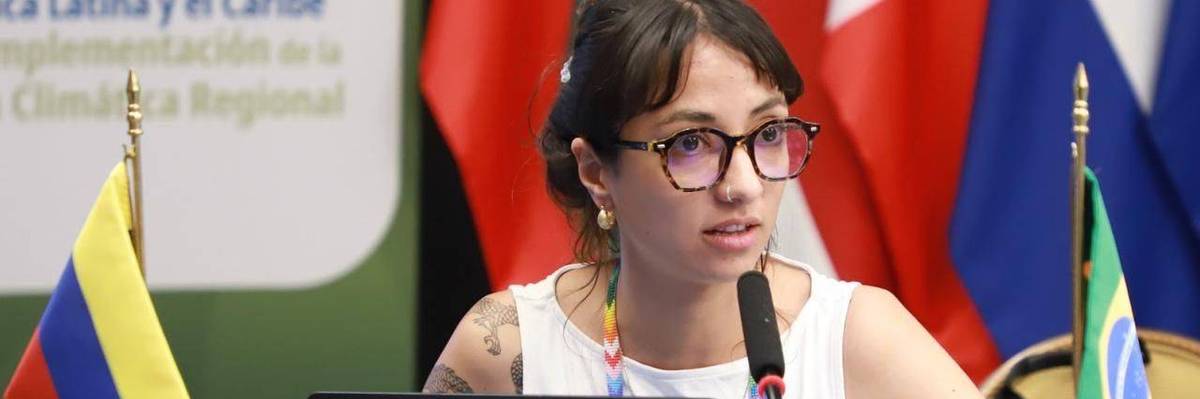
Daniela Durán González speaks at a climate event in Mexico City.
Daniela Durán González’s words felt less like a procedural objection and more like an oracle speaking truth in the court of self-appointed climate policy gods.
The final moments of United Nations climate summits usually follow a familiar script. In the closing plenary, decisions are gaveled through, despite several powerful objections stated by delegates from climate-vulnerable countries and quietly noted by the Conference of Parties presidency, and the appearance of full consensus by all governments is carefully preserved—no matter how compromised the outcome actually is.
At COP30 in Brazil, that script was nearly held with business as usual.
By the final plenary, meaningful references to fossil fuel phaseout, pushed by a growing number of countries, had already been stripped from the presented outcome text. Many months of organizing and campaigning by civil society, increasingly dire scientific warnings, and pressure from leaders in Brazil and some of the most climate-vulnerable nations had been erased. The fossil fuel omission left behind a painful awareness of the continued death and destruction of communities and land that will inevitably result from this inaction. The disappointing outcome was sadly to be expected, but that didn’t make the moment any less heavy.
Civil society engages in COPs year after year, not because we believe these negotiations will save us, but because they are sites of power, and nonengagement would signal the loss of resolve. We come to stop devastating outcomes from getting worse, to confront decision-makers face to face, to hold governments accountable in real time, and to intervene with sustainable and equitable solutions that are rising from frontline and grassroots communities.
The climate emergency is a mirror, reflecting back to humanity that how we are living with the Earth and each other is existentially flawed.
But something unusual happened in the final COP30 plenary that many of us were thrilled to witness. The climate negotiator from Colombia lifted her flag and spoke out.
Daniela Durán González, head of international affairs at the Colombian Ministry of Environment and Sustainable Development, raised a procedural objection and disrupted the final conference procedures. The mood in the room shifted instantly, and what had felt preordained suddenly felt like a seismic eruption. I remember exchanging glances with my colleagues as we rose to our feet, cheering as the weight of the moment sank in. For a brief, electric moment in time, the machinery of managed consensus was forced to stop.
Throughout COP30, negotiators wrestled with the need to scale up finance—especially for adaptation; commitments to mitigation efforts; and deep political divisions over whether and how to confront the root causes of climate change, including by advancing just transition pathways. At the center of those divisions and heated discourses were fossil fuels—the source of most global greenhouse gas emissions. Despite support from roughly 80 countries for including language on a roadmap to phase out fossil fuels, opposition from major producing nations and others prevented the inclusion of any explicit mention of fossil fuels in the final outcome text.
Instead of addressing the source of the crisis, the agreed outcome text tinkered only on the margins with some vague commitment to tripling adaptation finance by 2035 and a focus on advancing voluntary implementation initiatives, while abandoning a direct confrontation of fossil fuel phaseout that many delegates had sought.
COP30 unfolded amid a growing and dangerous consolidation of power further aggravating and entrenching inequity. Many of the world’s wealthiest governments and global elites are well aware not only of the accelerating climate crisis, but simultaneously of biodiversity collapse and social instability. Because they are dependent on the fossil fuel economy for their wealth and power, these leaders are willing to do anything but stop the extraction of coal, oil, and gas. Rather than changing course (and exploring other energy sources), many major players are preparing to survive the polycrisis that they themselves are inciting, by escaping to fortified enclaves, privatized resilience, and militarized borders—while the rest of the world absorbs the fallout.
Science offers no room for denial about where all of this is heading. Under existing climate policies, global warming could reach nearly 2.8°C. While countries have strengthened current national climate pledges, even if honored, the world would still be moving toward 2.3-2.5°C of global warming. Any of these scenarios is a catastrophic overshoot. What we call “climate disasters” are, in truth, interlocking ecological, social, and economic crises unfolding simultaneously. Every fraction of a degree of warming deepens the wound that’s inflicted on forests, oceans, ice, and human communities alike. We are talking about forests that breathe life into the Earth, rivers that carry the water of life, soils that sustain our food.
The world’s richest corporations and governments have built their wealth on fossil fuel extraction and domination, and they will not suddenly stop these operations on their own. More than 1,600 fossil fuel lobbyists roamed the halls of COP30, their presence outnumbering every party’s delegation except Brazil’s and setting a new deplorable record. Throughout the conference, fossil fuel-producing countries worked to revert the negotiations back to narrow discussions of emission reductions alone, protecting their expansion agenda while presenting the appearance of action. This is why organizing and resistance by civil society are so essential.
The climate crisis is a symptom of deeper, interlocking crises—racial, economic, ecological, and spiritual—rooted in an ideology of supremacy that treats land, water, life, and people as disposable. Indigenous, Black, brown, and Global South communities have borne the brunt of this deadly logic for centuries, and climate breakdown is an acute and tragically visible manifestation of this ideology.
It was into this constructed reality that Daniela Durán González made her forceful intervention in the closing plenary, reminding us that Brazilian President Luiz Inácio Lula da Silva officially designated the COP30 climate summit in Belém as the "COP of Truth."
The "COP of the Truth" cannot support an outcome that ignores science. According to the IPCC, nearly 75% of global CO2 emissions come from fossil fuels. There is no mitigation if we cannot discuss transitioning away from fossil fuels with means of implementation in a just, orderly, and equitable manner… Denying the best available science requires us to not only put the climate regime at risk but also our existence.
The hall erupted as civil society cheered her on.
Her objection to adopting the mitigation text—registered through a formal point of order—caused the entire plenary proceedings to come to an abrupt stop, which is an exceptionally rare act in a space defined by diplomatic choreography. The COP Presidency temporarily halted the plenary to deliberate the point of order, which inevitably served to bring further attention to the powerful objection. But what followed, as the session reopened, exposed even more about the culture of power dynamics inside these negotiations.
Rather than engaging substantively, a senior Russian delegate took to the floor and admonished González and other objecting nations (who were also represented by women leaders) to “refrain from behaving like children who want to get your hands on all the sweets.” Delegates from Latin America (also women leaders) immediately rebuked the comment as offensive and inappropriate. The exchange laid bare how patriarchal and colonial logics continue to shape climate discourse—where women, particularly women from the Global South, are met with ridicule rather than respect when they speak truth to power.
In that moment, Daniela Durán González’s words felt less like a procedural objection and more like an oracle speaking truth in the court of self-appointed climate policy gods. To hear a strong woman, unbowed, articulate what Indigenous peoples, frontline communities, and global climate advocates have been demanding was to glimpse a different futurity—one not dictated by patriarchal, colonial inertia but shaped by those who have lived the consequences first or deeply care about our collective future.
The climate emergency is a mirror, reflecting back to humanity that how we are living with the Earth and each other is existentially flawed. To address it, we must also confront questions of leadership, equity, justice, and care. Every negotiation, every summit, every treaty is not merely a political event—it is a new opportunity to take part in writing and choosing our future by confronting power imbalances and inequities.
The UN climate process operates by consensus, meaning every party must agree before a decision is adopted. In theory, this is meant to protect equity. However, in practice, it amplifies the power of fossil fuel states and entrenched economic interests, diluting ambition and sidelining voices that challenge the status quo. In recent years, civil society has advocated for reform in the UN climate summit process to limit the power of the fossil fuel industry and elevate the solutions and advocacy of climate justice leadership.
Yet, González’s intervention did not disappear from the proceedings. When the closing plenary resumed, the COP30 President, Ambassador André Corrêa do Lago, acknowledged the need for further work on fossil fuel phaseout by proposing a Presidency-led one-year road map process. He suggested the same for deforestation, as both of these critical—and interconnected—issues were absent from the formal text.
This acknowledgment was also recognized and was in support of another significant breakthrough heralded at COP30. Colombia, alongside the Netherlands, announced an April 2026 international conference focused entirely on fossil fuel phaseout, informed by years of advocacy from climate justice movements and the vision of a civil society initiative called the Fossil Fuel Non-Proliferation Treaty.
Throughout COP30 women leaders, including Daniela Durán González reminded us that leadership is not an inheritance of patriarchal privilege but responsibility to the living, those yet to be born, and the sacred agreement between humanity and Earth.
The April conference in Colombia comes at a pivotal time and demonstrates just how many countries are ready to move forward on a phase-out plan. At COP30, more than 80 countries called for language in support of a transition away from fossil fuels, and there are now 18 countries that have endorsed the Fossil Fuel Non-Proliferation Treaty. These countries recognize what is at stake, and the criticality of their upcoming dialogue cannot be overstated. To arrange this conference is to formally acknowledge that no matter how many technological solutions might be developed, if we do not stop the source of climate collapse—coal, oil, and gas—we will not be here to carry out the next steps toward rebuilding as a human community.
It needs to be stated that the parties’ adoption of a new Gender Action Plan and agreement to develop a Just Transition Mechanism were real victories at COP30, ones that were hard fought for and should be truly celebrated, even if details—and dedicated funding—for their successful implementation are yet to be elaborated. They are crucial mechanisms the climate justice movement can utilize to drive change from within the UN Framework Convention on Climate Change process, even as it seeks to reform the UNFCCC to better fulfill its mandate and promise. Nevertheless, what was delivered at COP30 is profoundly insufficient. It falls short of what is urgently needed in collective action for the millions already living through climate-fueled devastation and for ecosystems being irreversibly damaged by fossil fuel expansion and deforestation.
Whether we like it or not, and despite the shortcomings of the process, the COP negotiations remain an important part of how we show up and how we collectively work to make our way out of the climate disaster. They provide the access to governments we need to make our demands turn into action. Yet, we can also remember that hope does not live in negotiated text—it lives in people’s movements globally. Communities continue to rise with clarity and courage, advancing real solutions grounded in Indigenous knowledge, feminist principles, climate justice frameworks, and frontline leadership. Communities are insisting on a world shaped by care, consent, justice, and liberation.
Indigenous women leaders from Brazil were clear from the beginning that the COP30 conference should take place in the Amazon. The rainforest biome is at a critical tipping point, and the entire world ecologically depends on the survival of the Amazon. The women wanted the world to hear the voice of the forest and the voices of Indigenous Peoples calling for protection against fossil fuels and other extractive industries.
Specifically, Indigenous women explained that they wanted the global community to experience the spirit of the Amazon because it is time to reforest our minds. “We are here not only to negotiate,” they said, “but to remember.”
Reforesting the mind is an invitation to undo the dead matter logic that governs modern systems—the belief that separation from the Earth is natural, that endless extraction is progress, and that the future can be postponed. It is a call to restore relationship, memory, equity, reciprocity, and responsibility as living principles.
COP30 revealed the crisis with painful clarity. But it also revealed the power of women’s voices to interrupt dangerous narratives and insist on truth. Throughout COP30 women leaders, including Daniela Durán González reminded us that leadership is not an inheritance of patriarchal privilege but responsibility to the living, those yet to be born, and the sacred agreement between humanity and Earth.
Sitting in the plenary with colleagues from all over the world—vigorously applauding both González’s intervention and the COP30 president’s favorable acknowledgement of the First Conference on Transitioning Away from Fossil Fuels in Colombia (a process outside of the UNFCCC)—it was impossible not to feel that history had briefly opened, offering a pathway for new opportunities.
That is why, ahead of the upcoming conference in Colombia, the Women’s Earth and Climate Action Network is organizing the Women’s Assembly for a Just Fossil Fuel Phaseout on March 31, the last day of Women’s History Month. At the assembly over 20 global women leaders will convene to advance strategies, proposals, and projects to call for transformative action in Colombia. All are welcome. Now, we need to work toward reforesting our minds and using that opening to ensure a better, more just future.Dear Common Dreams reader, It’s been nearly 30 years since I co-founded Common Dreams with my late wife, Lina Newhouser. We had the radical notion that journalism should serve the public good, not corporate profits. It was clear to us from the outset what it would take to build such a project. No paid advertisements. No corporate sponsors. No millionaire publisher telling us what to think or do. Many people said we wouldn't last a year, but we proved those doubters wrong. Together with a tremendous team of journalists and dedicated staff, we built an independent media outlet free from the constraints of profits and corporate control. Our mission has always been simple: To inform. To inspire. To ignite change for the common good. Building Common Dreams was not easy. Our survival was never guaranteed. When you take on the most powerful forces—Wall Street greed, fossil fuel industry destruction, Big Tech lobbyists, and uber-rich oligarchs who have spent billions upon billions rigging the economy and democracy in their favor—the only bulwark you have is supporters who believe in your work. But here’s the urgent message from me today. It's never been this bad out there. And it's never been this hard to keep us going. At the very moment Common Dreams is most needed, the threats we face are intensifying. We need your support now more than ever. We don't accept corporate advertising and never will. We don't have a paywall because we don't think people should be blocked from critical news based on their ability to pay. Everything we do is funded by the donations of readers like you. When everyone does the little they can afford, we are strong. But if that support retreats or dries up, so do we. Will you donate now to make sure Common Dreams not only survives but thrives? —Craig Brown, Co-founder |
The final moments of United Nations climate summits usually follow a familiar script. In the closing plenary, decisions are gaveled through, despite several powerful objections stated by delegates from climate-vulnerable countries and quietly noted by the Conference of Parties presidency, and the appearance of full consensus by all governments is carefully preserved—no matter how compromised the outcome actually is.
At COP30 in Brazil, that script was nearly held with business as usual.
By the final plenary, meaningful references to fossil fuel phaseout, pushed by a growing number of countries, had already been stripped from the presented outcome text. Many months of organizing and campaigning by civil society, increasingly dire scientific warnings, and pressure from leaders in Brazil and some of the most climate-vulnerable nations had been erased. The fossil fuel omission left behind a painful awareness of the continued death and destruction of communities and land that will inevitably result from this inaction. The disappointing outcome was sadly to be expected, but that didn’t make the moment any less heavy.
Civil society engages in COPs year after year, not because we believe these negotiations will save us, but because they are sites of power, and nonengagement would signal the loss of resolve. We come to stop devastating outcomes from getting worse, to confront decision-makers face to face, to hold governments accountable in real time, and to intervene with sustainable and equitable solutions that are rising from frontline and grassroots communities.
The climate emergency is a mirror, reflecting back to humanity that how we are living with the Earth and each other is existentially flawed.
But something unusual happened in the final COP30 plenary that many of us were thrilled to witness. The climate negotiator from Colombia lifted her flag and spoke out.
Daniela Durán González, head of international affairs at the Colombian Ministry of Environment and Sustainable Development, raised a procedural objection and disrupted the final conference procedures. The mood in the room shifted instantly, and what had felt preordained suddenly felt like a seismic eruption. I remember exchanging glances with my colleagues as we rose to our feet, cheering as the weight of the moment sank in. For a brief, electric moment in time, the machinery of managed consensus was forced to stop.
Throughout COP30, negotiators wrestled with the need to scale up finance—especially for adaptation; commitments to mitigation efforts; and deep political divisions over whether and how to confront the root causes of climate change, including by advancing just transition pathways. At the center of those divisions and heated discourses were fossil fuels—the source of most global greenhouse gas emissions. Despite support from roughly 80 countries for including language on a roadmap to phase out fossil fuels, opposition from major producing nations and others prevented the inclusion of any explicit mention of fossil fuels in the final outcome text.
Instead of addressing the source of the crisis, the agreed outcome text tinkered only on the margins with some vague commitment to tripling adaptation finance by 2035 and a focus on advancing voluntary implementation initiatives, while abandoning a direct confrontation of fossil fuel phaseout that many delegates had sought.
COP30 unfolded amid a growing and dangerous consolidation of power further aggravating and entrenching inequity. Many of the world’s wealthiest governments and global elites are well aware not only of the accelerating climate crisis, but simultaneously of biodiversity collapse and social instability. Because they are dependent on the fossil fuel economy for their wealth and power, these leaders are willing to do anything but stop the extraction of coal, oil, and gas. Rather than changing course (and exploring other energy sources), many major players are preparing to survive the polycrisis that they themselves are inciting, by escaping to fortified enclaves, privatized resilience, and militarized borders—while the rest of the world absorbs the fallout.
Science offers no room for denial about where all of this is heading. Under existing climate policies, global warming could reach nearly 2.8°C. While countries have strengthened current national climate pledges, even if honored, the world would still be moving toward 2.3-2.5°C of global warming. Any of these scenarios is a catastrophic overshoot. What we call “climate disasters” are, in truth, interlocking ecological, social, and economic crises unfolding simultaneously. Every fraction of a degree of warming deepens the wound that’s inflicted on forests, oceans, ice, and human communities alike. We are talking about forests that breathe life into the Earth, rivers that carry the water of life, soils that sustain our food.
The world’s richest corporations and governments have built their wealth on fossil fuel extraction and domination, and they will not suddenly stop these operations on their own. More than 1,600 fossil fuel lobbyists roamed the halls of COP30, their presence outnumbering every party’s delegation except Brazil’s and setting a new deplorable record. Throughout the conference, fossil fuel-producing countries worked to revert the negotiations back to narrow discussions of emission reductions alone, protecting their expansion agenda while presenting the appearance of action. This is why organizing and resistance by civil society are so essential.
The climate crisis is a symptom of deeper, interlocking crises—racial, economic, ecological, and spiritual—rooted in an ideology of supremacy that treats land, water, life, and people as disposable. Indigenous, Black, brown, and Global South communities have borne the brunt of this deadly logic for centuries, and climate breakdown is an acute and tragically visible manifestation of this ideology.
It was into this constructed reality that Daniela Durán González made her forceful intervention in the closing plenary, reminding us that Brazilian President Luiz Inácio Lula da Silva officially designated the COP30 climate summit in Belém as the "COP of Truth."
The "COP of the Truth" cannot support an outcome that ignores science. According to the IPCC, nearly 75% of global CO2 emissions come from fossil fuels. There is no mitigation if we cannot discuss transitioning away from fossil fuels with means of implementation in a just, orderly, and equitable manner… Denying the best available science requires us to not only put the climate regime at risk but also our existence.
The hall erupted as civil society cheered her on.
Her objection to adopting the mitigation text—registered through a formal point of order—caused the entire plenary proceedings to come to an abrupt stop, which is an exceptionally rare act in a space defined by diplomatic choreography. The COP Presidency temporarily halted the plenary to deliberate the point of order, which inevitably served to bring further attention to the powerful objection. But what followed, as the session reopened, exposed even more about the culture of power dynamics inside these negotiations.
Rather than engaging substantively, a senior Russian delegate took to the floor and admonished González and other objecting nations (who were also represented by women leaders) to “refrain from behaving like children who want to get your hands on all the sweets.” Delegates from Latin America (also women leaders) immediately rebuked the comment as offensive and inappropriate. The exchange laid bare how patriarchal and colonial logics continue to shape climate discourse—where women, particularly women from the Global South, are met with ridicule rather than respect when they speak truth to power.
In that moment, Daniela Durán González’s words felt less like a procedural objection and more like an oracle speaking truth in the court of self-appointed climate policy gods. To hear a strong woman, unbowed, articulate what Indigenous peoples, frontline communities, and global climate advocates have been demanding was to glimpse a different futurity—one not dictated by patriarchal, colonial inertia but shaped by those who have lived the consequences first or deeply care about our collective future.
The climate emergency is a mirror, reflecting back to humanity that how we are living with the Earth and each other is existentially flawed. To address it, we must also confront questions of leadership, equity, justice, and care. Every negotiation, every summit, every treaty is not merely a political event—it is a new opportunity to take part in writing and choosing our future by confronting power imbalances and inequities.
The UN climate process operates by consensus, meaning every party must agree before a decision is adopted. In theory, this is meant to protect equity. However, in practice, it amplifies the power of fossil fuel states and entrenched economic interests, diluting ambition and sidelining voices that challenge the status quo. In recent years, civil society has advocated for reform in the UN climate summit process to limit the power of the fossil fuel industry and elevate the solutions and advocacy of climate justice leadership.
Yet, González’s intervention did not disappear from the proceedings. When the closing plenary resumed, the COP30 President, Ambassador André Corrêa do Lago, acknowledged the need for further work on fossil fuel phaseout by proposing a Presidency-led one-year road map process. He suggested the same for deforestation, as both of these critical—and interconnected—issues were absent from the formal text.
This acknowledgment was also recognized and was in support of another significant breakthrough heralded at COP30. Colombia, alongside the Netherlands, announced an April 2026 international conference focused entirely on fossil fuel phaseout, informed by years of advocacy from climate justice movements and the vision of a civil society initiative called the Fossil Fuel Non-Proliferation Treaty.
Throughout COP30 women leaders, including Daniela Durán González reminded us that leadership is not an inheritance of patriarchal privilege but responsibility to the living, those yet to be born, and the sacred agreement between humanity and Earth.
The April conference in Colombia comes at a pivotal time and demonstrates just how many countries are ready to move forward on a phase-out plan. At COP30, more than 80 countries called for language in support of a transition away from fossil fuels, and there are now 18 countries that have endorsed the Fossil Fuel Non-Proliferation Treaty. These countries recognize what is at stake, and the criticality of their upcoming dialogue cannot be overstated. To arrange this conference is to formally acknowledge that no matter how many technological solutions might be developed, if we do not stop the source of climate collapse—coal, oil, and gas—we will not be here to carry out the next steps toward rebuilding as a human community.
It needs to be stated that the parties’ adoption of a new Gender Action Plan and agreement to develop a Just Transition Mechanism were real victories at COP30, ones that were hard fought for and should be truly celebrated, even if details—and dedicated funding—for their successful implementation are yet to be elaborated. They are crucial mechanisms the climate justice movement can utilize to drive change from within the UN Framework Convention on Climate Change process, even as it seeks to reform the UNFCCC to better fulfill its mandate and promise. Nevertheless, what was delivered at COP30 is profoundly insufficient. It falls short of what is urgently needed in collective action for the millions already living through climate-fueled devastation and for ecosystems being irreversibly damaged by fossil fuel expansion and deforestation.
Whether we like it or not, and despite the shortcomings of the process, the COP negotiations remain an important part of how we show up and how we collectively work to make our way out of the climate disaster. They provide the access to governments we need to make our demands turn into action. Yet, we can also remember that hope does not live in negotiated text—it lives in people’s movements globally. Communities continue to rise with clarity and courage, advancing real solutions grounded in Indigenous knowledge, feminist principles, climate justice frameworks, and frontline leadership. Communities are insisting on a world shaped by care, consent, justice, and liberation.
Indigenous women leaders from Brazil were clear from the beginning that the COP30 conference should take place in the Amazon. The rainforest biome is at a critical tipping point, and the entire world ecologically depends on the survival of the Amazon. The women wanted the world to hear the voice of the forest and the voices of Indigenous Peoples calling for protection against fossil fuels and other extractive industries.
Specifically, Indigenous women explained that they wanted the global community to experience the spirit of the Amazon because it is time to reforest our minds. “We are here not only to negotiate,” they said, “but to remember.”
Reforesting the mind is an invitation to undo the dead matter logic that governs modern systems—the belief that separation from the Earth is natural, that endless extraction is progress, and that the future can be postponed. It is a call to restore relationship, memory, equity, reciprocity, and responsibility as living principles.
COP30 revealed the crisis with painful clarity. But it also revealed the power of women’s voices to interrupt dangerous narratives and insist on truth. Throughout COP30 women leaders, including Daniela Durán González reminded us that leadership is not an inheritance of patriarchal privilege but responsibility to the living, those yet to be born, and the sacred agreement between humanity and Earth.
Sitting in the plenary with colleagues from all over the world—vigorously applauding both González’s intervention and the COP30 president’s favorable acknowledgement of the First Conference on Transitioning Away from Fossil Fuels in Colombia (a process outside of the UNFCCC)—it was impossible not to feel that history had briefly opened, offering a pathway for new opportunities.
That is why, ahead of the upcoming conference in Colombia, the Women’s Earth and Climate Action Network is organizing the Women’s Assembly for a Just Fossil Fuel Phaseout on March 31, the last day of Women’s History Month. At the assembly over 20 global women leaders will convene to advance strategies, proposals, and projects to call for transformative action in Colombia. All are welcome. Now, we need to work toward reforesting our minds and using that opening to ensure a better, more just future.The final moments of United Nations climate summits usually follow a familiar script. In the closing plenary, decisions are gaveled through, despite several powerful objections stated by delegates from climate-vulnerable countries and quietly noted by the Conference of Parties presidency, and the appearance of full consensus by all governments is carefully preserved—no matter how compromised the outcome actually is.
At COP30 in Brazil, that script was nearly held with business as usual.
By the final plenary, meaningful references to fossil fuel phaseout, pushed by a growing number of countries, had already been stripped from the presented outcome text. Many months of organizing and campaigning by civil society, increasingly dire scientific warnings, and pressure from leaders in Brazil and some of the most climate-vulnerable nations had been erased. The fossil fuel omission left behind a painful awareness of the continued death and destruction of communities and land that will inevitably result from this inaction. The disappointing outcome was sadly to be expected, but that didn’t make the moment any less heavy.
Civil society engages in COPs year after year, not because we believe these negotiations will save us, but because they are sites of power, and nonengagement would signal the loss of resolve. We come to stop devastating outcomes from getting worse, to confront decision-makers face to face, to hold governments accountable in real time, and to intervene with sustainable and equitable solutions that are rising from frontline and grassroots communities.
The climate emergency is a mirror, reflecting back to humanity that how we are living with the Earth and each other is existentially flawed.
But something unusual happened in the final COP30 plenary that many of us were thrilled to witness. The climate negotiator from Colombia lifted her flag and spoke out.
Daniela Durán González, head of international affairs at the Colombian Ministry of Environment and Sustainable Development, raised a procedural objection and disrupted the final conference procedures. The mood in the room shifted instantly, and what had felt preordained suddenly felt like a seismic eruption. I remember exchanging glances with my colleagues as we rose to our feet, cheering as the weight of the moment sank in. For a brief, electric moment in time, the machinery of managed consensus was forced to stop.
Throughout COP30, negotiators wrestled with the need to scale up finance—especially for adaptation; commitments to mitigation efforts; and deep political divisions over whether and how to confront the root causes of climate change, including by advancing just transition pathways. At the center of those divisions and heated discourses were fossil fuels—the source of most global greenhouse gas emissions. Despite support from roughly 80 countries for including language on a roadmap to phase out fossil fuels, opposition from major producing nations and others prevented the inclusion of any explicit mention of fossil fuels in the final outcome text.
Instead of addressing the source of the crisis, the agreed outcome text tinkered only on the margins with some vague commitment to tripling adaptation finance by 2035 and a focus on advancing voluntary implementation initiatives, while abandoning a direct confrontation of fossil fuel phaseout that many delegates had sought.
COP30 unfolded amid a growing and dangerous consolidation of power further aggravating and entrenching inequity. Many of the world’s wealthiest governments and global elites are well aware not only of the accelerating climate crisis, but simultaneously of biodiversity collapse and social instability. Because they are dependent on the fossil fuel economy for their wealth and power, these leaders are willing to do anything but stop the extraction of coal, oil, and gas. Rather than changing course (and exploring other energy sources), many major players are preparing to survive the polycrisis that they themselves are inciting, by escaping to fortified enclaves, privatized resilience, and militarized borders—while the rest of the world absorbs the fallout.
Science offers no room for denial about where all of this is heading. Under existing climate policies, global warming could reach nearly 2.8°C. While countries have strengthened current national climate pledges, even if honored, the world would still be moving toward 2.3-2.5°C of global warming. Any of these scenarios is a catastrophic overshoot. What we call “climate disasters” are, in truth, interlocking ecological, social, and economic crises unfolding simultaneously. Every fraction of a degree of warming deepens the wound that’s inflicted on forests, oceans, ice, and human communities alike. We are talking about forests that breathe life into the Earth, rivers that carry the water of life, soils that sustain our food.
The world’s richest corporations and governments have built their wealth on fossil fuel extraction and domination, and they will not suddenly stop these operations on their own. More than 1,600 fossil fuel lobbyists roamed the halls of COP30, their presence outnumbering every party’s delegation except Brazil’s and setting a new deplorable record. Throughout the conference, fossil fuel-producing countries worked to revert the negotiations back to narrow discussions of emission reductions alone, protecting their expansion agenda while presenting the appearance of action. This is why organizing and resistance by civil society are so essential.
The climate crisis is a symptom of deeper, interlocking crises—racial, economic, ecological, and spiritual—rooted in an ideology of supremacy that treats land, water, life, and people as disposable. Indigenous, Black, brown, and Global South communities have borne the brunt of this deadly logic for centuries, and climate breakdown is an acute and tragically visible manifestation of this ideology.
It was into this constructed reality that Daniela Durán González made her forceful intervention in the closing plenary, reminding us that Brazilian President Luiz Inácio Lula da Silva officially designated the COP30 climate summit in Belém as the "COP of Truth."
The "COP of the Truth" cannot support an outcome that ignores science. According to the IPCC, nearly 75% of global CO2 emissions come from fossil fuels. There is no mitigation if we cannot discuss transitioning away from fossil fuels with means of implementation in a just, orderly, and equitable manner… Denying the best available science requires us to not only put the climate regime at risk but also our existence.
The hall erupted as civil society cheered her on.
Her objection to adopting the mitigation text—registered through a formal point of order—caused the entire plenary proceedings to come to an abrupt stop, which is an exceptionally rare act in a space defined by diplomatic choreography. The COP Presidency temporarily halted the plenary to deliberate the point of order, which inevitably served to bring further attention to the powerful objection. But what followed, as the session reopened, exposed even more about the culture of power dynamics inside these negotiations.
Rather than engaging substantively, a senior Russian delegate took to the floor and admonished González and other objecting nations (who were also represented by women leaders) to “refrain from behaving like children who want to get your hands on all the sweets.” Delegates from Latin America (also women leaders) immediately rebuked the comment as offensive and inappropriate. The exchange laid bare how patriarchal and colonial logics continue to shape climate discourse—where women, particularly women from the Global South, are met with ridicule rather than respect when they speak truth to power.
In that moment, Daniela Durán González’s words felt less like a procedural objection and more like an oracle speaking truth in the court of self-appointed climate policy gods. To hear a strong woman, unbowed, articulate what Indigenous peoples, frontline communities, and global climate advocates have been demanding was to glimpse a different futurity—one not dictated by patriarchal, colonial inertia but shaped by those who have lived the consequences first or deeply care about our collective future.
The climate emergency is a mirror, reflecting back to humanity that how we are living with the Earth and each other is existentially flawed. To address it, we must also confront questions of leadership, equity, justice, and care. Every negotiation, every summit, every treaty is not merely a political event—it is a new opportunity to take part in writing and choosing our future by confronting power imbalances and inequities.
The UN climate process operates by consensus, meaning every party must agree before a decision is adopted. In theory, this is meant to protect equity. However, in practice, it amplifies the power of fossil fuel states and entrenched economic interests, diluting ambition and sidelining voices that challenge the status quo. In recent years, civil society has advocated for reform in the UN climate summit process to limit the power of the fossil fuel industry and elevate the solutions and advocacy of climate justice leadership.
Yet, González’s intervention did not disappear from the proceedings. When the closing plenary resumed, the COP30 President, Ambassador André Corrêa do Lago, acknowledged the need for further work on fossil fuel phaseout by proposing a Presidency-led one-year road map process. He suggested the same for deforestation, as both of these critical—and interconnected—issues were absent from the formal text.
This acknowledgment was also recognized and was in support of another significant breakthrough heralded at COP30. Colombia, alongside the Netherlands, announced an April 2026 international conference focused entirely on fossil fuel phaseout, informed by years of advocacy from climate justice movements and the vision of a civil society initiative called the Fossil Fuel Non-Proliferation Treaty.
Throughout COP30 women leaders, including Daniela Durán González reminded us that leadership is not an inheritance of patriarchal privilege but responsibility to the living, those yet to be born, and the sacred agreement between humanity and Earth.
The April conference in Colombia comes at a pivotal time and demonstrates just how many countries are ready to move forward on a phase-out plan. At COP30, more than 80 countries called for language in support of a transition away from fossil fuels, and there are now 18 countries that have endorsed the Fossil Fuel Non-Proliferation Treaty. These countries recognize what is at stake, and the criticality of their upcoming dialogue cannot be overstated. To arrange this conference is to formally acknowledge that no matter how many technological solutions might be developed, if we do not stop the source of climate collapse—coal, oil, and gas—we will not be here to carry out the next steps toward rebuilding as a human community.
It needs to be stated that the parties’ adoption of a new Gender Action Plan and agreement to develop a Just Transition Mechanism were real victories at COP30, ones that were hard fought for and should be truly celebrated, even if details—and dedicated funding—for their successful implementation are yet to be elaborated. They are crucial mechanisms the climate justice movement can utilize to drive change from within the UN Framework Convention on Climate Change process, even as it seeks to reform the UNFCCC to better fulfill its mandate and promise. Nevertheless, what was delivered at COP30 is profoundly insufficient. It falls short of what is urgently needed in collective action for the millions already living through climate-fueled devastation and for ecosystems being irreversibly damaged by fossil fuel expansion and deforestation.
Whether we like it or not, and despite the shortcomings of the process, the COP negotiations remain an important part of how we show up and how we collectively work to make our way out of the climate disaster. They provide the access to governments we need to make our demands turn into action. Yet, we can also remember that hope does not live in negotiated text—it lives in people’s movements globally. Communities continue to rise with clarity and courage, advancing real solutions grounded in Indigenous knowledge, feminist principles, climate justice frameworks, and frontline leadership. Communities are insisting on a world shaped by care, consent, justice, and liberation.
Indigenous women leaders from Brazil were clear from the beginning that the COP30 conference should take place in the Amazon. The rainforest biome is at a critical tipping point, and the entire world ecologically depends on the survival of the Amazon. The women wanted the world to hear the voice of the forest and the voices of Indigenous Peoples calling for protection against fossil fuels and other extractive industries.
Specifically, Indigenous women explained that they wanted the global community to experience the spirit of the Amazon because it is time to reforest our minds. “We are here not only to negotiate,” they said, “but to remember.”
Reforesting the mind is an invitation to undo the dead matter logic that governs modern systems—the belief that separation from the Earth is natural, that endless extraction is progress, and that the future can be postponed. It is a call to restore relationship, memory, equity, reciprocity, and responsibility as living principles.
COP30 revealed the crisis with painful clarity. But it also revealed the power of women’s voices to interrupt dangerous narratives and insist on truth. Throughout COP30 women leaders, including Daniela Durán González reminded us that leadership is not an inheritance of patriarchal privilege but responsibility to the living, those yet to be born, and the sacred agreement between humanity and Earth.
Sitting in the plenary with colleagues from all over the world—vigorously applauding both González’s intervention and the COP30 president’s favorable acknowledgement of the First Conference on Transitioning Away from Fossil Fuels in Colombia (a process outside of the UNFCCC)—it was impossible not to feel that history had briefly opened, offering a pathway for new opportunities.
That is why, ahead of the upcoming conference in Colombia, the Women’s Earth and Climate Action Network is organizing the Women’s Assembly for a Just Fossil Fuel Phaseout on March 31, the last day of Women’s History Month. At the assembly over 20 global women leaders will convene to advance strategies, proposals, and projects to call for transformative action in Colombia. All are welcome. Now, we need to work toward reforesting our minds and using that opening to ensure a better, more just future.