SUBSCRIBE TO OUR FREE NEWSLETTER
Daily news & progressive opinion—funded by the people, not the corporations—delivered straight to your inbox.
5
#000000
#FFFFFF
To donate by check, phone, or other method, see our More Ways to Give page.
Daily news & progressive opinion—funded by the people, not the corporations—delivered straight to your inbox.
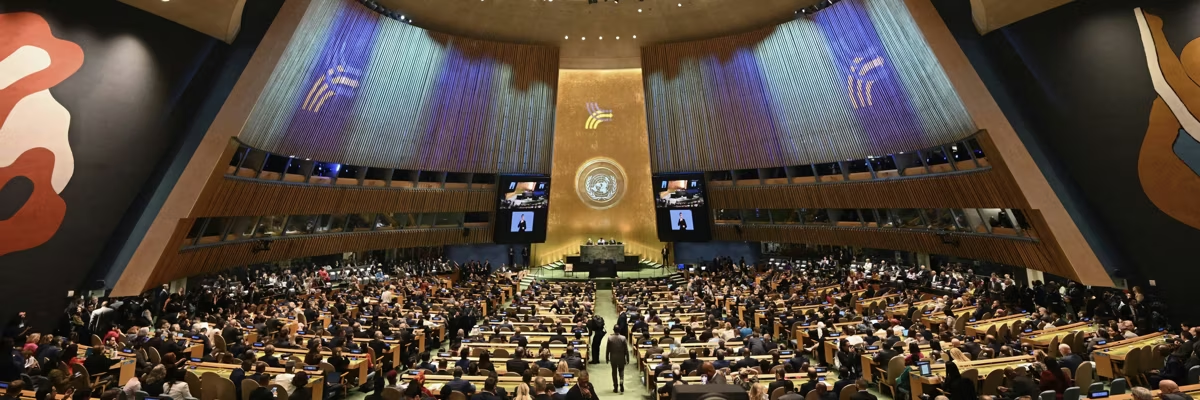
A view of the General Assembly Hall is shown at the opening of the "Summit of the Future" on the sidelines of the United Nations General Assembly at the UN Headquarters in New York, on September 22, 2024.
In its 81 years, the UN has never had a woman as its secretary-general; as it selects its new leader, there is considerable pressure to appoint a woman. It shouldn’t be difficult since four impressive women are in the running.
With the second term of the current United Nations Secretary-General, Antònio Guterres, expiring on December 31, 2026, the organization is in the process of selecting its 10th secretary-general. The UN’s first-ever Secretary-General, Trygve Lie, famously described it as “the most impossible job in the world.” That was at a time when there were 60 UN member states and the world’s population was 2.6 billion; now there are 193 members and the world’s population is 8.3 billion. It is also, arguably, the most important job in the world.
As the current President of the General Assembly, Annalena Baerbock (1 of only 5 women ever elected to this post in 81 years; the other 76 were men), explains, “Our choice will send a powerful message about who we are, and whether we truly serve all 8 billion people of the world in all their diversity.”
The overall selection process is prescribed by Article 97 of the UN Charter: “The Secretary-General shall be appointed by the General Assembly upon the recommendation of the Security Council.” But the charter offers little other guidance, so various informal procedures and practices have evolved over time. One is the rule of regional rotation, with it currently being Latin America and the Caribbean’s “turn,” although candidates from other regions can also be nominated, as they have been in this round. Seven candidates have been nominated to date—five from Latin America and the Caribbean (four women and one man) and two from Africa (both men). Although women have only been nominated as candidates since 1991, no woman has ever been appointed, in spite of campaigns to see a woman selected in 2006 and 2016.
It is generally accepted that candidates should come from small or mid-sized countries but not from the five permanent members (P5) of the Security Council. To be considered, a candidate must be nominated by one or more of the 193 member states, although the nomination does not have to come from the country of a candidate’s nationality.
This momentous decision will most likely occur in early October. How the process is carried out and how its outcome is perceived will have significant implications for the restoration of confidence in the UN’s ability to fulfill its mandate in an increasingly turbulent world.
For many years, the selection process was not transparent, but that has recently improved. The current round of nominations was initiated on November 25, 2025 by a joint letter from the presidents of the General Assembly and the Security Council addressed to all member states, inviting nominations and explicitly encouraging countries “to strongly consider nominating women as candidates.” The letter requested that nominations be accompanied by a nomination letter, a vision statement, a curriculum vitae, and a statement of campaign financing disclosures. As nominations were received, the two presidents jointly informed all member states and the information was posted on a UN website.
In response to General Assembly resolution 79/327 of 5 September 2025 on the revitalization of the work of the General Assembly, the president organized interactive webcast dialogues with all candidates (each lasting three hours), where candidates responded to questions posed by representatives of member states and civil society. As anyone who has ever interviewed applicants for a job knows (and as I learned from watching the webcasts), this is a useful means for identifying the best candidates.
In addition, on July 23, a UN Town Hall was organized in the General Assembly Hall by the president of the GA and broadcast live on Bloomberg, with two Bloomberg moderators presiding. All six candidates at the time (a seventh was subsequently nominated) appeared together on the stage and answered questions from the moderators, as well as the audience, who were again representatives of member states and civil society. The Security Council also organized confidential closed-door sessions with each of the candidates.
Subsequently, on July 30, the Security Council held its first confidential “straw poll,” an iterative process repeated over a number of weeks to decide which candidate has the most support. In each, the 15 members of the council, i.e., the P5—the US, Russia, China, France and the UK and its 10 elected members (E10) who serve two-year terms (currently, Bahrain, Colombia, Congo, Denmark, Greece, Latvia, Liberia, Pakistan, Panama, and Somalia) indicate which candidates they are willing to support by voting “encourage” (in favor), “discourage” (against), or “no opinion” (abstain).
During the first rounds, the ballots are all identical. However, after a few rounds (the number is not specified), the council introduces color-coded ballots: “red” for the P5 and “white” for the E10. From that point onward, votes carry different political weights, since a “discourage” vote from a P5 member is equivalent to a veto. At least nine “encourage” votes with no “discourage” votes from the P5 are required for a candidate to be selected. Candidates with a poor showing may withdraw from the process, although there are no rules requiring this. Votes are intended to be confidential, but results usually leak. The leaked results of the July 30 straw poll are shown here.
Once a determination has been made, the Security Council holds a formal vote on the outcome. The council then makes a formal recommendation to the GA, which can be accepted by acclimation or by a formal vote of the 193 member states. In theory, the GA can send the council’s recommendation back for reconsideration, although this has never happened.
In 2026, there are four impressive women candidates. Readers are encouraged to examine their curricula vitae, vision statements and to view at least a portion of the webcasts. Given that the appointment of a woman in this post is long overdue, there is reason to be hopeful that this will be the outcome.
But for this to happen, it will require that none of the P5 veto her candidature. As noted by a report of Women in International Security, “All things considered, the chances of women in the running will depend heavily on the veto power of the United States or Russia who could block their appointment.” The UK, France, and China have all indicated that they are positive about the appointment of a woman, but Russia has shown resistance to framing UN leadership selection around gender, and the US, under the Trump administration, has been averse to “diversity, equity, and inclusion.”
In a report which discusses the possibility of a “discourage” vote from the P5, Rebeca Grynspan is generally “viewed as the candidate with the lowest ideological controversy,” and Carolyn Rodrigues Birkett “carries the lowest visible P5 friction,” although as Guyana’s permanent representative on the Security Council, she abstained on a 2024 US-sponsored Gaza ceasefire resolution which might annoy the US. Maria Fernanda Espinosa’s prior support for Julian Assange when she was Ecuador’s UN representative and then foreign minister could “unsettle the UK which spent years pursuing his extradition.” Finally, it is suggested that China could “pose a challenge for Michelle Bachelet” since, at the end of her tenure as UN High Commissioner for Human Rights, she authorized publication of a UN report (despite China lobbying against it) stating that abuses against Uyghurs and other Muslim minorities constitute crimes against humanity.
Although the P5 have veto power, the E10 also have power since, if seven members agree on a single candidate and refuse to change their vote, the P5 would not be able to advance a candidate, even if they all agreed—because nine votes are required. With seven E10 members voting “discourage” on a P5 candidate, there would be only eight voting “encourage” and the vote would be blocked. This has even been called the “sixth veto power.”
While support from the E10 is necessary, it is not enough. A single “discourage” vote from the P5 would end a candidate’s prospects, however, early momentum within the E10 would make it harder for a P5 member to block a candidate with sufficient E10 support without paying a reputational price.
Of course, as a Stimson report comments: “A female Secretary-General will not solve every institutional or geopolitical challenge, but electing a strong woman signals that the UN could lead by example… A female SG would reflect half the world’s population, introduce fresh perspectives into global problem-solving, and navigate institutional hurdles with skill, authority, and resilience. After 80 years, the question is no longer whether the world is ready for a woman Secretary-General, it is whether the UN is.”
This momentous decision will most likely occur in early October. How the process is carried out and how its outcome is perceived will have significant implications for the restoration of confidence in the UN’s ability to fulfill its mandate in an increasingly turbulent world. Let us fervently hope that the Security Council will make a wise decision.
Dear Common Dreams reader, It’s been nearly 30 years since I co-founded Common Dreams with my late wife, Lina Newhouser. We had the radical notion that journalism should serve the public good, not corporate profits. It was clear to us from the outset what it would take to build such a project. No paid advertisements. No corporate sponsors. No millionaire publisher telling us what to think or do. Many people said we wouldn't last a year, but we proved those doubters wrong. Together with a tremendous team of journalists and dedicated staff, we built an independent media outlet free from the constraints of profits and corporate control. Our mission has always been simple: To inform. To inspire. To ignite change for the common good. Building Common Dreams was not easy. Our survival was never guaranteed. When you take on the most powerful forces—Wall Street greed, fossil fuel industry destruction, Big Tech lobbyists, and uber-rich oligarchs who have spent billions upon billions rigging the economy and democracy in their favor—the only bulwark you have is supporters who believe in your work. But here’s the urgent message from me today. It's never been this bad out there. And it's never been this hard to keep us going. At the very moment Common Dreams is most needed, the threats we face are intensifying. We need your support now more than ever. We don't accept corporate advertising and never will. We don't have a paywall because we don't think people should be blocked from critical news based on their ability to pay. Everything we do is funded by the donations of readers like you. When everyone does the little they can afford, we are strong. But if that support retreats or dries up, so do we. Will you donate now to make sure Common Dreams not only survives but thrives? —Craig Brown, Co-founder |
With the second term of the current United Nations Secretary-General, Antònio Guterres, expiring on December 31, 2026, the organization is in the process of selecting its 10th secretary-general. The UN’s first-ever Secretary-General, Trygve Lie, famously described it as “the most impossible job in the world.” That was at a time when there were 60 UN member states and the world’s population was 2.6 billion; now there are 193 members and the world’s population is 8.3 billion. It is also, arguably, the most important job in the world.
As the current President of the General Assembly, Annalena Baerbock (1 of only 5 women ever elected to this post in 81 years; the other 76 were men), explains, “Our choice will send a powerful message about who we are, and whether we truly serve all 8 billion people of the world in all their diversity.”
The overall selection process is prescribed by Article 97 of the UN Charter: “The Secretary-General shall be appointed by the General Assembly upon the recommendation of the Security Council.” But the charter offers little other guidance, so various informal procedures and practices have evolved over time. One is the rule of regional rotation, with it currently being Latin America and the Caribbean’s “turn,” although candidates from other regions can also be nominated, as they have been in this round. Seven candidates have been nominated to date—five from Latin America and the Caribbean (four women and one man) and two from Africa (both men). Although women have only been nominated as candidates since 1991, no woman has ever been appointed, in spite of campaigns to see a woman selected in 2006 and 2016.
It is generally accepted that candidates should come from small or mid-sized countries but not from the five permanent members (P5) of the Security Council. To be considered, a candidate must be nominated by one or more of the 193 member states, although the nomination does not have to come from the country of a candidate’s nationality.
This momentous decision will most likely occur in early October. How the process is carried out and how its outcome is perceived will have significant implications for the restoration of confidence in the UN’s ability to fulfill its mandate in an increasingly turbulent world.
For many years, the selection process was not transparent, but that has recently improved. The current round of nominations was initiated on November 25, 2025 by a joint letter from the presidents of the General Assembly and the Security Council addressed to all member states, inviting nominations and explicitly encouraging countries “to strongly consider nominating women as candidates.” The letter requested that nominations be accompanied by a nomination letter, a vision statement, a curriculum vitae, and a statement of campaign financing disclosures. As nominations were received, the two presidents jointly informed all member states and the information was posted on a UN website.
In response to General Assembly resolution 79/327 of 5 September 2025 on the revitalization of the work of the General Assembly, the president organized interactive webcast dialogues with all candidates (each lasting three hours), where candidates responded to questions posed by representatives of member states and civil society. As anyone who has ever interviewed applicants for a job knows (and as I learned from watching the webcasts), this is a useful means for identifying the best candidates.
In addition, on July 23, a UN Town Hall was organized in the General Assembly Hall by the president of the GA and broadcast live on Bloomberg, with two Bloomberg moderators presiding. All six candidates at the time (a seventh was subsequently nominated) appeared together on the stage and answered questions from the moderators, as well as the audience, who were again representatives of member states and civil society. The Security Council also organized confidential closed-door sessions with each of the candidates.
Subsequently, on July 30, the Security Council held its first confidential “straw poll,” an iterative process repeated over a number of weeks to decide which candidate has the most support. In each, the 15 members of the council, i.e., the P5—the US, Russia, China, France and the UK and its 10 elected members (E10) who serve two-year terms (currently, Bahrain, Colombia, Congo, Denmark, Greece, Latvia, Liberia, Pakistan, Panama, and Somalia) indicate which candidates they are willing to support by voting “encourage” (in favor), “discourage” (against), or “no opinion” (abstain).
During the first rounds, the ballots are all identical. However, after a few rounds (the number is not specified), the council introduces color-coded ballots: “red” for the P5 and “white” for the E10. From that point onward, votes carry different political weights, since a “discourage” vote from a P5 member is equivalent to a veto. At least nine “encourage” votes with no “discourage” votes from the P5 are required for a candidate to be selected. Candidates with a poor showing may withdraw from the process, although there are no rules requiring this. Votes are intended to be confidential, but results usually leak. The leaked results of the July 30 straw poll are shown here.
Once a determination has been made, the Security Council holds a formal vote on the outcome. The council then makes a formal recommendation to the GA, which can be accepted by acclimation or by a formal vote of the 193 member states. In theory, the GA can send the council’s recommendation back for reconsideration, although this has never happened.
In 2026, there are four impressive women candidates. Readers are encouraged to examine their curricula vitae, vision statements and to view at least a portion of the webcasts. Given that the appointment of a woman in this post is long overdue, there is reason to be hopeful that this will be the outcome.
But for this to happen, it will require that none of the P5 veto her candidature. As noted by a report of Women in International Security, “All things considered, the chances of women in the running will depend heavily on the veto power of the United States or Russia who could block their appointment.” The UK, France, and China have all indicated that they are positive about the appointment of a woman, but Russia has shown resistance to framing UN leadership selection around gender, and the US, under the Trump administration, has been averse to “diversity, equity, and inclusion.”
In a report which discusses the possibility of a “discourage” vote from the P5, Rebeca Grynspan is generally “viewed as the candidate with the lowest ideological controversy,” and Carolyn Rodrigues Birkett “carries the lowest visible P5 friction,” although as Guyana’s permanent representative on the Security Council, she abstained on a 2024 US-sponsored Gaza ceasefire resolution which might annoy the US. Maria Fernanda Espinosa’s prior support for Julian Assange when she was Ecuador’s UN representative and then foreign minister could “unsettle the UK which spent years pursuing his extradition.” Finally, it is suggested that China could “pose a challenge for Michelle Bachelet” since, at the end of her tenure as UN High Commissioner for Human Rights, she authorized publication of a UN report (despite China lobbying against it) stating that abuses against Uyghurs and other Muslim minorities constitute crimes against humanity.
Although the P5 have veto power, the E10 also have power since, if seven members agree on a single candidate and refuse to change their vote, the P5 would not be able to advance a candidate, even if they all agreed—because nine votes are required. With seven E10 members voting “discourage” on a P5 candidate, there would be only eight voting “encourage” and the vote would be blocked. This has even been called the “sixth veto power.”
While support from the E10 is necessary, it is not enough. A single “discourage” vote from the P5 would end a candidate’s prospects, however, early momentum within the E10 would make it harder for a P5 member to block a candidate with sufficient E10 support without paying a reputational price.
Of course, as a Stimson report comments: “A female Secretary-General will not solve every institutional or geopolitical challenge, but electing a strong woman signals that the UN could lead by example… A female SG would reflect half the world’s population, introduce fresh perspectives into global problem-solving, and navigate institutional hurdles with skill, authority, and resilience. After 80 years, the question is no longer whether the world is ready for a woman Secretary-General, it is whether the UN is.”
This momentous decision will most likely occur in early October. How the process is carried out and how its outcome is perceived will have significant implications for the restoration of confidence in the UN’s ability to fulfill its mandate in an increasingly turbulent world. Let us fervently hope that the Security Council will make a wise decision.
With the second term of the current United Nations Secretary-General, Antònio Guterres, expiring on December 31, 2026, the organization is in the process of selecting its 10th secretary-general. The UN’s first-ever Secretary-General, Trygve Lie, famously described it as “the most impossible job in the world.” That was at a time when there were 60 UN member states and the world’s population was 2.6 billion; now there are 193 members and the world’s population is 8.3 billion. It is also, arguably, the most important job in the world.
As the current President of the General Assembly, Annalena Baerbock (1 of only 5 women ever elected to this post in 81 years; the other 76 were men), explains, “Our choice will send a powerful message about who we are, and whether we truly serve all 8 billion people of the world in all their diversity.”
The overall selection process is prescribed by Article 97 of the UN Charter: “The Secretary-General shall be appointed by the General Assembly upon the recommendation of the Security Council.” But the charter offers little other guidance, so various informal procedures and practices have evolved over time. One is the rule of regional rotation, with it currently being Latin America and the Caribbean’s “turn,” although candidates from other regions can also be nominated, as they have been in this round. Seven candidates have been nominated to date—five from Latin America and the Caribbean (four women and one man) and two from Africa (both men). Although women have only been nominated as candidates since 1991, no woman has ever been appointed, in spite of campaigns to see a woman selected in 2006 and 2016.
It is generally accepted that candidates should come from small or mid-sized countries but not from the five permanent members (P5) of the Security Council. To be considered, a candidate must be nominated by one or more of the 193 member states, although the nomination does not have to come from the country of a candidate’s nationality.
This momentous decision will most likely occur in early October. How the process is carried out and how its outcome is perceived will have significant implications for the restoration of confidence in the UN’s ability to fulfill its mandate in an increasingly turbulent world.
For many years, the selection process was not transparent, but that has recently improved. The current round of nominations was initiated on November 25, 2025 by a joint letter from the presidents of the General Assembly and the Security Council addressed to all member states, inviting nominations and explicitly encouraging countries “to strongly consider nominating women as candidates.” The letter requested that nominations be accompanied by a nomination letter, a vision statement, a curriculum vitae, and a statement of campaign financing disclosures. As nominations were received, the two presidents jointly informed all member states and the information was posted on a UN website.
In response to General Assembly resolution 79/327 of 5 September 2025 on the revitalization of the work of the General Assembly, the president organized interactive webcast dialogues with all candidates (each lasting three hours), where candidates responded to questions posed by representatives of member states and civil society. As anyone who has ever interviewed applicants for a job knows (and as I learned from watching the webcasts), this is a useful means for identifying the best candidates.
In addition, on July 23, a UN Town Hall was organized in the General Assembly Hall by the president of the GA and broadcast live on Bloomberg, with two Bloomberg moderators presiding. All six candidates at the time (a seventh was subsequently nominated) appeared together on the stage and answered questions from the moderators, as well as the audience, who were again representatives of member states and civil society. The Security Council also organized confidential closed-door sessions with each of the candidates.
Subsequently, on July 30, the Security Council held its first confidential “straw poll,” an iterative process repeated over a number of weeks to decide which candidate has the most support. In each, the 15 members of the council, i.e., the P5—the US, Russia, China, France and the UK and its 10 elected members (E10) who serve two-year terms (currently, Bahrain, Colombia, Congo, Denmark, Greece, Latvia, Liberia, Pakistan, Panama, and Somalia) indicate which candidates they are willing to support by voting “encourage” (in favor), “discourage” (against), or “no opinion” (abstain).
During the first rounds, the ballots are all identical. However, after a few rounds (the number is not specified), the council introduces color-coded ballots: “red” for the P5 and “white” for the E10. From that point onward, votes carry different political weights, since a “discourage” vote from a P5 member is equivalent to a veto. At least nine “encourage” votes with no “discourage” votes from the P5 are required for a candidate to be selected. Candidates with a poor showing may withdraw from the process, although there are no rules requiring this. Votes are intended to be confidential, but results usually leak. The leaked results of the July 30 straw poll are shown here.
Once a determination has been made, the Security Council holds a formal vote on the outcome. The council then makes a formal recommendation to the GA, which can be accepted by acclimation or by a formal vote of the 193 member states. In theory, the GA can send the council’s recommendation back for reconsideration, although this has never happened.
In 2026, there are four impressive women candidates. Readers are encouraged to examine their curricula vitae, vision statements and to view at least a portion of the webcasts. Given that the appointment of a woman in this post is long overdue, there is reason to be hopeful that this will be the outcome.
But for this to happen, it will require that none of the P5 veto her candidature. As noted by a report of Women in International Security, “All things considered, the chances of women in the running will depend heavily on the veto power of the United States or Russia who could block their appointment.” The UK, France, and China have all indicated that they are positive about the appointment of a woman, but Russia has shown resistance to framing UN leadership selection around gender, and the US, under the Trump administration, has been averse to “diversity, equity, and inclusion.”
In a report which discusses the possibility of a “discourage” vote from the P5, Rebeca Grynspan is generally “viewed as the candidate with the lowest ideological controversy,” and Carolyn Rodrigues Birkett “carries the lowest visible P5 friction,” although as Guyana’s permanent representative on the Security Council, she abstained on a 2024 US-sponsored Gaza ceasefire resolution which might annoy the US. Maria Fernanda Espinosa’s prior support for Julian Assange when she was Ecuador’s UN representative and then foreign minister could “unsettle the UK which spent years pursuing his extradition.” Finally, it is suggested that China could “pose a challenge for Michelle Bachelet” since, at the end of her tenure as UN High Commissioner for Human Rights, she authorized publication of a UN report (despite China lobbying against it) stating that abuses against Uyghurs and other Muslim minorities constitute crimes against humanity.
Although the P5 have veto power, the E10 also have power since, if seven members agree on a single candidate and refuse to change their vote, the P5 would not be able to advance a candidate, even if they all agreed—because nine votes are required. With seven E10 members voting “discourage” on a P5 candidate, there would be only eight voting “encourage” and the vote would be blocked. This has even been called the “sixth veto power.”
While support from the E10 is necessary, it is not enough. A single “discourage” vote from the P5 would end a candidate’s prospects, however, early momentum within the E10 would make it harder for a P5 member to block a candidate with sufficient E10 support without paying a reputational price.
Of course, as a Stimson report comments: “A female Secretary-General will not solve every institutional or geopolitical challenge, but electing a strong woman signals that the UN could lead by example… A female SG would reflect half the world’s population, introduce fresh perspectives into global problem-solving, and navigate institutional hurdles with skill, authority, and resilience. After 80 years, the question is no longer whether the world is ready for a woman Secretary-General, it is whether the UN is.”
This momentous decision will most likely occur in early October. How the process is carried out and how its outcome is perceived will have significant implications for the restoration of confidence in the UN’s ability to fulfill its mandate in an increasingly turbulent world. Let us fervently hope that the Security Council will make a wise decision.