

SUBSCRIBE TO OUR FREE NEWSLETTER
Daily news & progressive opinion—funded by the people, not the corporations—delivered straight to your inbox.
5
#000000
#FFFFFF
To donate by check, phone, or other method, see our More Ways to Give page.
Daily news & progressive opinion—funded by the people, not the corporations—delivered straight to your inbox.
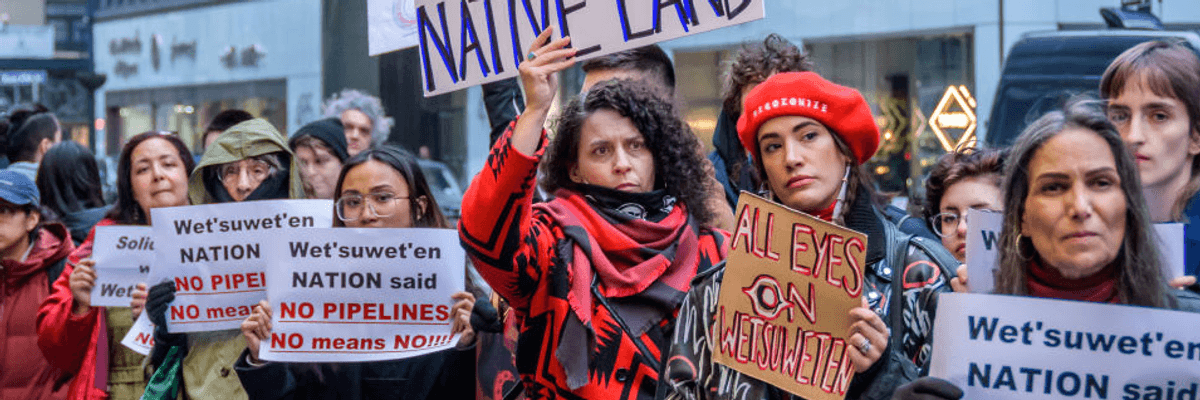
Demonstrators rally at a solidarity protest for the Wet'suwet'en First Nations people and against the Coastal GasLink pipeline at the Canadian consulate in New York City on February 18, 2020. (Photo: Erik McGregor/LightRocket/Getty Images)
First Nations land defenders on Monday filed a submission to the United Nations detailing how their territory and human rights are being violated by Canadian and British Columbian authorities in service of a fossil fuel corporation's gas pipeline.
"We are intimidated and surveilled by armed RCMP, smeared as terrorists, and dragged through colonial courts. This is the reality of Canada."
The submission to the United Nations Human Rights Council was filed by the Gidimt'en--one of the five clans of the Wet'suwet'en Nation--who for years have been fighting to stop the construction of Coastal GasLink's pipeline through their territory in northern British Columbia.
The filing notes that "ongoing human rights violations, militarization of Wet'suwet'en lands, forcible removal and criminalization of peaceful land defenders, and irreparable harm due to industrial destruction of Wet'suwet'en lands and cultural sites are occurring despite declarations by federal and provincial governments for reconciliation with Indigenous peoples."
All five Wet'suwet'en clans oppose the pipeline, which is being built on tribal land that the Canadian Supreme Court acknowledges as unceded. Canadian authorities, including the Royal Canadian Mounted Police (RCMP), have answered nonviolent Wet'suwet'en land defense with heavily armed officers employing heavy-handed removal tactics.
Scores of Wet'suwet'en land defenders, including four hereditary chiefs, have been arrested and charged, as have journalists and legal observers. In December, Coastal GasLink dropped charges against two journalists who were arrested while covering a militarized police raid last November 19.
More than 30 land defenders are scheduled to appear in the British Columbian Supreme Court in Prince George, built on the site of a burned Lheidli T'enneh village, next week.
Meanwhile, construction continues on the 416-mile pipeline, which will carry gas from Michif Piiyii (Metis) territory in northeastern British Columbia to an export terminal in coastal Kitimat, on the land of the xa'isla wawis (Haisla) people.
"By deploying legal, political, and economic tactics to violate our rights, Canada and B.C. are contravening the spirit of reconciliation, as well as their binding obligations to Indigenous law, Canadian constitutional law, UNDRIP, and international law," the Gidimt'en submission states, referring to the United Nations Declaration on the Rights of Indigenous Peoples.
Gidimt'en Checkpoint spokesperson Sleydo' said in a statement that "we urge the United Nations to conduct a field visit to Wet'suwet'en territory because Canada and B.C. have not withdrawn RCMP from our territory and have not suspended Coastal GasLink's permits, despite the United Nations Committee on the Elimination of Racial Discrimination calling on them to do so."
"Wet'suwet'en is an international frontline to protect the rights of Indigenous peoples and to prevent climate change," she added. "Yet we are intimidated and surveilled by armed RCMP, smeared as terrorists, and dragged through colonial courts. This is the reality of Canada."
Dear Common Dreams reader, It’s been nearly 30 years since I co-founded Common Dreams with my late wife, Lina Newhouser. We had the radical notion that journalism should serve the public good, not corporate profits. It was clear to us from the outset what it would take to build such a project. No paid advertisements. No corporate sponsors. No millionaire publisher telling us what to think or do. Many people said we wouldn't last a year, but we proved those doubters wrong. Together with a tremendous team of journalists and dedicated staff, we built an independent media outlet free from the constraints of profits and corporate control. Our mission has always been simple: To inform. To inspire. To ignite change for the common good. Building Common Dreams was not easy. Our survival was never guaranteed. When you take on the most powerful forces—Wall Street greed, fossil fuel industry destruction, Big Tech lobbyists, and uber-rich oligarchs who have spent billions upon billions rigging the economy and democracy in their favor—the only bulwark you have is supporters who believe in your work. But here’s the urgent message from me today. It's never been this bad out there. And it's never been this hard to keep us going. At the very moment Common Dreams is most needed, the threats we face are intensifying. We need your support now more than ever. We don't accept corporate advertising and never will. We don't have a paywall because we don't think people should be blocked from critical news based on their ability to pay. Everything we do is funded by the donations of readers like you. When everyone does the little they can afford, we are strong. But if that support retreats or dries up, so do we. Will you donate now to make sure Common Dreams not only survives but thrives? —Craig Brown, Co-founder |
First Nations land defenders on Monday filed a submission to the United Nations detailing how their territory and human rights are being violated by Canadian and British Columbian authorities in service of a fossil fuel corporation's gas pipeline.
"We are intimidated and surveilled by armed RCMP, smeared as terrorists, and dragged through colonial courts. This is the reality of Canada."
The submission to the United Nations Human Rights Council was filed by the Gidimt'en--one of the five clans of the Wet'suwet'en Nation--who for years have been fighting to stop the construction of Coastal GasLink's pipeline through their territory in northern British Columbia.
The filing notes that "ongoing human rights violations, militarization of Wet'suwet'en lands, forcible removal and criminalization of peaceful land defenders, and irreparable harm due to industrial destruction of Wet'suwet'en lands and cultural sites are occurring despite declarations by federal and provincial governments for reconciliation with Indigenous peoples."
All five Wet'suwet'en clans oppose the pipeline, which is being built on tribal land that the Canadian Supreme Court acknowledges as unceded. Canadian authorities, including the Royal Canadian Mounted Police (RCMP), have answered nonviolent Wet'suwet'en land defense with heavily armed officers employing heavy-handed removal tactics.
Scores of Wet'suwet'en land defenders, including four hereditary chiefs, have been arrested and charged, as have journalists and legal observers. In December, Coastal GasLink dropped charges against two journalists who were arrested while covering a militarized police raid last November 19.
More than 30 land defenders are scheduled to appear in the British Columbian Supreme Court in Prince George, built on the site of a burned Lheidli T'enneh village, next week.
Meanwhile, construction continues on the 416-mile pipeline, which will carry gas from Michif Piiyii (Metis) territory in northeastern British Columbia to an export terminal in coastal Kitimat, on the land of the xa'isla wawis (Haisla) people.
"By deploying legal, political, and economic tactics to violate our rights, Canada and B.C. are contravening the spirit of reconciliation, as well as their binding obligations to Indigenous law, Canadian constitutional law, UNDRIP, and international law," the Gidimt'en submission states, referring to the United Nations Declaration on the Rights of Indigenous Peoples.
Gidimt'en Checkpoint spokesperson Sleydo' said in a statement that "we urge the United Nations to conduct a field visit to Wet'suwet'en territory because Canada and B.C. have not withdrawn RCMP from our territory and have not suspended Coastal GasLink's permits, despite the United Nations Committee on the Elimination of Racial Discrimination calling on them to do so."
"Wet'suwet'en is an international frontline to protect the rights of Indigenous peoples and to prevent climate change," she added. "Yet we are intimidated and surveilled by armed RCMP, smeared as terrorists, and dragged through colonial courts. This is the reality of Canada."
First Nations land defenders on Monday filed a submission to the United Nations detailing how their territory and human rights are being violated by Canadian and British Columbian authorities in service of a fossil fuel corporation's gas pipeline.
"We are intimidated and surveilled by armed RCMP, smeared as terrorists, and dragged through colonial courts. This is the reality of Canada."
The submission to the United Nations Human Rights Council was filed by the Gidimt'en--one of the five clans of the Wet'suwet'en Nation--who for years have been fighting to stop the construction of Coastal GasLink's pipeline through their territory in northern British Columbia.
The filing notes that "ongoing human rights violations, militarization of Wet'suwet'en lands, forcible removal and criminalization of peaceful land defenders, and irreparable harm due to industrial destruction of Wet'suwet'en lands and cultural sites are occurring despite declarations by federal and provincial governments for reconciliation with Indigenous peoples."
All five Wet'suwet'en clans oppose the pipeline, which is being built on tribal land that the Canadian Supreme Court acknowledges as unceded. Canadian authorities, including the Royal Canadian Mounted Police (RCMP), have answered nonviolent Wet'suwet'en land defense with heavily armed officers employing heavy-handed removal tactics.
Scores of Wet'suwet'en land defenders, including four hereditary chiefs, have been arrested and charged, as have journalists and legal observers. In December, Coastal GasLink dropped charges against two journalists who were arrested while covering a militarized police raid last November 19.
More than 30 land defenders are scheduled to appear in the British Columbian Supreme Court in Prince George, built on the site of a burned Lheidli T'enneh village, next week.
Meanwhile, construction continues on the 416-mile pipeline, which will carry gas from Michif Piiyii (Metis) territory in northeastern British Columbia to an export terminal in coastal Kitimat, on the land of the xa'isla wawis (Haisla) people.
"By deploying legal, political, and economic tactics to violate our rights, Canada and B.C. are contravening the spirit of reconciliation, as well as their binding obligations to Indigenous law, Canadian constitutional law, UNDRIP, and international law," the Gidimt'en submission states, referring to the United Nations Declaration on the Rights of Indigenous Peoples.
Gidimt'en Checkpoint spokesperson Sleydo' said in a statement that "we urge the United Nations to conduct a field visit to Wet'suwet'en territory because Canada and B.C. have not withdrawn RCMP from our territory and have not suspended Coastal GasLink's permits, despite the United Nations Committee on the Elimination of Racial Discrimination calling on them to do so."
"Wet'suwet'en is an international frontline to protect the rights of Indigenous peoples and to prevent climate change," she added. "Yet we are intimidated and surveilled by armed RCMP, smeared as terrorists, and dragged through colonial courts. This is the reality of Canada."

