SUBSCRIBE TO OUR FREE NEWSLETTER
Daily news & progressive opinion—funded by the people, not the corporations—delivered straight to your inbox.
5
#000000
#FFFFFF
To donate by check, phone, or other method, see our More Ways to Give page.
Daily news & progressive opinion—funded by the people, not the corporations—delivered straight to your inbox.
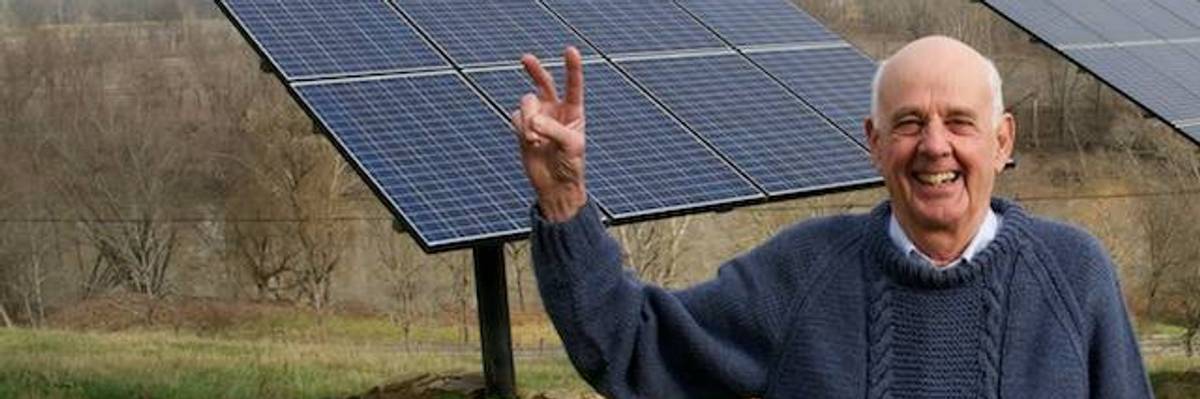
Wendell Berry stands in front of solar panels on his farm in Henry County, Kentucky in 2011.
Musk indulges in the kind of fantasy that drove Berry to distraction (and to work)—all about control and domination, all done by the few to the many, utterly ignorant of context. Immodest in every way.
Wendell Berry, who died Monday at the age of 92, was such a great man that I hardly know where to start. He was on the very short list of the best writers of our time: His essays on rural America were the words that launched 10,000 farmers markets; his poems, the staple of many happy weddings (and I’ve peed in a dozen different bathrooms where the Manifesto of the Mad Farmer’s Liberation Front was framed above the toilet). If you’ve never read his short stories of the Port William Membership, or his finest novel, Jayber Crow, you can count yourself lucky that you’ll get to encounter them for the first time.
Berry was also, of course, politically engaged. I remember standing with him 20 years ago, at a protest against the Capitol Hill power plant that I’d asked him to attend. It was a bitterly cold day, and at one point he turned to me and smiled and said, "Do you think maybe they’ll arrest us soon?" He didn’t particularly like movements, but he understood the power of moral witness; he occupied the Kentucky governor’s office, in a protest against mountaintop removal coal mining, with a toothbrush and volume of Shakespeare in his pocket.
And, perhaps above all, his life was a work of both art and politics—his decision to give up a New York lit’ry career and to return instead to the Kentucky of his boyhood, settling along the Ohio River where he and his wife Tanya farmed and he wrote, embodying the commitment to place and community that animated his writing. (His family is asking that in lieu of flowers people might send a donation to the Berry Center that is carrying on his agrarian work).
I was very lucky that my wife handed me a copy of his essay collection Home Economics about 40 years ago, when we were still courting. If I hadn’t fallen under his spell I’m not sure I would have spent my life in rural America, red state and blue; I know that he taught me how to see my town and my county, and my country and my species, in new-old ways that have undergirded all my work. And I’m very glad that we became friends, visiting and writing back and forth. His droll good humor rarely faltered, in my experience. I did not agree with him at all times, nor he with me—though he had solar panels behind his house, for instance, he didn’t think they belonged on farmland, while I think they’re a boon to both farmer and planet. But we agreed on most things of real dimension, and I was always delighted to see in the mailbox a letter with the return address of Port Royal Kentucky. He was one of the last people with whom I had a true written, as opposed to electronic, correspondence. Sometimes he’d tap things out on a manual typewriter, but more often it would be in pencil, on lined yellow paper.
The most recent arrived in July, and after news about grandsons and granddaughters it contained his newest discovery, a 1940 volume titled Stops, A Handbook for Those Who Know Their Punctuation and Those Who Aren’t Quite Sure. He was recommending it to me on the grounds that it is the “only book of my acquaintance that makes grammar delightful,” but also because he’d noted that it was published by the press (now defunct) at Middlebury College, where I teach. So while the rest of us were figuring out how to enlist Claude to help with our composition, one of the best writers of our age was still enjoying sharpening his prose, just as he enjoyed sharpening the tools of his work in field and forest. “I’m writing this on the porch of the ‘camp house,’ still unwired, built, I think, in 1964, in the woods between the river and the road.” He died on that farm on Monday, surrounded by family.
I got the news about his passing even as I was trying to grapple with the latest from a man who will attract more notice when he dies, but less affection. Elon Musk is always advancing his own vision of the world, of course—in fact, he’s just pledged to spend $100 million helping Republicans this fall. Or maybe $200 million—neither would be a noticeable sum to a trillionaire, of course. Whatever good he did with his early advocacy for electric vehicles has now been undone 100 times over with his advocacy for the people who hate EVs and all the other things we need. (He’s, as of last week, building gas turbines to make more electricity for his right-wing Grok AI project, already polluting the air of Black neighborhoods in Memphis).
He offers the Nazi salute; we are at his behest settling thousands of refugees from white South Africa (and no others) in our country; his rancid racism has destroyed Twitter. It would be a pleasure never to think of him again, but because he’s the richest man in the world, one has to monitor what he says. And here’s Monday’s installment, from of course his own social media site:
Extremely severe extinction events happen every 100M years or so and just switching to sustainable energy will not be enough to stop them.
Space satellites to control temperature and massive geo-engineering will be needed or it will be game over.
The disingenuousness of this is remarkable. Extremely severe extinction events have indeed happened just five times in the last half-billion years, which means it would be extremely unlikely we’d spontaneously come across one any time soon: Human civilization is, after all, just 10,000 years old. And yet of course we face one, not because of anything nature has done, but because we’ve filled the air with carbon dioxide from burning fossil fuel, which his allies wish to continue indefinitely. “Just switching to sustainable energy” is in fact the one good, scalable weapon we have to fight that, but since he’s a part of the political movement against this idea, he is now backing an alternative: “space satellites to control temperature,” which he further explains will be accomplished by a “super-intelligent swarm” of “sentient satellites, launched into Earth-Sun Lagrange points by mass drivers on the Moon.”
This is the kind of fantasy that drove Berry to distraction (and to work)—all about control and domination, all done by the few to the many, utterly ignorant of context. Immodest in every way.
But in Musk’s case it was accompanied by another revelation that began to emerge over the weekend. It turns out that the human toll of the horrific rampaging floods on the Nepal-Tibet border may well have been exacerbated by Musk’s decision to destroy the US Agency for International Development early in the DOGE assault on our government. USAID, in collaboration with NASA, helped maintain a network of monitors high in the Himalayas and Hindu Kush. Musk, in February 2025, “spent the weekend feeding USAID into the wood chipper. Could gone to some great parties. Did that instead.” One casualty was apparently this network. As Jeremy Konyndyk, who oversaw America’s response to the 2015 Nepal earthquake, wrote this weekend on (ironically) X:
DOGE famously used keyword searches for terms like "climate" to terminate federal grants. Among the victims: a collab between USAID and NASA for flood prediction, early warning, disaster readiness, glacier inventories, and mapping dangerous glacial lakes in Nepal.
As Konyndyk added:
Could these programs have helped foresee or mitigate this week's glacial flooding catastrophe? Hard to say with an outlier event like this. But that was their purpose.
Sadly, it's hard to anticipate or mitigate climate hazards which your ideology has decreed do not exist.
Musk’s victims already number in the millions—a Lancet study predicts 14 million by 2030 as the indirect results of shutting down America’s humanitarian work, which puts him up there in the Stalin-Mao category, and almost certainly the most deadly human of this millennium. So maybe a few thousand more people hardly matter.
But contrast what Musk did with the actions of a principal at a school along the river. When a friend upstream phoned one of his teachers a blurted warning, he immediately evacuated the entire student body, saving at least 900 lives. Given a warning, he acted (precisely what the world has not done with climate change). “I thought that even if the warning turned out to be wrong, the worst it would cost us was one day of study,” Rajendra Dawadi said. “But taking it lightly could mean the loss of hundreds of lives.”
Principal Dawadi will spend the rest of his life going to the weddings of the students whose lives he saved, and I imagine there will be no small number of babies named in his honor. Elon Musk’s name will be cursed—the richest man in human history, who used his wealth and power to kill the most vulnerable people on the planet.
Here is a recent poem of Wendell Berry’s, published in The New Yorker less than a year ago and titled "The Loved Ones":
The loved ones we call the dead
depart from us and for a while
are absent. And then as if
called back by our love, they come
near us again. They enter our dreams.
We feel they have been near us
when we have not thought of them.
They are simply here, simply waiting
while we are distracted among
our obligations. At last
it comes to us: They live now
in the permanent world.
We are the absent ones.
Dear Common Dreams reader, It’s been nearly 30 years since I co-founded Common Dreams with my late wife, Lina Newhouser. We had the radical notion that journalism should serve the public good, not corporate profits. It was clear to us from the outset what it would take to build such a project. No paid advertisements. No corporate sponsors. No millionaire publisher telling us what to think or do. Many people said we wouldn't last a year, but we proved those doubters wrong. Together with a tremendous team of journalists and dedicated staff, we built an independent media outlet free from the constraints of profits and corporate control. Our mission has always been simple: To inform. To inspire. To ignite change for the common good. Building Common Dreams was not easy. Our survival was never guaranteed. When you take on the most powerful forces—Wall Street greed, fossil fuel industry destruction, Big Tech lobbyists, and uber-rich oligarchs who have spent billions upon billions rigging the economy and democracy in their favor—the only bulwark you have is supporters who believe in your work. But here’s the urgent message from me today. It's never been this bad out there. And it's never been this hard to keep us going. At the very moment Common Dreams is most needed, the threats we face are intensifying. We need your support now more than ever. We don't accept corporate advertising and never will. We don't have a paywall because we don't think people should be blocked from critical news based on their ability to pay. Everything we do is funded by the donations of readers like you. When everyone does the little they can afford, we are strong. But if that support retreats or dries up, so do we. Will you donate now to make sure Common Dreams not only survives but thrives? —Craig Brown, Co-founder |
Wendell Berry, who died Monday at the age of 92, was such a great man that I hardly know where to start. He was on the very short list of the best writers of our time: His essays on rural America were the words that launched 10,000 farmers markets; his poems, the staple of many happy weddings (and I’ve peed in a dozen different bathrooms where the Manifesto of the Mad Farmer’s Liberation Front was framed above the toilet). If you’ve never read his short stories of the Port William Membership, or his finest novel, Jayber Crow, you can count yourself lucky that you’ll get to encounter them for the first time.
Berry was also, of course, politically engaged. I remember standing with him 20 years ago, at a protest against the Capitol Hill power plant that I’d asked him to attend. It was a bitterly cold day, and at one point he turned to me and smiled and said, "Do you think maybe they’ll arrest us soon?" He didn’t particularly like movements, but he understood the power of moral witness; he occupied the Kentucky governor’s office, in a protest against mountaintop removal coal mining, with a toothbrush and volume of Shakespeare in his pocket.
And, perhaps above all, his life was a work of both art and politics—his decision to give up a New York lit’ry career and to return instead to the Kentucky of his boyhood, settling along the Ohio River where he and his wife Tanya farmed and he wrote, embodying the commitment to place and community that animated his writing. (His family is asking that in lieu of flowers people might send a donation to the Berry Center that is carrying on his agrarian work).
I was very lucky that my wife handed me a copy of his essay collection Home Economics about 40 years ago, when we were still courting. If I hadn’t fallen under his spell I’m not sure I would have spent my life in rural America, red state and blue; I know that he taught me how to see my town and my county, and my country and my species, in new-old ways that have undergirded all my work. And I’m very glad that we became friends, visiting and writing back and forth. His droll good humor rarely faltered, in my experience. I did not agree with him at all times, nor he with me—though he had solar panels behind his house, for instance, he didn’t think they belonged on farmland, while I think they’re a boon to both farmer and planet. But we agreed on most things of real dimension, and I was always delighted to see in the mailbox a letter with the return address of Port Royal Kentucky. He was one of the last people with whom I had a true written, as opposed to electronic, correspondence. Sometimes he’d tap things out on a manual typewriter, but more often it would be in pencil, on lined yellow paper.
The most recent arrived in July, and after news about grandsons and granddaughters it contained his newest discovery, a 1940 volume titled Stops, A Handbook for Those Who Know Their Punctuation and Those Who Aren’t Quite Sure. He was recommending it to me on the grounds that it is the “only book of my acquaintance that makes grammar delightful,” but also because he’d noted that it was published by the press (now defunct) at Middlebury College, where I teach. So while the rest of us were figuring out how to enlist Claude to help with our composition, one of the best writers of our age was still enjoying sharpening his prose, just as he enjoyed sharpening the tools of his work in field and forest. “I’m writing this on the porch of the ‘camp house,’ still unwired, built, I think, in 1964, in the woods between the river and the road.” He died on that farm on Monday, surrounded by family.
I got the news about his passing even as I was trying to grapple with the latest from a man who will attract more notice when he dies, but less affection. Elon Musk is always advancing his own vision of the world, of course—in fact, he’s just pledged to spend $100 million helping Republicans this fall. Or maybe $200 million—neither would be a noticeable sum to a trillionaire, of course. Whatever good he did with his early advocacy for electric vehicles has now been undone 100 times over with his advocacy for the people who hate EVs and all the other things we need. (He’s, as of last week, building gas turbines to make more electricity for his right-wing Grok AI project, already polluting the air of Black neighborhoods in Memphis).
He offers the Nazi salute; we are at his behest settling thousands of refugees from white South Africa (and no others) in our country; his rancid racism has destroyed Twitter. It would be a pleasure never to think of him again, but because he’s the richest man in the world, one has to monitor what he says. And here’s Monday’s installment, from of course his own social media site:
Extremely severe extinction events happen every 100M years or so and just switching to sustainable energy will not be enough to stop them.
Space satellites to control temperature and massive geo-engineering will be needed or it will be game over.
The disingenuousness of this is remarkable. Extremely severe extinction events have indeed happened just five times in the last half-billion years, which means it would be extremely unlikely we’d spontaneously come across one any time soon: Human civilization is, after all, just 10,000 years old. And yet of course we face one, not because of anything nature has done, but because we’ve filled the air with carbon dioxide from burning fossil fuel, which his allies wish to continue indefinitely. “Just switching to sustainable energy” is in fact the one good, scalable weapon we have to fight that, but since he’s a part of the political movement against this idea, he is now backing an alternative: “space satellites to control temperature,” which he further explains will be accomplished by a “super-intelligent swarm” of “sentient satellites, launched into Earth-Sun Lagrange points by mass drivers on the Moon.”
This is the kind of fantasy that drove Berry to distraction (and to work)—all about control and domination, all done by the few to the many, utterly ignorant of context. Immodest in every way.
But in Musk’s case it was accompanied by another revelation that began to emerge over the weekend. It turns out that the human toll of the horrific rampaging floods on the Nepal-Tibet border may well have been exacerbated by Musk’s decision to destroy the US Agency for International Development early in the DOGE assault on our government. USAID, in collaboration with NASA, helped maintain a network of monitors high in the Himalayas and Hindu Kush. Musk, in February 2025, “spent the weekend feeding USAID into the wood chipper. Could gone to some great parties. Did that instead.” One casualty was apparently this network. As Jeremy Konyndyk, who oversaw America’s response to the 2015 Nepal earthquake, wrote this weekend on (ironically) X:
DOGE famously used keyword searches for terms like "climate" to terminate federal grants. Among the victims: a collab between USAID and NASA for flood prediction, early warning, disaster readiness, glacier inventories, and mapping dangerous glacial lakes in Nepal.
As Konyndyk added:
Could these programs have helped foresee or mitigate this week's glacial flooding catastrophe? Hard to say with an outlier event like this. But that was their purpose.
Sadly, it's hard to anticipate or mitigate climate hazards which your ideology has decreed do not exist.
Musk’s victims already number in the millions—a Lancet study predicts 14 million by 2030 as the indirect results of shutting down America’s humanitarian work, which puts him up there in the Stalin-Mao category, and almost certainly the most deadly human of this millennium. So maybe a few thousand more people hardly matter.
But contrast what Musk did with the actions of a principal at a school along the river. When a friend upstream phoned one of his teachers a blurted warning, he immediately evacuated the entire student body, saving at least 900 lives. Given a warning, he acted (precisely what the world has not done with climate change). “I thought that even if the warning turned out to be wrong, the worst it would cost us was one day of study,” Rajendra Dawadi said. “But taking it lightly could mean the loss of hundreds of lives.”
Principal Dawadi will spend the rest of his life going to the weddings of the students whose lives he saved, and I imagine there will be no small number of babies named in his honor. Elon Musk’s name will be cursed—the richest man in human history, who used his wealth and power to kill the most vulnerable people on the planet.
Here is a recent poem of Wendell Berry’s, published in The New Yorker less than a year ago and titled "The Loved Ones":
The loved ones we call the dead
depart from us and for a while
are absent. And then as if
called back by our love, they come
near us again. They enter our dreams.
We feel they have been near us
when we have not thought of them.
They are simply here, simply waiting
while we are distracted among
our obligations. At last
it comes to us: They live now
in the permanent world.
We are the absent ones.
Wendell Berry, who died Monday at the age of 92, was such a great man that I hardly know where to start. He was on the very short list of the best writers of our time: His essays on rural America were the words that launched 10,000 farmers markets; his poems, the staple of many happy weddings (and I’ve peed in a dozen different bathrooms where the Manifesto of the Mad Farmer’s Liberation Front was framed above the toilet). If you’ve never read his short stories of the Port William Membership, or his finest novel, Jayber Crow, you can count yourself lucky that you’ll get to encounter them for the first time.
Berry was also, of course, politically engaged. I remember standing with him 20 years ago, at a protest against the Capitol Hill power plant that I’d asked him to attend. It was a bitterly cold day, and at one point he turned to me and smiled and said, "Do you think maybe they’ll arrest us soon?" He didn’t particularly like movements, but he understood the power of moral witness; he occupied the Kentucky governor’s office, in a protest against mountaintop removal coal mining, with a toothbrush and volume of Shakespeare in his pocket.
And, perhaps above all, his life was a work of both art and politics—his decision to give up a New York lit’ry career and to return instead to the Kentucky of his boyhood, settling along the Ohio River where he and his wife Tanya farmed and he wrote, embodying the commitment to place and community that animated his writing. (His family is asking that in lieu of flowers people might send a donation to the Berry Center that is carrying on his agrarian work).
I was very lucky that my wife handed me a copy of his essay collection Home Economics about 40 years ago, when we were still courting. If I hadn’t fallen under his spell I’m not sure I would have spent my life in rural America, red state and blue; I know that he taught me how to see my town and my county, and my country and my species, in new-old ways that have undergirded all my work. And I’m very glad that we became friends, visiting and writing back and forth. His droll good humor rarely faltered, in my experience. I did not agree with him at all times, nor he with me—though he had solar panels behind his house, for instance, he didn’t think they belonged on farmland, while I think they’re a boon to both farmer and planet. But we agreed on most things of real dimension, and I was always delighted to see in the mailbox a letter with the return address of Port Royal Kentucky. He was one of the last people with whom I had a true written, as opposed to electronic, correspondence. Sometimes he’d tap things out on a manual typewriter, but more often it would be in pencil, on lined yellow paper.
The most recent arrived in July, and after news about grandsons and granddaughters it contained his newest discovery, a 1940 volume titled Stops, A Handbook for Those Who Know Their Punctuation and Those Who Aren’t Quite Sure. He was recommending it to me on the grounds that it is the “only book of my acquaintance that makes grammar delightful,” but also because he’d noted that it was published by the press (now defunct) at Middlebury College, where I teach. So while the rest of us were figuring out how to enlist Claude to help with our composition, one of the best writers of our age was still enjoying sharpening his prose, just as he enjoyed sharpening the tools of his work in field and forest. “I’m writing this on the porch of the ‘camp house,’ still unwired, built, I think, in 1964, in the woods between the river and the road.” He died on that farm on Monday, surrounded by family.
I got the news about his passing even as I was trying to grapple with the latest from a man who will attract more notice when he dies, but less affection. Elon Musk is always advancing his own vision of the world, of course—in fact, he’s just pledged to spend $100 million helping Republicans this fall. Or maybe $200 million—neither would be a noticeable sum to a trillionaire, of course. Whatever good he did with his early advocacy for electric vehicles has now been undone 100 times over with his advocacy for the people who hate EVs and all the other things we need. (He’s, as of last week, building gas turbines to make more electricity for his right-wing Grok AI project, already polluting the air of Black neighborhoods in Memphis).
He offers the Nazi salute; we are at his behest settling thousands of refugees from white South Africa (and no others) in our country; his rancid racism has destroyed Twitter. It would be a pleasure never to think of him again, but because he’s the richest man in the world, one has to monitor what he says. And here’s Monday’s installment, from of course his own social media site:
Extremely severe extinction events happen every 100M years or so and just switching to sustainable energy will not be enough to stop them.
Space satellites to control temperature and massive geo-engineering will be needed or it will be game over.
The disingenuousness of this is remarkable. Extremely severe extinction events have indeed happened just five times in the last half-billion years, which means it would be extremely unlikely we’d spontaneously come across one any time soon: Human civilization is, after all, just 10,000 years old. And yet of course we face one, not because of anything nature has done, but because we’ve filled the air with carbon dioxide from burning fossil fuel, which his allies wish to continue indefinitely. “Just switching to sustainable energy” is in fact the one good, scalable weapon we have to fight that, but since he’s a part of the political movement against this idea, he is now backing an alternative: “space satellites to control temperature,” which he further explains will be accomplished by a “super-intelligent swarm” of “sentient satellites, launched into Earth-Sun Lagrange points by mass drivers on the Moon.”
This is the kind of fantasy that drove Berry to distraction (and to work)—all about control and domination, all done by the few to the many, utterly ignorant of context. Immodest in every way.
But in Musk’s case it was accompanied by another revelation that began to emerge over the weekend. It turns out that the human toll of the horrific rampaging floods on the Nepal-Tibet border may well have been exacerbated by Musk’s decision to destroy the US Agency for International Development early in the DOGE assault on our government. USAID, in collaboration with NASA, helped maintain a network of monitors high in the Himalayas and Hindu Kush. Musk, in February 2025, “spent the weekend feeding USAID into the wood chipper. Could gone to some great parties. Did that instead.” One casualty was apparently this network. As Jeremy Konyndyk, who oversaw America’s response to the 2015 Nepal earthquake, wrote this weekend on (ironically) X:
DOGE famously used keyword searches for terms like "climate" to terminate federal grants. Among the victims: a collab between USAID and NASA for flood prediction, early warning, disaster readiness, glacier inventories, and mapping dangerous glacial lakes in Nepal.
As Konyndyk added:
Could these programs have helped foresee or mitigate this week's glacial flooding catastrophe? Hard to say with an outlier event like this. But that was their purpose.
Sadly, it's hard to anticipate or mitigate climate hazards which your ideology has decreed do not exist.
Musk’s victims already number in the millions—a Lancet study predicts 14 million by 2030 as the indirect results of shutting down America’s humanitarian work, which puts him up there in the Stalin-Mao category, and almost certainly the most deadly human of this millennium. So maybe a few thousand more people hardly matter.
But contrast what Musk did with the actions of a principal at a school along the river. When a friend upstream phoned one of his teachers a blurted warning, he immediately evacuated the entire student body, saving at least 900 lives. Given a warning, he acted (precisely what the world has not done with climate change). “I thought that even if the warning turned out to be wrong, the worst it would cost us was one day of study,” Rajendra Dawadi said. “But taking it lightly could mean the loss of hundreds of lives.”
Principal Dawadi will spend the rest of his life going to the weddings of the students whose lives he saved, and I imagine there will be no small number of babies named in his honor. Elon Musk’s name will be cursed—the richest man in human history, who used his wealth and power to kill the most vulnerable people on the planet.
Here is a recent poem of Wendell Berry’s, published in The New Yorker less than a year ago and titled "The Loved Ones":
The loved ones we call the dead
depart from us and for a while
are absent. And then as if
called back by our love, they come
near us again. They enter our dreams.
We feel they have been near us
when we have not thought of them.
They are simply here, simply waiting
while we are distracted among
our obligations. At last
it comes to us: They live now
in the permanent world.
We are the absent ones.