SUBSCRIBE TO OUR FREE NEWSLETTER
Daily news & progressive opinion—funded by the people, not the corporations—delivered straight to your inbox.
5
#000000
#FFFFFF
To donate by check, phone, or other method, see our More Ways to Give page.
Daily news & progressive opinion—funded by the people, not the corporations—delivered straight to your inbox.

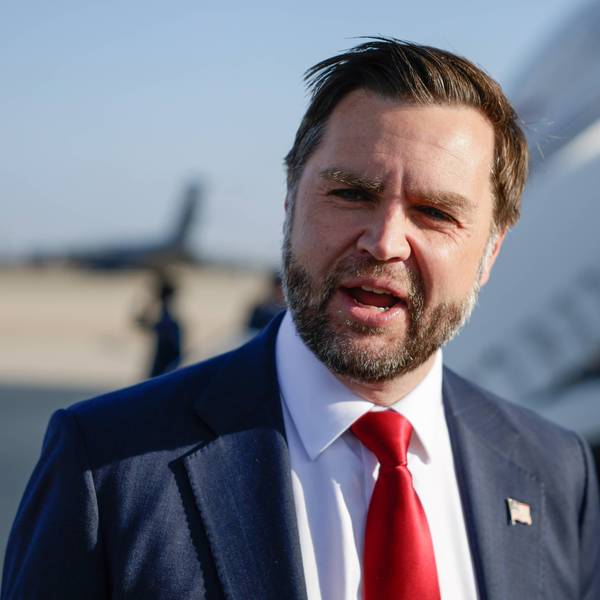
Republican vice presidential nominee U.S. Sen. J.D. Vance (R-OH) arrives to speak during a rally with running mate U.S. Republican Presidential nominee former President Donald Trump at Herb Brooks National Hockey Center on July 27, 2024 in St Cloud, Minnesota.
The former Republican president, despite all his allegedly populist rhetoric, has a deeply anti-worker record from his first term. Vance's record is no different and he's no better.
It was a scene to behold: a union president delivering a booming, barn-burner speech at the Republican National Convention in Milwaukee—“the first Teamster in our 121-year history” to address the Republican Party, Teamsters President Sean O’Brien told the cheering crowd. While the union hasn’t endorsed former President Donald Trump (yet), O’Brien’s appearance—and Trump’s pick of Ohio Senator and “Hillbilly Elegy” author JD Vance as his running mate—aimed to solidify the bizarre notion that the Republican ticket is pro-labor and “economic populist.”
O’Brien’s speech was rousing and provocative, a stinging rebuke of corporate power and economic elitism, as the union leader railed against “an American worker being taken for granted. Workers being sold out to big banks, Big Tech corporates, and the elite.” It was a fiery populist speech you’d expect at a union convention, not promoting a Republican Party whose policies enable these conditions and oppose pro-worker solutions.
The convention didn’t cheer quite as loudly when O’Brien urged “legal protections that make it safer for workers to get a contract … Americans vote for unions but can never get a union contract.” As he rightly noted, “It’s only when Americans band together in democratic unions that we win real improvements on wages, benefits, and working conditions.”
One big problem: Trump, Vance, and the Republican Party have opposed every effort to support workers and unions. The facts show they have no record of supporting policies to improve workers’ lives.
AFL-CIO President Liz Shuler immediately countered the idea that Vance is pro-labor: “Working people know talk is cheap. JD Vance opposed the PRO Act [Protecting the Right to Organize], has a bill to let bosses bypass their workers with phony company unions, and voted against pro-worker NLRB and DOL appointments. No matter what he says, he’s refused to show up for working people where it counts.”
An AFL-CIO statement added that Vance “likes to play union supporter on the picket line, but his record proves that to be a sham,” noting that the senator “disparaged striking UAW members while collecting hefty donations from one of the major auto companies.”
Vance also cosponsored the Teamwork for Employees and Managers Act, along with Republican Senator Marco Rubio of Florida, which would effectively undermine labor unions by allowing voluntary “employee involvement organizations,” which would not be covered by collective-bargaining agreements and could be dissolved by an employer.
Trump, despite all his allegedly populist rhetoric, has a deeply anti-worker record from his first term.
In outlining “fifty reasons the Trump Administration is bad for workers,” the Economic Policy Institute wrote in 2020 that President Trump “systematically promoted the interests of corporate executives and shareholders over those of working people and failed to protect workers’ safety, wages, and rights.”
The previous Trump Administration failed to protect essential workers during the deadliest days of the COVID-19 pandemic; pushed to cut wages for migrant farmworkers, who already toil for poverty wages; undermined workers’ right to organize into unions; and betrayed all his promises to Rust Belt manufacturing workers by promoting the offshoring of manufacturing jobs through policies that “resulted in continued offshoring, including the net loss of nearly 1,800 factories between 2016 and 2018 and 740,000 manufacturing jobs since February 2020.”
Terri Gerstein, director of the NYU Wagner Labor Initiative, may have said it best: “Pro-worker is raising the minimum wage, ensuring people get overtime, supporting paid sick and family leave. Play-acting as working class by dressing up in jeans and acting aggrieved doesn’t do anything for real working people who are struggling.”
This country and this world are at a monumental crossroads. US voters have an opportunity to beat back the forces of fascism and confront the billionaires who are rigging the economy, our media system, and our democracy, making it increasingly impossible for ordinary people to get by. We’re not just talking about the election. We’re talking about what must be done once these fascist elements are vanquished from power. We need a bolder set of solutions than what either major party has so far been willing to offer and a working-class movement ready to fight like hell for it. Trump didn't emerge from nowhere. The conditions that fueled MAGA authoritarianism were created by decades of radical neoliberal economic policies and a corrupt political system dominated by corporate interests. They slashed taxes on the super-rich, promising that the benefits would trickle down. They said giveaways to the corporate titans would make life more affordable for the rest of us. It was all bullshit. And when a bitter, betrayed populace searches for someone to blame, right-wing demagogues have little trouble finding scapegoats. People know when they're being lied to, but you won't hear any of this from the corporate media. Only independent journalism—powered and funded by people who believe in building a better world—can deliver truly trustworthy daily news. If you share our vision, please contribute whatever you can to sustain our work. |
It was a scene to behold: a union president delivering a booming, barn-burner speech at the Republican National Convention in Milwaukee—“the first Teamster in our 121-year history” to address the Republican Party, Teamsters President Sean O’Brien told the cheering crowd. While the union hasn’t endorsed former President Donald Trump (yet), O’Brien’s appearance—and Trump’s pick of Ohio Senator and “Hillbilly Elegy” author JD Vance as his running mate—aimed to solidify the bizarre notion that the Republican ticket is pro-labor and “economic populist.”
O’Brien’s speech was rousing and provocative, a stinging rebuke of corporate power and economic elitism, as the union leader railed against “an American worker being taken for granted. Workers being sold out to big banks, Big Tech corporates, and the elite.” It was a fiery populist speech you’d expect at a union convention, not promoting a Republican Party whose policies enable these conditions and oppose pro-worker solutions.
The convention didn’t cheer quite as loudly when O’Brien urged “legal protections that make it safer for workers to get a contract … Americans vote for unions but can never get a union contract.” As he rightly noted, “It’s only when Americans band together in democratic unions that we win real improvements on wages, benefits, and working conditions.”
One big problem: Trump, Vance, and the Republican Party have opposed every effort to support workers and unions. The facts show they have no record of supporting policies to improve workers’ lives.
AFL-CIO President Liz Shuler immediately countered the idea that Vance is pro-labor: “Working people know talk is cheap. JD Vance opposed the PRO Act [Protecting the Right to Organize], has a bill to let bosses bypass their workers with phony company unions, and voted against pro-worker NLRB and DOL appointments. No matter what he says, he’s refused to show up for working people where it counts.”
An AFL-CIO statement added that Vance “likes to play union supporter on the picket line, but his record proves that to be a sham,” noting that the senator “disparaged striking UAW members while collecting hefty donations from one of the major auto companies.”
Vance also cosponsored the Teamwork for Employees and Managers Act, along with Republican Senator Marco Rubio of Florida, which would effectively undermine labor unions by allowing voluntary “employee involvement organizations,” which would not be covered by collective-bargaining agreements and could be dissolved by an employer.
Trump, despite all his allegedly populist rhetoric, has a deeply anti-worker record from his first term.
In outlining “fifty reasons the Trump Administration is bad for workers,” the Economic Policy Institute wrote in 2020 that President Trump “systematically promoted the interests of corporate executives and shareholders over those of working people and failed to protect workers’ safety, wages, and rights.”
The previous Trump Administration failed to protect essential workers during the deadliest days of the COVID-19 pandemic; pushed to cut wages for migrant farmworkers, who already toil for poverty wages; undermined workers’ right to organize into unions; and betrayed all his promises to Rust Belt manufacturing workers by promoting the offshoring of manufacturing jobs through policies that “resulted in continued offshoring, including the net loss of nearly 1,800 factories between 2016 and 2018 and 740,000 manufacturing jobs since February 2020.”
Terri Gerstein, director of the NYU Wagner Labor Initiative, may have said it best: “Pro-worker is raising the minimum wage, ensuring people get overtime, supporting paid sick and family leave. Play-acting as working class by dressing up in jeans and acting aggrieved doesn’t do anything for real working people who are struggling.”