SUBSCRIBE TO OUR FREE NEWSLETTER
Daily news & progressive opinion—funded by the people, not the corporations—delivered straight to your inbox.
5
#000000
#FFFFFF
To donate by check, phone, or other method, see our More Ways to Give page.
Daily news & progressive opinion—funded by the people, not the corporations—delivered straight to your inbox.
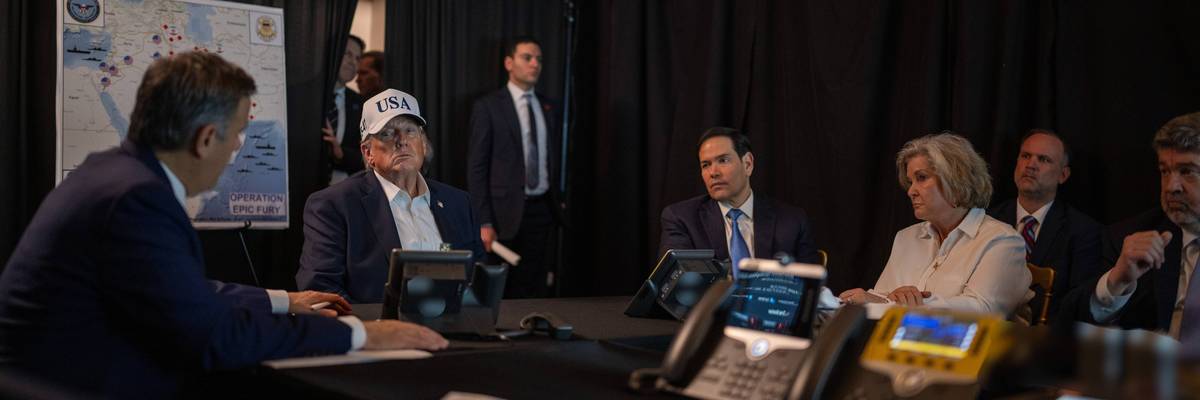
US President Donald Trump (C) oversees "Operation Epic Fury" with (L-R) Central Intelligence Agency Director John Ratcliffe, US Secretary of State Marco Rubio, and White House Chief of Staff Susie Wiles at Mar-a-Lago on February 28, 2026 in Palm Beach, Florida.
Why did Trump suddenly move so sharply in favor of war in his second term, turning against his popular base and his promises of no new wars? In an interview, historian David N. Gibbs offers some answers.
The world’s two major rogue states, the US and Israel, attacked Iran on February 28, 2026 by using an imaginary threat to overthrow the Iranian regime and hoping in turn to install in its place a “friendly” government. There is no end to war in sight after one month as Iran hasn’t lost the capacity to retaliate and there has been no rebellion inside Iran. Moreover, there are very strong indications that the US is preparing for ground operations in Iran, a move that, if it materializes, will unleash hell in the neighborhood and beyond.
In the interview that follows, renowned historian David N. Gibbs describes the war against Iran by the United States as a prime example of the “extraordinary subservience” on the part of President Donald Trump to Israeli Prime Minister Benjamin Netanyahu’s government. The Butcher of Gaza had long hoped to drag the US into direct military confrontation with Iran and has finally succeeded doing so. But the interviewee also points out that Trump may have had in mind objectives of his own when he decided to go to war with Iran.
David N. Gibbs is a professor of history at the University of Arizona, who specializes in political conflicts in sub-Saharan Africa, Eastern Europe, and Afghanistan, as well as US economic history. His most recent book is Revolt of the Rich: How the Politics of the 1970s Widened America’s Class Divide.
C. J. Polychroniou: David, as the Iran war rages on and threatens to engulf the entire Middle East region and beyond, I want to start by asking you to reflect on the following. The first Trump administration proved to be less warlike than both the Obama and Biden presidencies. Why do you think Donald Trump is pursuing such a bellicose foreign policy during his second term?
David N. Gibbs: One of the most striking features of Donald Trump’s second presidential term is the belligerent, violent stance, much harsher than what was seen in his first term. This has been true across the board, from the streets of Minneapolis to the Caribbean and Greenland; and now very dramatically in the Persian Gulf. This is a pure war of aggression, since Iran presented no imminent security threat to the United States or to Israel, as intelligence specialist Joseph Kent, who recently resigned from the Trump administration, has made clear. Accordingly, the war is a violation of the United Nations Charter, which prohibits wars of aggression not authorized by the Security Council. Trump has also violated the US Constitution, which stipulates that international treaties that are signed by the United States—such as the UN Charter—form part of “the supreme Law of the Land.”
In launching war against Iran, Trump II is acting very much like previous presidents from both parties. He is following in the grand tradition of the US president as war maker. Consider George W. Bush’s 2003 invasion of Iraq, which was equally reckless and destructive, producing enormous costs in both dollars and lives, with no security benefits whatsoever. And yet it was backed by both parties, with then-Sen. Hillary Clinton (D-NY) acting as a loyal supporter of the war. The extraordinary subservience that Trump is now displaying toward the Netanyahu government—despite his promises of “America First”—also follows a long tradition of pro-Israel activities by previous administrations, since at least the 1970s.
Trump’s desire for national greatness through war dovetailed nicely with the neocon idea.
And there have been many more cases of disastrous US interventions, besides Iraq, including the violent regime change operations against governments in Libya and Syria, with negative consequences for both the inhabitants of those countries and for regional security. In 2014, US officials helped to overthrow the elected government of Ukraine, thus destabilizing the country and laying the groundwork for a later war with Russia (and in doing so, they violated the Charter of the Organization of American States, which prohibits all forms of external intervention). In the 1990s, NATO bombing campaigns in Bosnia-Herzegovina and Kosovo augmented the scale of human suffering, while US officials blocked negotiated settlements that could have settled these conflicts through peaceful means.
Consider too the weaponization of economic sanctions by US presidents, which over the past 50 years have killed many millions of innocents, according to one recent study. American officials in previous administrations have shown remarkable callousness, when queried about the deadly effects of sanctions. While his bizarre communication style is unique among recent presidents, Trump’s penchant for violence is not unique.
It should be emphasized that Trump’s newly aggressive foreign policy seems fundamentally different from what we saw in his first term: In the first term, Trump showed many disturbing tendencies, including the assassination of Iranian General Qasem Soleimani and the breaking of a perfectly viable US-Iranian agreement that limited Iranian nuclear enrichment. What Trump did not do in his first term was start any new wars, and in this respect, the first Trump presidency stood out historically. Many on the left bristle at this idea—but the fact is that first term, Trump was indeed one of the least warlike presidents since 1945.
Why did Trump suddenly move so sharply in favor of war in his second term, turning against his popular base and his promises of no new wars? My best guess is that Trump—in his instinctive megalomania—wanted to be not merely a two-term president, but also a great president, comparable to Abraham Lincoln or Franklin Delano Roosevelt, a war-winning leader fit for Mount Rushmore. Other motives included a desire to enhance US control of world oil, to be used as an instrument against challengers, such as China; to open up through force new investment opportunities for US companies; to enable old-fashioned corruption of the type that almost always is associated with war and covert operations; to please the ubiquitous Israel Lobby; and to distract from Trump’s embarrassing associations with Jeffrey Epstein. On balance, however, I assume that Trump’s quest for greatness loomed large in his decision to wage war.
Obviously, Trump’s aim for Mount Rushmore is failing, as his glorious war against Iran is already producing political and economic disaster. The preparations for war seem remarkably superficial, in a way that is once again, reminiscent of past wars. Recall the numerous failures associated with the War on Terror. What most impresses me most about the Iran war is how similar it seems to past US foreign adventures.
Polychroniou: The MAGA era was defined by isolationism and rejection of the neoconservative fantasy of remaking the world in America’s image. Is it accurate to say that the Trump administration has reverted to a neocon foreign policy?
Gibbs: Neoconservatism emerged during the 1970s, in response to the US military humiliation in Vietnam. Having studied the private papers of neoconservatives at Stanford University and elsewhere, I view the neocon ideology as a form of pro-military extremism, which glorifies overseas US interventions as inherently desirable, based on the experience of Israel. The neocons openly admire the military accomplishments of the Israel Defense Forces, who aggressively attack their adversaries. And the IDF does not apologize or express regret about their aggressiveness. In the eyes of neocons, the IDF points the way to how America should behave in the world arena. Since they first emerged half a century ago, the neoconservatives have gradually become the dominant foreign policy perspective in both US parties.
You are correct that in the first presidential term, Trump resisted the neoconservative agenda of relentless militarism and was publicly critical of the neocons. Many prominent neocons moved away from the Republicans and toward the Democrats, beginning in 2016. However, Trump has now pivoted to a neoconservative strategy, especially in his war against Iran. He has finally jumped on the bandwagon. In executing this pivot, Trump is responding to two pressure points: First the neocon idea is so pervasive that it is difficult to find policy specialists who are not active neocons. In the present Trump cabinet, Marco Rubio—who is both secretary of state and national security adviser—has always been in the neoconservative camp and has emerged as the main shaper of policy. And secondly, Trump’s desire for national greatness through war dovetailed nicely with the neocon idea.
For Trump’s base, I sense exhaustion with the prospect of permanent war. There is a realization that we have been spending too much on guns, too little on butter, and Trump was initially seen as the solution to this problem. When Trump backers use the term “America First,” many of them mean that we should focus on improving living conditions here in the United States, while reducing our emphasis on global power projection. Trump’s abandonment of the America First agenda is already producing splits within the Trumpian coalition, which are sure to grow as the war becomes a fiasco. These political splits will become even more dramatic if (or more likely when) Trump decides to insert US ground forces into Iran, and American casualties mount.
Polychroniou: It’s quite obvious that both the US and Israel miscalculated Iran’s response to war. The US and Israeli air campaign has decimated Iran’s political and military leadership, but the regime is still intact and there has been no Iranian uprising. Indeed, Trump has gone from “we’re winning the war” and “we won the war” to asking for help from NATO allies. How likely is it that we will see a US military ground invasion of Iran?
Gibbs: US interventions are often associated with the idea of “mission creep,” whereby small interventions inexorably grow into larger interventions. This happened in Vietnam on a large scale, where relatively small numbers of US military advisers gradually evolved into a massive ground war over many years, with disastrous consequences.
The most important accomplishment of the Iran war will be heightened nuclear danger.
We are seeing this same pattern play out in Iran, whereby Trump’s fantasy of a quick win, through “decapitating” the Iranian leadership—murdering their leaders—has failed. The Islamic Republic, despite its numerous weaknesses, has proven more durable that many had imagined. I do not see any immediate likelihood of a ceasefire or a compromise settlement, since the Iranians have no incentive to compromise. They have been attacked by Israel and the United States twice in only a matter of months, first in June 2025 and now again. And, as John Mearsheimer emphasized, Iran now holds the upper hand on the battlefield.
In the absence of any compromise settlement, Trump will be tempted to land US ground forces in Iran, first on a limited scale, perhaps on Kharg Island, then followed by larger and larger numbers of ground forces. What we are clearly seeing is a growing military and economic quagmire of immense proportions.
Polychroniou: Nuclear weapons haven’t been used in wartime since the bombings of Hiroshima and Nagasaki in August 1945. I fear that the Trump administration may not hesitate to make use of nuclear weapons against Iran if it realizes that it’s going to lose this war. Do you have such concerns? And in the event that the worse case scenario unfolds, what might be Iran’s own response?
Gibbs: One clear effect of US military aggression over the years has been to accelerate nuclear proliferation, as more and more countries conclude that the only way to deter US aggression is to acquire nuclear weapons. Many will look to the North Koreans, who adopted a nuclear strategy—complete with long-range missiles—and are thus protected from attack. Another case worth considering is Libya, under Muammar Gaddafi, who gave up nuclear ambitions in exchange for a tacit understanding that the United States and its allies would not overthrow his government. Then, in 2011, the US and NATO took advantage of Libya’s weakness and violently overthrow the government, with Gaddafi being tortured to death.
The obvious result of this history is that more and more countries will consider developing nuclear weapons of their own, beginning of course with Iran. And the coming wave of proliferation will heighten the risks that nuclear weapons will be used, thus endangering global security. The most important accomplishment of the Iran war will be heightened nuclear danger.
One of the most disturbing features of contemporary politics is the absence of any real antinuclear movement in the United States or anywhere else. During the Cold War, the antinuclear movement was huge, and fear of nuclear war was integrated into the popular culture, as a constant source of anxiety. When the Cold War ended, however, the antinuclear movement disappeared without a trace, and people now seem unworried about the very real dangers of nuclear war. The political left in particular seems completely uninterested, and I am baffled to understand why.
Polychroniou: What Can We Do About It?
Gibbs: In the short term, we on the left must set aside our petty prejudices and form a broad anti-war coalition, including people on both the left and right who oppose what Trump is doing in Iran and permanent war more generally. And let us revive an antinuclear movement, while we are at it. There is clearly a large and growing anti-war movement on the right, and smart leftists should not hesitate to work with them. Let us forget the culture wars for one moment and focus on the horrors of real war.
Dear Common Dreams reader, It’s been nearly 30 years since I co-founded Common Dreams with my late wife, Lina Newhouser. We had the radical notion that journalism should serve the public good, not corporate profits. It was clear to us from the outset what it would take to build such a project. No paid advertisements. No corporate sponsors. No millionaire publisher telling us what to think or do. Many people said we wouldn't last a year, but we proved those doubters wrong. Together with a tremendous team of journalists and dedicated staff, we built an independent media outlet free from the constraints of profits and corporate control. Our mission has always been simple: To inform. To inspire. To ignite change for the common good. Building Common Dreams was not easy. Our survival was never guaranteed. When you take on the most powerful forces—Wall Street greed, fossil fuel industry destruction, Big Tech lobbyists, and uber-rich oligarchs who have spent billions upon billions rigging the economy and democracy in their favor—the only bulwark you have is supporters who believe in your work. But here’s the urgent message from me today. It's never been this bad out there. And it's never been this hard to keep us going. At the very moment Common Dreams is most needed, the threats we face are intensifying. We need your support now more than ever. We don't accept corporate advertising and never will. We don't have a paywall because we don't think people should be blocked from critical news based on their ability to pay. Everything we do is funded by the donations of readers like you. When everyone does the little they can afford, we are strong. But if that support retreats or dries up, so do we. Will you donate now to make sure Common Dreams not only survives but thrives? —Craig Brown, Co-founder |
The world’s two major rogue states, the US and Israel, attacked Iran on February 28, 2026 by using an imaginary threat to overthrow the Iranian regime and hoping in turn to install in its place a “friendly” government. There is no end to war in sight after one month as Iran hasn’t lost the capacity to retaliate and there has been no rebellion inside Iran. Moreover, there are very strong indications that the US is preparing for ground operations in Iran, a move that, if it materializes, will unleash hell in the neighborhood and beyond.
In the interview that follows, renowned historian David N. Gibbs describes the war against Iran by the United States as a prime example of the “extraordinary subservience” on the part of President Donald Trump to Israeli Prime Minister Benjamin Netanyahu’s government. The Butcher of Gaza had long hoped to drag the US into direct military confrontation with Iran and has finally succeeded doing so. But the interviewee also points out that Trump may have had in mind objectives of his own when he decided to go to war with Iran.
David N. Gibbs is a professor of history at the University of Arizona, who specializes in political conflicts in sub-Saharan Africa, Eastern Europe, and Afghanistan, as well as US economic history. His most recent book is Revolt of the Rich: How the Politics of the 1970s Widened America’s Class Divide.
C. J. Polychroniou: David, as the Iran war rages on and threatens to engulf the entire Middle East region and beyond, I want to start by asking you to reflect on the following. The first Trump administration proved to be less warlike than both the Obama and Biden presidencies. Why do you think Donald Trump is pursuing such a bellicose foreign policy during his second term?
David N. Gibbs: One of the most striking features of Donald Trump’s second presidential term is the belligerent, violent stance, much harsher than what was seen in his first term. This has been true across the board, from the streets of Minneapolis to the Caribbean and Greenland; and now very dramatically in the Persian Gulf. This is a pure war of aggression, since Iran presented no imminent security threat to the United States or to Israel, as intelligence specialist Joseph Kent, who recently resigned from the Trump administration, has made clear. Accordingly, the war is a violation of the United Nations Charter, which prohibits wars of aggression not authorized by the Security Council. Trump has also violated the US Constitution, which stipulates that international treaties that are signed by the United States—such as the UN Charter—form part of “the supreme Law of the Land.”
In launching war against Iran, Trump II is acting very much like previous presidents from both parties. He is following in the grand tradition of the US president as war maker. Consider George W. Bush’s 2003 invasion of Iraq, which was equally reckless and destructive, producing enormous costs in both dollars and lives, with no security benefits whatsoever. And yet it was backed by both parties, with then-Sen. Hillary Clinton (D-NY) acting as a loyal supporter of the war. The extraordinary subservience that Trump is now displaying toward the Netanyahu government—despite his promises of “America First”—also follows a long tradition of pro-Israel activities by previous administrations, since at least the 1970s.
Trump’s desire for national greatness through war dovetailed nicely with the neocon idea.
And there have been many more cases of disastrous US interventions, besides Iraq, including the violent regime change operations against governments in Libya and Syria, with negative consequences for both the inhabitants of those countries and for regional security. In 2014, US officials helped to overthrow the elected government of Ukraine, thus destabilizing the country and laying the groundwork for a later war with Russia (and in doing so, they violated the Charter of the Organization of American States, which prohibits all forms of external intervention). In the 1990s, NATO bombing campaigns in Bosnia-Herzegovina and Kosovo augmented the scale of human suffering, while US officials blocked negotiated settlements that could have settled these conflicts through peaceful means.
Consider too the weaponization of economic sanctions by US presidents, which over the past 50 years have killed many millions of innocents, according to one recent study. American officials in previous administrations have shown remarkable callousness, when queried about the deadly effects of sanctions. While his bizarre communication style is unique among recent presidents, Trump’s penchant for violence is not unique.
It should be emphasized that Trump’s newly aggressive foreign policy seems fundamentally different from what we saw in his first term: In the first term, Trump showed many disturbing tendencies, including the assassination of Iranian General Qasem Soleimani and the breaking of a perfectly viable US-Iranian agreement that limited Iranian nuclear enrichment. What Trump did not do in his first term was start any new wars, and in this respect, the first Trump presidency stood out historically. Many on the left bristle at this idea—but the fact is that first term, Trump was indeed one of the least warlike presidents since 1945.
Why did Trump suddenly move so sharply in favor of war in his second term, turning against his popular base and his promises of no new wars? My best guess is that Trump—in his instinctive megalomania—wanted to be not merely a two-term president, but also a great president, comparable to Abraham Lincoln or Franklin Delano Roosevelt, a war-winning leader fit for Mount Rushmore. Other motives included a desire to enhance US control of world oil, to be used as an instrument against challengers, such as China; to open up through force new investment opportunities for US companies; to enable old-fashioned corruption of the type that almost always is associated with war and covert operations; to please the ubiquitous Israel Lobby; and to distract from Trump’s embarrassing associations with Jeffrey Epstein. On balance, however, I assume that Trump’s quest for greatness loomed large in his decision to wage war.
Obviously, Trump’s aim for Mount Rushmore is failing, as his glorious war against Iran is already producing political and economic disaster. The preparations for war seem remarkably superficial, in a way that is once again, reminiscent of past wars. Recall the numerous failures associated with the War on Terror. What most impresses me most about the Iran war is how similar it seems to past US foreign adventures.
Polychroniou: The MAGA era was defined by isolationism and rejection of the neoconservative fantasy of remaking the world in America’s image. Is it accurate to say that the Trump administration has reverted to a neocon foreign policy?
Gibbs: Neoconservatism emerged during the 1970s, in response to the US military humiliation in Vietnam. Having studied the private papers of neoconservatives at Stanford University and elsewhere, I view the neocon ideology as a form of pro-military extremism, which glorifies overseas US interventions as inherently desirable, based on the experience of Israel. The neocons openly admire the military accomplishments of the Israel Defense Forces, who aggressively attack their adversaries. And the IDF does not apologize or express regret about their aggressiveness. In the eyes of neocons, the IDF points the way to how America should behave in the world arena. Since they first emerged half a century ago, the neoconservatives have gradually become the dominant foreign policy perspective in both US parties.
You are correct that in the first presidential term, Trump resisted the neoconservative agenda of relentless militarism and was publicly critical of the neocons. Many prominent neocons moved away from the Republicans and toward the Democrats, beginning in 2016. However, Trump has now pivoted to a neoconservative strategy, especially in his war against Iran. He has finally jumped on the bandwagon. In executing this pivot, Trump is responding to two pressure points: First the neocon idea is so pervasive that it is difficult to find policy specialists who are not active neocons. In the present Trump cabinet, Marco Rubio—who is both secretary of state and national security adviser—has always been in the neoconservative camp and has emerged as the main shaper of policy. And secondly, Trump’s desire for national greatness through war dovetailed nicely with the neocon idea.
For Trump’s base, I sense exhaustion with the prospect of permanent war. There is a realization that we have been spending too much on guns, too little on butter, and Trump was initially seen as the solution to this problem. When Trump backers use the term “America First,” many of them mean that we should focus on improving living conditions here in the United States, while reducing our emphasis on global power projection. Trump’s abandonment of the America First agenda is already producing splits within the Trumpian coalition, which are sure to grow as the war becomes a fiasco. These political splits will become even more dramatic if (or more likely when) Trump decides to insert US ground forces into Iran, and American casualties mount.
Polychroniou: It’s quite obvious that both the US and Israel miscalculated Iran’s response to war. The US and Israeli air campaign has decimated Iran’s political and military leadership, but the regime is still intact and there has been no Iranian uprising. Indeed, Trump has gone from “we’re winning the war” and “we won the war” to asking for help from NATO allies. How likely is it that we will see a US military ground invasion of Iran?
Gibbs: US interventions are often associated with the idea of “mission creep,” whereby small interventions inexorably grow into larger interventions. This happened in Vietnam on a large scale, where relatively small numbers of US military advisers gradually evolved into a massive ground war over many years, with disastrous consequences.
The most important accomplishment of the Iran war will be heightened nuclear danger.
We are seeing this same pattern play out in Iran, whereby Trump’s fantasy of a quick win, through “decapitating” the Iranian leadership—murdering their leaders—has failed. The Islamic Republic, despite its numerous weaknesses, has proven more durable that many had imagined. I do not see any immediate likelihood of a ceasefire or a compromise settlement, since the Iranians have no incentive to compromise. They have been attacked by Israel and the United States twice in only a matter of months, first in June 2025 and now again. And, as John Mearsheimer emphasized, Iran now holds the upper hand on the battlefield.
In the absence of any compromise settlement, Trump will be tempted to land US ground forces in Iran, first on a limited scale, perhaps on Kharg Island, then followed by larger and larger numbers of ground forces. What we are clearly seeing is a growing military and economic quagmire of immense proportions.
Polychroniou: Nuclear weapons haven’t been used in wartime since the bombings of Hiroshima and Nagasaki in August 1945. I fear that the Trump administration may not hesitate to make use of nuclear weapons against Iran if it realizes that it’s going to lose this war. Do you have such concerns? And in the event that the worse case scenario unfolds, what might be Iran’s own response?
Gibbs: One clear effect of US military aggression over the years has been to accelerate nuclear proliferation, as more and more countries conclude that the only way to deter US aggression is to acquire nuclear weapons. Many will look to the North Koreans, who adopted a nuclear strategy—complete with long-range missiles—and are thus protected from attack. Another case worth considering is Libya, under Muammar Gaddafi, who gave up nuclear ambitions in exchange for a tacit understanding that the United States and its allies would not overthrow his government. Then, in 2011, the US and NATO took advantage of Libya’s weakness and violently overthrow the government, with Gaddafi being tortured to death.
The obvious result of this history is that more and more countries will consider developing nuclear weapons of their own, beginning of course with Iran. And the coming wave of proliferation will heighten the risks that nuclear weapons will be used, thus endangering global security. The most important accomplishment of the Iran war will be heightened nuclear danger.
One of the most disturbing features of contemporary politics is the absence of any real antinuclear movement in the United States or anywhere else. During the Cold War, the antinuclear movement was huge, and fear of nuclear war was integrated into the popular culture, as a constant source of anxiety. When the Cold War ended, however, the antinuclear movement disappeared without a trace, and people now seem unworried about the very real dangers of nuclear war. The political left in particular seems completely uninterested, and I am baffled to understand why.
Polychroniou: What Can We Do About It?
Gibbs: In the short term, we on the left must set aside our petty prejudices and form a broad anti-war coalition, including people on both the left and right who oppose what Trump is doing in Iran and permanent war more generally. And let us revive an antinuclear movement, while we are at it. There is clearly a large and growing anti-war movement on the right, and smart leftists should not hesitate to work with them. Let us forget the culture wars for one moment and focus on the horrors of real war.
The world’s two major rogue states, the US and Israel, attacked Iran on February 28, 2026 by using an imaginary threat to overthrow the Iranian regime and hoping in turn to install in its place a “friendly” government. There is no end to war in sight after one month as Iran hasn’t lost the capacity to retaliate and there has been no rebellion inside Iran. Moreover, there are very strong indications that the US is preparing for ground operations in Iran, a move that, if it materializes, will unleash hell in the neighborhood and beyond.
In the interview that follows, renowned historian David N. Gibbs describes the war against Iran by the United States as a prime example of the “extraordinary subservience” on the part of President Donald Trump to Israeli Prime Minister Benjamin Netanyahu’s government. The Butcher of Gaza had long hoped to drag the US into direct military confrontation with Iran and has finally succeeded doing so. But the interviewee also points out that Trump may have had in mind objectives of his own when he decided to go to war with Iran.
David N. Gibbs is a professor of history at the University of Arizona, who specializes in political conflicts in sub-Saharan Africa, Eastern Europe, and Afghanistan, as well as US economic history. His most recent book is Revolt of the Rich: How the Politics of the 1970s Widened America’s Class Divide.
C. J. Polychroniou: David, as the Iran war rages on and threatens to engulf the entire Middle East region and beyond, I want to start by asking you to reflect on the following. The first Trump administration proved to be less warlike than both the Obama and Biden presidencies. Why do you think Donald Trump is pursuing such a bellicose foreign policy during his second term?
David N. Gibbs: One of the most striking features of Donald Trump’s second presidential term is the belligerent, violent stance, much harsher than what was seen in his first term. This has been true across the board, from the streets of Minneapolis to the Caribbean and Greenland; and now very dramatically in the Persian Gulf. This is a pure war of aggression, since Iran presented no imminent security threat to the United States or to Israel, as intelligence specialist Joseph Kent, who recently resigned from the Trump administration, has made clear. Accordingly, the war is a violation of the United Nations Charter, which prohibits wars of aggression not authorized by the Security Council. Trump has also violated the US Constitution, which stipulates that international treaties that are signed by the United States—such as the UN Charter—form part of “the supreme Law of the Land.”
In launching war against Iran, Trump II is acting very much like previous presidents from both parties. He is following in the grand tradition of the US president as war maker. Consider George W. Bush’s 2003 invasion of Iraq, which was equally reckless and destructive, producing enormous costs in both dollars and lives, with no security benefits whatsoever. And yet it was backed by both parties, with then-Sen. Hillary Clinton (D-NY) acting as a loyal supporter of the war. The extraordinary subservience that Trump is now displaying toward the Netanyahu government—despite his promises of “America First”—also follows a long tradition of pro-Israel activities by previous administrations, since at least the 1970s.
Trump’s desire for national greatness through war dovetailed nicely with the neocon idea.
And there have been many more cases of disastrous US interventions, besides Iraq, including the violent regime change operations against governments in Libya and Syria, with negative consequences for both the inhabitants of those countries and for regional security. In 2014, US officials helped to overthrow the elected government of Ukraine, thus destabilizing the country and laying the groundwork for a later war with Russia (and in doing so, they violated the Charter of the Organization of American States, which prohibits all forms of external intervention). In the 1990s, NATO bombing campaigns in Bosnia-Herzegovina and Kosovo augmented the scale of human suffering, while US officials blocked negotiated settlements that could have settled these conflicts through peaceful means.
Consider too the weaponization of economic sanctions by US presidents, which over the past 50 years have killed many millions of innocents, according to one recent study. American officials in previous administrations have shown remarkable callousness, when queried about the deadly effects of sanctions. While his bizarre communication style is unique among recent presidents, Trump’s penchant for violence is not unique.
It should be emphasized that Trump’s newly aggressive foreign policy seems fundamentally different from what we saw in his first term: In the first term, Trump showed many disturbing tendencies, including the assassination of Iranian General Qasem Soleimani and the breaking of a perfectly viable US-Iranian agreement that limited Iranian nuclear enrichment. What Trump did not do in his first term was start any new wars, and in this respect, the first Trump presidency stood out historically. Many on the left bristle at this idea—but the fact is that first term, Trump was indeed one of the least warlike presidents since 1945.
Why did Trump suddenly move so sharply in favor of war in his second term, turning against his popular base and his promises of no new wars? My best guess is that Trump—in his instinctive megalomania—wanted to be not merely a two-term president, but also a great president, comparable to Abraham Lincoln or Franklin Delano Roosevelt, a war-winning leader fit for Mount Rushmore. Other motives included a desire to enhance US control of world oil, to be used as an instrument against challengers, such as China; to open up through force new investment opportunities for US companies; to enable old-fashioned corruption of the type that almost always is associated with war and covert operations; to please the ubiquitous Israel Lobby; and to distract from Trump’s embarrassing associations with Jeffrey Epstein. On balance, however, I assume that Trump’s quest for greatness loomed large in his decision to wage war.
Obviously, Trump’s aim for Mount Rushmore is failing, as his glorious war against Iran is already producing political and economic disaster. The preparations for war seem remarkably superficial, in a way that is once again, reminiscent of past wars. Recall the numerous failures associated with the War on Terror. What most impresses me most about the Iran war is how similar it seems to past US foreign adventures.
Polychroniou: The MAGA era was defined by isolationism and rejection of the neoconservative fantasy of remaking the world in America’s image. Is it accurate to say that the Trump administration has reverted to a neocon foreign policy?
Gibbs: Neoconservatism emerged during the 1970s, in response to the US military humiliation in Vietnam. Having studied the private papers of neoconservatives at Stanford University and elsewhere, I view the neocon ideology as a form of pro-military extremism, which glorifies overseas US interventions as inherently desirable, based on the experience of Israel. The neocons openly admire the military accomplishments of the Israel Defense Forces, who aggressively attack their adversaries. And the IDF does not apologize or express regret about their aggressiveness. In the eyes of neocons, the IDF points the way to how America should behave in the world arena. Since they first emerged half a century ago, the neoconservatives have gradually become the dominant foreign policy perspective in both US parties.
You are correct that in the first presidential term, Trump resisted the neoconservative agenda of relentless militarism and was publicly critical of the neocons. Many prominent neocons moved away from the Republicans and toward the Democrats, beginning in 2016. However, Trump has now pivoted to a neoconservative strategy, especially in his war against Iran. He has finally jumped on the bandwagon. In executing this pivot, Trump is responding to two pressure points: First the neocon idea is so pervasive that it is difficult to find policy specialists who are not active neocons. In the present Trump cabinet, Marco Rubio—who is both secretary of state and national security adviser—has always been in the neoconservative camp and has emerged as the main shaper of policy. And secondly, Trump’s desire for national greatness through war dovetailed nicely with the neocon idea.
For Trump’s base, I sense exhaustion with the prospect of permanent war. There is a realization that we have been spending too much on guns, too little on butter, and Trump was initially seen as the solution to this problem. When Trump backers use the term “America First,” many of them mean that we should focus on improving living conditions here in the United States, while reducing our emphasis on global power projection. Trump’s abandonment of the America First agenda is already producing splits within the Trumpian coalition, which are sure to grow as the war becomes a fiasco. These political splits will become even more dramatic if (or more likely when) Trump decides to insert US ground forces into Iran, and American casualties mount.
Polychroniou: It’s quite obvious that both the US and Israel miscalculated Iran’s response to war. The US and Israeli air campaign has decimated Iran’s political and military leadership, but the regime is still intact and there has been no Iranian uprising. Indeed, Trump has gone from “we’re winning the war” and “we won the war” to asking for help from NATO allies. How likely is it that we will see a US military ground invasion of Iran?
Gibbs: US interventions are often associated with the idea of “mission creep,” whereby small interventions inexorably grow into larger interventions. This happened in Vietnam on a large scale, where relatively small numbers of US military advisers gradually evolved into a massive ground war over many years, with disastrous consequences.
The most important accomplishment of the Iran war will be heightened nuclear danger.
We are seeing this same pattern play out in Iran, whereby Trump’s fantasy of a quick win, through “decapitating” the Iranian leadership—murdering their leaders—has failed. The Islamic Republic, despite its numerous weaknesses, has proven more durable that many had imagined. I do not see any immediate likelihood of a ceasefire or a compromise settlement, since the Iranians have no incentive to compromise. They have been attacked by Israel and the United States twice in only a matter of months, first in June 2025 and now again. And, as John Mearsheimer emphasized, Iran now holds the upper hand on the battlefield.
In the absence of any compromise settlement, Trump will be tempted to land US ground forces in Iran, first on a limited scale, perhaps on Kharg Island, then followed by larger and larger numbers of ground forces. What we are clearly seeing is a growing military and economic quagmire of immense proportions.
Polychroniou: Nuclear weapons haven’t been used in wartime since the bombings of Hiroshima and Nagasaki in August 1945. I fear that the Trump administration may not hesitate to make use of nuclear weapons against Iran if it realizes that it’s going to lose this war. Do you have such concerns? And in the event that the worse case scenario unfolds, what might be Iran’s own response?
Gibbs: One clear effect of US military aggression over the years has been to accelerate nuclear proliferation, as more and more countries conclude that the only way to deter US aggression is to acquire nuclear weapons. Many will look to the North Koreans, who adopted a nuclear strategy—complete with long-range missiles—and are thus protected from attack. Another case worth considering is Libya, under Muammar Gaddafi, who gave up nuclear ambitions in exchange for a tacit understanding that the United States and its allies would not overthrow his government. Then, in 2011, the US and NATO took advantage of Libya’s weakness and violently overthrow the government, with Gaddafi being tortured to death.
The obvious result of this history is that more and more countries will consider developing nuclear weapons of their own, beginning of course with Iran. And the coming wave of proliferation will heighten the risks that nuclear weapons will be used, thus endangering global security. The most important accomplishment of the Iran war will be heightened nuclear danger.
One of the most disturbing features of contemporary politics is the absence of any real antinuclear movement in the United States or anywhere else. During the Cold War, the antinuclear movement was huge, and fear of nuclear war was integrated into the popular culture, as a constant source of anxiety. When the Cold War ended, however, the antinuclear movement disappeared without a trace, and people now seem unworried about the very real dangers of nuclear war. The political left in particular seems completely uninterested, and I am baffled to understand why.
Polychroniou: What Can We Do About It?
Gibbs: In the short term, we on the left must set aside our petty prejudices and form a broad anti-war coalition, including people on both the left and right who oppose what Trump is doing in Iran and permanent war more generally. And let us revive an antinuclear movement, while we are at it. There is clearly a large and growing anti-war movement on the right, and smart leftists should not hesitate to work with them. Let us forget the culture wars for one moment and focus on the horrors of real war.