
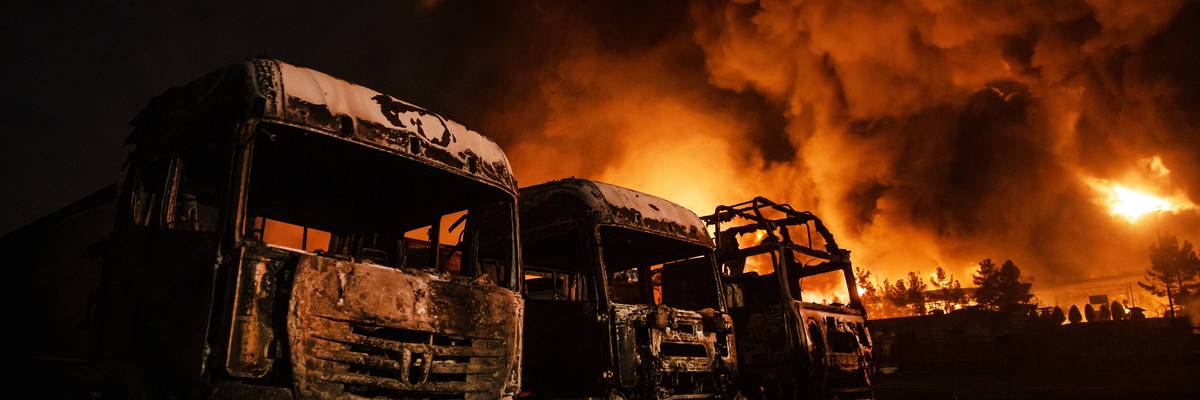
Fire breaks out at the Shahran oil depot after US and Israeli attacks, leaving numerous fuel tankers and vehicles in the area unusable in Tehran, Iran on March 8, 2026.
Santa Marta Fossil Fuel Conference Must Emphasize Scourge of Illegal, Unpopular Iran War
Fossil fuels and militarism are part of the same architecture of power. If governments are serious about combating climate change, they must be willing to challenge the political and economic structures that sustain extraction and war.
We cannot separate fossil fuels from the ongoing US and Israeli war on Iran. The volatility surrounding the Strait of Hormuz has shaken the global economy, restricting the passage of oil from the largest producers in the Gulf region.
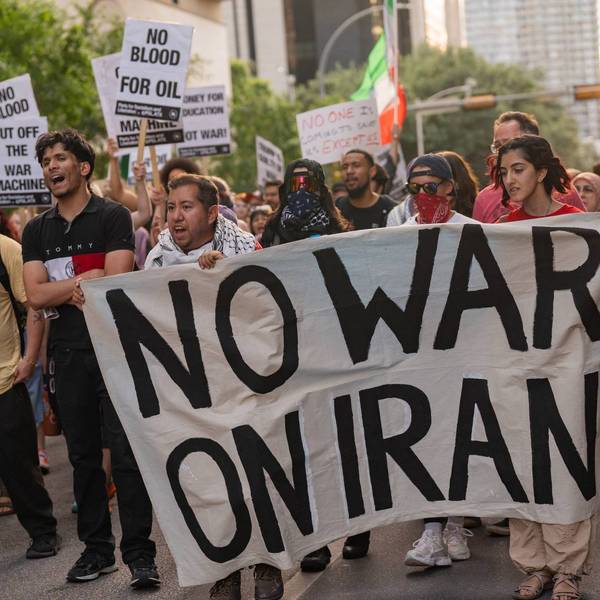
The economic costs of this illegal, unjust, and unpopular war are mounting alongside the heartbreaking human costs—including troops lost and thousands killed throughout Iran and Lebanon.
But there’s also a rapidly increasing environmental cost. The first two weeks of Operation Epic Fury alone emitted 5 million tons of carbon dioxide—equivalent to the 84 lowest-emitting countries combined.
The international community must end this war—and address the deeper climate crisis—before more damage is done. Luckily, a vehicle of hope opens up at the end of April in Santa Marta, Colombia, offering a prime chance for countries to move toward a more secure future and livable planet.
The First-Ever Conference to End Fossil Fuels
Governments are gathering in Santa Marta for the first-ever global diplomatic conference explicitly focused on transitioning away from fossil fuels. Co-hosted by Colombia and the Netherlands, the convening brings together dozens of countries, alongside civil society and Indigenous leaders, to do what decades of climate negotiations have failed to do: confront fossil fuels directly.
Unfortunately, international climate negotiations centered on the United Nations process have failed to move us meaningfully closer to a just transition by refusing to confront fossil fuels. Instead, they have relied on emission targets, offsets, and market mechanisms that allow extraction to continue.
Fossil fuels are the lifeline of the modern military-industrial complex. At the same time, militaries exist in part to secure access to fossil fuels.
The Santa Marta conference breaks from this framework. It creates space to ask a more fundamental question: What would it take to actually phase out fossil fuels—and who stands in the way?
The Santa Marta conference is a crucial initial step for stakeholders to commit to a global fossil fuel non-proliferation treaty. Groups will address the processes, timelines, and actions needed to get to a negotiated agreement for a fossil fuel phaseout, which will be further developed in a future gathering in the Pacific nation of Tuvalu.
The Military-Oil-Industrial Complex
But taking that step seriously requires confronting another issue that has been deliberately sidelined: militarism.
Fossil fuels are the lifeline of the modern military-industrial complex. At the same time, militaries exist in part to secure access to fossil fuels. The infrastructure of war, from weapons production to military bases, locks governments into long-term fossil fuel dependence while also acting as the enforcement arm of fossil fuel interests. Militaries protect oil supply chains, secure trade routes, and shape geopolitical outcomes around these fuels in favor of dominant powers.
Military control over oil and gas long shaped the architecture of global power. This dynamic is visible across the globe. US aggression toward Iran continues to escalate tensions around oil, and the US intervention in Venezuela is inseparable from the country’s position as a major oil producer. In Palestine as well, Israel’s US-backed occupation and control of offshore gas deposits, among other resources, is part of the broader system of colonization that cannot be separated from land, infrastructure, and energy.
As long as nations invest in their militaries at the expense of everything else, fossil fuel dependence won’t be broken. The $2.7 trillion in global military spending in 2024 siphons resources that are desperately needed to achieve a full fossil fuel phaseout and global just transition: healthcare, education, jobs, renewable energy, and direct spending to confront the climate crisis.
The United States is the worst culprit as the highest military spender in the world. The Pentagon is also the largest institutional consumer of fossil fuels in the world—it has a larger carbon footprint than most entire countries. Next year, President Donald Trump is demanding a shocking $1.5 trillion Pentagon budget. Even now, estimates suggest that the US is spending $1 billion to $2 billion per day on its assault on Iran, while the US contributed just $2 billion to the Green Climate Fund in the span of 10 years.
Santa Marta Must Address Militarism, Too
Militarism does more than protect the fossil fuel system. It actively undermines the possibility of a just transition. That’s why we, along with other groups part of the Santa Marta conference, are calling on countries and stakeholders to consider three demands:
- Address critical gaps in military emissions reporting.
- Reduce the dependence of militaries on fossil fuels.
- Reverse runaway military spending to support a just transition.
Achieving this will require coordinated pressure at all levels—by governments, international bodies, Indigenous and Afro-descendant leaders, academics, organizers, and civil society—to get to a fossil fuel phaseout and a more secure world.
The conference in Santa Marta represents a break from decades of delay through the UNFCCC process. But it will only matter if it confronts the full system driving this crisis. Fossil fuels and militarism are part of the same architecture of power. If governments are serious about combating climate change, they must be willing to do more than set targets. They must be willing to challenge the political and economic structures that sustain extraction and war.
That means investing in the real work of a just transition: shifting economics, redistributing resources, and repairing harm that has been done to frontline communities. That means no new fossil fuel expansion. No false solutions that prolong dependence. And no continued investment in systems of violence that undermine the possibility of a just transition.
We can continue to fund war and extraction or we can choose to invest in our communities, in care, and in a future that is not built on sacrifice. Santa Marta opens the door. What comes next depends on whether we are willing to walk through it and to demand our governments to do the same.
We are at a crossroads
This country and this world are at a monumental crossroads. In a few short weeks, US voters will have an opportunity to beat back the forces of fascism and confront the billionaires who are rigging the economy, our media system, and our democracy, making it increasingly impossible for ordinary people to get by. We’re not just talking about the election. We’re talking about what must be done once these fascist elements are vanquished from power. We need a bolder set of solutions than what either major party has so far been willing to offer and a working-class movement ready to fight like hell for it. Trump didn't emerge from nowhere. The conditions that fueled MAGA authoritarianism were created by decades of radical neoliberal economic policies and a corrupt political system dominated by corporate interests. They slashed taxes on the super-rich, promising that the benefits would trickle down. They said giveaways to the corporate titans would make life more affordable for the rest of us. It was all bullshit. And when a bitter, betrayed populace searches for someone to blame, right-wing demagogues have little trouble finding scapegoats. People know when they're being lied to, but you won't hear any of this from the corporate media. Only independent journalism—powered and funded by people who believe in building a better world—can deliver truly trustworthy daily news. Our Fall Campaign is underway, and we need your help. To power our newsroom through the rest of the year, we need to raise $125,000 by midnight on October 31. So if you share our vision, please contribute whatever you can to sustain our work. |
We cannot separate fossil fuels from the ongoing US and Israeli war on Iran. The volatility surrounding the Strait of Hormuz has shaken the global economy, restricting the passage of oil from the largest producers in the Gulf region.
The economic costs of this illegal, unjust, and unpopular war are mounting alongside the heartbreaking human costs—including troops lost and thousands killed throughout Iran and Lebanon.
But there’s also a rapidly increasing environmental cost. The first two weeks of Operation Epic Fury alone emitted 5 million tons of carbon dioxide—equivalent to the 84 lowest-emitting countries combined.
The international community must end this war—and address the deeper climate crisis—before more damage is done. Luckily, a vehicle of hope opens up at the end of April in Santa Marta, Colombia, offering a prime chance for countries to move toward a more secure future and livable planet.
The First-Ever Conference to End Fossil Fuels
Governments are gathering in Santa Marta for the first-ever global diplomatic conference explicitly focused on transitioning away from fossil fuels. Co-hosted by Colombia and the Netherlands, the convening brings together dozens of countries, alongside civil society and Indigenous leaders, to do what decades of climate negotiations have failed to do: confront fossil fuels directly.
Unfortunately, international climate negotiations centered on the United Nations process have failed to move us meaningfully closer to a just transition by refusing to confront fossil fuels. Instead, they have relied on emission targets, offsets, and market mechanisms that allow extraction to continue.
Fossil fuels are the lifeline of the modern military-industrial complex. At the same time, militaries exist in part to secure access to fossil fuels.
The Santa Marta conference breaks from this framework. It creates space to ask a more fundamental question: What would it take to actually phase out fossil fuels—and who stands in the way?
The Santa Marta conference is a crucial initial step for stakeholders to commit to a global fossil fuel non-proliferation treaty. Groups will address the processes, timelines, and actions needed to get to a negotiated agreement for a fossil fuel phaseout, which will be further developed in a future gathering in the Pacific nation of Tuvalu.
The Military-Oil-Industrial Complex
But taking that step seriously requires confronting another issue that has been deliberately sidelined: militarism.
Fossil fuels are the lifeline of the modern military-industrial complex. At the same time, militaries exist in part to secure access to fossil fuels. The infrastructure of war, from weapons production to military bases, locks governments into long-term fossil fuel dependence while also acting as the enforcement arm of fossil fuel interests. Militaries protect oil supply chains, secure trade routes, and shape geopolitical outcomes around these fuels in favor of dominant powers.
Military control over oil and gas long shaped the architecture of global power. This dynamic is visible across the globe. US aggression toward Iran continues to escalate tensions around oil, and the US intervention in Venezuela is inseparable from the country’s position as a major oil producer. In Palestine as well, Israel’s US-backed occupation and control of offshore gas deposits, among other resources, is part of the broader system of colonization that cannot be separated from land, infrastructure, and energy.
As long as nations invest in their militaries at the expense of everything else, fossil fuel dependence won’t be broken. The $2.7 trillion in global military spending in 2024 siphons resources that are desperately needed to achieve a full fossil fuel phaseout and global just transition: healthcare, education, jobs, renewable energy, and direct spending to confront the climate crisis.
The United States is the worst culprit as the highest military spender in the world. The Pentagon is also the largest institutional consumer of fossil fuels in the world—it has a larger carbon footprint than most entire countries. Next year, President Donald Trump is demanding a shocking $1.5 trillion Pentagon budget. Even now, estimates suggest that the US is spending $1 billion to $2 billion per day on its assault on Iran, while the US contributed just $2 billion to the Green Climate Fund in the span of 10 years.
Santa Marta Must Address Militarism, Too
Militarism does more than protect the fossil fuel system. It actively undermines the possibility of a just transition. That’s why we, along with other groups part of the Santa Marta conference, are calling on countries and stakeholders to consider three demands:
- Address critical gaps in military emissions reporting.
- Reduce the dependence of militaries on fossil fuels.
- Reverse runaway military spending to support a just transition.
Achieving this will require coordinated pressure at all levels—by governments, international bodies, Indigenous and Afro-descendant leaders, academics, organizers, and civil society—to get to a fossil fuel phaseout and a more secure world.
The conference in Santa Marta represents a break from decades of delay through the UNFCCC process. But it will only matter if it confronts the full system driving this crisis. Fossil fuels and militarism are part of the same architecture of power. If governments are serious about combating climate change, they must be willing to do more than set targets. They must be willing to challenge the political and economic structures that sustain extraction and war.
That means investing in the real work of a just transition: shifting economics, redistributing resources, and repairing harm that has been done to frontline communities. That means no new fossil fuel expansion. No false solutions that prolong dependence. And no continued investment in systems of violence that undermine the possibility of a just transition.
We can continue to fund war and extraction or we can choose to invest in our communities, in care, and in a future that is not built on sacrifice. Santa Marta opens the door. What comes next depends on whether we are willing to walk through it and to demand our governments to do the same.
- Sanders Rips Trump-Netanyahu for 'Unraveling International Law' With War on Iran ›
- Israel, Oil, and Megalomania Are Behind Trump's Iran War ›
- 'Stop This Lawless War,' Advocates Say as Trump Warns of Coming Power Plant, Bridge Attacks in Iran ›
- No to Disastrous War With Iran ›
- As Trump Threatens Iran, Veterans Arrested Protesting 'War Machine' at US Capitol ›
We cannot separate fossil fuels from the ongoing US and Israeli war on Iran. The volatility surrounding the Strait of Hormuz has shaken the global economy, restricting the passage of oil from the largest producers in the Gulf region.
The economic costs of this illegal, unjust, and unpopular war are mounting alongside the heartbreaking human costs—including troops lost and thousands killed throughout Iran and Lebanon.
But there’s also a rapidly increasing environmental cost. The first two weeks of Operation Epic Fury alone emitted 5 million tons of carbon dioxide—equivalent to the 84 lowest-emitting countries combined.
The international community must end this war—and address the deeper climate crisis—before more damage is done. Luckily, a vehicle of hope opens up at the end of April in Santa Marta, Colombia, offering a prime chance for countries to move toward a more secure future and livable planet.
The First-Ever Conference to End Fossil Fuels
Governments are gathering in Santa Marta for the first-ever global diplomatic conference explicitly focused on transitioning away from fossil fuels. Co-hosted by Colombia and the Netherlands, the convening brings together dozens of countries, alongside civil society and Indigenous leaders, to do what decades of climate negotiations have failed to do: confront fossil fuels directly.
Unfortunately, international climate negotiations centered on the United Nations process have failed to move us meaningfully closer to a just transition by refusing to confront fossil fuels. Instead, they have relied on emission targets, offsets, and market mechanisms that allow extraction to continue.
Fossil fuels are the lifeline of the modern military-industrial complex. At the same time, militaries exist in part to secure access to fossil fuels.
The Santa Marta conference breaks from this framework. It creates space to ask a more fundamental question: What would it take to actually phase out fossil fuels—and who stands in the way?
The Santa Marta conference is a crucial initial step for stakeholders to commit to a global fossil fuel non-proliferation treaty. Groups will address the processes, timelines, and actions needed to get to a negotiated agreement for a fossil fuel phaseout, which will be further developed in a future gathering in the Pacific nation of Tuvalu.
The Military-Oil-Industrial Complex
But taking that step seriously requires confronting another issue that has been deliberately sidelined: militarism.
Fossil fuels are the lifeline of the modern military-industrial complex. At the same time, militaries exist in part to secure access to fossil fuels. The infrastructure of war, from weapons production to military bases, locks governments into long-term fossil fuel dependence while also acting as the enforcement arm of fossil fuel interests. Militaries protect oil supply chains, secure trade routes, and shape geopolitical outcomes around these fuels in favor of dominant powers.
Military control over oil and gas long shaped the architecture of global power. This dynamic is visible across the globe. US aggression toward Iran continues to escalate tensions around oil, and the US intervention in Venezuela is inseparable from the country’s position as a major oil producer. In Palestine as well, Israel’s US-backed occupation and control of offshore gas deposits, among other resources, is part of the broader system of colonization that cannot be separated from land, infrastructure, and energy.
As long as nations invest in their militaries at the expense of everything else, fossil fuel dependence won’t be broken. The $2.7 trillion in global military spending in 2024 siphons resources that are desperately needed to achieve a full fossil fuel phaseout and global just transition: healthcare, education, jobs, renewable energy, and direct spending to confront the climate crisis.
The United States is the worst culprit as the highest military spender in the world. The Pentagon is also the largest institutional consumer of fossil fuels in the world—it has a larger carbon footprint than most entire countries. Next year, President Donald Trump is demanding a shocking $1.5 trillion Pentagon budget. Even now, estimates suggest that the US is spending $1 billion to $2 billion per day on its assault on Iran, while the US contributed just $2 billion to the Green Climate Fund in the span of 10 years.
Santa Marta Must Address Militarism, Too
Militarism does more than protect the fossil fuel system. It actively undermines the possibility of a just transition. That’s why we, along with other groups part of the Santa Marta conference, are calling on countries and stakeholders to consider three demands:
- Address critical gaps in military emissions reporting.
- Reduce the dependence of militaries on fossil fuels.
- Reverse runaway military spending to support a just transition.
Achieving this will require coordinated pressure at all levels—by governments, international bodies, Indigenous and Afro-descendant leaders, academics, organizers, and civil society—to get to a fossil fuel phaseout and a more secure world.
The conference in Santa Marta represents a break from decades of delay through the UNFCCC process. But it will only matter if it confronts the full system driving this crisis. Fossil fuels and militarism are part of the same architecture of power. If governments are serious about combating climate change, they must be willing to do more than set targets. They must be willing to challenge the political and economic structures that sustain extraction and war.
That means investing in the real work of a just transition: shifting economics, redistributing resources, and repairing harm that has been done to frontline communities. That means no new fossil fuel expansion. No false solutions that prolong dependence. And no continued investment in systems of violence that undermine the possibility of a just transition.
We can continue to fund war and extraction or we can choose to invest in our communities, in care, and in a future that is not built on sacrifice. Santa Marta opens the door. What comes next depends on whether we are willing to walk through it and to demand our governments to do the same.
- Sanders Rips Trump-Netanyahu for 'Unraveling International Law' With War on Iran ›
- Israel, Oil, and Megalomania Are Behind Trump's Iran War ›
- 'Stop This Lawless War,' Advocates Say as Trump Warns of Coming Power Plant, Bridge Attacks in Iran ›
- No to Disastrous War With Iran ›
- As Trump Threatens Iran, Veterans Arrested Protesting 'War Machine' at US Capitol ›