SUBSCRIBE TO OUR FREE NEWSLETTER
Daily news & progressive opinion—funded by the people, not the corporations—delivered straight to your inbox.
5
#000000
#FFFFFF
To donate by check, phone, or other method, see our More Ways to Give page.
Daily news & progressive opinion—funded by the people, not the corporations—delivered straight to your inbox.
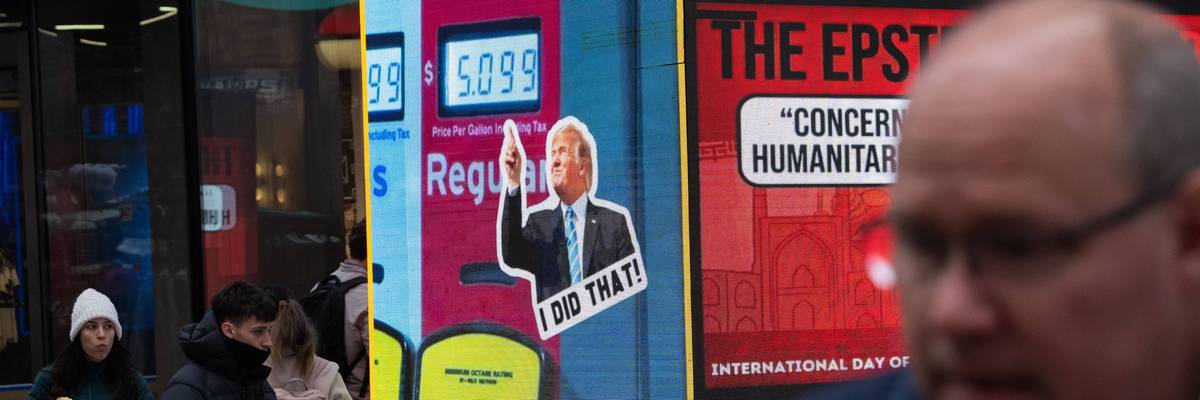
A truck with an image of US President Donald Trump and rising gas prices drives past during a rally for Al Quds Day on March 13, 2026 in New York City.
It’s unclear how more temporary ceasefires in hostilities between the growing number of parties involved in the Iran-US war can solve problems such as the rise of gas prices and fall of spending on other commodities.
Getting a cup of complimentary coffee at my credit union recently, I glanced to the left and saw a younger woman with a mass of pennies placing them into a machine for conversion to cash. "The US Mint stopped producing pennies," I said to her. “They might be valuable.”
She quickly replied, "I need gas."
Rising gas prices are an outcome of the US war of aggression against Iran, begun five months ago. As a result, inflationary pressures are rising stateside.
One thing is plain as day. Ceasefires between Iran and the US are temporary and connect with fluctuations of oil prices, currently increasing. Rising prices of oil drive price increases at the gas pump.
The logic of military conflicts is one of unpredictable outcomes, economically and politically.
Meanwhile, this sentence in the recent Bureau of Labor Statistics inflation report stands out like a third thumb. “The index for energy increased 15.7% over the past 12 months due in large part to the index for gasoline rising 26.7% over the same period." That spike is despite presidential announcements about how well the war against Iran is going for the US to his dual audiences of MAGA voters and capitalist investors.
Apparently, repetition of a falsification has limitations. Don’t tell the president, though.
Inflation as a result of supply disruptions as we experienced with global value chains during the pandemic is a systemic contradiction. Global economic integration, e.g., the shift of US industry abroad that increases the distances of supply chains, is no risk-free strategy to increase profits and market share for corporate America.
We see in real time that the global economy which requires oil to operate feeds the imbalance between consumption, production, and distribution of commodities such as energy. The shutdown of the Strait of Hormuz and Red Sea with Yemen’s entry into the Iran-US war are driving the decrease in oil production and distribution, and therefore consumption.
Under the current phase of capitalism, or neoliberalism, the government shores up the weakening buying power of the working class with direct support of the corporations and the wealthy. In the case of the Iran-US war, despite the endless American taxpayer outlays for military spending with bipartisan support, the dwindling supply of energy from the Persian Gulf that businesses and consumers rely upon is driving inflationary pressures. The rise of gas prices is proof of that. There’s more.
Spending a bigger chunk of household income on gas means that working families spend less in other areas. Take fast food spending. Consumption of fast food is down 4% in May 2026 from its peak in September 2025, according to the US Bureau of Economic Affairs.
It’s unclear how more temporary ceasefires in hostilities between the growing number of parties involved in the Iran-US war, now including Saudi Arabia and Yemen, can solve problems such as the rise of gas prices and fall of spending on other commodities in the US. The logic of military conflicts is one of unpredictable outcomes, economically and politically. Claiming to know what's next is a fool's errand.
Dear Common Dreams reader, It’s been nearly 30 years since I co-founded Common Dreams with my late wife, Lina Newhouser. We had the radical notion that journalism should serve the public good, not corporate profits. It was clear to us from the outset what it would take to build such a project. No paid advertisements. No corporate sponsors. No millionaire publisher telling us what to think or do. Many people said we wouldn't last a year, but we proved those doubters wrong. Together with a tremendous team of journalists and dedicated staff, we built an independent media outlet free from the constraints of profits and corporate control. Our mission has always been simple: To inform. To inspire. To ignite change for the common good. Building Common Dreams was not easy. Our survival was never guaranteed. When you take on the most powerful forces—Wall Street greed, fossil fuel industry destruction, Big Tech lobbyists, and uber-rich oligarchs who have spent billions upon billions rigging the economy and democracy in their favor—the only bulwark you have is supporters who believe in your work. But here’s the urgent message from me today. It's never been this bad out there. And it's never been this hard to keep us going. At the very moment Common Dreams is most needed, the threats we face are intensifying. We need your support now more than ever. We don't accept corporate advertising and never will. We don't have a paywall because we don't think people should be blocked from critical news based on their ability to pay. Everything we do is funded by the donations of readers like you. When everyone does the little they can afford, we are strong. But if that support retreats or dries up, so do we. Will you donate now to make sure Common Dreams not only survives but thrives? —Craig Brown, Co-founder |
Getting a cup of complimentary coffee at my credit union recently, I glanced to the left and saw a younger woman with a mass of pennies placing them into a machine for conversion to cash. "The US Mint stopped producing pennies," I said to her. “They might be valuable.”
She quickly replied, "I need gas."
Rising gas prices are an outcome of the US war of aggression against Iran, begun five months ago. As a result, inflationary pressures are rising stateside.
One thing is plain as day. Ceasefires between Iran and the US are temporary and connect with fluctuations of oil prices, currently increasing. Rising prices of oil drive price increases at the gas pump.
The logic of military conflicts is one of unpredictable outcomes, economically and politically.
Meanwhile, this sentence in the recent Bureau of Labor Statistics inflation report stands out like a third thumb. “The index for energy increased 15.7% over the past 12 months due in large part to the index for gasoline rising 26.7% over the same period." That spike is despite presidential announcements about how well the war against Iran is going for the US to his dual audiences of MAGA voters and capitalist investors.
Apparently, repetition of a falsification has limitations. Don’t tell the president, though.
Inflation as a result of supply disruptions as we experienced with global value chains during the pandemic is a systemic contradiction. Global economic integration, e.g., the shift of US industry abroad that increases the distances of supply chains, is no risk-free strategy to increase profits and market share for corporate America.
We see in real time that the global economy which requires oil to operate feeds the imbalance between consumption, production, and distribution of commodities such as energy. The shutdown of the Strait of Hormuz and Red Sea with Yemen’s entry into the Iran-US war are driving the decrease in oil production and distribution, and therefore consumption.
Under the current phase of capitalism, or neoliberalism, the government shores up the weakening buying power of the working class with direct support of the corporations and the wealthy. In the case of the Iran-US war, despite the endless American taxpayer outlays for military spending with bipartisan support, the dwindling supply of energy from the Persian Gulf that businesses and consumers rely upon is driving inflationary pressures. The rise of gas prices is proof of that. There’s more.
Spending a bigger chunk of household income on gas means that working families spend less in other areas. Take fast food spending. Consumption of fast food is down 4% in May 2026 from its peak in September 2025, according to the US Bureau of Economic Affairs.
It’s unclear how more temporary ceasefires in hostilities between the growing number of parties involved in the Iran-US war, now including Saudi Arabia and Yemen, can solve problems such as the rise of gas prices and fall of spending on other commodities in the US. The logic of military conflicts is one of unpredictable outcomes, economically and politically. Claiming to know what's next is a fool's errand.
Getting a cup of complimentary coffee at my credit union recently, I glanced to the left and saw a younger woman with a mass of pennies placing them into a machine for conversion to cash. "The US Mint stopped producing pennies," I said to her. “They might be valuable.”
She quickly replied, "I need gas."
Rising gas prices are an outcome of the US war of aggression against Iran, begun five months ago. As a result, inflationary pressures are rising stateside.
One thing is plain as day. Ceasefires between Iran and the US are temporary and connect with fluctuations of oil prices, currently increasing. Rising prices of oil drive price increases at the gas pump.
The logic of military conflicts is one of unpredictable outcomes, economically and politically.
Meanwhile, this sentence in the recent Bureau of Labor Statistics inflation report stands out like a third thumb. “The index for energy increased 15.7% over the past 12 months due in large part to the index for gasoline rising 26.7% over the same period." That spike is despite presidential announcements about how well the war against Iran is going for the US to his dual audiences of MAGA voters and capitalist investors.
Apparently, repetition of a falsification has limitations. Don’t tell the president, though.
Inflation as a result of supply disruptions as we experienced with global value chains during the pandemic is a systemic contradiction. Global economic integration, e.g., the shift of US industry abroad that increases the distances of supply chains, is no risk-free strategy to increase profits and market share for corporate America.
We see in real time that the global economy which requires oil to operate feeds the imbalance between consumption, production, and distribution of commodities such as energy. The shutdown of the Strait of Hormuz and Red Sea with Yemen’s entry into the Iran-US war are driving the decrease in oil production and distribution, and therefore consumption.
Under the current phase of capitalism, or neoliberalism, the government shores up the weakening buying power of the working class with direct support of the corporations and the wealthy. In the case of the Iran-US war, despite the endless American taxpayer outlays for military spending with bipartisan support, the dwindling supply of energy from the Persian Gulf that businesses and consumers rely upon is driving inflationary pressures. The rise of gas prices is proof of that. There’s more.
Spending a bigger chunk of household income on gas means that working families spend less in other areas. Take fast food spending. Consumption of fast food is down 4% in May 2026 from its peak in September 2025, according to the US Bureau of Economic Affairs.
It’s unclear how more temporary ceasefires in hostilities between the growing number of parties involved in the Iran-US war, now including Saudi Arabia and Yemen, can solve problems such as the rise of gas prices and fall of spending on other commodities in the US. The logic of military conflicts is one of unpredictable outcomes, economically and politically. Claiming to know what's next is a fool's errand.