SUBSCRIBE TO OUR FREE NEWSLETTER
Daily news & progressive opinion—funded by the people, not the corporations—delivered straight to your inbox.
5
#000000
#FFFFFF
To donate by check, phone, or other method, see our More Ways to Give page.
Daily news & progressive opinion—funded by the people, not the corporations—delivered straight to your inbox.
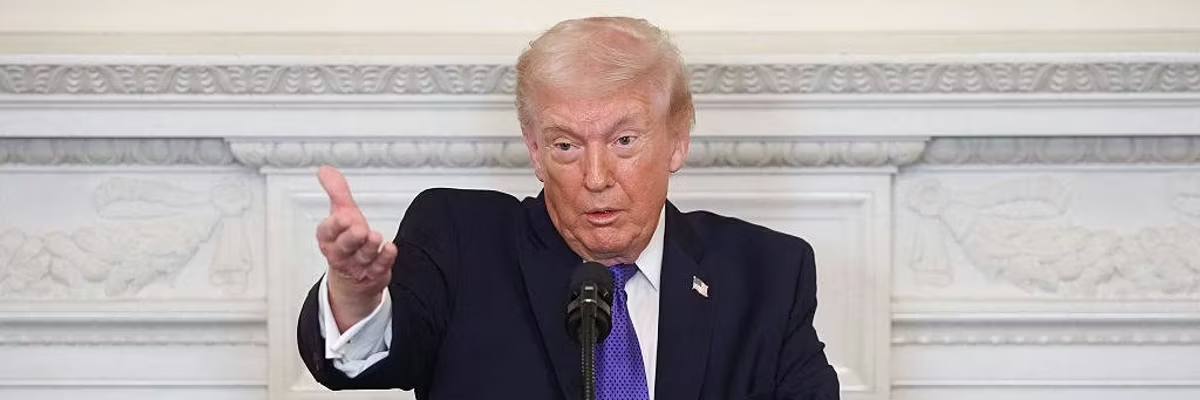
President Donald Trump delivers remarks during a working breakfast with governors in the State Dining Room at the White House on February 20, 2026 in Washington, DC.
One analyst predicted Iran would close the Strait of Hormuz and attack oil installations "in the hope of driving oil prices to record levels" should the US strike.
US President Donald Trump on Friday confirmed that he's considering launching an unprovoked military strike against Iran.
According to the New York Times, Trump was asked by reporters on Friday if he was considering attacking Iran, and he replied, "I guess I can say I am considering that."
The US has for weeks been sending fleets of warships, including the world's largest aircraft carrier, to the Middle East in apparent preparation for a massive military operation against Iran.
According to a Friday report from Al Jazeera, the buildup is the largest by the US Air Force in the region since the 2003 Iraq War, and it includes deployments of E-3 Sentry Airborne Warning and Control System (AWACS) aircraft, F-35 stealth strike fighters and F-22 air superiority jets, and F-15 and F-16 fighter jets.
Trump has not given any justification for launching such an attack, nor has he asked the US Congress to approve it, even though the Constitution gives the legislative branch the power to declare war.
Reps. Ro Khanna (D-Calif.) and Thomas Massie (R-Ky.) have been pushing for a vote in the US House of Representatives on a war powers resolution that would require Congress to debate and approve any act of war with Iran.
It is also not clear what goals the president would hope to achieve with the attack. A Thursday CNN report indicated that Trump is now weighing several options ranging from "more targeted strikes to sustained operations that could potentially last for weeks," including "plans to take out Tehran’s leaders."
Trita Parsi, co-founder and executive vice president of the Quincy Institute for Responsible Statecraft, wrote in a Friday analysis of Trump's reported attack plans that there is little chance that the president will be able to achieve a quick victory over Iran simply because the offers he has made to its government are nonstarters.
"Since the US strategy... is to escalate until Tehran caves, and since capitulation is a non-option for Iran, the Iranians are incentivized to strike back right away at the US," explained Parsi. "The only exit Tehran sees is to fight back, inflict as much pain as possible on the US, and hope that this causes Trump to back off or accept a more equitable deal."
Parsi acknowledged that there is no way Iran can defeat the US militarily, but could "get close to destroying Trump’s presidency before it loses the war" through a number of maneuvers intended to spike the price of oil, including "closing the Strait of Hormuz" and attacking "oil installations in the region in the hope of driving oil prices to record levels and by that inflation in the US."
"This is an extremely risky option for Iran," Parsi conceded, "but one that Tehran sees as less risky than the capitulation 'deal' Trump is seeking to force on Iran."
Dear Common Dreams reader, It’s been nearly 30 years since I co-founded Common Dreams with my late wife, Lina Newhouser. We had the radical notion that journalism should serve the public good, not corporate profits. It was clear to us from the outset what it would take to build such a project. No paid advertisements. No corporate sponsors. No millionaire publisher telling us what to think or do. Many people said we wouldn't last a year, but we proved those doubters wrong. Together with a tremendous team of journalists and dedicated staff, we built an independent media outlet free from the constraints of profits and corporate control. Our mission has always been simple: To inform. To inspire. To ignite change for the common good. Building Common Dreams was not easy. Our survival was never guaranteed. When you take on the most powerful forces—Wall Street greed, fossil fuel industry destruction, Big Tech lobbyists, and uber-rich oligarchs who have spent billions upon billions rigging the economy and democracy in their favor—the only bulwark you have is supporters who believe in your work. But here’s the urgent message from me today. It's never been this bad out there. And it's never been this hard to keep us going. At the very moment Common Dreams is most needed, the threats we face are intensifying. We need your support now more than ever. We don't accept corporate advertising and never will. We don't have a paywall because we don't think people should be blocked from critical news based on their ability to pay. Everything we do is funded by the donations of readers like you. When everyone does the little they can afford, we are strong. But if that support retreats or dries up, so do we. Will you donate now to make sure Common Dreams not only survives but thrives? —Craig Brown, Co-founder |
US President Donald Trump on Friday confirmed that he's considering launching an unprovoked military strike against Iran.
According to the New York Times, Trump was asked by reporters on Friday if he was considering attacking Iran, and he replied, "I guess I can say I am considering that."
The US has for weeks been sending fleets of warships, including the world's largest aircraft carrier, to the Middle East in apparent preparation for a massive military operation against Iran.
According to a Friday report from Al Jazeera, the buildup is the largest by the US Air Force in the region since the 2003 Iraq War, and it includes deployments of E-3 Sentry Airborne Warning and Control System (AWACS) aircraft, F-35 stealth strike fighters and F-22 air superiority jets, and F-15 and F-16 fighter jets.
Trump has not given any justification for launching such an attack, nor has he asked the US Congress to approve it, even though the Constitution gives the legislative branch the power to declare war.
Reps. Ro Khanna (D-Calif.) and Thomas Massie (R-Ky.) have been pushing for a vote in the US House of Representatives on a war powers resolution that would require Congress to debate and approve any act of war with Iran.
It is also not clear what goals the president would hope to achieve with the attack. A Thursday CNN report indicated that Trump is now weighing several options ranging from "more targeted strikes to sustained operations that could potentially last for weeks," including "plans to take out Tehran’s leaders."
Trita Parsi, co-founder and executive vice president of the Quincy Institute for Responsible Statecraft, wrote in a Friday analysis of Trump's reported attack plans that there is little chance that the president will be able to achieve a quick victory over Iran simply because the offers he has made to its government are nonstarters.
"Since the US strategy... is to escalate until Tehran caves, and since capitulation is a non-option for Iran, the Iranians are incentivized to strike back right away at the US," explained Parsi. "The only exit Tehran sees is to fight back, inflict as much pain as possible on the US, and hope that this causes Trump to back off or accept a more equitable deal."
Parsi acknowledged that there is no way Iran can defeat the US militarily, but could "get close to destroying Trump’s presidency before it loses the war" through a number of maneuvers intended to spike the price of oil, including "closing the Strait of Hormuz" and attacking "oil installations in the region in the hope of driving oil prices to record levels and by that inflation in the US."
"This is an extremely risky option for Iran," Parsi conceded, "but one that Tehran sees as less risky than the capitulation 'deal' Trump is seeking to force on Iran."
US President Donald Trump on Friday confirmed that he's considering launching an unprovoked military strike against Iran.
According to the New York Times, Trump was asked by reporters on Friday if he was considering attacking Iran, and he replied, "I guess I can say I am considering that."
The US has for weeks been sending fleets of warships, including the world's largest aircraft carrier, to the Middle East in apparent preparation for a massive military operation against Iran.
According to a Friday report from Al Jazeera, the buildup is the largest by the US Air Force in the region since the 2003 Iraq War, and it includes deployments of E-3 Sentry Airborne Warning and Control System (AWACS) aircraft, F-35 stealth strike fighters and F-22 air superiority jets, and F-15 and F-16 fighter jets.
Trump has not given any justification for launching such an attack, nor has he asked the US Congress to approve it, even though the Constitution gives the legislative branch the power to declare war.
Reps. Ro Khanna (D-Calif.) and Thomas Massie (R-Ky.) have been pushing for a vote in the US House of Representatives on a war powers resolution that would require Congress to debate and approve any act of war with Iran.
It is also not clear what goals the president would hope to achieve with the attack. A Thursday CNN report indicated that Trump is now weighing several options ranging from "more targeted strikes to sustained operations that could potentially last for weeks," including "plans to take out Tehran’s leaders."
Trita Parsi, co-founder and executive vice president of the Quincy Institute for Responsible Statecraft, wrote in a Friday analysis of Trump's reported attack plans that there is little chance that the president will be able to achieve a quick victory over Iran simply because the offers he has made to its government are nonstarters.
"Since the US strategy... is to escalate until Tehran caves, and since capitulation is a non-option for Iran, the Iranians are incentivized to strike back right away at the US," explained Parsi. "The only exit Tehran sees is to fight back, inflict as much pain as possible on the US, and hope that this causes Trump to back off or accept a more equitable deal."
Parsi acknowledged that there is no way Iran can defeat the US militarily, but could "get close to destroying Trump’s presidency before it loses the war" through a number of maneuvers intended to spike the price of oil, including "closing the Strait of Hormuz" and attacking "oil installations in the region in the hope of driving oil prices to record levels and by that inflation in the US."
"This is an extremely risky option for Iran," Parsi conceded, "but one that Tehran sees as less risky than the capitulation 'deal' Trump is seeking to force on Iran."