

5
#000000
#FFFFFF
To donate by check, phone, or other method, see our More Ways to Give page.
Daily news & progressive opinion—funded by the people, not the corporations—delivered straight to your inbox.
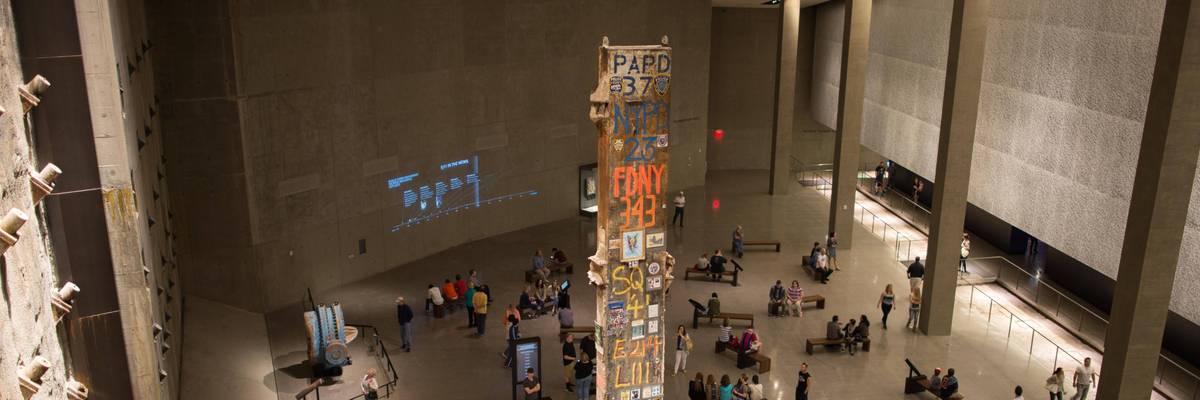
The main underground hall of the National September 11 Museum is shown with the last steel column removed from the World Trade Center site.
There is wisdom in honoring one’s pain and setting it aside, to live. I still believe that. I no longer know if it’s possible when the country doing the wounding has stopped bothering to hide it.
"The well-prepared heart has hope during adversity and fear during prosperity.”—Erica McAlpine
Twenty-five years, and the day keeps getting bigger instead of smaller. Three thousand dead in a single morning, then some multiple of that across the wars launched in its wake, then a shifting count out of Gaza that outpaces anyone’s will to keep totaling it. I did not expect grief to go on collecting interest this long. I did not expect to still be bitter, on a date this rehearsed, in a country this practiced at looking away.
I have written some version of this before. On some earlier September, I posted this: “#NeverForget is bad spiritual advice. Especially, when one has exacted revenge that far exceeds initial loss. To spell it out, honor your dead but remember, too, the 100,000+ Iraqi civilian noncombatants murdered in a vengeful, unjust ‘war.’ It is unseemly to keep one’s wounds open, while downplaying those of others that we’ve inflicted. There is wisdom, humility, and self preservation in honoring one’s pain & setting it aside, to Live.” Under it, I’d put a line from Friedrich Nietzsche, “Without forgetting it is quite impossible to live at all"; another, unattributed, “If the other person injures you, you may forget the injury, but if you injure him you will always remember"; and closed with Kahlil Gibran: “Hate is a dead thing. Who of you would be a tomb?”
This is not the only year I have said some version of it. Social media keeps a ledger I never asked for: one friend calling it the voice of reason, another admitting he’d learned the hard way that making this case got him nowhere with people he knew, a third telling me the 9/11 Memorial & Museum has a final section on the wars that followed, built into the same ground as the names of the dead. “We can always do better,” I wrote back to that last one, which was as much comfort as I had that day.
Then there is the exchange that still says more than anything I could add to it. A commenter, spoiling for a fight, wrote that we were lucky the whole Middle East hadn’t been leveled. “You’re a funny guy,” I wrote back, “and I’m too fond of you to take seriously your outrageous comment,” and sent him “a great big, virtual hug, until I can give you one in person.” Another commenter played along just long enough to ask what exactly had been won. Afghans and Iraqis, he answered himself: more Americans dead in the war on terror than in the towers, “them” and “us” collapsing into the same casualty list. “Yes,” I wrote back, “it’s always civilian casualties,” which is the whole essay in four words, if I am honest, and everything since has only been me finding 400 more ways to say it.
I could republish that old post today, and only the arithmetic would need updating. Ammiel Alcalay, writing this same week, names the habit outright: Keep what happens abroad in one room and what happens at home in another, so neither has to answer to the other. Brown University’s Costs of War project puts the toll of these 25 years, direct and indirect combined, at 4.5 to 4.7 million and still counting. Alcalay draws the line forward, to what he calls, correctly, “the genocide in Gaza and seizure of land in Palestine.” The number I gave my friends, a decade or more ago, was 100,000. It never got revised. It got buried under the next one, and the next. There is no exchange rate for human suffering. The afterlife of September 11 was not measured abroad alone. At home, Muslims remained available for suspicion: The Council on American-Islamic Relations recorded 8,683 complaints in 2025, its highest annual total. This week, Rudy Giuliani went on television to say the city’s current mayor, its first Muslim one, shouldn’t attend Friday’s ceremony, then said Muslims are taught from childhood that they want to “dominate us.” Twenty-five years on, and grief still comes with a loyalty test.
What has changed since is the camouflage. Richard Nixon needed Henry Kissinger to bomb Cambodia in the dark. Barack Obama needed kill lists and a “disposition matrix,” a targeting database mapping how terrorism suspects would be captured or killed, dressed up in the calm language of due process. Donald Trump needs none of it. He says the part that used to need a translator, calls it winning, and the bombs land anyway, in the same places they always did. He is the pattern finally caught without its coat on, a confession the country has been rehearsing since before I wrote that old post, only now said out loud.
It was a friend, in that same 2018 thread, who was already flagging the collusion with Saudi Arabia over Yemen: American weapons, sold for profit, into a war just as unjust as the ones carrying our own name. I hadn’t known. I said so. Eight years on, Britain has announced plans, not yet law, to ban imports from illegal settlements and create powers to sanction companies that support, facilitate, or profit from them. It is a small thing. It is also an acknowledgment, however belated, that complicity can carry a price.
I wrote, once, that there is wisdom in honoring one’s pain and setting it aside, to live, that what is spiritually true for us as individuals is also true for us as nations. I still believe that. I no longer know if it’s possible when the country doing the wounding has stopped bothering to hide it, or if honoring the dead, now, requires that we stop setting anything aside at all.
Dear Common Dreams reader, It’s been nearly 30 years since I co-founded Common Dreams with my late wife, Lina Newhouser. We had the radical notion that journalism should serve the public good, not corporate profits. It was clear to us from the outset what it would take to build such a project. No paid advertisements. No corporate sponsors. No millionaire publisher telling us what to think or do. Many people said we wouldn't last a year, but we proved those doubters wrong. Together with a tremendous team of journalists and dedicated staff, we built an independent media outlet free from the constraints of profits and corporate control. Our mission has always been simple: To inform. To inspire. To ignite change for the common good. Building Common Dreams was not easy. Our survival was never guaranteed. When you take on the most powerful forces—Wall Street greed, fossil fuel industry destruction, Big Tech lobbyists, and uber-rich oligarchs who have spent billions upon billions rigging the economy and democracy in their favor—the only bulwark you have is supporters who believe in your work. But here’s the urgent message from me today. It's never been this bad out there. And it's never been this hard to keep us going. At the very moment Common Dreams is most needed, the threats we face are intensifying. We need your support now more than ever. We don't accept corporate advertising and never will. We don't have a paywall because we don't think people should be blocked from critical news based on their ability to pay. Everything we do is funded by the donations of readers like you. When everyone does the little they can afford, we are strong. But if that support retreats or dries up, so do we. Will you donate now to make sure Common Dreams not only survives but thrives? —Craig Brown, Co-founder |
"The well-prepared heart has hope during adversity and fear during prosperity.”—Erica McAlpine
Twenty-five years, and the day keeps getting bigger instead of smaller. Three thousand dead in a single morning, then some multiple of that across the wars launched in its wake, then a shifting count out of Gaza that outpaces anyone’s will to keep totaling it. I did not expect grief to go on collecting interest this long. I did not expect to still be bitter, on a date this rehearsed, in a country this practiced at looking away.
I have written some version of this before. On some earlier September, I posted this: “#NeverForget is bad spiritual advice. Especially, when one has exacted revenge that far exceeds initial loss. To spell it out, honor your dead but remember, too, the 100,000+ Iraqi civilian noncombatants murdered in a vengeful, unjust ‘war.’ It is unseemly to keep one’s wounds open, while downplaying those of others that we’ve inflicted. There is wisdom, humility, and self preservation in honoring one’s pain & setting it aside, to Live.” Under it, I’d put a line from Friedrich Nietzsche, “Without forgetting it is quite impossible to live at all"; another, unattributed, “If the other person injures you, you may forget the injury, but if you injure him you will always remember"; and closed with Kahlil Gibran: “Hate is a dead thing. Who of you would be a tomb?”
This is not the only year I have said some version of it. Social media keeps a ledger I never asked for: one friend calling it the voice of reason, another admitting he’d learned the hard way that making this case got him nowhere with people he knew, a third telling me the 9/11 Memorial & Museum has a final section on the wars that followed, built into the same ground as the names of the dead. “We can always do better,” I wrote back to that last one, which was as much comfort as I had that day.
Then there is the exchange that still says more than anything I could add to it. A commenter, spoiling for a fight, wrote that we were lucky the whole Middle East hadn’t been leveled. “You’re a funny guy,” I wrote back, “and I’m too fond of you to take seriously your outrageous comment,” and sent him “a great big, virtual hug, until I can give you one in person.” Another commenter played along just long enough to ask what exactly had been won. Afghans and Iraqis, he answered himself: more Americans dead in the war on terror than in the towers, “them” and “us” collapsing into the same casualty list. “Yes,” I wrote back, “it’s always civilian casualties,” which is the whole essay in four words, if I am honest, and everything since has only been me finding 400 more ways to say it.
I could republish that old post today, and only the arithmetic would need updating. Ammiel Alcalay, writing this same week, names the habit outright: Keep what happens abroad in one room and what happens at home in another, so neither has to answer to the other. Brown University’s Costs of War project puts the toll of these 25 years, direct and indirect combined, at 4.5 to 4.7 million and still counting. Alcalay draws the line forward, to what he calls, correctly, “the genocide in Gaza and seizure of land in Palestine.” The number I gave my friends, a decade or more ago, was 100,000. It never got revised. It got buried under the next one, and the next. There is no exchange rate for human suffering. The afterlife of September 11 was not measured abroad alone. At home, Muslims remained available for suspicion: The Council on American-Islamic Relations recorded 8,683 complaints in 2025, its highest annual total. This week, Rudy Giuliani went on television to say the city’s current mayor, its first Muslim one, shouldn’t attend Friday’s ceremony, then said Muslims are taught from childhood that they want to “dominate us.” Twenty-five years on, and grief still comes with a loyalty test.
What has changed since is the camouflage. Richard Nixon needed Henry Kissinger to bomb Cambodia in the dark. Barack Obama needed kill lists and a “disposition matrix,” a targeting database mapping how terrorism suspects would be captured or killed, dressed up in the calm language of due process. Donald Trump needs none of it. He says the part that used to need a translator, calls it winning, and the bombs land anyway, in the same places they always did. He is the pattern finally caught without its coat on, a confession the country has been rehearsing since before I wrote that old post, only now said out loud.
It was a friend, in that same 2018 thread, who was already flagging the collusion with Saudi Arabia over Yemen: American weapons, sold for profit, into a war just as unjust as the ones carrying our own name. I hadn’t known. I said so. Eight years on, Britain has announced plans, not yet law, to ban imports from illegal settlements and create powers to sanction companies that support, facilitate, or profit from them. It is a small thing. It is also an acknowledgment, however belated, that complicity can carry a price.
I wrote, once, that there is wisdom in honoring one’s pain and setting it aside, to live, that what is spiritually true for us as individuals is also true for us as nations. I still believe that. I no longer know if it’s possible when the country doing the wounding has stopped bothering to hide it, or if honoring the dead, now, requires that we stop setting anything aside at all.
"The well-prepared heart has hope during adversity and fear during prosperity.”—Erica McAlpine
Twenty-five years, and the day keeps getting bigger instead of smaller. Three thousand dead in a single morning, then some multiple of that across the wars launched in its wake, then a shifting count out of Gaza that outpaces anyone’s will to keep totaling it. I did not expect grief to go on collecting interest this long. I did not expect to still be bitter, on a date this rehearsed, in a country this practiced at looking away.
I have written some version of this before. On some earlier September, I posted this: “#NeverForget is bad spiritual advice. Especially, when one has exacted revenge that far exceeds initial loss. To spell it out, honor your dead but remember, too, the 100,000+ Iraqi civilian noncombatants murdered in a vengeful, unjust ‘war.’ It is unseemly to keep one’s wounds open, while downplaying those of others that we’ve inflicted. There is wisdom, humility, and self preservation in honoring one’s pain & setting it aside, to Live.” Under it, I’d put a line from Friedrich Nietzsche, “Without forgetting it is quite impossible to live at all"; another, unattributed, “If the other person injures you, you may forget the injury, but if you injure him you will always remember"; and closed with Kahlil Gibran: “Hate is a dead thing. Who of you would be a tomb?”
This is not the only year I have said some version of it. Social media keeps a ledger I never asked for: one friend calling it the voice of reason, another admitting he’d learned the hard way that making this case got him nowhere with people he knew, a third telling me the 9/11 Memorial & Museum has a final section on the wars that followed, built into the same ground as the names of the dead. “We can always do better,” I wrote back to that last one, which was as much comfort as I had that day.
Then there is the exchange that still says more than anything I could add to it. A commenter, spoiling for a fight, wrote that we were lucky the whole Middle East hadn’t been leveled. “You’re a funny guy,” I wrote back, “and I’m too fond of you to take seriously your outrageous comment,” and sent him “a great big, virtual hug, until I can give you one in person.” Another commenter played along just long enough to ask what exactly had been won. Afghans and Iraqis, he answered himself: more Americans dead in the war on terror than in the towers, “them” and “us” collapsing into the same casualty list. “Yes,” I wrote back, “it’s always civilian casualties,” which is the whole essay in four words, if I am honest, and everything since has only been me finding 400 more ways to say it.
I could republish that old post today, and only the arithmetic would need updating. Ammiel Alcalay, writing this same week, names the habit outright: Keep what happens abroad in one room and what happens at home in another, so neither has to answer to the other. Brown University’s Costs of War project puts the toll of these 25 years, direct and indirect combined, at 4.5 to 4.7 million and still counting. Alcalay draws the line forward, to what he calls, correctly, “the genocide in Gaza and seizure of land in Palestine.” The number I gave my friends, a decade or more ago, was 100,000. It never got revised. It got buried under the next one, and the next. There is no exchange rate for human suffering. The afterlife of September 11 was not measured abroad alone. At home, Muslims remained available for suspicion: The Council on American-Islamic Relations recorded 8,683 complaints in 2025, its highest annual total. This week, Rudy Giuliani went on television to say the city’s current mayor, its first Muslim one, shouldn’t attend Friday’s ceremony, then said Muslims are taught from childhood that they want to “dominate us.” Twenty-five years on, and grief still comes with a loyalty test.
What has changed since is the camouflage. Richard Nixon needed Henry Kissinger to bomb Cambodia in the dark. Barack Obama needed kill lists and a “disposition matrix,” a targeting database mapping how terrorism suspects would be captured or killed, dressed up in the calm language of due process. Donald Trump needs none of it. He says the part that used to need a translator, calls it winning, and the bombs land anyway, in the same places they always did. He is the pattern finally caught without its coat on, a confession the country has been rehearsing since before I wrote that old post, only now said out loud.
It was a friend, in that same 2018 thread, who was already flagging the collusion with Saudi Arabia over Yemen: American weapons, sold for profit, into a war just as unjust as the ones carrying our own name. I hadn’t known. I said so. Eight years on, Britain has announced plans, not yet law, to ban imports from illegal settlements and create powers to sanction companies that support, facilitate, or profit from them. It is a small thing. It is also an acknowledgment, however belated, that complicity can carry a price.
I wrote, once, that there is wisdom in honoring one’s pain and setting it aside, to live, that what is spiritually true for us as individuals is also true for us as nations. I still believe that. I no longer know if it’s possible when the country doing the wounding has stopped bothering to hide it, or if honoring the dead, now, requires that we stop setting anything aside at all.

