SUBSCRIBE TO OUR FREE NEWSLETTER
Daily news & progressive opinion—funded by the people, not the corporations—delivered straight to your inbox.
5
#000000
#FFFFFF
To donate by check, phone, or other method, see our More Ways to Give page.
Daily news & progressive opinion—funded by the people, not the corporations—delivered straight to your inbox.
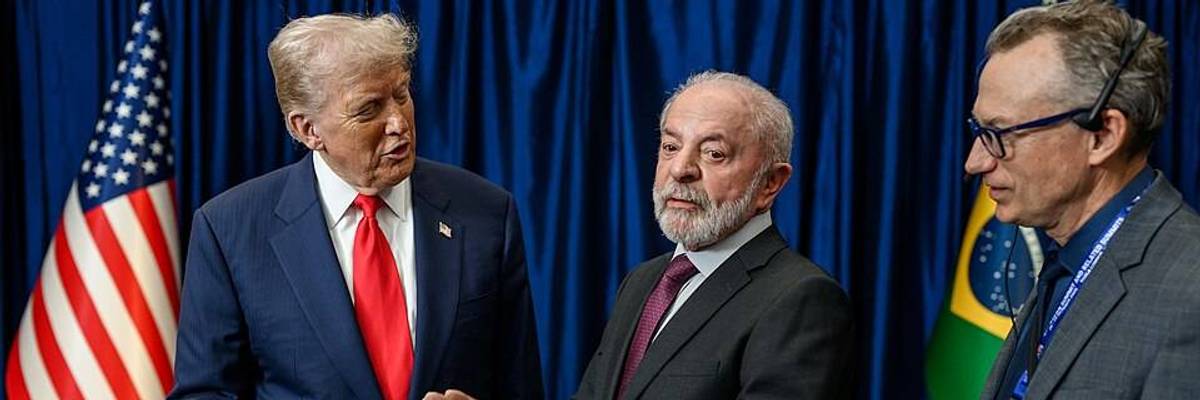
President Donald Trump meets with Brazilian President Luiz Inacio da Silva during the ASEAN Summit at the Kuala Lumpur Convention Center on October 25, 2025, in Kuala Lumpur, Malaysia.
Sociologists Aldon Morris and Nara Roberta Silva remind us that authoritarianism is neither inevitable nor self-defeating: Democracy endures only when ordinary people organize creatively, disrupt oppressive arrangements, build durable institutions, and discover new capacities through struggle.
By late summer of 2026, the campaign against America's democratic institutions had become almost dizzying in its reach. It moved through turbulent waters from the Strait of Hormuz to the Lincoln Memorial Reflecting Pool, raised new tariff barriers and imagined golden ballrooms, revived Jim Crow at the polls and McCarthyism at the State Department, and found time, between denunciations of Canadian wildfires and Democratic Socialists of America, to take aim at the Smithsonian Institution.
The widely admired museum, established “for the increase and diffusion of knowledge among men” and celebrating the 180th anniversary of its founding on August 10, 2026, became the object of a sustained assault. Complaining about the institution’s allegedly “woke agenda,” the Trump administration displaced the Smithsonian’s traditional Folklife Festival by holding something it named "The Great American State Fair" in its place. Notwithstanding the failure of the latter, the Smithsonian’s celebration of the US Republic’s Semiquincentennial also drew the administration’s ire.
The resulting “Restoring Truth and Sanity to American History” Executive Order (July 24, 2026) demanded “content corrections” and warning notices across Smithsonian exhibits and buildings. On August 4, a federal funding cut of more than 10% reduced the Smithsonian’s budget to its lowest level in over a decade.
If there was any doubt that the censorship and the budget cut belonged to the same antidemocratic project, Samuel J. Redman, a University of Massachusetts Amherst professor and student of Smithsonian history, notes that he cannot “recall a single instance where exhibits have been directly wrestled with by the upper echelons of the federal government.” Among the administration’s grievances was the Smithsonian’s depiction of race relations. The White House report specifically objected to the Smithsonian framing civil rights activist Emmett Till’s murder as being “not just part of a racist past” but a reflection of “our ongoing present” (p.113). It also decried a Smithsonian web page featuring the bullet-riddled historical marker showing where Till’s body was found in 1955.
Crises become politically meaningful only when people build institutions, practice disruption, invent new forms of solidarity, defend truth, sustain hope, and connect local struggles to global ones.
Grappling with this history and its antidemocratic turn, I sat down to have a conversation with two prominent scholars of social movements, Dr. Aldon Morris of Northwestern University and past president of the American Sociological Association, and Dr. Nara Roberta Silva of the Brooklyn Institute for Social Research and author of an award-winning Brazilian book on the #Occupy movement in the US, for a better understanding of this moment.
The situation in the United States is, after all, not completely unique. Brazil and the United States are both headed into pivotal national elections this fall. Both countries experienced violent coup attempts in 2020. And the two multiracial giants of the Americas are both countries where Black leadership in the struggle for democracy remains critical.
For Dr. Morris, the administration’s consternation at the Emmett Till story is suggestive of the conversations that authoritarians wish to preempt. Mamie Elizabeth Till-Mobley, Emmett’s mom notably insisted on an open casket at his funeral, “I think everybody needed to know what had happened to Emmett Till.” And so, the world saw Till’s mutilated body and his community’s grief, sparking a global movement. It is “the story about how a mother ignited and fired up the country and therewith the world about racial inequality,” Morris observes.
Before drawing general lessons about the long struggle between democracy and authoritarianism, Morris and Silva pause to reckon with the immediate crisis. Both begin from the creativity and agency of social movements, yet Morris—speaking for a generation shaped by the Civil Rights Movement—admits to a profound sense of historical surprise. “We had no idea that we would be here right now,” he reflects. “We did not think that truth itself would become something that was to be banned.” In his view, the administration’s campaign against the Smithsonian is therefore not only a dispute over museum exhibits or Black history. “He is not simply attacking Black history,” Morris argues. “He is attacking the distribution of truth about the relationships between human beings, races, and nations. An attack on something like the Smithsonian is a flash point revealing the kind of trouble we face.”
For Dr. Silva, a scholar of US movements as well as those active in her native Brazil, the administration initiatives are a “defining feature of our historical moment” characterized by “the erosion of the public sphere.” In fact, looking at former Brazilian President Jair Bolsonaro’s negative impact on that country’s democratic project, Silva concludes, that the “very idea of public has been severely damaged.” Although Morris and Silva disagreed about the extent of erosion, both were similarly concerned about authoritarian historical revisionism. Invoking one of Dr. Martin Luther King, Jr.’s favorite quotes, “Truth, crushed to Earth, will rise again,” Morris outlined a hopeful, but by no means certain path into the future. “I think that work like that of Nara and myself shows that human agency among the oppressed is a very important social change factor, and it has to be ignited and energized to make a difference.”
Both thinkers are extremely sober about the prospects for democratic change. Looking at the structure of authoritarian movements in Brazil, Silva suggests that we have to address its broad base, even if it is minoritarian in nature: “Coordination exists at the top, but, as a system, the structure is hydra-headed, with several foci working to galvanize followers, create narrative lines, and break new ground.” As such, progressive projects, while themselves broad based and majoritarian in conception, must necessarily carry out institutional reform and enact “a socioeconomic program that meaningfully addresses the crises that brought about the reemergence of authoritarianism.”
Taking a long view, Morris cautions: “What we see is a dialectical process between oppression and efforts of change, social movement activity... We fought a civil war to overthrow slavery in the 1860s. [W. E. B.] Du Bois showed that it was the agency of the slaves themselves that essentially freed the slaves through the general strike. So we get this brief period that looks like we're finally going to have democracy, equality between the races. That lasts for about 11 or 12 years, and then we get the overthrow of Reconstruction, and all of what came after that. All of the violence against Black people, the lynching, and the Jim Crow regime, right?” The US continued “in this oppressive situation and then comes the Civil Rights Movement” and only to be followed by the current, long rollback. “My sense,” Morris avers, “is that social movements, especially the effective ones, are always trial and error.”
Following along with Silva, Morris offers a transnational vision: “We need grassroots movements connected from the United States to Brazil, to South Africa, to Gaza—to all over including the Congo. What I'm saying is that the struggle has always had these global dimensions, but the world has never been so globalized as it is now. We have to be much more concerned with worldwide democracy, worldwide transformation, because what we know is that the systems of oppression are global.”
Before outlining the elements of a hoped-for transnational, pan-democratic movement, Morris finds hope in the face of dismal, on-the-ground facts: The shared global attention to Gaza. This point often confounds liberal and conservative commentators alike, as seen in the handwringing over Michigan US Senate nominee Abdul al-Sayed and New York City Mayor Zohran Mamdani, both whom have been outspoken on Palestine. But, for Morris, recalling the Emmett Till moment, “It is hard for large numbers of people across the globe to really wrap their minds around 20 to 30 thousand babies being starved to death and killed, to whole families being wiped out, and 90% of the population and more dislocated, the destruction of every university in Gaza, the destruction of hospitals, and so forth. This is the one place that seems to be generating some kind of international coherence.”
Silva agrees that a transnational human rights politics is well established, but she is concerned, “We are still a little lost about how to operate in the new terrain of digital media ecosystems, fragmented and precarious workforces, declining organizations, and unstable party systems.” Further, she laments that movements that often put hundreds of thousands, even millions, of people onto the streets nevertheless may secure few immediate positive outcomes or even significant media attention—a point explored adroitly in several national contexts by journalist Vincent Bevins in If We Burn. For Bevins, as with Silva and Morris, the capacity to formulate demands, move beyond mere mobilization to develop organization and leadership, explain the discrepancy between the scale of popular mobilization and outcomes.
Morris shares this concern: “Another March on Washington to celebrate the 1963 March on Washington is not going to accomplish anything as long as it is merely ritualized behavior. The real challenge is whether this generation of activists will be creative again—whether they will figure out how to engage in protest that matters. Marches and demonstrations become ritual when they don’t create social disruption against oppressive forces.”
Silva sees a version of this dilemma in Brazil, as social movements gained greater access to the state under Workers’ Party administrations but also saw their capacity for independent mobilization and disruption decline. Yet recent experience shows that protesting can still exert considerable leverage—in September 2025, nationwide demonstrations blocked attempts to further entrench oligarchic control. Some of the most effective moments of Luiz Inácio Lula da Silva's current administration have come precisely when pressure from below has reinforced, or forced, action from above. For Silva, the Brazilian experience suggests that the challenge for social movements is not simply to mobilize large numbers of people but also to disrupt political routines.
Over the course of our conversation together, the two sociologists reach agreement on the following lessons for durable democracy:
For me, then, the attack on the Smithsonian is about far more than the fate of public museums or competing interpretations of the past. It is part of a broader struggle over whether democratic societies can sustain the institutions, historical memory, and public spaces needed to preserve truth, solidarity, and collective action. Morris and Silva remind us that authoritarianism is neither inevitable nor self-defeating: Democracy endures only when ordinary people organize creatively, disrupt oppressive arrangements, build durable institutions, and discover new capacities through struggle. If there is a lesson from US history and from contemporary Brazil for this moment, it is that the next democratic turn will not be granted from above; it will be ignited from below.
Dear Common Dreams reader, It’s been nearly 30 years since I co-founded Common Dreams with my late wife, Lina Newhouser. We had the radical notion that journalism should serve the public good, not corporate profits. It was clear to us from the outset what it would take to build such a project. No paid advertisements. No corporate sponsors. No millionaire publisher telling us what to think or do. Many people said we wouldn't last a year, but we proved those doubters wrong. Together with a tremendous team of journalists and dedicated staff, we built an independent media outlet free from the constraints of profits and corporate control. Our mission has always been simple: To inform. To inspire. To ignite change for the common good. Building Common Dreams was not easy. Our survival was never guaranteed. When you take on the most powerful forces—Wall Street greed, fossil fuel industry destruction, Big Tech lobbyists, and uber-rich oligarchs who have spent billions upon billions rigging the economy and democracy in their favor—the only bulwark you have is supporters who believe in your work. But here’s the urgent message from me today. It's never been this bad out there. And it's never been this hard to keep us going. At the very moment Common Dreams is most needed, the threats we face are intensifying. We need your support now more than ever. We don't accept corporate advertising and never will. We don't have a paywall because we don't think people should be blocked from critical news based on their ability to pay. Everything we do is funded by the donations of readers like you. When everyone does the little they can afford, we are strong. But if that support retreats or dries up, so do we. Will you donate now to make sure Common Dreams not only survives but thrives? —Craig Brown, Co-founder |
By late summer of 2026, the campaign against America's democratic institutions had become almost dizzying in its reach. It moved through turbulent waters from the Strait of Hormuz to the Lincoln Memorial Reflecting Pool, raised new tariff barriers and imagined golden ballrooms, revived Jim Crow at the polls and McCarthyism at the State Department, and found time, between denunciations of Canadian wildfires and Democratic Socialists of America, to take aim at the Smithsonian Institution.
The widely admired museum, established “for the increase and diffusion of knowledge among men” and celebrating the 180th anniversary of its founding on August 10, 2026, became the object of a sustained assault. Complaining about the institution’s allegedly “woke agenda,” the Trump administration displaced the Smithsonian’s traditional Folklife Festival by holding something it named "The Great American State Fair" in its place. Notwithstanding the failure of the latter, the Smithsonian’s celebration of the US Republic’s Semiquincentennial also drew the administration’s ire.
The resulting “Restoring Truth and Sanity to American History” Executive Order (July 24, 2026) demanded “content corrections” and warning notices across Smithsonian exhibits and buildings. On August 4, a federal funding cut of more than 10% reduced the Smithsonian’s budget to its lowest level in over a decade.
If there was any doubt that the censorship and the budget cut belonged to the same antidemocratic project, Samuel J. Redman, a University of Massachusetts Amherst professor and student of Smithsonian history, notes that he cannot “recall a single instance where exhibits have been directly wrestled with by the upper echelons of the federal government.” Among the administration’s grievances was the Smithsonian’s depiction of race relations. The White House report specifically objected to the Smithsonian framing civil rights activist Emmett Till’s murder as being “not just part of a racist past” but a reflection of “our ongoing present” (p.113). It also decried a Smithsonian web page featuring the bullet-riddled historical marker showing where Till’s body was found in 1955.
Crises become politically meaningful only when people build institutions, practice disruption, invent new forms of solidarity, defend truth, sustain hope, and connect local struggles to global ones.
Grappling with this history and its antidemocratic turn, I sat down to have a conversation with two prominent scholars of social movements, Dr. Aldon Morris of Northwestern University and past president of the American Sociological Association, and Dr. Nara Roberta Silva of the Brooklyn Institute for Social Research and author of an award-winning Brazilian book on the #Occupy movement in the US, for a better understanding of this moment.
The situation in the United States is, after all, not completely unique. Brazil and the United States are both headed into pivotal national elections this fall. Both countries experienced violent coup attempts in 2020. And the two multiracial giants of the Americas are both countries where Black leadership in the struggle for democracy remains critical.
For Dr. Morris, the administration’s consternation at the Emmett Till story is suggestive of the conversations that authoritarians wish to preempt. Mamie Elizabeth Till-Mobley, Emmett’s mom notably insisted on an open casket at his funeral, “I think everybody needed to know what had happened to Emmett Till.” And so, the world saw Till’s mutilated body and his community’s grief, sparking a global movement. It is “the story about how a mother ignited and fired up the country and therewith the world about racial inequality,” Morris observes.
Before drawing general lessons about the long struggle between democracy and authoritarianism, Morris and Silva pause to reckon with the immediate crisis. Both begin from the creativity and agency of social movements, yet Morris—speaking for a generation shaped by the Civil Rights Movement—admits to a profound sense of historical surprise. “We had no idea that we would be here right now,” he reflects. “We did not think that truth itself would become something that was to be banned.” In his view, the administration’s campaign against the Smithsonian is therefore not only a dispute over museum exhibits or Black history. “He is not simply attacking Black history,” Morris argues. “He is attacking the distribution of truth about the relationships between human beings, races, and nations. An attack on something like the Smithsonian is a flash point revealing the kind of trouble we face.”
For Dr. Silva, a scholar of US movements as well as those active in her native Brazil, the administration initiatives are a “defining feature of our historical moment” characterized by “the erosion of the public sphere.” In fact, looking at former Brazilian President Jair Bolsonaro’s negative impact on that country’s democratic project, Silva concludes, that the “very idea of public has been severely damaged.” Although Morris and Silva disagreed about the extent of erosion, both were similarly concerned about authoritarian historical revisionism. Invoking one of Dr. Martin Luther King, Jr.’s favorite quotes, “Truth, crushed to Earth, will rise again,” Morris outlined a hopeful, but by no means certain path into the future. “I think that work like that of Nara and myself shows that human agency among the oppressed is a very important social change factor, and it has to be ignited and energized to make a difference.”
Both thinkers are extremely sober about the prospects for democratic change. Looking at the structure of authoritarian movements in Brazil, Silva suggests that we have to address its broad base, even if it is minoritarian in nature: “Coordination exists at the top, but, as a system, the structure is hydra-headed, with several foci working to galvanize followers, create narrative lines, and break new ground.” As such, progressive projects, while themselves broad based and majoritarian in conception, must necessarily carry out institutional reform and enact “a socioeconomic program that meaningfully addresses the crises that brought about the reemergence of authoritarianism.”
Taking a long view, Morris cautions: “What we see is a dialectical process between oppression and efforts of change, social movement activity... We fought a civil war to overthrow slavery in the 1860s. [W. E. B.] Du Bois showed that it was the agency of the slaves themselves that essentially freed the slaves through the general strike. So we get this brief period that looks like we're finally going to have democracy, equality between the races. That lasts for about 11 or 12 years, and then we get the overthrow of Reconstruction, and all of what came after that. All of the violence against Black people, the lynching, and the Jim Crow regime, right?” The US continued “in this oppressive situation and then comes the Civil Rights Movement” and only to be followed by the current, long rollback. “My sense,” Morris avers, “is that social movements, especially the effective ones, are always trial and error.”
Following along with Silva, Morris offers a transnational vision: “We need grassroots movements connected from the United States to Brazil, to South Africa, to Gaza—to all over including the Congo. What I'm saying is that the struggle has always had these global dimensions, but the world has never been so globalized as it is now. We have to be much more concerned with worldwide democracy, worldwide transformation, because what we know is that the systems of oppression are global.”
Before outlining the elements of a hoped-for transnational, pan-democratic movement, Morris finds hope in the face of dismal, on-the-ground facts: The shared global attention to Gaza. This point often confounds liberal and conservative commentators alike, as seen in the handwringing over Michigan US Senate nominee Abdul al-Sayed and New York City Mayor Zohran Mamdani, both whom have been outspoken on Palestine. But, for Morris, recalling the Emmett Till moment, “It is hard for large numbers of people across the globe to really wrap their minds around 20 to 30 thousand babies being starved to death and killed, to whole families being wiped out, and 90% of the population and more dislocated, the destruction of every university in Gaza, the destruction of hospitals, and so forth. This is the one place that seems to be generating some kind of international coherence.”
Silva agrees that a transnational human rights politics is well established, but she is concerned, “We are still a little lost about how to operate in the new terrain of digital media ecosystems, fragmented and precarious workforces, declining organizations, and unstable party systems.” Further, she laments that movements that often put hundreds of thousands, even millions, of people onto the streets nevertheless may secure few immediate positive outcomes or even significant media attention—a point explored adroitly in several national contexts by journalist Vincent Bevins in If We Burn. For Bevins, as with Silva and Morris, the capacity to formulate demands, move beyond mere mobilization to develop organization and leadership, explain the discrepancy between the scale of popular mobilization and outcomes.
Morris shares this concern: “Another March on Washington to celebrate the 1963 March on Washington is not going to accomplish anything as long as it is merely ritualized behavior. The real challenge is whether this generation of activists will be creative again—whether they will figure out how to engage in protest that matters. Marches and demonstrations become ritual when they don’t create social disruption against oppressive forces.”
Silva sees a version of this dilemma in Brazil, as social movements gained greater access to the state under Workers’ Party administrations but also saw their capacity for independent mobilization and disruption decline. Yet recent experience shows that protesting can still exert considerable leverage—in September 2025, nationwide demonstrations blocked attempts to further entrench oligarchic control. Some of the most effective moments of Luiz Inácio Lula da Silva's current administration have come precisely when pressure from below has reinforced, or forced, action from above. For Silva, the Brazilian experience suggests that the challenge for social movements is not simply to mobilize large numbers of people but also to disrupt political routines.
Over the course of our conversation together, the two sociologists reach agreement on the following lessons for durable democracy:
For me, then, the attack on the Smithsonian is about far more than the fate of public museums or competing interpretations of the past. It is part of a broader struggle over whether democratic societies can sustain the institutions, historical memory, and public spaces needed to preserve truth, solidarity, and collective action. Morris and Silva remind us that authoritarianism is neither inevitable nor self-defeating: Democracy endures only when ordinary people organize creatively, disrupt oppressive arrangements, build durable institutions, and discover new capacities through struggle. If there is a lesson from US history and from contemporary Brazil for this moment, it is that the next democratic turn will not be granted from above; it will be ignited from below.
By late summer of 2026, the campaign against America's democratic institutions had become almost dizzying in its reach. It moved through turbulent waters from the Strait of Hormuz to the Lincoln Memorial Reflecting Pool, raised new tariff barriers and imagined golden ballrooms, revived Jim Crow at the polls and McCarthyism at the State Department, and found time, between denunciations of Canadian wildfires and Democratic Socialists of America, to take aim at the Smithsonian Institution.
The widely admired museum, established “for the increase and diffusion of knowledge among men” and celebrating the 180th anniversary of its founding on August 10, 2026, became the object of a sustained assault. Complaining about the institution’s allegedly “woke agenda,” the Trump administration displaced the Smithsonian’s traditional Folklife Festival by holding something it named "The Great American State Fair" in its place. Notwithstanding the failure of the latter, the Smithsonian’s celebration of the US Republic’s Semiquincentennial also drew the administration’s ire.
The resulting “Restoring Truth and Sanity to American History” Executive Order (July 24, 2026) demanded “content corrections” and warning notices across Smithsonian exhibits and buildings. On August 4, a federal funding cut of more than 10% reduced the Smithsonian’s budget to its lowest level in over a decade.
If there was any doubt that the censorship and the budget cut belonged to the same antidemocratic project, Samuel J. Redman, a University of Massachusetts Amherst professor and student of Smithsonian history, notes that he cannot “recall a single instance where exhibits have been directly wrestled with by the upper echelons of the federal government.” Among the administration’s grievances was the Smithsonian’s depiction of race relations. The White House report specifically objected to the Smithsonian framing civil rights activist Emmett Till’s murder as being “not just part of a racist past” but a reflection of “our ongoing present” (p.113). It also decried a Smithsonian web page featuring the bullet-riddled historical marker showing where Till’s body was found in 1955.
Crises become politically meaningful only when people build institutions, practice disruption, invent new forms of solidarity, defend truth, sustain hope, and connect local struggles to global ones.
Grappling with this history and its antidemocratic turn, I sat down to have a conversation with two prominent scholars of social movements, Dr. Aldon Morris of Northwestern University and past president of the American Sociological Association, and Dr. Nara Roberta Silva of the Brooklyn Institute for Social Research and author of an award-winning Brazilian book on the #Occupy movement in the US, for a better understanding of this moment.
The situation in the United States is, after all, not completely unique. Brazil and the United States are both headed into pivotal national elections this fall. Both countries experienced violent coup attempts in 2020. And the two multiracial giants of the Americas are both countries where Black leadership in the struggle for democracy remains critical.
For Dr. Morris, the administration’s consternation at the Emmett Till story is suggestive of the conversations that authoritarians wish to preempt. Mamie Elizabeth Till-Mobley, Emmett’s mom notably insisted on an open casket at his funeral, “I think everybody needed to know what had happened to Emmett Till.” And so, the world saw Till’s mutilated body and his community’s grief, sparking a global movement. It is “the story about how a mother ignited and fired up the country and therewith the world about racial inequality,” Morris observes.
Before drawing general lessons about the long struggle between democracy and authoritarianism, Morris and Silva pause to reckon with the immediate crisis. Both begin from the creativity and agency of social movements, yet Morris—speaking for a generation shaped by the Civil Rights Movement—admits to a profound sense of historical surprise. “We had no idea that we would be here right now,” he reflects. “We did not think that truth itself would become something that was to be banned.” In his view, the administration’s campaign against the Smithsonian is therefore not only a dispute over museum exhibits or Black history. “He is not simply attacking Black history,” Morris argues. “He is attacking the distribution of truth about the relationships between human beings, races, and nations. An attack on something like the Smithsonian is a flash point revealing the kind of trouble we face.”
For Dr. Silva, a scholar of US movements as well as those active in her native Brazil, the administration initiatives are a “defining feature of our historical moment” characterized by “the erosion of the public sphere.” In fact, looking at former Brazilian President Jair Bolsonaro’s negative impact on that country’s democratic project, Silva concludes, that the “very idea of public has been severely damaged.” Although Morris and Silva disagreed about the extent of erosion, both were similarly concerned about authoritarian historical revisionism. Invoking one of Dr. Martin Luther King, Jr.’s favorite quotes, “Truth, crushed to Earth, will rise again,” Morris outlined a hopeful, but by no means certain path into the future. “I think that work like that of Nara and myself shows that human agency among the oppressed is a very important social change factor, and it has to be ignited and energized to make a difference.”
Both thinkers are extremely sober about the prospects for democratic change. Looking at the structure of authoritarian movements in Brazil, Silva suggests that we have to address its broad base, even if it is minoritarian in nature: “Coordination exists at the top, but, as a system, the structure is hydra-headed, with several foci working to galvanize followers, create narrative lines, and break new ground.” As such, progressive projects, while themselves broad based and majoritarian in conception, must necessarily carry out institutional reform and enact “a socioeconomic program that meaningfully addresses the crises that brought about the reemergence of authoritarianism.”
Taking a long view, Morris cautions: “What we see is a dialectical process between oppression and efforts of change, social movement activity... We fought a civil war to overthrow slavery in the 1860s. [W. E. B.] Du Bois showed that it was the agency of the slaves themselves that essentially freed the slaves through the general strike. So we get this brief period that looks like we're finally going to have democracy, equality between the races. That lasts for about 11 or 12 years, and then we get the overthrow of Reconstruction, and all of what came after that. All of the violence against Black people, the lynching, and the Jim Crow regime, right?” The US continued “in this oppressive situation and then comes the Civil Rights Movement” and only to be followed by the current, long rollback. “My sense,” Morris avers, “is that social movements, especially the effective ones, are always trial and error.”
Following along with Silva, Morris offers a transnational vision: “We need grassroots movements connected from the United States to Brazil, to South Africa, to Gaza—to all over including the Congo. What I'm saying is that the struggle has always had these global dimensions, but the world has never been so globalized as it is now. We have to be much more concerned with worldwide democracy, worldwide transformation, because what we know is that the systems of oppression are global.”
Before outlining the elements of a hoped-for transnational, pan-democratic movement, Morris finds hope in the face of dismal, on-the-ground facts: The shared global attention to Gaza. This point often confounds liberal and conservative commentators alike, as seen in the handwringing over Michigan US Senate nominee Abdul al-Sayed and New York City Mayor Zohran Mamdani, both whom have been outspoken on Palestine. But, for Morris, recalling the Emmett Till moment, “It is hard for large numbers of people across the globe to really wrap their minds around 20 to 30 thousand babies being starved to death and killed, to whole families being wiped out, and 90% of the population and more dislocated, the destruction of every university in Gaza, the destruction of hospitals, and so forth. This is the one place that seems to be generating some kind of international coherence.”
Silva agrees that a transnational human rights politics is well established, but she is concerned, “We are still a little lost about how to operate in the new terrain of digital media ecosystems, fragmented and precarious workforces, declining organizations, and unstable party systems.” Further, she laments that movements that often put hundreds of thousands, even millions, of people onto the streets nevertheless may secure few immediate positive outcomes or even significant media attention—a point explored adroitly in several national contexts by journalist Vincent Bevins in If We Burn. For Bevins, as with Silva and Morris, the capacity to formulate demands, move beyond mere mobilization to develop organization and leadership, explain the discrepancy between the scale of popular mobilization and outcomes.
Morris shares this concern: “Another March on Washington to celebrate the 1963 March on Washington is not going to accomplish anything as long as it is merely ritualized behavior. The real challenge is whether this generation of activists will be creative again—whether they will figure out how to engage in protest that matters. Marches and demonstrations become ritual when they don’t create social disruption against oppressive forces.”
Silva sees a version of this dilemma in Brazil, as social movements gained greater access to the state under Workers’ Party administrations but also saw their capacity for independent mobilization and disruption decline. Yet recent experience shows that protesting can still exert considerable leverage—in September 2025, nationwide demonstrations blocked attempts to further entrench oligarchic control. Some of the most effective moments of Luiz Inácio Lula da Silva's current administration have come precisely when pressure from below has reinforced, or forced, action from above. For Silva, the Brazilian experience suggests that the challenge for social movements is not simply to mobilize large numbers of people but also to disrupt political routines.
Over the course of our conversation together, the two sociologists reach agreement on the following lessons for durable democracy:
For me, then, the attack on the Smithsonian is about far more than the fate of public museums or competing interpretations of the past. It is part of a broader struggle over whether democratic societies can sustain the institutions, historical memory, and public spaces needed to preserve truth, solidarity, and collective action. Morris and Silva remind us that authoritarianism is neither inevitable nor self-defeating: Democracy endures only when ordinary people organize creatively, disrupt oppressive arrangements, build durable institutions, and discover new capacities through struggle. If there is a lesson from US history and from contemporary Brazil for this moment, it is that the next democratic turn will not be granted from above; it will be ignited from below.