SUBSCRIBE TO OUR FREE NEWSLETTER
Daily news & progressive opinion—funded by the people, not the corporations—delivered straight to your inbox.
5
#000000
#FFFFFF
To donate by check, phone, or other method, see our More Ways to Give page.
Daily news & progressive opinion—funded by the people, not the corporations—delivered straight to your inbox.
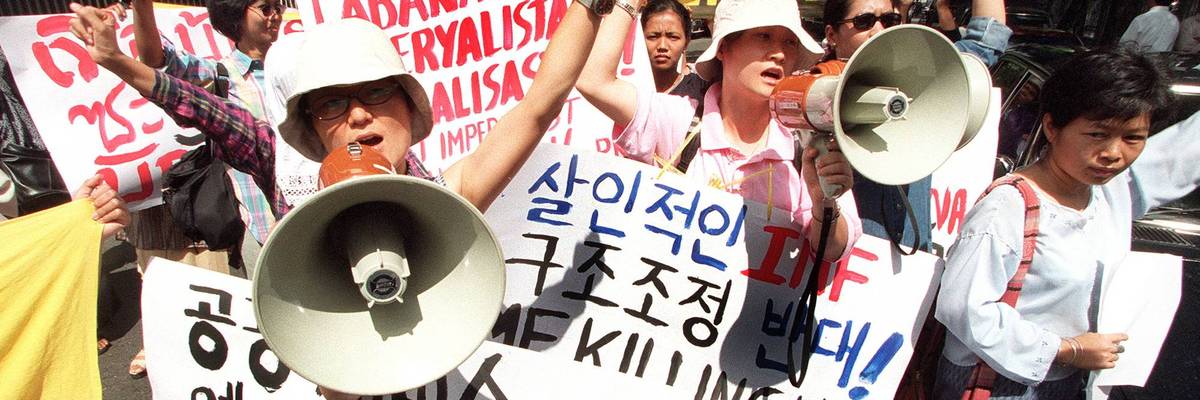
Female protesters claiming they represent women farmers from Laos, Indonesia, Vietnam, Malaysia, South Korea, Japan, and Thailand stage a peaceful demonstration against the International Monetary Fund and World Bank in front of the Bank of Thailand headquarters in Bangkok on August, 13 1999.
From October 12-18, 2026, the World Bank and IMF will hold their Annual Meetings in Thailand. Assembly of the Poor will mobilize to demonstrate that their policy prescriptions have inflicted severe harm on our people from the past to the present, and threaten our future.
Following World War II, the United States played a pivotal role in establishing the World Bank and the International Monetary Fundm or IMF. Originally tasked with post-war reconstruction, their focus soon shifted toward development aid for developing countries, including Thailand. In 1961, these two institutions guided the drafting of Thailand’s First National Economic Development Plan. They recommended large-scale infrastructure investments—ports, highways, and mega-dams—alongside import-substitution industrialization, agricultural reform through technology, chemical inputs, and genetic improvement of crops and livestock, as well as logging concessions aimed at generating national revenue. Land allocation programs were also introduced. Together, these policies triggered transformations that severely disrupted the livelihoods of smallholder farmers and peasants.
The recommendations of both institutions led directly to widespread deforestation and the destruction of natural resources through logging concessions and hydroelectric dam projects. Agricultural reforms degraded local ecosystems and drove up production costs while crop prices plummeted, pushing farmers into staggering debt and bankruptcy. Land allocation programs largely failed the rural poor; title deeds fell predominantly into the hands of bureaucrats, state officials, and wealthy investors. Smallholder farmers and peasants who did receive plots were left to clear and cultivate the land without government support, ultimately forcing many to abandon their holdings. A considerable number of people migrated to urban centers as cheap labor, crowding into slums area, facing homelessness, and becoming landless.
Development under the guidance of the World Bank and the IMF continued under subsequent National Economic and Social Development Plans—now in their 13th plan—yet consistently disregarded the poor. The two institutions hold joint Annual Meetings worldwide, having convened in Thailand for the first time in 1991. That same year, the World Bank approved a loan for the Pak Mun Dam in Ubon Ratchathani Province despite fierce opposition from many local villagers and civil society groups. The fallout from the dam was devastating: destroyed fisheries, extinction of fish species, community conflict and division, and electricity generation that fell far short of projections. It remains an indelible stain left by the World Bank in Thailand—one notably absent from its official history.
We reaffirm that genuine development must respect community rights over land, soil, water, and forests, uphold food sovereignty, and guarantee universal welfare as a fundamental human right.
The consequences of these development frameworks stirred widespread hardship among small-scale farmers, igniting protests, petitions, and grassroots resistance against top-down development in every nook and cranny. Escalating tensions between rural communities and the state led to arrests, prosecutions, violent crackdowns, and in some instances, the assassination of grassroots leaders. In December 1995, villagers impacted by dam constructions, communities evicted from forest areas, residents affected by the construction of an industrial plant, small-scale fishers affected by commercial fishing, marginalized workers, and slum dwellers gathered at Thammasat University and they announced the establishment of the “Assembly of the Poor” on December 10, 1995. The Assembly of the Poor moved their assembly to Khong Chiam District in Ubon Ratchathani Province, along the banks of the Mun River, where they drafted the "Pak Mun Declaration." The declaration proclaimed that local communities had been systematically impoverished by developmental policies that ignored their existence—leaving them poor not only economically, but impoverished in rights, opportunities, and political power. They declared that they had been made poor and would rise up to fight and demand that the state resolve their poverty.
Just two years later, during the 1997 Asian Financial Crisis (the "Tom Yum Kung Crisis"), the IMF stepped in with a bailout package for Thailand. To ensure rapid debt repayment, the IMF imposed stringent conditions: passing laws to regulate water usage, privatizing state enterprises to reduce public spending and boost revenue, and enacting legislation to remove universities and hospitals from the civil service system. These policies directly burdened the poor and sparked widespread popular resistance.
On September 3 this year, the World Bank released its report titled Building Thailand’s Future Today, declaring that poverty in Thailand had been virtually eradicated and touting a vision to elevate Thailand to a "high-income country" by 2037 through investment in five future industries. For the Assembly of the Poor, this represents a new wave of resource grabbing: data Center projects consuming massive amounts of water and electric power at the expense of local communities; green economy agendas and carbon credits threatening community rights; luxury tourism displacing Indigenous settlements; free trade agreements undermining local seed sovereignty; and transit-oriented developments displacing the urban poor. The report also urged immediate policy recommendations to establish legal and institutional frameworks for economic corridors beyond the Eastern Economic Corridor (EEC), paving the way for continuous, long-term structural development.
Compounding this, the IMF instructed the Thai government to abandon universal social welfare in favor of "targeted welfare" to maintain fiscal discipline—forcing vulnerable citizens to undergo demeaning "poverty testing" to access basic welfare benefits. The Thai government swiftly embraced these recommendations and accelerated projects aligned with both institutions, once again shifting the burden onto the poor and small-scale farmers. This is not building the nation's future; it is mortgaging it to international capital under a development paradigm that has dominated Thailand since its First National Economic and Social Development Plans, keeping citizens impoverished in rights, opportunities, and political power for over seven decades.
From October 12-18, 2026, the World Bank and IMF will hold their Annual Meetings in Thailand once again. Assembly of the Poor will mobilize to demonstrate that their policy prescriptions have inflicted severe harm on our people from the past to the present, and threaten our future. We reaffirm that genuine development must respect community rights over land, soil, water, and forests, uphold food sovereignty, and guarantee universal welfare as a fundamental human right. What is happening in Thailand is not an isolated story; it is part of a global neoliberal model through which international financial institutions strip developing nations, the poor, and peasants of their policy sovereignty. Our mobilization during the 2026 World Bank-IMF Annual Meetings in Bangkok is an international struggle to expose these policies, demand accountability, and reclaim policy sovereignty for the people.
Dear Common Dreams reader, It’s been nearly 30 years since I co-founded Common Dreams with my late wife, Lina Newhouser. We had the radical notion that journalism should serve the public good, not corporate profits. It was clear to us from the outset what it would take to build such a project. No paid advertisements. No corporate sponsors. No millionaire publisher telling us what to think or do. Many people said we wouldn't last a year, but we proved those doubters wrong. Together with a tremendous team of journalists and dedicated staff, we built an independent media outlet free from the constraints of profits and corporate control. Our mission has always been simple: To inform. To inspire. To ignite change for the common good. Building Common Dreams was not easy. Our survival was never guaranteed. When you take on the most powerful forces—Wall Street greed, fossil fuel industry destruction, Big Tech lobbyists, and uber-rich oligarchs who have spent billions upon billions rigging the economy and democracy in their favor—the only bulwark you have is supporters who believe in your work. But here’s the urgent message from me today. It's never been this bad out there. And it's never been this hard to keep us going. At the very moment Common Dreams is most needed, the threats we face are intensifying. We need your support now more than ever. We don't accept corporate advertising and never will. We don't have a paywall because we don't think people should be blocked from critical news based on their ability to pay. Everything we do is funded by the donations of readers like you. When everyone does the little they can afford, we are strong. But if that support retreats or dries up, so do we. Will you donate now to make sure Common Dreams not only survives but thrives? —Craig Brown, Co-founder |
Following World War II, the United States played a pivotal role in establishing the World Bank and the International Monetary Fundm or IMF. Originally tasked with post-war reconstruction, their focus soon shifted toward development aid for developing countries, including Thailand. In 1961, these two institutions guided the drafting of Thailand’s First National Economic Development Plan. They recommended large-scale infrastructure investments—ports, highways, and mega-dams—alongside import-substitution industrialization, agricultural reform through technology, chemical inputs, and genetic improvement of crops and livestock, as well as logging concessions aimed at generating national revenue. Land allocation programs were also introduced. Together, these policies triggered transformations that severely disrupted the livelihoods of smallholder farmers and peasants.
The recommendations of both institutions led directly to widespread deforestation and the destruction of natural resources through logging concessions and hydroelectric dam projects. Agricultural reforms degraded local ecosystems and drove up production costs while crop prices plummeted, pushing farmers into staggering debt and bankruptcy. Land allocation programs largely failed the rural poor; title deeds fell predominantly into the hands of bureaucrats, state officials, and wealthy investors. Smallholder farmers and peasants who did receive plots were left to clear and cultivate the land without government support, ultimately forcing many to abandon their holdings. A considerable number of people migrated to urban centers as cheap labor, crowding into slums area, facing homelessness, and becoming landless.
Development under the guidance of the World Bank and the IMF continued under subsequent National Economic and Social Development Plans—now in their 13th plan—yet consistently disregarded the poor. The two institutions hold joint Annual Meetings worldwide, having convened in Thailand for the first time in 1991. That same year, the World Bank approved a loan for the Pak Mun Dam in Ubon Ratchathani Province despite fierce opposition from many local villagers and civil society groups. The fallout from the dam was devastating: destroyed fisheries, extinction of fish species, community conflict and division, and electricity generation that fell far short of projections. It remains an indelible stain left by the World Bank in Thailand—one notably absent from its official history.
We reaffirm that genuine development must respect community rights over land, soil, water, and forests, uphold food sovereignty, and guarantee universal welfare as a fundamental human right.
The consequences of these development frameworks stirred widespread hardship among small-scale farmers, igniting protests, petitions, and grassroots resistance against top-down development in every nook and cranny. Escalating tensions between rural communities and the state led to arrests, prosecutions, violent crackdowns, and in some instances, the assassination of grassroots leaders. In December 1995, villagers impacted by dam constructions, communities evicted from forest areas, residents affected by the construction of an industrial plant, small-scale fishers affected by commercial fishing, marginalized workers, and slum dwellers gathered at Thammasat University and they announced the establishment of the “Assembly of the Poor” on December 10, 1995. The Assembly of the Poor moved their assembly to Khong Chiam District in Ubon Ratchathani Province, along the banks of the Mun River, where they drafted the "Pak Mun Declaration." The declaration proclaimed that local communities had been systematically impoverished by developmental policies that ignored their existence—leaving them poor not only economically, but impoverished in rights, opportunities, and political power. They declared that they had been made poor and would rise up to fight and demand that the state resolve their poverty.
Just two years later, during the 1997 Asian Financial Crisis (the "Tom Yum Kung Crisis"), the IMF stepped in with a bailout package for Thailand. To ensure rapid debt repayment, the IMF imposed stringent conditions: passing laws to regulate water usage, privatizing state enterprises to reduce public spending and boost revenue, and enacting legislation to remove universities and hospitals from the civil service system. These policies directly burdened the poor and sparked widespread popular resistance.
On September 3 this year, the World Bank released its report titled Building Thailand’s Future Today, declaring that poverty in Thailand had been virtually eradicated and touting a vision to elevate Thailand to a "high-income country" by 2037 through investment in five future industries. For the Assembly of the Poor, this represents a new wave of resource grabbing: data Center projects consuming massive amounts of water and electric power at the expense of local communities; green economy agendas and carbon credits threatening community rights; luxury tourism displacing Indigenous settlements; free trade agreements undermining local seed sovereignty; and transit-oriented developments displacing the urban poor. The report also urged immediate policy recommendations to establish legal and institutional frameworks for economic corridors beyond the Eastern Economic Corridor (EEC), paving the way for continuous, long-term structural development.
Compounding this, the IMF instructed the Thai government to abandon universal social welfare in favor of "targeted welfare" to maintain fiscal discipline—forcing vulnerable citizens to undergo demeaning "poverty testing" to access basic welfare benefits. The Thai government swiftly embraced these recommendations and accelerated projects aligned with both institutions, once again shifting the burden onto the poor and small-scale farmers. This is not building the nation's future; it is mortgaging it to international capital under a development paradigm that has dominated Thailand since its First National Economic and Social Development Plans, keeping citizens impoverished in rights, opportunities, and political power for over seven decades.
From October 12-18, 2026, the World Bank and IMF will hold their Annual Meetings in Thailand once again. Assembly of the Poor will mobilize to demonstrate that their policy prescriptions have inflicted severe harm on our people from the past to the present, and threaten our future. We reaffirm that genuine development must respect community rights over land, soil, water, and forests, uphold food sovereignty, and guarantee universal welfare as a fundamental human right. What is happening in Thailand is not an isolated story; it is part of a global neoliberal model through which international financial institutions strip developing nations, the poor, and peasants of their policy sovereignty. Our mobilization during the 2026 World Bank-IMF Annual Meetings in Bangkok is an international struggle to expose these policies, demand accountability, and reclaim policy sovereignty for the people.
Following World War II, the United States played a pivotal role in establishing the World Bank and the International Monetary Fundm or IMF. Originally tasked with post-war reconstruction, their focus soon shifted toward development aid for developing countries, including Thailand. In 1961, these two institutions guided the drafting of Thailand’s First National Economic Development Plan. They recommended large-scale infrastructure investments—ports, highways, and mega-dams—alongside import-substitution industrialization, agricultural reform through technology, chemical inputs, and genetic improvement of crops and livestock, as well as logging concessions aimed at generating national revenue. Land allocation programs were also introduced. Together, these policies triggered transformations that severely disrupted the livelihoods of smallholder farmers and peasants.
The recommendations of both institutions led directly to widespread deforestation and the destruction of natural resources through logging concessions and hydroelectric dam projects. Agricultural reforms degraded local ecosystems and drove up production costs while crop prices plummeted, pushing farmers into staggering debt and bankruptcy. Land allocation programs largely failed the rural poor; title deeds fell predominantly into the hands of bureaucrats, state officials, and wealthy investors. Smallholder farmers and peasants who did receive plots were left to clear and cultivate the land without government support, ultimately forcing many to abandon their holdings. A considerable number of people migrated to urban centers as cheap labor, crowding into slums area, facing homelessness, and becoming landless.
Development under the guidance of the World Bank and the IMF continued under subsequent National Economic and Social Development Plans—now in their 13th plan—yet consistently disregarded the poor. The two institutions hold joint Annual Meetings worldwide, having convened in Thailand for the first time in 1991. That same year, the World Bank approved a loan for the Pak Mun Dam in Ubon Ratchathani Province despite fierce opposition from many local villagers and civil society groups. The fallout from the dam was devastating: destroyed fisheries, extinction of fish species, community conflict and division, and electricity generation that fell far short of projections. It remains an indelible stain left by the World Bank in Thailand—one notably absent from its official history.
We reaffirm that genuine development must respect community rights over land, soil, water, and forests, uphold food sovereignty, and guarantee universal welfare as a fundamental human right.
The consequences of these development frameworks stirred widespread hardship among small-scale farmers, igniting protests, petitions, and grassroots resistance against top-down development in every nook and cranny. Escalating tensions between rural communities and the state led to arrests, prosecutions, violent crackdowns, and in some instances, the assassination of grassroots leaders. In December 1995, villagers impacted by dam constructions, communities evicted from forest areas, residents affected by the construction of an industrial plant, small-scale fishers affected by commercial fishing, marginalized workers, and slum dwellers gathered at Thammasat University and they announced the establishment of the “Assembly of the Poor” on December 10, 1995. The Assembly of the Poor moved their assembly to Khong Chiam District in Ubon Ratchathani Province, along the banks of the Mun River, where they drafted the "Pak Mun Declaration." The declaration proclaimed that local communities had been systematically impoverished by developmental policies that ignored their existence—leaving them poor not only economically, but impoverished in rights, opportunities, and political power. They declared that they had been made poor and would rise up to fight and demand that the state resolve their poverty.
Just two years later, during the 1997 Asian Financial Crisis (the "Tom Yum Kung Crisis"), the IMF stepped in with a bailout package for Thailand. To ensure rapid debt repayment, the IMF imposed stringent conditions: passing laws to regulate water usage, privatizing state enterprises to reduce public spending and boost revenue, and enacting legislation to remove universities and hospitals from the civil service system. These policies directly burdened the poor and sparked widespread popular resistance.
On September 3 this year, the World Bank released its report titled Building Thailand’s Future Today, declaring that poverty in Thailand had been virtually eradicated and touting a vision to elevate Thailand to a "high-income country" by 2037 through investment in five future industries. For the Assembly of the Poor, this represents a new wave of resource grabbing: data Center projects consuming massive amounts of water and electric power at the expense of local communities; green economy agendas and carbon credits threatening community rights; luxury tourism displacing Indigenous settlements; free trade agreements undermining local seed sovereignty; and transit-oriented developments displacing the urban poor. The report also urged immediate policy recommendations to establish legal and institutional frameworks for economic corridors beyond the Eastern Economic Corridor (EEC), paving the way for continuous, long-term structural development.
Compounding this, the IMF instructed the Thai government to abandon universal social welfare in favor of "targeted welfare" to maintain fiscal discipline—forcing vulnerable citizens to undergo demeaning "poverty testing" to access basic welfare benefits. The Thai government swiftly embraced these recommendations and accelerated projects aligned with both institutions, once again shifting the burden onto the poor and small-scale farmers. This is not building the nation's future; it is mortgaging it to international capital under a development paradigm that has dominated Thailand since its First National Economic and Social Development Plans, keeping citizens impoverished in rights, opportunities, and political power for over seven decades.
From October 12-18, 2026, the World Bank and IMF will hold their Annual Meetings in Thailand once again. Assembly of the Poor will mobilize to demonstrate that their policy prescriptions have inflicted severe harm on our people from the past to the present, and threaten our future. We reaffirm that genuine development must respect community rights over land, soil, water, and forests, uphold food sovereignty, and guarantee universal welfare as a fundamental human right. What is happening in Thailand is not an isolated story; it is part of a global neoliberal model through which international financial institutions strip developing nations, the poor, and peasants of their policy sovereignty. Our mobilization during the 2026 World Bank-IMF Annual Meetings in Bangkok is an international struggle to expose these policies, demand accountability, and reclaim policy sovereignty for the people.