SUBSCRIBE TO OUR FREE NEWSLETTER
Daily news & progressive opinion—funded by the people, not the corporations—delivered straight to your inbox.
5
#000000
#FFFFFF
To donate by check, phone, or other method, see our More Ways to Give page.
Daily news & progressive opinion—funded by the people, not the corporations—delivered straight to your inbox.
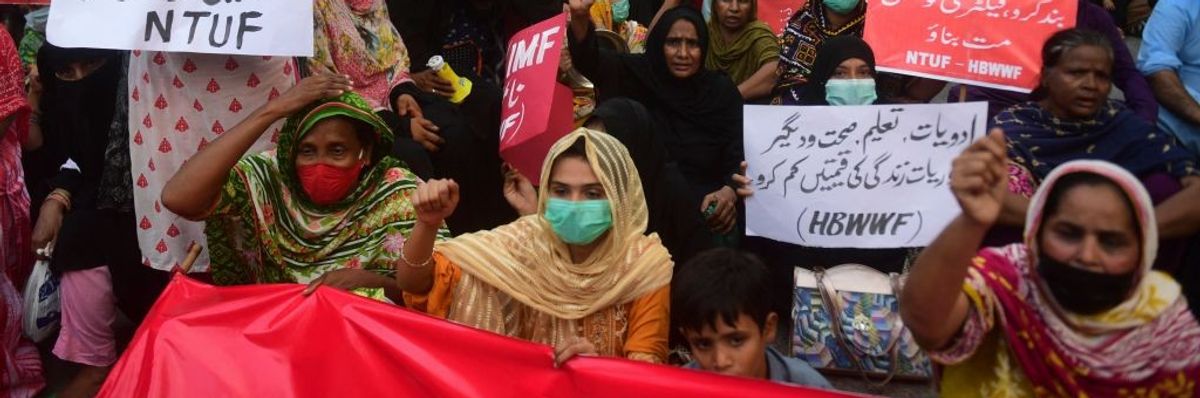
Activists of trade and labor unions protest against Pakistan's high inflation rates, the World bank and the International Monetary Fund in Karachi on October 7, 2021.
Human Rights Watch looked at 39 loans in 38 countries since the start of the pandemic, and found that 30 of them contained at least one term that threatened human rights.
The International Monetary Fund continues to impose austerity measures that threaten human rights.
That's the conclusion of a Human Rights Watch (HRW) report published Monday that looks at 39 loans approved in 38 countries between the beginning of the Covid-19 lockdowns in March 2020 and March 2023. While, at the start of the pandemic, IMF managing director Kristalina Georgieva spoke of investing in a recovery that was "greener, smarter, and fairer," the majority of the loans reviewed by HRW still included requirements like lower government spending or higher regressive taxes.
"Despite its promises at the beginning of the pandemic to learn from past mistakes, the IMF is pushing policies that have a long track record of exacerbating poverty and inequality and undermining rights," HRW senior researcher and advocate on economic justice and rights Sarah Saadoun said in a statement.
The loans considered in the HRW report impacted countries home to 1.1 billion people, and 30 of them had at least one requirement that put their rights at risk. Twenty-two of them included limits on public wage bills, 23 included regressive value-added taxes, and 20 decreased or eliminated subsidies for fuel or electricity.
While HRW acknowledged that eliminating fossil fuel subsidies is a necessary part of the transition to renewable energy, this needs to be done in a way that takes the needs of the poorest into account. For example, Saadoun told Euronews of a woman who works seven days a week as a domestic worker in Sri Lanka.
"The impact of the economic crisis there meant her earnings were essentially cut in half. On top of that, in an effort to reduce public spending, the government cut subsidies for electricity," she said. "She and her son had to move in with her mother, meaning that she is completely dependent on her relatives and her employer to survive."
"I can either get medicine (insulin) for my diabetes or pay for my daughter to go to school or keep the lights on at my house."
HRW argues that both the IMF and the governments they loan to have an obligation to address economic crises in ways that further, rather than retrench on, human rights. At the same time, the IMF's austerity measures fail at its own goal of reducing debt. Its April 2023 World Economic Outlook concluded that they "do not reduce debt ratios, on average."
The report looked at the case of Jordan, which has received IMF loans since 2012, yet has a higher debt-to-gross-domestic-product ratio than at the beginning.
Jordan is also an example of how one measure the IMF has introduced to offset the harm of austerity is insufficient. The IMF has taken to relying on social spending floors or means-tested relief programs. Jordan, for example, instituted a cash-transfer program called Takaful in 2019. While poverty in Jordan increased from 15 to 24% between 2018 and 2022, the program only aided approximately 5% of total Jordanians in 2022, or around 20% of those struggling with poverty.
"While the spending floor and Takaful were an improvement over the earlier programs, they are a bandage on a bullet wound," the report authors wrote. "The reforms generated billions in savings and new revenues through measures that increased the cost of living, yet public spending on health, education, and social assistance did not increase as a percentage of the budget."
HRW had several recommendations for what the IMF could do to reform its programs to bolster human rights. They include conducting human rights assessments of the impacts of these programs, setting different social spending floors for essential services such as health and education, and replacing means-tested programs with universal protections.
If these changes are not adopted, Pakistan offers a warning example. There, a July 2022 agreement between the IMF and the government stipulated higher taxes, a market-based exchange rate, and an end to subsidies for energy and fuel, as HRW pointed out.
"I can either get medicine (insulin) for my diabetes or pay for my daughter to go to school or keep the lights on at my house," a 47-year-old Lahore rickshaw driver told HRW. "I can do only one of the three. The IMF should come and see how I am managing my life."
Dear Common Dreams reader, It’s been nearly 30 years since I co-founded Common Dreams with my late wife, Lina Newhouser. We had the radical notion that journalism should serve the public good, not corporate profits. It was clear to us from the outset what it would take to build such a project. No paid advertisements. No corporate sponsors. No millionaire publisher telling us what to think or do. Many people said we wouldn't last a year, but we proved those doubters wrong. Together with a tremendous team of journalists and dedicated staff, we built an independent media outlet free from the constraints of profits and corporate control. Our mission has always been simple: To inform. To inspire. To ignite change for the common good. Building Common Dreams was not easy. Our survival was never guaranteed. When you take on the most powerful forces—Wall Street greed, fossil fuel industry destruction, Big Tech lobbyists, and uber-rich oligarchs who have spent billions upon billions rigging the economy and democracy in their favor—the only bulwark you have is supporters who believe in your work. But here’s the urgent message from me today. It's never been this bad out there. And it's never been this hard to keep us going. At the very moment Common Dreams is most needed, the threats we face are intensifying. We need your support now more than ever. We don't accept corporate advertising and never will. We don't have a paywall because we don't think people should be blocked from critical news based on their ability to pay. Everything we do is funded by the donations of readers like you. When everyone does the little they can afford, we are strong. But if that support retreats or dries up, so do we. Will you donate now to make sure Common Dreams not only survives but thrives? —Craig Brown, Co-founder |
The International Monetary Fund continues to impose austerity measures that threaten human rights.
That's the conclusion of a Human Rights Watch (HRW) report published Monday that looks at 39 loans approved in 38 countries between the beginning of the Covid-19 lockdowns in March 2020 and March 2023. While, at the start of the pandemic, IMF managing director Kristalina Georgieva spoke of investing in a recovery that was "greener, smarter, and fairer," the majority of the loans reviewed by HRW still included requirements like lower government spending or higher regressive taxes.
"Despite its promises at the beginning of the pandemic to learn from past mistakes, the IMF is pushing policies that have a long track record of exacerbating poverty and inequality and undermining rights," HRW senior researcher and advocate on economic justice and rights Sarah Saadoun said in a statement.
The loans considered in the HRW report impacted countries home to 1.1 billion people, and 30 of them had at least one requirement that put their rights at risk. Twenty-two of them included limits on public wage bills, 23 included regressive value-added taxes, and 20 decreased or eliminated subsidies for fuel or electricity.
While HRW acknowledged that eliminating fossil fuel subsidies is a necessary part of the transition to renewable energy, this needs to be done in a way that takes the needs of the poorest into account. For example, Saadoun told Euronews of a woman who works seven days a week as a domestic worker in Sri Lanka.
"The impact of the economic crisis there meant her earnings were essentially cut in half. On top of that, in an effort to reduce public spending, the government cut subsidies for electricity," she said. "She and her son had to move in with her mother, meaning that she is completely dependent on her relatives and her employer to survive."
"I can either get medicine (insulin) for my diabetes or pay for my daughter to go to school or keep the lights on at my house."
HRW argues that both the IMF and the governments they loan to have an obligation to address economic crises in ways that further, rather than retrench on, human rights. At the same time, the IMF's austerity measures fail at its own goal of reducing debt. Its April 2023 World Economic Outlook concluded that they "do not reduce debt ratios, on average."
The report looked at the case of Jordan, which has received IMF loans since 2012, yet has a higher debt-to-gross-domestic-product ratio than at the beginning.
Jordan is also an example of how one measure the IMF has introduced to offset the harm of austerity is insufficient. The IMF has taken to relying on social spending floors or means-tested relief programs. Jordan, for example, instituted a cash-transfer program called Takaful in 2019. While poverty in Jordan increased from 15 to 24% between 2018 and 2022, the program only aided approximately 5% of total Jordanians in 2022, or around 20% of those struggling with poverty.
"While the spending floor and Takaful were an improvement over the earlier programs, they are a bandage on a bullet wound," the report authors wrote. "The reforms generated billions in savings and new revenues through measures that increased the cost of living, yet public spending on health, education, and social assistance did not increase as a percentage of the budget."
HRW had several recommendations for what the IMF could do to reform its programs to bolster human rights. They include conducting human rights assessments of the impacts of these programs, setting different social spending floors for essential services such as health and education, and replacing means-tested programs with universal protections.
If these changes are not adopted, Pakistan offers a warning example. There, a July 2022 agreement between the IMF and the government stipulated higher taxes, a market-based exchange rate, and an end to subsidies for energy and fuel, as HRW pointed out.
"I can either get medicine (insulin) for my diabetes or pay for my daughter to go to school or keep the lights on at my house," a 47-year-old Lahore rickshaw driver told HRW. "I can do only one of the three. The IMF should come and see how I am managing my life."
The International Monetary Fund continues to impose austerity measures that threaten human rights.
That's the conclusion of a Human Rights Watch (HRW) report published Monday that looks at 39 loans approved in 38 countries between the beginning of the Covid-19 lockdowns in March 2020 and March 2023. While, at the start of the pandemic, IMF managing director Kristalina Georgieva spoke of investing in a recovery that was "greener, smarter, and fairer," the majority of the loans reviewed by HRW still included requirements like lower government spending or higher regressive taxes.
"Despite its promises at the beginning of the pandemic to learn from past mistakes, the IMF is pushing policies that have a long track record of exacerbating poverty and inequality and undermining rights," HRW senior researcher and advocate on economic justice and rights Sarah Saadoun said in a statement.
The loans considered in the HRW report impacted countries home to 1.1 billion people, and 30 of them had at least one requirement that put their rights at risk. Twenty-two of them included limits on public wage bills, 23 included regressive value-added taxes, and 20 decreased or eliminated subsidies for fuel or electricity.
While HRW acknowledged that eliminating fossil fuel subsidies is a necessary part of the transition to renewable energy, this needs to be done in a way that takes the needs of the poorest into account. For example, Saadoun told Euronews of a woman who works seven days a week as a domestic worker in Sri Lanka.
"The impact of the economic crisis there meant her earnings were essentially cut in half. On top of that, in an effort to reduce public spending, the government cut subsidies for electricity," she said. "She and her son had to move in with her mother, meaning that she is completely dependent on her relatives and her employer to survive."
"I can either get medicine (insulin) for my diabetes or pay for my daughter to go to school or keep the lights on at my house."
HRW argues that both the IMF and the governments they loan to have an obligation to address economic crises in ways that further, rather than retrench on, human rights. At the same time, the IMF's austerity measures fail at its own goal of reducing debt. Its April 2023 World Economic Outlook concluded that they "do not reduce debt ratios, on average."
The report looked at the case of Jordan, which has received IMF loans since 2012, yet has a higher debt-to-gross-domestic-product ratio than at the beginning.
Jordan is also an example of how one measure the IMF has introduced to offset the harm of austerity is insufficient. The IMF has taken to relying on social spending floors or means-tested relief programs. Jordan, for example, instituted a cash-transfer program called Takaful in 2019. While poverty in Jordan increased from 15 to 24% between 2018 and 2022, the program only aided approximately 5% of total Jordanians in 2022, or around 20% of those struggling with poverty.
"While the spending floor and Takaful were an improvement over the earlier programs, they are a bandage on a bullet wound," the report authors wrote. "The reforms generated billions in savings and new revenues through measures that increased the cost of living, yet public spending on health, education, and social assistance did not increase as a percentage of the budget."
HRW had several recommendations for what the IMF could do to reform its programs to bolster human rights. They include conducting human rights assessments of the impacts of these programs, setting different social spending floors for essential services such as health and education, and replacing means-tested programs with universal protections.
If these changes are not adopted, Pakistan offers a warning example. There, a July 2022 agreement between the IMF and the government stipulated higher taxes, a market-based exchange rate, and an end to subsidies for energy and fuel, as HRW pointed out.
"I can either get medicine (insulin) for my diabetes or pay for my daughter to go to school or keep the lights on at my house," a 47-year-old Lahore rickshaw driver told HRW. "I can do only one of the three. The IMF should come and see how I am managing my life."