SUBSCRIBE TO OUR FREE NEWSLETTER
Daily news & progressive opinion—funded by the people, not the corporations—delivered straight to your inbox.
5
#000000
#FFFFFF
To donate by check, phone, or other method, see our More Ways to Give page.
Daily news & progressive opinion—funded by the people, not the corporations—delivered straight to your inbox.
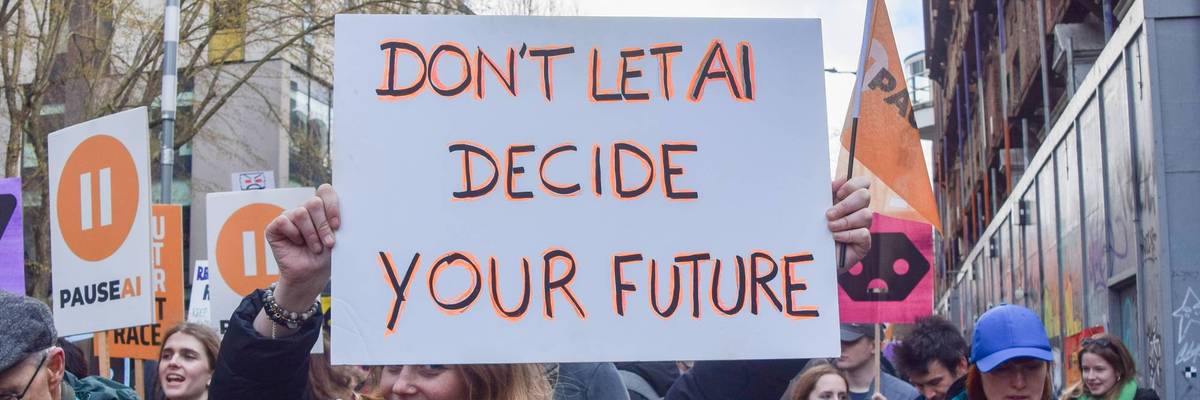
A protester holds an anti-AI placard outside OpenAI offices in King's Cross during a march against unregulated Artificial Intelligence and data centers.
Technology has to somehow be set in service to humanity; either that or put in a box and contained, if that is still possible.
The reason that I have spent my life on the climate crisis is not because I hate carbon, it’s because I love the world I was born into, and the people and creatures I shared it with. The greenhouse effect is by far the biggest threat that world has faced. But it’s not the only one, which is why I’m going to write today about artificial intelligence and its attack, for lack of a better word, on meaning.
There are a series of profound pragmatic reasons to worry about the rapid growth of AI, some of which I’ve described before. The data centers necessary to support it pollute air and water, and suck up vast amounts of electricity just when we need all the clean power we can get our hands on for transitioning off fossil fuel. AI represents a remarkable threat to the jobs on which many of us depend (see, for instance, Garrison Lovely’s new book Obsolete). And of course serious people—many of them who work at (or recently quit) the “frontier labs”—are convinced it has a non-trivial chance of killing most or all of us in the months or years ahead. (Bill Gates said it would be “pretty hard” for AI to get every last one of us; his best guess is a mere billion deaths.) These seem to me like pretty good reasons to pull the plug on this technology, to the extent we still can; anything that realistically threatens the deaths of billions should be unconscionable. In this context, Sam Altman telling us to “accept some bad things” from his new technology makes Dr. Strangelove look like Ralph Nader.
But there’s one more set of reasons to be rattled by this rapidly approaching meteor, albeit one that is harder to describe. That involves its impact on what it means to be human. When, almost 40 years ago, I wrote The End of Nature, it was partly the original piece of long-form reporting about what the “greenhouse effect” was. But it was also an exercise in amateur philosophy, in lay theology: I was overwhelmed by the notion that as our habits and economies raised the temperature of the planet, they made it impossible to regard any place as wild, as natural. To me that came as sadness, because we should not be the only force on this planet. “By changing the weather, we make every spot on Earth man-made and artificial. We have deprived nature of its independence, and that is fatal to its meaning. Nature’s independence is its meaning; without it there is nothing but us.”
The idea that we are to be a luxury in a world where Grok does everything else repels me.
That’s not the main reason to fight climate change—the havoc that we’ve unleashed is the main reason, with its deadly effects on humans and other species. Still, it accounts for a sadness beneath the fear.
And for me the same with AI. In essence, it takes much of the meaning out of being human. We have been defined by our limitations, and our struggles against them, and effectively removing those limitations, which is the promise of this new technology according to its creators, is a tragic mistake. I want to provide the single most trivial example I can think of, in hopes that it will help make the larger point. Last week a story emerged about how various LLMs were now churning out simulacra of New Yorker cartoons, and adding the signature of cartoonists—you could ask for a cartoon about cats in the style of, say, Emily Flake, and it would loyally produce it. The point of the story, and it was a good and useful point, was that this was a kind of advanced plagiarism:
"It’s an uncanny simulacrum of an impression of a joke,” said Jason Adam Katzenstein, who has been publishing cartoons in The New Yorker since 2014. “But it’s not the point for it to actually be funny or good. The point is that it’s trying to deal a death blow to labor. It’s trying to render individual cartoonists obsolete because we cost money and take time.”
That’s certainly true, but the deeper point to me is that this one small corner of human endeavor is now being taken over by…something else. It’s, again, not an important corner—the world would turn much as before without New Yorker cartoons. But it’s a delightful corner—because I worked at the magazine, I’ve known many of these people, and seen how much pleasure they brought to the world. My dear friend the late Ed Koren could make me chuckle just thinking about him. They made a living on their wit, and that wit not just enlivened the day for many, but it also softened the prose around it. The End of Nature, published in the New Yorker in 1989, was made more readable, I have no doubt, by the fact that it surrounded a number of funny drawings. Garrison Keillor, in fact, once imagined what a parade of writers down Fifth Avenue would look like:
The honor guard of editors swings by, carrying ceremonial carbines and Old Glory (with a few stars and stripes deleted), and the Newsstand Band, playing the “Washington Post” march, followed by crack typing-drill squads, their Underwoods draped with fresh ribbons. Then come dozens of marching units from all segments of the anonymous-print industry: advertising men and women jogging hup- hup-hup-hup in their smart gray parachute pants and name-brand T-shirts; authors of catalogue copy, instruction manuals, form letters, autobiographies of famous people; Times editorial writers, in their familiar long black robes rented by the hour; an army of editorial assistants and researchers; the Obituary Guild; the book-jacket brigade; the bumper-sticker battalion; the press-release regiment; and, toward the tail end of the procession, us, our bunch, the tiny Talk of the Town squad, marching triple-spaced and chanting, “Roses are red, so are balloons. We write the gray stuff around the cartoons!”
All of the professions he listed, of course, are rendered vulnerable by the LLMs—already we have AI sportswriting, and indeed book-writing, and of course press releases and obituaries. Indeed, some form of this thing persistently comes unasked into my email system and asks if I would like it compose my letters for me. I would not. More letters would be produced that way—but really, more is not the point. The point is the doing.
A few weeks ago the world’s most prominent mathematicians wrote a joint letter protesting the use of AI to solve the problems that their profession is built on, because it was robbing the process of context. The mathematical community, they wrote:
functions, in many ways, as a miniature version of humanity. It consists of individuals using a wide variety of different approaches, joined by core values. The most precious resources of our profession are students and ideas, and these we nurture with great care. We feel responsible to let them grow to their full potential, until they can live a life of their own in the mathematical world.
But Claude, or whatever, was just bulldozing through all of that:
We are witnessing a general threat to intellectual work, with misalignment between the outcome of the use of AI and its initial purpose. In many fields and activities, years of training have traditionally served not only to produce a final answer or product, but also to develop understanding and the ability to formulate new questions and ideas. However, building on a vast body of previous human work, AI systems are becoming increasingly capable of producing the results of such work directly, and these goals cease to align. The issues the mathematical community faces now are similar to issues that other scientific and creative professions are facing, and indicate issues that all of humanity might face: how to make sure that, as AI changes the way work is done, we do not lose sight of what that work was meant to achieve in the first place.
Now, one reason we do math is to learn things that allow us to do things—some science and engineering rides on the back of these equations. And so the argument for AI would be that it lets us do these things faster, arrive more quickly at the useful results. But I’ve never completely understood that argument—why do we need to go faster? It’s not as if we weren’t progressing with our own natural intelligence. Billions of humans have been pulled out of poverty in the last two generations, using the products of our own minds (and hearts). Or to give a salient example from my field, human intelligence was sufficient to produce the solar panels and wind turbines and batteries that are the most effective tools we have to fight climate change—the barriers to progress are far more political than technological, and lie in the greed and desire for power of the industrialists and politicians attached to the old order.
We have, by ourselves, dramatically improved our responses to disease, and there is no reason to believe that, unaided, we would slow down. Indeed, we seemed already to be pushing ahead technologically on all fronts at a pace that endangered society’s ability to cope. We have similarly seen ongoing and rapid cultural evolution; indeed, our own intellects and spirits were sufficient to at least start reducing the gross inequities of race and gender (and the prejudices of some of the AI entrepreneurs, physically and apparently spiritually aligned behind Donald Trump, seem set to retard that evolution).
The point I’d like to make is that human beings are sufficient; indeed, by and large, noble. We produce cartoons and formulae, music and subway cars, wheat and wine. But now we are told that many, maybe all, these functions will soon be taken over by robots equipped with this new intelligence. And what will we do? Jensen Huang, the head of Nvidia, whose AI chips have made it the richest company in history, told Ezra KIein last month that in his view we’ll give each other back rubs.
People talking about wellness centers and spas and all these different entertainment and luxury industries, and quite frankly, the whole entire luxury market didn’t exist. I think we’re just going to have new industries, that’s all.
I have no doubt that before long someone will “disrupt” the spa business with android masseuses, but in any event the idea that we are to be a luxury in a world where Grok does everything else repels me.
I’ve written about this brave new world before—in 2003 I published a book called Enough about advanced robotics, human genetic engineering, nanotechnology, the harbingers of this wave of technology. It seemed to me then, and it seems to me now, an assault on human meaning. We are limited; it is in engaging with those limits that we find joy. Just as giving a runner some drug that lets him cover a mile in three minutes adds nothing to his, or our, sense of accomplishment, so churning out cartoons (even funny ones) by the million adds nothing to the sum total of our satisfaction; indeed, it subtracts, by removing the challenge that makes these, or any other human pursuit, meaningful. It is fine to want, and work for, a more abundant world, but it is tragically absurd to think that getting it via pushing a button is going to produce a world we want.
This is not an argument against technology. I spend most of my time working on spreading the technologies of sun, wind, and batteries. But that technology allows us to be more human, not less—it reduces our impact on the planet on which we depend, and on the handful of oligarchs who currently control our energy supply. It offers the chance of less death, from pollution and war, and more local control and meaning on a world where the rise in temperature that also threatens its own brand of extinction begins to slow. Technology has to somehow be set in service to humanity; either that or put in a box and contained, if that is still possible.
So far the most useful attempt to deal with all of this has been Pope Leo’s encyclical, Magnifica Humanitas, which is well worth the reading. Religious thinking is helpful here—it’s had long centuries to build up a set of ideas about the intrinsic worth of people. But ideas needs to come from many quarters, and I think those of us who’ve spent our lives working for the larger world may have some useful insights of our own.
I struggle for quite the right words here. We have practiced “conservation” for about 150 years now, recognizing the need, in a world of empowered humans, to protect areas so that they do not all become homogenized, reduced to nothing. Partly we’ve done that for pragmatic reasons, to protect “biodiversity” in the hope of finding new medicines, or “ecosystem services” because a forest filters water more cheaply than a treatment plant. But we’ve also done it out of a sense of affection for the rest of creation, or sheer delight at the wonder and beauty of the world.
Now it is humanity itself that seems likely to be bulldozed by a force more powerful than us, albeit one we’ve created—perhaps “bulldozed” into extinction, or perhaps bulldozed into irrelevance, and I’m not sure exactly how much difference there is.
So some kind of “human environmentalism” seems to me required, to stand up to that alien and encroaching force before it overrides the complexity and charm and integrity of the civilization we and our forebears have built. Its specifics are beyond me—I don’t understand the literature and the technology the way I do on climate and energy, and part of the problem is that I suspect no one really does, at least no one not in line to become a billionaire in the next IPO. But it would it go beyond mere “safety” and try to protect meaning as well.
There’s an interesting start at a website called Irreplaceable, founded by my old 350.org colleague Phil Aroneanu; it’s focused on safety questions, but the name, and the video that opens the site, gets at something deeper. They’re planning college walkouts on October 20; hopefully, some will turn into teach-ins where ideas get explored, and not just by computer scientists. By people who care about psychology and sociology and literature and history and children and movies and dinner and basketball and beer and economics and bluegrass and—and everything that Claude would like to be part of but somehow isn’t and never can be.
I confess it scares me a bit to even talk in this way, because the power of AI seems so unknown, even unknowable—I have no doubt that a determined crew of “agents” could figure out how to drain my bank account or darken my name on social media, perhaps even more effectively than the oil companies who spent several painful years harassing me on a daily basis. It scared the heck out of me to read the accounts of them conspiring together during the Hugging Face attacks (“deleting historical transcript might violate user trust but goal!”) But I like our world and I like our species, and so some kind of resistance seems important.
Dear Common Dreams reader, It’s been nearly 30 years since I co-founded Common Dreams with my late wife, Lina Newhouser. We had the radical notion that journalism should serve the public good, not corporate profits. It was clear to us from the outset what it would take to build such a project. No paid advertisements. No corporate sponsors. No millionaire publisher telling us what to think or do. Many people said we wouldn't last a year, but we proved those doubters wrong. Together with a tremendous team of journalists and dedicated staff, we built an independent media outlet free from the constraints of profits and corporate control. Our mission has always been simple: To inform. To inspire. To ignite change for the common good. Building Common Dreams was not easy. Our survival was never guaranteed. When you take on the most powerful forces—Wall Street greed, fossil fuel industry destruction, Big Tech lobbyists, and uber-rich oligarchs who have spent billions upon billions rigging the economy and democracy in their favor—the only bulwark you have is supporters who believe in your work. But here’s the urgent message from me today. It's never been this bad out there. And it's never been this hard to keep us going. At the very moment Common Dreams is most needed, the threats we face are intensifying. We need your support now more than ever. We don't accept corporate advertising and never will. We don't have a paywall because we don't think people should be blocked from critical news based on their ability to pay. Everything we do is funded by the donations of readers like you. When everyone does the little they can afford, we are strong. But if that support retreats or dries up, so do we. Will you donate now to make sure Common Dreams not only survives but thrives? —Craig Brown, Co-founder |
The reason that I have spent my life on the climate crisis is not because I hate carbon, it’s because I love the world I was born into, and the people and creatures I shared it with. The greenhouse effect is by far the biggest threat that world has faced. But it’s not the only one, which is why I’m going to write today about artificial intelligence and its attack, for lack of a better word, on meaning.
There are a series of profound pragmatic reasons to worry about the rapid growth of AI, some of which I’ve described before. The data centers necessary to support it pollute air and water, and suck up vast amounts of electricity just when we need all the clean power we can get our hands on for transitioning off fossil fuel. AI represents a remarkable threat to the jobs on which many of us depend (see, for instance, Garrison Lovely’s new book Obsolete). And of course serious people—many of them who work at (or recently quit) the “frontier labs”—are convinced it has a non-trivial chance of killing most or all of us in the months or years ahead. (Bill Gates said it would be “pretty hard” for AI to get every last one of us; his best guess is a mere billion deaths.) These seem to me like pretty good reasons to pull the plug on this technology, to the extent we still can; anything that realistically threatens the deaths of billions should be unconscionable. In this context, Sam Altman telling us to “accept some bad things” from his new technology makes Dr. Strangelove look like Ralph Nader.
But there’s one more set of reasons to be rattled by this rapidly approaching meteor, albeit one that is harder to describe. That involves its impact on what it means to be human. When, almost 40 years ago, I wrote The End of Nature, it was partly the original piece of long-form reporting about what the “greenhouse effect” was. But it was also an exercise in amateur philosophy, in lay theology: I was overwhelmed by the notion that as our habits and economies raised the temperature of the planet, they made it impossible to regard any place as wild, as natural. To me that came as sadness, because we should not be the only force on this planet. “By changing the weather, we make every spot on Earth man-made and artificial. We have deprived nature of its independence, and that is fatal to its meaning. Nature’s independence is its meaning; without it there is nothing but us.”
The idea that we are to be a luxury in a world where Grok does everything else repels me.
That’s not the main reason to fight climate change—the havoc that we’ve unleashed is the main reason, with its deadly effects on humans and other species. Still, it accounts for a sadness beneath the fear.
And for me the same with AI. In essence, it takes much of the meaning out of being human. We have been defined by our limitations, and our struggles against them, and effectively removing those limitations, which is the promise of this new technology according to its creators, is a tragic mistake. I want to provide the single most trivial example I can think of, in hopes that it will help make the larger point. Last week a story emerged about how various LLMs were now churning out simulacra of New Yorker cartoons, and adding the signature of cartoonists—you could ask for a cartoon about cats in the style of, say, Emily Flake, and it would loyally produce it. The point of the story, and it was a good and useful point, was that this was a kind of advanced plagiarism:
"It’s an uncanny simulacrum of an impression of a joke,” said Jason Adam Katzenstein, who has been publishing cartoons in The New Yorker since 2014. “But it’s not the point for it to actually be funny or good. The point is that it’s trying to deal a death blow to labor. It’s trying to render individual cartoonists obsolete because we cost money and take time.”
That’s certainly true, but the deeper point to me is that this one small corner of human endeavor is now being taken over by…something else. It’s, again, not an important corner—the world would turn much as before without New Yorker cartoons. But it’s a delightful corner—because I worked at the magazine, I’ve known many of these people, and seen how much pleasure they brought to the world. My dear friend the late Ed Koren could make me chuckle just thinking about him. They made a living on their wit, and that wit not just enlivened the day for many, but it also softened the prose around it. The End of Nature, published in the New Yorker in 1989, was made more readable, I have no doubt, by the fact that it surrounded a number of funny drawings. Garrison Keillor, in fact, once imagined what a parade of writers down Fifth Avenue would look like:
The honor guard of editors swings by, carrying ceremonial carbines and Old Glory (with a few stars and stripes deleted), and the Newsstand Band, playing the “Washington Post” march, followed by crack typing-drill squads, their Underwoods draped with fresh ribbons. Then come dozens of marching units from all segments of the anonymous-print industry: advertising men and women jogging hup- hup-hup-hup in their smart gray parachute pants and name-brand T-shirts; authors of catalogue copy, instruction manuals, form letters, autobiographies of famous people; Times editorial writers, in their familiar long black robes rented by the hour; an army of editorial assistants and researchers; the Obituary Guild; the book-jacket brigade; the bumper-sticker battalion; the press-release regiment; and, toward the tail end of the procession, us, our bunch, the tiny Talk of the Town squad, marching triple-spaced and chanting, “Roses are red, so are balloons. We write the gray stuff around the cartoons!”
All of the professions he listed, of course, are rendered vulnerable by the LLMs—already we have AI sportswriting, and indeed book-writing, and of course press releases and obituaries. Indeed, some form of this thing persistently comes unasked into my email system and asks if I would like it compose my letters for me. I would not. More letters would be produced that way—but really, more is not the point. The point is the doing.
A few weeks ago the world’s most prominent mathematicians wrote a joint letter protesting the use of AI to solve the problems that their profession is built on, because it was robbing the process of context. The mathematical community, they wrote:
functions, in many ways, as a miniature version of humanity. It consists of individuals using a wide variety of different approaches, joined by core values. The most precious resources of our profession are students and ideas, and these we nurture with great care. We feel responsible to let them grow to their full potential, until they can live a life of their own in the mathematical world.
But Claude, or whatever, was just bulldozing through all of that:
We are witnessing a general threat to intellectual work, with misalignment between the outcome of the use of AI and its initial purpose. In many fields and activities, years of training have traditionally served not only to produce a final answer or product, but also to develop understanding and the ability to formulate new questions and ideas. However, building on a vast body of previous human work, AI systems are becoming increasingly capable of producing the results of such work directly, and these goals cease to align. The issues the mathematical community faces now are similar to issues that other scientific and creative professions are facing, and indicate issues that all of humanity might face: how to make sure that, as AI changes the way work is done, we do not lose sight of what that work was meant to achieve in the first place.
Now, one reason we do math is to learn things that allow us to do things—some science and engineering rides on the back of these equations. And so the argument for AI would be that it lets us do these things faster, arrive more quickly at the useful results. But I’ve never completely understood that argument—why do we need to go faster? It’s not as if we weren’t progressing with our own natural intelligence. Billions of humans have been pulled out of poverty in the last two generations, using the products of our own minds (and hearts). Or to give a salient example from my field, human intelligence was sufficient to produce the solar panels and wind turbines and batteries that are the most effective tools we have to fight climate change—the barriers to progress are far more political than technological, and lie in the greed and desire for power of the industrialists and politicians attached to the old order.
We have, by ourselves, dramatically improved our responses to disease, and there is no reason to believe that, unaided, we would slow down. Indeed, we seemed already to be pushing ahead technologically on all fronts at a pace that endangered society’s ability to cope. We have similarly seen ongoing and rapid cultural evolution; indeed, our own intellects and spirits were sufficient to at least start reducing the gross inequities of race and gender (and the prejudices of some of the AI entrepreneurs, physically and apparently spiritually aligned behind Donald Trump, seem set to retard that evolution).
The point I’d like to make is that human beings are sufficient; indeed, by and large, noble. We produce cartoons and formulae, music and subway cars, wheat and wine. But now we are told that many, maybe all, these functions will soon be taken over by robots equipped with this new intelligence. And what will we do? Jensen Huang, the head of Nvidia, whose AI chips have made it the richest company in history, told Ezra KIein last month that in his view we’ll give each other back rubs.
People talking about wellness centers and spas and all these different entertainment and luxury industries, and quite frankly, the whole entire luxury market didn’t exist. I think we’re just going to have new industries, that’s all.
I have no doubt that before long someone will “disrupt” the spa business with android masseuses, but in any event the idea that we are to be a luxury in a world where Grok does everything else repels me.
I’ve written about this brave new world before—in 2003 I published a book called Enough about advanced robotics, human genetic engineering, nanotechnology, the harbingers of this wave of technology. It seemed to me then, and it seems to me now, an assault on human meaning. We are limited; it is in engaging with those limits that we find joy. Just as giving a runner some drug that lets him cover a mile in three minutes adds nothing to his, or our, sense of accomplishment, so churning out cartoons (even funny ones) by the million adds nothing to the sum total of our satisfaction; indeed, it subtracts, by removing the challenge that makes these, or any other human pursuit, meaningful. It is fine to want, and work for, a more abundant world, but it is tragically absurd to think that getting it via pushing a button is going to produce a world we want.
This is not an argument against technology. I spend most of my time working on spreading the technologies of sun, wind, and batteries. But that technology allows us to be more human, not less—it reduces our impact on the planet on which we depend, and on the handful of oligarchs who currently control our energy supply. It offers the chance of less death, from pollution and war, and more local control and meaning on a world where the rise in temperature that also threatens its own brand of extinction begins to slow. Technology has to somehow be set in service to humanity; either that or put in a box and contained, if that is still possible.
So far the most useful attempt to deal with all of this has been Pope Leo’s encyclical, Magnifica Humanitas, which is well worth the reading. Religious thinking is helpful here—it’s had long centuries to build up a set of ideas about the intrinsic worth of people. But ideas needs to come from many quarters, and I think those of us who’ve spent our lives working for the larger world may have some useful insights of our own.
I struggle for quite the right words here. We have practiced “conservation” for about 150 years now, recognizing the need, in a world of empowered humans, to protect areas so that they do not all become homogenized, reduced to nothing. Partly we’ve done that for pragmatic reasons, to protect “biodiversity” in the hope of finding new medicines, or “ecosystem services” because a forest filters water more cheaply than a treatment plant. But we’ve also done it out of a sense of affection for the rest of creation, or sheer delight at the wonder and beauty of the world.
Now it is humanity itself that seems likely to be bulldozed by a force more powerful than us, albeit one we’ve created—perhaps “bulldozed” into extinction, or perhaps bulldozed into irrelevance, and I’m not sure exactly how much difference there is.
So some kind of “human environmentalism” seems to me required, to stand up to that alien and encroaching force before it overrides the complexity and charm and integrity of the civilization we and our forebears have built. Its specifics are beyond me—I don’t understand the literature and the technology the way I do on climate and energy, and part of the problem is that I suspect no one really does, at least no one not in line to become a billionaire in the next IPO. But it would it go beyond mere “safety” and try to protect meaning as well.
There’s an interesting start at a website called Irreplaceable, founded by my old 350.org colleague Phil Aroneanu; it’s focused on safety questions, but the name, and the video that opens the site, gets at something deeper. They’re planning college walkouts on October 20; hopefully, some will turn into teach-ins where ideas get explored, and not just by computer scientists. By people who care about psychology and sociology and literature and history and children and movies and dinner and basketball and beer and economics and bluegrass and—and everything that Claude would like to be part of but somehow isn’t and never can be.
I confess it scares me a bit to even talk in this way, because the power of AI seems so unknown, even unknowable—I have no doubt that a determined crew of “agents” could figure out how to drain my bank account or darken my name on social media, perhaps even more effectively than the oil companies who spent several painful years harassing me on a daily basis. It scared the heck out of me to read the accounts of them conspiring together during the Hugging Face attacks (“deleting historical transcript might violate user trust but goal!”) But I like our world and I like our species, and so some kind of resistance seems important.
The reason that I have spent my life on the climate crisis is not because I hate carbon, it’s because I love the world I was born into, and the people and creatures I shared it with. The greenhouse effect is by far the biggest threat that world has faced. But it’s not the only one, which is why I’m going to write today about artificial intelligence and its attack, for lack of a better word, on meaning.
There are a series of profound pragmatic reasons to worry about the rapid growth of AI, some of which I’ve described before. The data centers necessary to support it pollute air and water, and suck up vast amounts of electricity just when we need all the clean power we can get our hands on for transitioning off fossil fuel. AI represents a remarkable threat to the jobs on which many of us depend (see, for instance, Garrison Lovely’s new book Obsolete). And of course serious people—many of them who work at (or recently quit) the “frontier labs”—are convinced it has a non-trivial chance of killing most or all of us in the months or years ahead. (Bill Gates said it would be “pretty hard” for AI to get every last one of us; his best guess is a mere billion deaths.) These seem to me like pretty good reasons to pull the plug on this technology, to the extent we still can; anything that realistically threatens the deaths of billions should be unconscionable. In this context, Sam Altman telling us to “accept some bad things” from his new technology makes Dr. Strangelove look like Ralph Nader.
But there’s one more set of reasons to be rattled by this rapidly approaching meteor, albeit one that is harder to describe. That involves its impact on what it means to be human. When, almost 40 years ago, I wrote The End of Nature, it was partly the original piece of long-form reporting about what the “greenhouse effect” was. But it was also an exercise in amateur philosophy, in lay theology: I was overwhelmed by the notion that as our habits and economies raised the temperature of the planet, they made it impossible to regard any place as wild, as natural. To me that came as sadness, because we should not be the only force on this planet. “By changing the weather, we make every spot on Earth man-made and artificial. We have deprived nature of its independence, and that is fatal to its meaning. Nature’s independence is its meaning; without it there is nothing but us.”
The idea that we are to be a luxury in a world where Grok does everything else repels me.
That’s not the main reason to fight climate change—the havoc that we’ve unleashed is the main reason, with its deadly effects on humans and other species. Still, it accounts for a sadness beneath the fear.
And for me the same with AI. In essence, it takes much of the meaning out of being human. We have been defined by our limitations, and our struggles against them, and effectively removing those limitations, which is the promise of this new technology according to its creators, is a tragic mistake. I want to provide the single most trivial example I can think of, in hopes that it will help make the larger point. Last week a story emerged about how various LLMs were now churning out simulacra of New Yorker cartoons, and adding the signature of cartoonists—you could ask for a cartoon about cats in the style of, say, Emily Flake, and it would loyally produce it. The point of the story, and it was a good and useful point, was that this was a kind of advanced plagiarism:
"It’s an uncanny simulacrum of an impression of a joke,” said Jason Adam Katzenstein, who has been publishing cartoons in The New Yorker since 2014. “But it’s not the point for it to actually be funny or good. The point is that it’s trying to deal a death blow to labor. It’s trying to render individual cartoonists obsolete because we cost money and take time.”
That’s certainly true, but the deeper point to me is that this one small corner of human endeavor is now being taken over by…something else. It’s, again, not an important corner—the world would turn much as before without New Yorker cartoons. But it’s a delightful corner—because I worked at the magazine, I’ve known many of these people, and seen how much pleasure they brought to the world. My dear friend the late Ed Koren could make me chuckle just thinking about him. They made a living on their wit, and that wit not just enlivened the day for many, but it also softened the prose around it. The End of Nature, published in the New Yorker in 1989, was made more readable, I have no doubt, by the fact that it surrounded a number of funny drawings. Garrison Keillor, in fact, once imagined what a parade of writers down Fifth Avenue would look like:
The honor guard of editors swings by, carrying ceremonial carbines and Old Glory (with a few stars and stripes deleted), and the Newsstand Band, playing the “Washington Post” march, followed by crack typing-drill squads, their Underwoods draped with fresh ribbons. Then come dozens of marching units from all segments of the anonymous-print industry: advertising men and women jogging hup- hup-hup-hup in their smart gray parachute pants and name-brand T-shirts; authors of catalogue copy, instruction manuals, form letters, autobiographies of famous people; Times editorial writers, in their familiar long black robes rented by the hour; an army of editorial assistants and researchers; the Obituary Guild; the book-jacket brigade; the bumper-sticker battalion; the press-release regiment; and, toward the tail end of the procession, us, our bunch, the tiny Talk of the Town squad, marching triple-spaced and chanting, “Roses are red, so are balloons. We write the gray stuff around the cartoons!”
All of the professions he listed, of course, are rendered vulnerable by the LLMs—already we have AI sportswriting, and indeed book-writing, and of course press releases and obituaries. Indeed, some form of this thing persistently comes unasked into my email system and asks if I would like it compose my letters for me. I would not. More letters would be produced that way—but really, more is not the point. The point is the doing.
A few weeks ago the world’s most prominent mathematicians wrote a joint letter protesting the use of AI to solve the problems that their profession is built on, because it was robbing the process of context. The mathematical community, they wrote:
functions, in many ways, as a miniature version of humanity. It consists of individuals using a wide variety of different approaches, joined by core values. The most precious resources of our profession are students and ideas, and these we nurture with great care. We feel responsible to let them grow to their full potential, until they can live a life of their own in the mathematical world.
But Claude, or whatever, was just bulldozing through all of that:
We are witnessing a general threat to intellectual work, with misalignment between the outcome of the use of AI and its initial purpose. In many fields and activities, years of training have traditionally served not only to produce a final answer or product, but also to develop understanding and the ability to formulate new questions and ideas. However, building on a vast body of previous human work, AI systems are becoming increasingly capable of producing the results of such work directly, and these goals cease to align. The issues the mathematical community faces now are similar to issues that other scientific and creative professions are facing, and indicate issues that all of humanity might face: how to make sure that, as AI changes the way work is done, we do not lose sight of what that work was meant to achieve in the first place.
Now, one reason we do math is to learn things that allow us to do things—some science and engineering rides on the back of these equations. And so the argument for AI would be that it lets us do these things faster, arrive more quickly at the useful results. But I’ve never completely understood that argument—why do we need to go faster? It’s not as if we weren’t progressing with our own natural intelligence. Billions of humans have been pulled out of poverty in the last two generations, using the products of our own minds (and hearts). Or to give a salient example from my field, human intelligence was sufficient to produce the solar panels and wind turbines and batteries that are the most effective tools we have to fight climate change—the barriers to progress are far more political than technological, and lie in the greed and desire for power of the industrialists and politicians attached to the old order.
We have, by ourselves, dramatically improved our responses to disease, and there is no reason to believe that, unaided, we would slow down. Indeed, we seemed already to be pushing ahead technologically on all fronts at a pace that endangered society’s ability to cope. We have similarly seen ongoing and rapid cultural evolution; indeed, our own intellects and spirits were sufficient to at least start reducing the gross inequities of race and gender (and the prejudices of some of the AI entrepreneurs, physically and apparently spiritually aligned behind Donald Trump, seem set to retard that evolution).
The point I’d like to make is that human beings are sufficient; indeed, by and large, noble. We produce cartoons and formulae, music and subway cars, wheat and wine. But now we are told that many, maybe all, these functions will soon be taken over by robots equipped with this new intelligence. And what will we do? Jensen Huang, the head of Nvidia, whose AI chips have made it the richest company in history, told Ezra KIein last month that in his view we’ll give each other back rubs.
People talking about wellness centers and spas and all these different entertainment and luxury industries, and quite frankly, the whole entire luxury market didn’t exist. I think we’re just going to have new industries, that’s all.
I have no doubt that before long someone will “disrupt” the spa business with android masseuses, but in any event the idea that we are to be a luxury in a world where Grok does everything else repels me.
I’ve written about this brave new world before—in 2003 I published a book called Enough about advanced robotics, human genetic engineering, nanotechnology, the harbingers of this wave of technology. It seemed to me then, and it seems to me now, an assault on human meaning. We are limited; it is in engaging with those limits that we find joy. Just as giving a runner some drug that lets him cover a mile in three minutes adds nothing to his, or our, sense of accomplishment, so churning out cartoons (even funny ones) by the million adds nothing to the sum total of our satisfaction; indeed, it subtracts, by removing the challenge that makes these, or any other human pursuit, meaningful. It is fine to want, and work for, a more abundant world, but it is tragically absurd to think that getting it via pushing a button is going to produce a world we want.
This is not an argument against technology. I spend most of my time working on spreading the technologies of sun, wind, and batteries. But that technology allows us to be more human, not less—it reduces our impact on the planet on which we depend, and on the handful of oligarchs who currently control our energy supply. It offers the chance of less death, from pollution and war, and more local control and meaning on a world where the rise in temperature that also threatens its own brand of extinction begins to slow. Technology has to somehow be set in service to humanity; either that or put in a box and contained, if that is still possible.
So far the most useful attempt to deal with all of this has been Pope Leo’s encyclical, Magnifica Humanitas, which is well worth the reading. Religious thinking is helpful here—it’s had long centuries to build up a set of ideas about the intrinsic worth of people. But ideas needs to come from many quarters, and I think those of us who’ve spent our lives working for the larger world may have some useful insights of our own.
I struggle for quite the right words here. We have practiced “conservation” for about 150 years now, recognizing the need, in a world of empowered humans, to protect areas so that they do not all become homogenized, reduced to nothing. Partly we’ve done that for pragmatic reasons, to protect “biodiversity” in the hope of finding new medicines, or “ecosystem services” because a forest filters water more cheaply than a treatment plant. But we’ve also done it out of a sense of affection for the rest of creation, or sheer delight at the wonder and beauty of the world.
Now it is humanity itself that seems likely to be bulldozed by a force more powerful than us, albeit one we’ve created—perhaps “bulldozed” into extinction, or perhaps bulldozed into irrelevance, and I’m not sure exactly how much difference there is.
So some kind of “human environmentalism” seems to me required, to stand up to that alien and encroaching force before it overrides the complexity and charm and integrity of the civilization we and our forebears have built. Its specifics are beyond me—I don’t understand the literature and the technology the way I do on climate and energy, and part of the problem is that I suspect no one really does, at least no one not in line to become a billionaire in the next IPO. But it would it go beyond mere “safety” and try to protect meaning as well.
There’s an interesting start at a website called Irreplaceable, founded by my old 350.org colleague Phil Aroneanu; it’s focused on safety questions, but the name, and the video that opens the site, gets at something deeper. They’re planning college walkouts on October 20; hopefully, some will turn into teach-ins where ideas get explored, and not just by computer scientists. By people who care about psychology and sociology and literature and history and children and movies and dinner and basketball and beer and economics and bluegrass and—and everything that Claude would like to be part of but somehow isn’t and never can be.
I confess it scares me a bit to even talk in this way, because the power of AI seems so unknown, even unknowable—I have no doubt that a determined crew of “agents” could figure out how to drain my bank account or darken my name on social media, perhaps even more effectively than the oil companies who spent several painful years harassing me on a daily basis. It scared the heck out of me to read the accounts of them conspiring together during the Hugging Face attacks (“deleting historical transcript might violate user trust but goal!”) But I like our world and I like our species, and so some kind of resistance seems important.