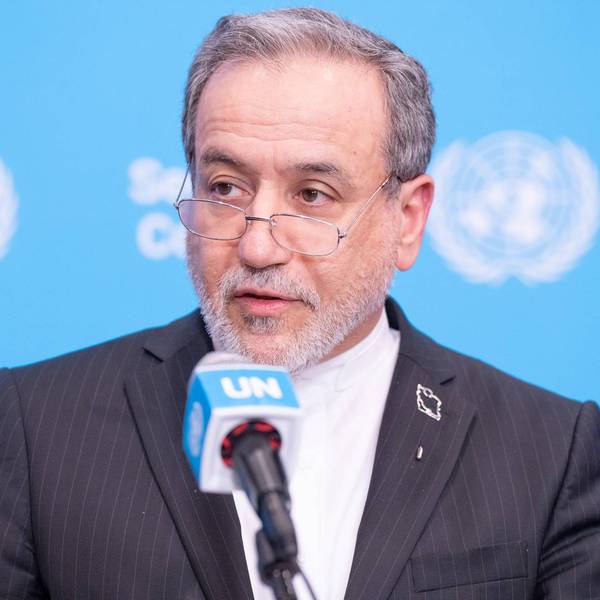
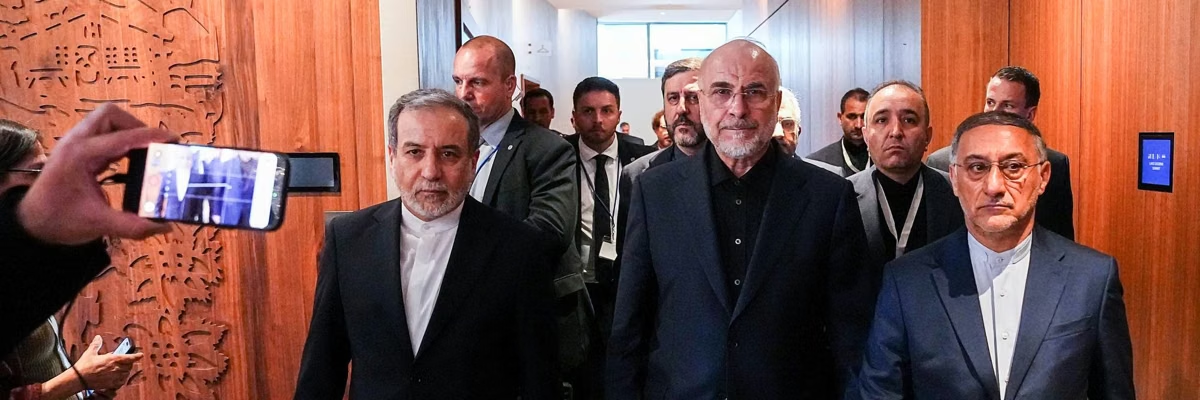
The Iranian delegation led by Mohammad Baqer Qalibaf, speaker of the parliament of Iran (center) arrives to meet with the Pakistani delegation led by Prime Minister Shehbaz Sharif (not pictured) on June 21, 2026 in Obbuergen, Switzerland.
To End the Iran War, the US Must Understand Tehran's Perspective
Trump and US war planners misread Tehran’s perception of the war. Iran is not on the verge of collapse; on the contrary, its leaders are now committed to match escalation with escalation until securing a negotiated settlement based on mutual concessions.
The war between the United States and Iran persists in a dangerous strategic stalemate. As Washington maintains a punishing economic and maritime blockade, Tehran continues to restrict passage through the Strait of Hormuz, imposing mounting costs on the United States, its allies, and the global economy. Neither side appears prepared to concede.
The Pentagon is sending a third aircraft carrier strike group to the region, while the Trump administration is reportedly considering strikes against Iranian nuclear and energy infrastructure, potentially using the GBU-43/B bomb, known as the “mother of all bombs.” Both moves support the possibility of the United States attempting to break this stalemate through force. Iran, meanwhile, has in recent weeks intensified attacks on commercial vessels attempting to transit Hormuz outside its designated route, with strikes becoming more frequent and destructive.
Washington appears to be continuing to misread the Iran it is confronting. The wars of 2025 and 2026 accelerated a fundamental shift in Tehran’s strategic thinking, away from years of relative restraint and toward a determination to impose sustained costs on the United States and its allies. Iranian leaders increasingly believe that their earlier restraint invited further attacks rather than deterring them, and that absorbing more punishment without retaliating forcefully would only encourage additional aggression.
Tehran is still willing to negotiate, but it is far less prepared to give up its leverage based on American assurances that it has little reason to trust.
A failure to understand this changed posture makes another round of American or Israeli strikes particularly dangerous: Rather than compelling Iran to surrender, it would likely provoke an even more damaging Iranian response. Tehran’s growing willingness to escalate does not mean it has abandoned diplomacy. The challenge for President Donald Trump is that the Iran emerging from this war is one less willing to yield to coercion, which remains open to a settlement based on meaningful reciprocal concessions.
Washington’s Options—and Their Limits
The central question is whether Washington is preparing to break the stalemate militarily. But as Carl von Clausewitz famously argued, war is a continuation of politics by other means. Whether Trump chooses to escalate therefore depends on his assessment of the political objectives at stake and whether further military force can advance them. The buildup of American forces alone tells us little about that calculation, particularly after months of warfare and economic coercion have failed to compel Tehran to yield.
How Washington perceives the war will determine what it believes it can do to break the current stalemate. If Washington sees continued economic hardship as eventually forcing Tehran to accept its demands, it can maintain the blockade and continue the war of attrition. But if the United States and Israel launch another major attack, it would suggest at least one of them no longer believes the current balance of pressure is working in their favor, or that they can afford to wait for Iran to buckle. Such an escalation would presumably seek to shift that balance by inflicting enough additional damage to compel Iranian concessions, particularly on the nuclear issue, where Tehran has resisted demands to surrender its stockpile of highly enriched uranium upfront, and over the future of the Strait of Hormuz, where Iran is seeking a new arrangement that preserves its leverage over maritime traffic.
Further attacks are likely to backfire, particularly given Tehran’s growing conviction that restraint has only invited further aggression. Iran has considerable scope to intensify its own pressure through Hormuz and strikes on regional energy infrastructure, driving up oil prices more, further disrupting global markets, and making the war even more costly for Washington to sustain. Tehran may also escalate on its own if it concludes that the existing level of disruption is insufficient to force American concessions. In either case, a new round of escalation could shift the balance of pressure further against Washington, leaving Trump in an even more difficult position despite inflicting greater destruction on Iran.
For Tehran, the experience of the war has reinforced the belief that surrendering its leverage before securing concrete American concessions would leave it vulnerable to renewed pressure and attacks.
A failure to understand Tehran’s own political calculus is a persistent problem in Washington, and one often at the root of maximalist attempts to compel changed behavior by coercion or force. Should the Trump administration pursue force despite Tehran’s changed posture, it will be repeating the failure of many presidencies before it.
The remaining options are political. Trump could unilaterally ease or end the blockade and effectively abandon the effort to compel Iran’s surrender, though that appears unlikely under present circumstances. Another similar possibility, according to CNN, is a final, spectacular military strike, potentially involving the “mother of all bombs,” designed to give Trump a symbolic “victory” he can declare before withdrawing. Some military planners have reportedly discussed what amounts to a “fireworks show,” even if the strikes fail to achieve Washington’s stated objectives. But such an exit would depend on Iran’s response, and Tehran could instead retaliate with further attacks on shipping and regional energy infrastructure, making it harder for Trump to declare the war over.
More realistically, Washington could negotiate a compromise to end the confrontation, accepting that any durable settlement will require meaningful concessions from both sides, including reciprocal steps on sanctions, Hormuz, and the nuclear issue.
The two sides remain far apart, however, on what a negotiated settlement would entail. Tehran continues to insist on seven conditions for ending the war, including lifting the blockade and sanctions, and presented mediators with a proposal during the United Nations General Assembly in September. The proposal reportedly builds on the June Islamabad memorandum of understanding (MOU), but changes the sequencing of concessions: Washington would first have to fulfill Iran’s conditions, including lifting the blockade and releasing frozen Iranian assets, before Tehran eases its restrictions on Hormuz and enters substantive nuclear negotiations.
This reflects Tehran’s deep distrust of Washington, rooted in what Iran sees as the United States’ failure to honor its commitments under the June MOU and by the subsequent resumption of major hostilities for 13 days in July. Washington, by contrast, is pressing for immediate nuclear concessions, including renewed inspections and removal of enriched uranium, while offering more limited economic relief and the release of frozen Iranian assets.
The central impasse is therefore not simply over the terms of a possible agreement, but over who must deliver first. For Tehran, the experience of the war has reinforced the belief that surrendering its leverage before securing concrete American concessions would leave it vulnerable to renewed pressure and attacks.
Against this backdrop, the battle over Hormuz has become an increasingly costly contest of adaptation and counter-adaptation, illustrating Tehran’s determination to impose economic costs rather than simply absorb American pressure. The United States and its Persian Gulf partners have developed an elaborate ship-to-ship transfer system in which smaller shuttle tankers carry oil through the strait, hugging the Omani coast, often under US military protection and with their tracking systems switched off, before transferring their cargoes to larger vessels in the Gulf of Oman. Many of these crossings take place at night while still under Iranian fire. Nevertheless, alongside Saudi Arabia’s East-West pipeline to the Red Sea, this has helped restore substantial volume of oil exports despite Iran’s restrictions, and at a price premium. Tehran has responded by sharply escalating attacks on vessels using these routes, including tankers involved in ship-to-ship transfers. The conflict has also expanded to the Red Sea, where Iran-aligned Houthis have attacked Saudi shipping and energy infrastructure and curtailed the Bab el-Mandeb chokepoint, while a separate drone strike launched from Iraq temporarily shut down Saudi Arabia’s East-West pipeline. These workarounds and countermeasures have kept both sides in the fight, but at mounting economic cost. The ship-to-ship transfer system is being pushed to its limits, freight and insurance costs have soared, Brent oil remains well above $100 a barrel, US gasoline and diesel prices have surged to record levels, and the resulting inflationary pressures are driving up borrowing costs across the American economy.
Realistic Paths to End the War
Iran’s increasingly aggressive campaign around Hormuz illustrates how profoundly the war changed Tehran’s approach to deterrence. As I argued in a recent Quincy Institute report, the wars of 2025 and 2026 have accelerated Tehran’s shift from strategic patience toward a doctrine of persistent counter-escalation. Tehran’s leaders now operate from an assumption that earlier restraint invited further attacks rather than deterring them, a changed posture revealed in a willingness to weaponize Hormuz and threaten the wider regional economy despite the enormous damage Iran itself has suffered. Another major American or Israeli attack is therefore unlikely to restore the old pattern of Iranian restraint. Instead, it could strengthen Tehran’s conviction that only sustained pressure on American and allied interests can deter further attacks and compel Washington to compromise.
Yet a more confrontational Iran is not necessarily an Iran unwilling to negotiate. As I argued in a separate Center for International Policy report, American policy has repeatedly underestimated Tehran’s capacity for pragmatism while overestimating the likelihood that mounting pressure will produce capitulation. Iran has a long history of pursuing diplomatic openings when its leaders perceive a credible opportunity to advance national interests, from the Rafsanjani and Khatami presidencies to the negotiations that produced the 2015 nuclear agreement. Even amid the present war, Tehran continues to put forward proposals for a negotiated settlement. What changed is its assessment of the risks of making concessions without reliable guarantees of American reciprocity. Tehran is still willing to negotiate, but it is far less prepared to give up its leverage based on American assurances that it has little reason to trust.
Washington retains overwhelming conventional military superiority, but months of warfare have shown the limits of pursuing maximalist objectives, whether Iran’s unconditional surrender or the collapse of its government.
Trump would be wise to recognize both realities. The June Islamabad MOU, together with Iran’s subsequent proposal at the UN General Assembly, offers a starting point for renewed diplomacy. The June understanding envisaged reciprocal steps, with Washington easing its blockade and economic restrictions and Tehran loosening its grip on Hormuz and eventually addressing its stockpile of highly enriched uranium through new nuclear negotiations. Reviving that framework would require the two sides to agree on a credible sequence of verifiable concessions, particularly given the latest collapse of trust following July’s renewed fighting.
Neither side would get everything it wants, but an agreement along these lines would offer Trump something that months of military escalation have failed to deliver: a way to end the war without inviting another round of potentially catastrophic Iranian retaliation in the region. Washington retains overwhelming conventional military superiority, but months of warfare have shown the limits of pursuing maximalist objectives, whether Iran’s unconditional surrender or the collapse of its government.
The question now is whether Trump will continue seeking capitulation through military pressure, or recognize that the war has made Tehran more determined to resist coercion while remaining open to a negotiated compromise.
We are at a crossroads
This country and this world are at a monumental crossroads. In a few short weeks, US voters will have an opportunity to beat back the forces of fascism and confront the billionaires who are rigging the economy, our media system, and our democracy, making it increasingly impossible for ordinary people to get by. We’re not just talking about the election. We’re talking about what must be done once these fascist elements are vanquished from power. We need a bolder set of solutions than what either major party has so far been willing to offer and a working-class movement ready to fight like hell for it. Trump didn't emerge from nowhere. The conditions that fueled MAGA authoritarianism were created by decades of radical neoliberal economic policies and a corrupt political system dominated by corporate interests. They slashed taxes on the super-rich, promising that the benefits would trickle down. They said giveaways to the corporate titans would make life more affordable for the rest of us. It was all bullshit. And when a bitter, betrayed populace searches for someone to blame, right-wing demagogues have little trouble finding scapegoats. People know when they're being lied to, but you won't hear any of this from the corporate media. Only independent journalism—powered and funded by people who believe in building a better world—can deliver truly trustworthy daily news. Our Fall Campaign is underway, and we need your help. To power our newsroom through the rest of the year, we need to raise $125,000 by midnight on October 31. So if you share our vision, please contribute whatever you can to sustain our work. |
The war between the United States and Iran persists in a dangerous strategic stalemate. As Washington maintains a punishing economic and maritime blockade, Tehran continues to restrict passage through the Strait of Hormuz, imposing mounting costs on the United States, its allies, and the global economy. Neither side appears prepared to concede.
The Pentagon is sending a third aircraft carrier strike group to the region, while the Trump administration is reportedly considering strikes against Iranian nuclear and energy infrastructure, potentially using the GBU-43/B bomb, known as the “mother of all bombs.” Both moves support the possibility of the United States attempting to break this stalemate through force. Iran, meanwhile, has in recent weeks intensified attacks on commercial vessels attempting to transit Hormuz outside its designated route, with strikes becoming more frequent and destructive.
Washington appears to be continuing to misread the Iran it is confronting. The wars of 2025 and 2026 accelerated a fundamental shift in Tehran’s strategic thinking, away from years of relative restraint and toward a determination to impose sustained costs on the United States and its allies. Iranian leaders increasingly believe that their earlier restraint invited further attacks rather than deterring them, and that absorbing more punishment without retaliating forcefully would only encourage additional aggression.
Tehran is still willing to negotiate, but it is far less prepared to give up its leverage based on American assurances that it has little reason to trust.
A failure to understand this changed posture makes another round of American or Israeli strikes particularly dangerous: Rather than compelling Iran to surrender, it would likely provoke an even more damaging Iranian response. Tehran’s growing willingness to escalate does not mean it has abandoned diplomacy. The challenge for President Donald Trump is that the Iran emerging from this war is one less willing to yield to coercion, which remains open to a settlement based on meaningful reciprocal concessions.
Washington’s Options—and Their Limits
The central question is whether Washington is preparing to break the stalemate militarily. But as Carl von Clausewitz famously argued, war is a continuation of politics by other means. Whether Trump chooses to escalate therefore depends on his assessment of the political objectives at stake and whether further military force can advance them. The buildup of American forces alone tells us little about that calculation, particularly after months of warfare and economic coercion have failed to compel Tehran to yield.
How Washington perceives the war will determine what it believes it can do to break the current stalemate. If Washington sees continued economic hardship as eventually forcing Tehran to accept its demands, it can maintain the blockade and continue the war of attrition. But if the United States and Israel launch another major attack, it would suggest at least one of them no longer believes the current balance of pressure is working in their favor, or that they can afford to wait for Iran to buckle. Such an escalation would presumably seek to shift that balance by inflicting enough additional damage to compel Iranian concessions, particularly on the nuclear issue, where Tehran has resisted demands to surrender its stockpile of highly enriched uranium upfront, and over the future of the Strait of Hormuz, where Iran is seeking a new arrangement that preserves its leverage over maritime traffic.
Further attacks are likely to backfire, particularly given Tehran’s growing conviction that restraint has only invited further aggression. Iran has considerable scope to intensify its own pressure through Hormuz and strikes on regional energy infrastructure, driving up oil prices more, further disrupting global markets, and making the war even more costly for Washington to sustain. Tehran may also escalate on its own if it concludes that the existing level of disruption is insufficient to force American concessions. In either case, a new round of escalation could shift the balance of pressure further against Washington, leaving Trump in an even more difficult position despite inflicting greater destruction on Iran.
For Tehran, the experience of the war has reinforced the belief that surrendering its leverage before securing concrete American concessions would leave it vulnerable to renewed pressure and attacks.
A failure to understand Tehran’s own political calculus is a persistent problem in Washington, and one often at the root of maximalist attempts to compel changed behavior by coercion or force. Should the Trump administration pursue force despite Tehran’s changed posture, it will be repeating the failure of many presidencies before it.
The remaining options are political. Trump could unilaterally ease or end the blockade and effectively abandon the effort to compel Iran’s surrender, though that appears unlikely under present circumstances. Another similar possibility, according to CNN, is a final, spectacular military strike, potentially involving the “mother of all bombs,” designed to give Trump a symbolic “victory” he can declare before withdrawing. Some military planners have reportedly discussed what amounts to a “fireworks show,” even if the strikes fail to achieve Washington’s stated objectives. But such an exit would depend on Iran’s response, and Tehran could instead retaliate with further attacks on shipping and regional energy infrastructure, making it harder for Trump to declare the war over.
More realistically, Washington could negotiate a compromise to end the confrontation, accepting that any durable settlement will require meaningful concessions from both sides, including reciprocal steps on sanctions, Hormuz, and the nuclear issue.
The two sides remain far apart, however, on what a negotiated settlement would entail. Tehran continues to insist on seven conditions for ending the war, including lifting the blockade and sanctions, and presented mediators with a proposal during the United Nations General Assembly in September. The proposal reportedly builds on the June Islamabad memorandum of understanding (MOU), but changes the sequencing of concessions: Washington would first have to fulfill Iran’s conditions, including lifting the blockade and releasing frozen Iranian assets, before Tehran eases its restrictions on Hormuz and enters substantive nuclear negotiations.
This reflects Tehran’s deep distrust of Washington, rooted in what Iran sees as the United States’ failure to honor its commitments under the June MOU and by the subsequent resumption of major hostilities for 13 days in July. Washington, by contrast, is pressing for immediate nuclear concessions, including renewed inspections and removal of enriched uranium, while offering more limited economic relief and the release of frozen Iranian assets.
The central impasse is therefore not simply over the terms of a possible agreement, but over who must deliver first. For Tehran, the experience of the war has reinforced the belief that surrendering its leverage before securing concrete American concessions would leave it vulnerable to renewed pressure and attacks.
Against this backdrop, the battle over Hormuz has become an increasingly costly contest of adaptation and counter-adaptation, illustrating Tehran’s determination to impose economic costs rather than simply absorb American pressure. The United States and its Persian Gulf partners have developed an elaborate ship-to-ship transfer system in which smaller shuttle tankers carry oil through the strait, hugging the Omani coast, often under US military protection and with their tracking systems switched off, before transferring their cargoes to larger vessels in the Gulf of Oman. Many of these crossings take place at night while still under Iranian fire. Nevertheless, alongside Saudi Arabia’s East-West pipeline to the Red Sea, this has helped restore substantial volume of oil exports despite Iran’s restrictions, and at a price premium. Tehran has responded by sharply escalating attacks on vessels using these routes, including tankers involved in ship-to-ship transfers. The conflict has also expanded to the Red Sea, where Iran-aligned Houthis have attacked Saudi shipping and energy infrastructure and curtailed the Bab el-Mandeb chokepoint, while a separate drone strike launched from Iraq temporarily shut down Saudi Arabia’s East-West pipeline. These workarounds and countermeasures have kept both sides in the fight, but at mounting economic cost. The ship-to-ship transfer system is being pushed to its limits, freight and insurance costs have soared, Brent oil remains well above $100 a barrel, US gasoline and diesel prices have surged to record levels, and the resulting inflationary pressures are driving up borrowing costs across the American economy.
Realistic Paths to End the War
Iran’s increasingly aggressive campaign around Hormuz illustrates how profoundly the war changed Tehran’s approach to deterrence. As I argued in a recent Quincy Institute report, the wars of 2025 and 2026 have accelerated Tehran’s shift from strategic patience toward a doctrine of persistent counter-escalation. Tehran’s leaders now operate from an assumption that earlier restraint invited further attacks rather than deterring them, a changed posture revealed in a willingness to weaponize Hormuz and threaten the wider regional economy despite the enormous damage Iran itself has suffered. Another major American or Israeli attack is therefore unlikely to restore the old pattern of Iranian restraint. Instead, it could strengthen Tehran’s conviction that only sustained pressure on American and allied interests can deter further attacks and compel Washington to compromise.
Yet a more confrontational Iran is not necessarily an Iran unwilling to negotiate. As I argued in a separate Center for International Policy report, American policy has repeatedly underestimated Tehran’s capacity for pragmatism while overestimating the likelihood that mounting pressure will produce capitulation. Iran has a long history of pursuing diplomatic openings when its leaders perceive a credible opportunity to advance national interests, from the Rafsanjani and Khatami presidencies to the negotiations that produced the 2015 nuclear agreement. Even amid the present war, Tehran continues to put forward proposals for a negotiated settlement. What changed is its assessment of the risks of making concessions without reliable guarantees of American reciprocity. Tehran is still willing to negotiate, but it is far less prepared to give up its leverage based on American assurances that it has little reason to trust.
Washington retains overwhelming conventional military superiority, but months of warfare have shown the limits of pursuing maximalist objectives, whether Iran’s unconditional surrender or the collapse of its government.
Trump would be wise to recognize both realities. The June Islamabad MOU, together with Iran’s subsequent proposal at the UN General Assembly, offers a starting point for renewed diplomacy. The June understanding envisaged reciprocal steps, with Washington easing its blockade and economic restrictions and Tehran loosening its grip on Hormuz and eventually addressing its stockpile of highly enriched uranium through new nuclear negotiations. Reviving that framework would require the two sides to agree on a credible sequence of verifiable concessions, particularly given the latest collapse of trust following July’s renewed fighting.
Neither side would get everything it wants, but an agreement along these lines would offer Trump something that months of military escalation have failed to deliver: a way to end the war without inviting another round of potentially catastrophic Iranian retaliation in the region. Washington retains overwhelming conventional military superiority, but months of warfare have shown the limits of pursuing maximalist objectives, whether Iran’s unconditional surrender or the collapse of its government.
The question now is whether Trump will continue seeking capitulation through military pressure, or recognize that the war has made Tehran more determined to resist coercion while remaining open to a negotiated compromise.
- Could the UN Secretary-General’s 'Good Offices' Help to End the Iran War? ›
- Stop Mad King Donald’s Iran War: An Open Letter to Members of the US Congress ›
- 'We Must Cut Off Funding': House Dem Readies Legal Action and New Bill to Halt Trump's Iran War ›
- How Can Dems Persuade Wary Voters They Will Really End the Iran War? ›
- Ending the Trump-Netanyahu War in the Middle East ›
- Take Action October 20 to End the Illegal US-Israeli War on Iran ›