SUBSCRIBE TO OUR FREE NEWSLETTER
Daily news & progressive opinion—funded by the people, not the corporations—delivered straight to your inbox.
5
#000000
#FFFFFF
To donate by check, phone, or other method, see our More Ways to Give page.
Daily news & progressive opinion—funded by the people, not the corporations—delivered straight to your inbox.
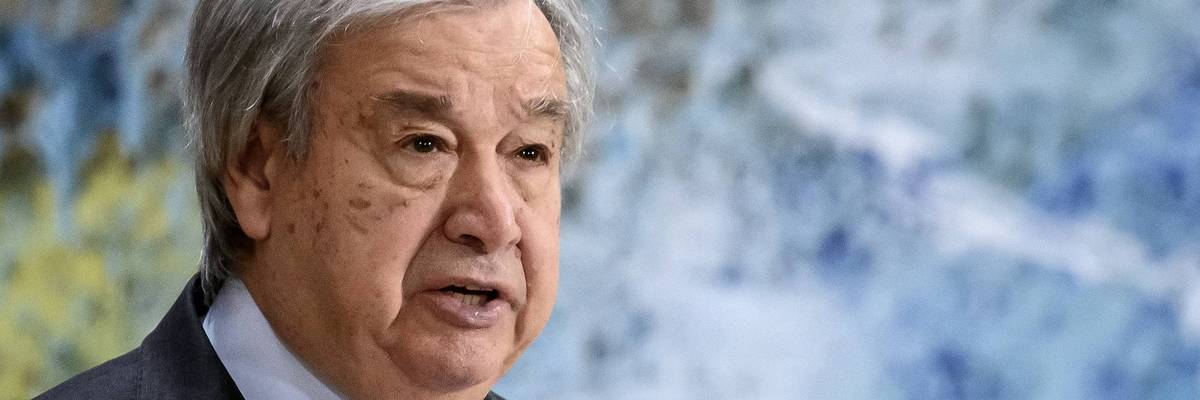
UN Secretary-General António Guterres delivers a speech at the opening of the 61st session of the UN Human Rights Council at the United Nations office in Geneva on February 23, 2026.
Given the two-week ceasefire, the recent appointment of an experienced personal envoy for the Middle East conflict by UN Secretary-General Guterres and the establishment of a UN Task Force to facilitate the opening of the Strait of Hormuz offer hope for lasting peace.
While the whole world held its breath, hoping for some way the overcome the ultimatum that President Donald Trump had given to Iran, Pakistan, working feverishly as a third-party mediator (with the help of Türkiye, Egypt, and other regional powers, as well as China), was able to obtain a last-minute agreement from the parties for a two-week cessation of hostilities which would allow commercial shipping to resume (with Iranian supervision) through the Strait of Hormuz.
Although widely welcomed, this brief ceasefire is only the beginning. To bring about a lasting end to the war, over the next two weeks the mediators will have to become involved in intensive negotiations with all of the parties to find a peace settlement acceptable to all.
This will require considerable in-depth, in-person consultations by the mediators with each of the parties to understand the issues and interests of each and to go beyond their incompatible positions to find common ground and develop creative solutions that reconcile differences, especially those related to each party’s security concerns.
Much of this work is best done through intensive shuttle diplomacy, wherein those acting as third parties discuss the issues and possible components of agreements through separate talks with each party. This is preferable to face-to-face plenary meetings between the parties, which are often unproductive, since the parties typically just reiterate and insist on their already well-known confrontational positions. Such work requires sufficient time, considerable finesse and creativity, as well as close coordination between all of those involved. Knowledge of previous peace processes and the substance of peace agreements is also very important.
If successful, however, the UN’s assistance with a viable solution would not only resolve the dangerous hostilities in the Middle East, but could also offer a more permanent off-ramp for the Trump administration.
Two recent initiatives by the United Nations secretary-general may prove useful in this regard. On March 25, Secretary-General António Guterres appointed Jean Arnault, a seasoned peacemaker with 40 years of experience in Latin America, Africa, Asia, and Europe, as his “personal envoy of the secretary-general on the Middle East conflict and its consequences” to carry out good offices on his behalf. Although perhaps not widely known, the secretary-general’s good offices functions (often carried out through “quiet diplomacy”) have been widely used since the UN’s inception 80 years ago, in large and small conflicts around the world, with considerable success.
In some situations, the secretary-general’s envoy has worked on their own directly with the parties; in other cases, the envoy has worked in close coordination with a small group of UN Member States. In this situation, the UN secretary-general’s personal envoy could offer his assistance to the already-existing group of state mediators led by Pakistan in their efforts to arrive at a peace agreement. Given the extremely short time frame available, such assistance should be welcomed.
It is likely that Iran will also welcome the involvement of a personal envoy of the secretary-general, since in 1988, the UN Secretary-General’s Personal Representative on Iran-Iraq, Jan Eliasson, helped bring about the end of the very long and destructive Iran-Iraq war. In this and other conflicts, the secretary-general’s good offices have been acceptable to conflicting parties because the UN is viewed as impartial, unlike mediation efforts by states, which have their own interests. As well, the deep experience of UN mediators in applying constructive problem-solving approaches to conflict resolution makes them attractive as third party mediators.
A second recent initiative by Secretary-General Guterres that may prove to be very helpful is the creation of a UN Task Force to facilitate resolution of maritime problems in the Strait of Hormuz. This initiative was based on previous UN experience at the beginning of the Russian invasion of Ukraine, whereby UN involvement helped overcome the cessation of maritime grain shipments from Ukraine, as well as food and fertilizer from Russia, which were causing a world food crisis.
After extensive talks hosted by Türkiye, with UN assistance, the Black Sea Grain Initiative was signed by Ukraine and Russia, as well as by Türkiye and the UN, in separate but concurrent “mirror” agreements. The first outlined the safe export of grain and related food and fertilizers via demined corridors in the Black Sea, with Türkiye inspecting ships on their way to Ukrainian ports to ensure they weren’t carrying weapons. The second outlined a set of procedures for getting food, fertilizer, and raw material exports safely out of Russia.
Drawing on this previous experience, The UN Task Force will involve some of the same UN specialized agencies that were helpful in the Black Sea Grain Initiative, such as the International Maritime Organization. The Task Force is meant to work out constructive and “operational maritime solutions” that will help to secure the evacuation of over 2,000 ships and 20,000 seafarers currently stranded in the Persian Gulf, as well as facilitate humanitarian corridors for the safe passage of goods.
Since it came to power, the Trump administration has generally ignored the capacities of the United Nations; its history and experience; and its universally-accepted authority. If successful, however, the UN’s assistance with a viable solution would not only resolve the dangerous hostilities in the Middle East, but could also offer a more permanent off-ramp for the Trump administration.
Although not widely known, it is now well-documented, that, during the height of the Cuban Missile Crisis, UN Secretary-General U Thant played a pivotal role in helping to avert a nuclear war and resolve the worst international crisis since the end of the World War II, by using his good offices to make proposals to US President John F. Kennedy and Soviet Premier Nikita Khrushchev for de-escalation and the ultimate resolution of the crisis.
As explained by the authors of an article in the Bulletin of the Atomic Scientists, the good offices of the secretary-general can offer a unique contribution to world peace:
For U Thant and his UN organization, the Cuban Missile Crisis was their finest hour... It was the week the United Nations helped the superpowers pull back from nuclear destruction. The nuclear clock did not strike midnight, largely because Thant facilitated face-saving and de-escalation, transmitted messages, traveled to Cuba, fostered restraint and hope, and made significant proposals, including the idea for the final settlement of the crisis... it is appropriate to finally give U Thant credit for his remarkable contribution to averting doomsday.
Let us hope that Secretary-General Guterres and his special envoy will be able to play a similarly constructive role in another extremely dangerous conflict and remind the world of the vital role that the UN has played and can continue to play in preventing and resolving violent conflicts among its member states.
Dear Common Dreams reader, It’s been nearly 30 years since I co-founded Common Dreams with my late wife, Lina Newhouser. We had the radical notion that journalism should serve the public good, not corporate profits. It was clear to us from the outset what it would take to build such a project. No paid advertisements. No corporate sponsors. No millionaire publisher telling us what to think or do. Many people said we wouldn't last a year, but we proved those doubters wrong. Together with a tremendous team of journalists and dedicated staff, we built an independent media outlet free from the constraints of profits and corporate control. Our mission has always been simple: To inform. To inspire. To ignite change for the common good. Building Common Dreams was not easy. Our survival was never guaranteed. When you take on the most powerful forces—Wall Street greed, fossil fuel industry destruction, Big Tech lobbyists, and uber-rich oligarchs who have spent billions upon billions rigging the economy and democracy in their favor—the only bulwark you have is supporters who believe in your work. But here’s the urgent message from me today. It's never been this bad out there. And it's never been this hard to keep us going. At the very moment Common Dreams is most needed, the threats we face are intensifying. We need your support now more than ever. We don't accept corporate advertising and never will. We don't have a paywall because we don't think people should be blocked from critical news based on their ability to pay. Everything we do is funded by the donations of readers like you. When everyone does the little they can afford, we are strong. But if that support retreats or dries up, so do we. Will you donate now to make sure Common Dreams not only survives but thrives? —Craig Brown, Co-founder |
While the whole world held its breath, hoping for some way the overcome the ultimatum that President Donald Trump had given to Iran, Pakistan, working feverishly as a third-party mediator (with the help of Türkiye, Egypt, and other regional powers, as well as China), was able to obtain a last-minute agreement from the parties for a two-week cessation of hostilities which would allow commercial shipping to resume (with Iranian supervision) through the Strait of Hormuz.
Although widely welcomed, this brief ceasefire is only the beginning. To bring about a lasting end to the war, over the next two weeks the mediators will have to become involved in intensive negotiations with all of the parties to find a peace settlement acceptable to all.
This will require considerable in-depth, in-person consultations by the mediators with each of the parties to understand the issues and interests of each and to go beyond their incompatible positions to find common ground and develop creative solutions that reconcile differences, especially those related to each party’s security concerns.
Much of this work is best done through intensive shuttle diplomacy, wherein those acting as third parties discuss the issues and possible components of agreements through separate talks with each party. This is preferable to face-to-face plenary meetings between the parties, which are often unproductive, since the parties typically just reiterate and insist on their already well-known confrontational positions. Such work requires sufficient time, considerable finesse and creativity, as well as close coordination between all of those involved. Knowledge of previous peace processes and the substance of peace agreements is also very important.
If successful, however, the UN’s assistance with a viable solution would not only resolve the dangerous hostilities in the Middle East, but could also offer a more permanent off-ramp for the Trump administration.
Two recent initiatives by the United Nations secretary-general may prove useful in this regard. On March 25, Secretary-General António Guterres appointed Jean Arnault, a seasoned peacemaker with 40 years of experience in Latin America, Africa, Asia, and Europe, as his “personal envoy of the secretary-general on the Middle East conflict and its consequences” to carry out good offices on his behalf. Although perhaps not widely known, the secretary-general’s good offices functions (often carried out through “quiet diplomacy”) have been widely used since the UN’s inception 80 years ago, in large and small conflicts around the world, with considerable success.
In some situations, the secretary-general’s envoy has worked on their own directly with the parties; in other cases, the envoy has worked in close coordination with a small group of UN Member States. In this situation, the UN secretary-general’s personal envoy could offer his assistance to the already-existing group of state mediators led by Pakistan in their efforts to arrive at a peace agreement. Given the extremely short time frame available, such assistance should be welcomed.
It is likely that Iran will also welcome the involvement of a personal envoy of the secretary-general, since in 1988, the UN Secretary-General’s Personal Representative on Iran-Iraq, Jan Eliasson, helped bring about the end of the very long and destructive Iran-Iraq war. In this and other conflicts, the secretary-general’s good offices have been acceptable to conflicting parties because the UN is viewed as impartial, unlike mediation efforts by states, which have their own interests. As well, the deep experience of UN mediators in applying constructive problem-solving approaches to conflict resolution makes them attractive as third party mediators.
A second recent initiative by Secretary-General Guterres that may prove to be very helpful is the creation of a UN Task Force to facilitate resolution of maritime problems in the Strait of Hormuz. This initiative was based on previous UN experience at the beginning of the Russian invasion of Ukraine, whereby UN involvement helped overcome the cessation of maritime grain shipments from Ukraine, as well as food and fertilizer from Russia, which were causing a world food crisis.
After extensive talks hosted by Türkiye, with UN assistance, the Black Sea Grain Initiative was signed by Ukraine and Russia, as well as by Türkiye and the UN, in separate but concurrent “mirror” agreements. The first outlined the safe export of grain and related food and fertilizers via demined corridors in the Black Sea, with Türkiye inspecting ships on their way to Ukrainian ports to ensure they weren’t carrying weapons. The second outlined a set of procedures for getting food, fertilizer, and raw material exports safely out of Russia.
Drawing on this previous experience, The UN Task Force will involve some of the same UN specialized agencies that were helpful in the Black Sea Grain Initiative, such as the International Maritime Organization. The Task Force is meant to work out constructive and “operational maritime solutions” that will help to secure the evacuation of over 2,000 ships and 20,000 seafarers currently stranded in the Persian Gulf, as well as facilitate humanitarian corridors for the safe passage of goods.
Since it came to power, the Trump administration has generally ignored the capacities of the United Nations; its history and experience; and its universally-accepted authority. If successful, however, the UN’s assistance with a viable solution would not only resolve the dangerous hostilities in the Middle East, but could also offer a more permanent off-ramp for the Trump administration.
Although not widely known, it is now well-documented, that, during the height of the Cuban Missile Crisis, UN Secretary-General U Thant played a pivotal role in helping to avert a nuclear war and resolve the worst international crisis since the end of the World War II, by using his good offices to make proposals to US President John F. Kennedy and Soviet Premier Nikita Khrushchev for de-escalation and the ultimate resolution of the crisis.
As explained by the authors of an article in the Bulletin of the Atomic Scientists, the good offices of the secretary-general can offer a unique contribution to world peace:
For U Thant and his UN organization, the Cuban Missile Crisis was their finest hour... It was the week the United Nations helped the superpowers pull back from nuclear destruction. The nuclear clock did not strike midnight, largely because Thant facilitated face-saving and de-escalation, transmitted messages, traveled to Cuba, fostered restraint and hope, and made significant proposals, including the idea for the final settlement of the crisis... it is appropriate to finally give U Thant credit for his remarkable contribution to averting doomsday.
Let us hope that Secretary-General Guterres and his special envoy will be able to play a similarly constructive role in another extremely dangerous conflict and remind the world of the vital role that the UN has played and can continue to play in preventing and resolving violent conflicts among its member states.
While the whole world held its breath, hoping for some way the overcome the ultimatum that President Donald Trump had given to Iran, Pakistan, working feverishly as a third-party mediator (with the help of Türkiye, Egypt, and other regional powers, as well as China), was able to obtain a last-minute agreement from the parties for a two-week cessation of hostilities which would allow commercial shipping to resume (with Iranian supervision) through the Strait of Hormuz.
Although widely welcomed, this brief ceasefire is only the beginning. To bring about a lasting end to the war, over the next two weeks the mediators will have to become involved in intensive negotiations with all of the parties to find a peace settlement acceptable to all.
This will require considerable in-depth, in-person consultations by the mediators with each of the parties to understand the issues and interests of each and to go beyond their incompatible positions to find common ground and develop creative solutions that reconcile differences, especially those related to each party’s security concerns.
Much of this work is best done through intensive shuttle diplomacy, wherein those acting as third parties discuss the issues and possible components of agreements through separate talks with each party. This is preferable to face-to-face plenary meetings between the parties, which are often unproductive, since the parties typically just reiterate and insist on their already well-known confrontational positions. Such work requires sufficient time, considerable finesse and creativity, as well as close coordination between all of those involved. Knowledge of previous peace processes and the substance of peace agreements is also very important.
If successful, however, the UN’s assistance with a viable solution would not only resolve the dangerous hostilities in the Middle East, but could also offer a more permanent off-ramp for the Trump administration.
Two recent initiatives by the United Nations secretary-general may prove useful in this regard. On March 25, Secretary-General António Guterres appointed Jean Arnault, a seasoned peacemaker with 40 years of experience in Latin America, Africa, Asia, and Europe, as his “personal envoy of the secretary-general on the Middle East conflict and its consequences” to carry out good offices on his behalf. Although perhaps not widely known, the secretary-general’s good offices functions (often carried out through “quiet diplomacy”) have been widely used since the UN’s inception 80 years ago, in large and small conflicts around the world, with considerable success.
In some situations, the secretary-general’s envoy has worked on their own directly with the parties; in other cases, the envoy has worked in close coordination with a small group of UN Member States. In this situation, the UN secretary-general’s personal envoy could offer his assistance to the already-existing group of state mediators led by Pakistan in their efforts to arrive at a peace agreement. Given the extremely short time frame available, such assistance should be welcomed.
It is likely that Iran will also welcome the involvement of a personal envoy of the secretary-general, since in 1988, the UN Secretary-General’s Personal Representative on Iran-Iraq, Jan Eliasson, helped bring about the end of the very long and destructive Iran-Iraq war. In this and other conflicts, the secretary-general’s good offices have been acceptable to conflicting parties because the UN is viewed as impartial, unlike mediation efforts by states, which have their own interests. As well, the deep experience of UN mediators in applying constructive problem-solving approaches to conflict resolution makes them attractive as third party mediators.
A second recent initiative by Secretary-General Guterres that may prove to be very helpful is the creation of a UN Task Force to facilitate resolution of maritime problems in the Strait of Hormuz. This initiative was based on previous UN experience at the beginning of the Russian invasion of Ukraine, whereby UN involvement helped overcome the cessation of maritime grain shipments from Ukraine, as well as food and fertilizer from Russia, which were causing a world food crisis.
After extensive talks hosted by Türkiye, with UN assistance, the Black Sea Grain Initiative was signed by Ukraine and Russia, as well as by Türkiye and the UN, in separate but concurrent “mirror” agreements. The first outlined the safe export of grain and related food and fertilizers via demined corridors in the Black Sea, with Türkiye inspecting ships on their way to Ukrainian ports to ensure they weren’t carrying weapons. The second outlined a set of procedures for getting food, fertilizer, and raw material exports safely out of Russia.
Drawing on this previous experience, The UN Task Force will involve some of the same UN specialized agencies that were helpful in the Black Sea Grain Initiative, such as the International Maritime Organization. The Task Force is meant to work out constructive and “operational maritime solutions” that will help to secure the evacuation of over 2,000 ships and 20,000 seafarers currently stranded in the Persian Gulf, as well as facilitate humanitarian corridors for the safe passage of goods.
Since it came to power, the Trump administration has generally ignored the capacities of the United Nations; its history and experience; and its universally-accepted authority. If successful, however, the UN’s assistance with a viable solution would not only resolve the dangerous hostilities in the Middle East, but could also offer a more permanent off-ramp for the Trump administration.
Although not widely known, it is now well-documented, that, during the height of the Cuban Missile Crisis, UN Secretary-General U Thant played a pivotal role in helping to avert a nuclear war and resolve the worst international crisis since the end of the World War II, by using his good offices to make proposals to US President John F. Kennedy and Soviet Premier Nikita Khrushchev for de-escalation and the ultimate resolution of the crisis.
As explained by the authors of an article in the Bulletin of the Atomic Scientists, the good offices of the secretary-general can offer a unique contribution to world peace:
For U Thant and his UN organization, the Cuban Missile Crisis was their finest hour... It was the week the United Nations helped the superpowers pull back from nuclear destruction. The nuclear clock did not strike midnight, largely because Thant facilitated face-saving and de-escalation, transmitted messages, traveled to Cuba, fostered restraint and hope, and made significant proposals, including the idea for the final settlement of the crisis... it is appropriate to finally give U Thant credit for his remarkable contribution to averting doomsday.
Let us hope that Secretary-General Guterres and his special envoy will be able to play a similarly constructive role in another extremely dangerous conflict and remind the world of the vital role that the UN has played and can continue to play in preventing and resolving violent conflicts among its member states.