SUBSCRIBE TO OUR FREE NEWSLETTER
Daily news & progressive opinion—funded by the people, not the corporations—delivered straight to your inbox.
5
#000000
#FFFFFF
To donate by check, phone, or other method, see our More Ways to Give page.
Daily news & progressive opinion—funded by the people, not the corporations—delivered straight to your inbox.
Despite billions of dollars put into trying to change individuals' opinions to fit the needs of corporations, people continue to hold onto values of health, well-being, community, mutual aid, and democracy. This is true power that can be harnessed.
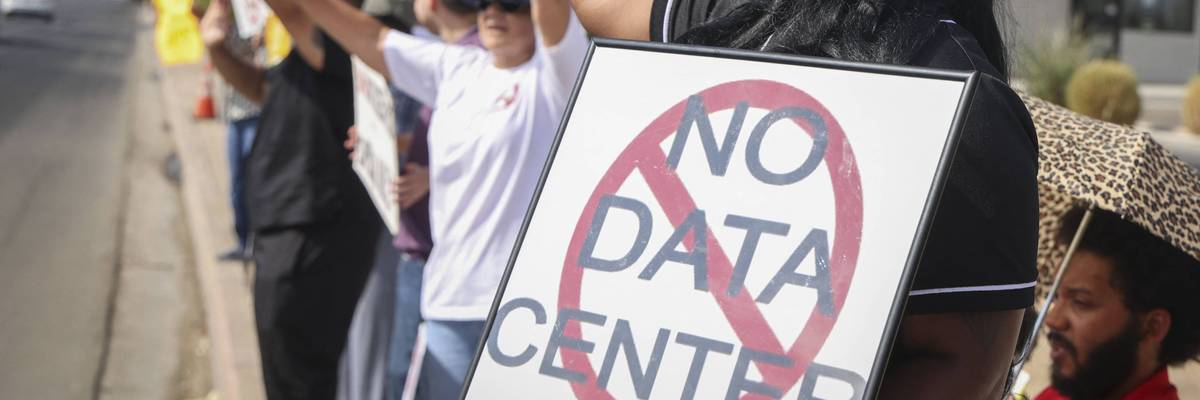
This summer, over 100 community members gave public comments against Project Taurus, an AI data center proposed by the tech and real estate company, Raeden, near Garden of the Gods in Colorado Springs. Despite only 15 comments in favor of the project, the city planning commission voted 6-2 to move forward with the project.
As a youth environmental and social justice organizer who sat through hours of the hearing and spent much of my past week encouraging community members to join me, I left the hearing devastated by the commission’s decision. Building a data center at a site already facing a water crisis and next to a National Natural Landmark felt like just one more step toward a society that has lost all care and consideration for communities and nature.
But the next day, as I discussed the hearing with one of my roommates, I found myself trying to convey the energy, hope, empathy, and deep care that had filled the hearing room. I explained my admiration for the dozens of working-class community members who sat for hours in a windowless room just to give a two-minute comment or simply support the other speakers. By the end of the conversation, I realized that despite being upset about the decision, the experience left me with hope and faith in the goodness of humanity.
As America continues to throw billions into war, cut Supplemental Nutrition Assistance Program and Medicaid funding, pull out of climate commitments, and move toward projects and systems that further harm people, we can begin to believe that Americans are not concerned with their neighbors’ well-being. What the hearing taught me, however, is that decisions—like whether to move forward with data center projects—and the current state of our county do not reflect our communities’ desires.
It is critical that decisions like the Colorado Springs Planning Commission’s don’t lead us to lose hope in one another and our collective power.
The committee’s decision is a reflection of money in politics. It is a reflection of desperately needing to change who our elected officials are. Of needing to address corporate consolidation that holds this power in opposition to people’s needs and not accountable to communities. Of needing to distribute power so that real people are better represented, and of needing to better support communities so that they have the time, resources, and energy to ensure their voices are taken into account in issues that affect them and their neighbors.
We are up against a political and economic system with such strong inertia that even if communities understand it isn’t working for them, only strategic coordinated action will bring about change. The more people are overworked, underfed, and under-resourced, the harder it is for them to advocate. They have less time to attend community meetings; to speak out about the meetings themselves being scheduled during the workday; to look into local candidates' positions; to turn out to vote. And they have less money to contribute to grassroots campaigns that refuse money from Big Oil, Big Pharma, Big Agriculture, the American Israel Public Affairs Committee, and Big Tech.
Though Raeden claims to have people’s best interests in mind, it is structured to secure a profit, not to adhere to communities’ needs. A majority of Americans oppose local data center construction, and only 14% of Americans feel comfortable with a data center built nearby. This aligns with the 85% of public comments that were in opposition to Project Taurus.
Community members spoke about the project's impact on neighborhood health, the environment, wildlife, water, and energy. They explained that the center’s infrasound can’t be blocked by Raeden’s proposed 30-foot sound wall; diesel backup generators pose severe health risks by emitting high levels of toxic particles that cause respiratory issues, worsen asthma, and increase long-term cancer risks; and although Raeden emphasizes its closed-loop cooling system to save water in an environment that is already in a major drought, the treatment chemicals used pose risks to the local environment and health of our water supply while the system as a whole significantly increases energy usage, which the company itself admits will likely be powered by fossil fuels and nuclear plants.
Furthermore, community members emphasized that data centers are not built for community needs. The energy itself powers mass surveillance and military AI programs for companies like Palantir and the world’s largest prisoner tracking company, BI, both of which are headquartered in Colorado.
Raeden tells the community that it will bring jobs and money to the Springs. However, while Raeden will immediately profit from the development, the long-term economic benefits for the community are much more dubious. Experts have increasingly been raising concerns about the longevity of AI investments, or what they refer to as the “AI bubble.” A recent MIT study found that 95% of AI companies have achieved zero return on investment, despite investments of $30 to $40 billion in the technology. The end of the AI bubble is predicted to be akin to the 2008 financial crisis but with more devastating effects. Similar to 2008, when banks got a $500 billion bailout while 6 million Americans lost their homes, tech companies will likely be protected while communities will suffer the costs. Raeden, for instance, will be protected because it is a real estate company and does not have roots in the community, unlike Colorado Springs residents.
As one community member emphasized, Raeden came into Colorado Springs not for the water or natural resources the city can provide, but to take advantage of the city's human desperation. Northwest Colorado Springs is in need of jobs and local investment.
Raeden came to the Springs expecting to be welcomed by a community too tired and worn out to push back, but the company has been met with a very different reality. Despite the minimal transparency from the city and Raeden, not only are a large majority of community members against data centers, but the community has also been able to spread awareness about the project and mobilize over 100 people to show up to speak out for nature, their neighbors’ health, and the fate of future generations.
I have built my worldview around a belief that if we all come together as regular people with human values, we will have the power to stand up against even the millions of dollars corporations throw at candidates, policy, or, in this case, data centers. The hearing was a realization of this working-class movement of the people that I spend much of my time striving for.
The hard part was supposed to be getting people to come together and to show up. We did that. People spoke eloquently, with knowledge, and heartfelt appeals. And still, they were denied.
Nevertheless, this past week has shown me that people are truly good. Despite billions of dollars put into trying to change individuals' opinions to fit the needs of corporations, people continue to hold onto values of health, well-being, community, mutual aid, and democracy. This is true power that can be harnessed.
It is critical that decisions like the Colorado Springs Planning Commission’s don’t lead us to lose hope in one another and our collective power. Corporations like Raeden would love nothing more than for us to be apathetic and divided. Instead, we must stay true to our demands for humanity. Stay true to these demands as we vote for candidates who prioritize human needs over corporate interests. As we increase our trust in one another, the conversations we have with our neighbors, and our faith in our power. We will continue to show up and prove that people have not given consent for our current systems.
There are now over 300 local bans and moratoriums on data centers across the US, including Denver, Jefferson County, Boulder, Longmont, and Monument, and a majority of Americans support pausing the construction of AI data centers for at least one year.
Colorado Springs proved that communities have not and will not accept a rise in corporate trickle-down projects as a replacement for government programs. We proved that communities will continue to show up for one another and stay grounded in human values. We proved that this fight is far from easy and anything but fair, but we will persist.
Dear Common Dreams reader, It’s been nearly 30 years since I co-founded Common Dreams with my late wife, Lina Newhouser. We had the radical notion that journalism should serve the public good, not corporate profits. It was clear to us from the outset what it would take to build such a project. No paid advertisements. No corporate sponsors. No millionaire publisher telling us what to think or do. Many people said we wouldn't last a year, but we proved those doubters wrong. Together with a tremendous team of journalists and dedicated staff, we built an independent media outlet free from the constraints of profits and corporate control. Our mission has always been simple: To inform. To inspire. To ignite change for the common good. Building Common Dreams was not easy. Our survival was never guaranteed. When you take on the most powerful forces—Wall Street greed, fossil fuel industry destruction, Big Tech lobbyists, and uber-rich oligarchs who have spent billions upon billions rigging the economy and democracy in their favor—the only bulwark you have is supporters who believe in your work. But here’s the urgent message from me today. It's never been this bad out there. And it's never been this hard to keep us going. At the very moment Common Dreams is most needed, the threats we face are intensifying. We need your support now more than ever. We don't accept corporate advertising and never will. We don't have a paywall because we don't think people should be blocked from critical news based on their ability to pay. Everything we do is funded by the donations of readers like you. When everyone does the little they can afford, we are strong. But if that support retreats or dries up, so do we. Will you donate now to make sure Common Dreams not only survives but thrives? —Craig Brown, Co-founder |
This summer, over 100 community members gave public comments against Project Taurus, an AI data center proposed by the tech and real estate company, Raeden, near Garden of the Gods in Colorado Springs. Despite only 15 comments in favor of the project, the city planning commission voted 6-2 to move forward with the project.
As a youth environmental and social justice organizer who sat through hours of the hearing and spent much of my past week encouraging community members to join me, I left the hearing devastated by the commission’s decision. Building a data center at a site already facing a water crisis and next to a National Natural Landmark felt like just one more step toward a society that has lost all care and consideration for communities and nature.
But the next day, as I discussed the hearing with one of my roommates, I found myself trying to convey the energy, hope, empathy, and deep care that had filled the hearing room. I explained my admiration for the dozens of working-class community members who sat for hours in a windowless room just to give a two-minute comment or simply support the other speakers. By the end of the conversation, I realized that despite being upset about the decision, the experience left me with hope and faith in the goodness of humanity.
As America continues to throw billions into war, cut Supplemental Nutrition Assistance Program and Medicaid funding, pull out of climate commitments, and move toward projects and systems that further harm people, we can begin to believe that Americans are not concerned with their neighbors’ well-being. What the hearing taught me, however, is that decisions—like whether to move forward with data center projects—and the current state of our county do not reflect our communities’ desires.
It is critical that decisions like the Colorado Springs Planning Commission’s don’t lead us to lose hope in one another and our collective power.
The committee’s decision is a reflection of money in politics. It is a reflection of desperately needing to change who our elected officials are. Of needing to address corporate consolidation that holds this power in opposition to people’s needs and not accountable to communities. Of needing to distribute power so that real people are better represented, and of needing to better support communities so that they have the time, resources, and energy to ensure their voices are taken into account in issues that affect them and their neighbors.
We are up against a political and economic system with such strong inertia that even if communities understand it isn’t working for them, only strategic coordinated action will bring about change. The more people are overworked, underfed, and under-resourced, the harder it is for them to advocate. They have less time to attend community meetings; to speak out about the meetings themselves being scheduled during the workday; to look into local candidates' positions; to turn out to vote. And they have less money to contribute to grassroots campaigns that refuse money from Big Oil, Big Pharma, Big Agriculture, the American Israel Public Affairs Committee, and Big Tech.
Though Raeden claims to have people’s best interests in mind, it is structured to secure a profit, not to adhere to communities’ needs. A majority of Americans oppose local data center construction, and only 14% of Americans feel comfortable with a data center built nearby. This aligns with the 85% of public comments that were in opposition to Project Taurus.
Community members spoke about the project's impact on neighborhood health, the environment, wildlife, water, and energy. They explained that the center’s infrasound can’t be blocked by Raeden’s proposed 30-foot sound wall; diesel backup generators pose severe health risks by emitting high levels of toxic particles that cause respiratory issues, worsen asthma, and increase long-term cancer risks; and although Raeden emphasizes its closed-loop cooling system to save water in an environment that is already in a major drought, the treatment chemicals used pose risks to the local environment and health of our water supply while the system as a whole significantly increases energy usage, which the company itself admits will likely be powered by fossil fuels and nuclear plants.
Furthermore, community members emphasized that data centers are not built for community needs. The energy itself powers mass surveillance and military AI programs for companies like Palantir and the world’s largest prisoner tracking company, BI, both of which are headquartered in Colorado.
Raeden tells the community that it will bring jobs and money to the Springs. However, while Raeden will immediately profit from the development, the long-term economic benefits for the community are much more dubious. Experts have increasingly been raising concerns about the longevity of AI investments, or what they refer to as the “AI bubble.” A recent MIT study found that 95% of AI companies have achieved zero return on investment, despite investments of $30 to $40 billion in the technology. The end of the AI bubble is predicted to be akin to the 2008 financial crisis but with more devastating effects. Similar to 2008, when banks got a $500 billion bailout while 6 million Americans lost their homes, tech companies will likely be protected while communities will suffer the costs. Raeden, for instance, will be protected because it is a real estate company and does not have roots in the community, unlike Colorado Springs residents.
As one community member emphasized, Raeden came into Colorado Springs not for the water or natural resources the city can provide, but to take advantage of the city's human desperation. Northwest Colorado Springs is in need of jobs and local investment.
Raeden came to the Springs expecting to be welcomed by a community too tired and worn out to push back, but the company has been met with a very different reality. Despite the minimal transparency from the city and Raeden, not only are a large majority of community members against data centers, but the community has also been able to spread awareness about the project and mobilize over 100 people to show up to speak out for nature, their neighbors’ health, and the fate of future generations.
I have built my worldview around a belief that if we all come together as regular people with human values, we will have the power to stand up against even the millions of dollars corporations throw at candidates, policy, or, in this case, data centers. The hearing was a realization of this working-class movement of the people that I spend much of my time striving for.
The hard part was supposed to be getting people to come together and to show up. We did that. People spoke eloquently, with knowledge, and heartfelt appeals. And still, they were denied.
Nevertheless, this past week has shown me that people are truly good. Despite billions of dollars put into trying to change individuals' opinions to fit the needs of corporations, people continue to hold onto values of health, well-being, community, mutual aid, and democracy. This is true power that can be harnessed.
It is critical that decisions like the Colorado Springs Planning Commission’s don’t lead us to lose hope in one another and our collective power. Corporations like Raeden would love nothing more than for us to be apathetic and divided. Instead, we must stay true to our demands for humanity. Stay true to these demands as we vote for candidates who prioritize human needs over corporate interests. As we increase our trust in one another, the conversations we have with our neighbors, and our faith in our power. We will continue to show up and prove that people have not given consent for our current systems.
There are now over 300 local bans and moratoriums on data centers across the US, including Denver, Jefferson County, Boulder, Longmont, and Monument, and a majority of Americans support pausing the construction of AI data centers for at least one year.
Colorado Springs proved that communities have not and will not accept a rise in corporate trickle-down projects as a replacement for government programs. We proved that communities will continue to show up for one another and stay grounded in human values. We proved that this fight is far from easy and anything but fair, but we will persist.
This summer, over 100 community members gave public comments against Project Taurus, an AI data center proposed by the tech and real estate company, Raeden, near Garden of the Gods in Colorado Springs. Despite only 15 comments in favor of the project, the city planning commission voted 6-2 to move forward with the project.
As a youth environmental and social justice organizer who sat through hours of the hearing and spent much of my past week encouraging community members to join me, I left the hearing devastated by the commission’s decision. Building a data center at a site already facing a water crisis and next to a National Natural Landmark felt like just one more step toward a society that has lost all care and consideration for communities and nature.
But the next day, as I discussed the hearing with one of my roommates, I found myself trying to convey the energy, hope, empathy, and deep care that had filled the hearing room. I explained my admiration for the dozens of working-class community members who sat for hours in a windowless room just to give a two-minute comment or simply support the other speakers. By the end of the conversation, I realized that despite being upset about the decision, the experience left me with hope and faith in the goodness of humanity.
As America continues to throw billions into war, cut Supplemental Nutrition Assistance Program and Medicaid funding, pull out of climate commitments, and move toward projects and systems that further harm people, we can begin to believe that Americans are not concerned with their neighbors’ well-being. What the hearing taught me, however, is that decisions—like whether to move forward with data center projects—and the current state of our county do not reflect our communities’ desires.
It is critical that decisions like the Colorado Springs Planning Commission’s don’t lead us to lose hope in one another and our collective power.
The committee’s decision is a reflection of money in politics. It is a reflection of desperately needing to change who our elected officials are. Of needing to address corporate consolidation that holds this power in opposition to people’s needs and not accountable to communities. Of needing to distribute power so that real people are better represented, and of needing to better support communities so that they have the time, resources, and energy to ensure their voices are taken into account in issues that affect them and their neighbors.
We are up against a political and economic system with such strong inertia that even if communities understand it isn’t working for them, only strategic coordinated action will bring about change. The more people are overworked, underfed, and under-resourced, the harder it is for them to advocate. They have less time to attend community meetings; to speak out about the meetings themselves being scheduled during the workday; to look into local candidates' positions; to turn out to vote. And they have less money to contribute to grassroots campaigns that refuse money from Big Oil, Big Pharma, Big Agriculture, the American Israel Public Affairs Committee, and Big Tech.
Though Raeden claims to have people’s best interests in mind, it is structured to secure a profit, not to adhere to communities’ needs. A majority of Americans oppose local data center construction, and only 14% of Americans feel comfortable with a data center built nearby. This aligns with the 85% of public comments that were in opposition to Project Taurus.
Community members spoke about the project's impact on neighborhood health, the environment, wildlife, water, and energy. They explained that the center’s infrasound can’t be blocked by Raeden’s proposed 30-foot sound wall; diesel backup generators pose severe health risks by emitting high levels of toxic particles that cause respiratory issues, worsen asthma, and increase long-term cancer risks; and although Raeden emphasizes its closed-loop cooling system to save water in an environment that is already in a major drought, the treatment chemicals used pose risks to the local environment and health of our water supply while the system as a whole significantly increases energy usage, which the company itself admits will likely be powered by fossil fuels and nuclear plants.
Furthermore, community members emphasized that data centers are not built for community needs. The energy itself powers mass surveillance and military AI programs for companies like Palantir and the world’s largest prisoner tracking company, BI, both of which are headquartered in Colorado.
Raeden tells the community that it will bring jobs and money to the Springs. However, while Raeden will immediately profit from the development, the long-term economic benefits for the community are much more dubious. Experts have increasingly been raising concerns about the longevity of AI investments, or what they refer to as the “AI bubble.” A recent MIT study found that 95% of AI companies have achieved zero return on investment, despite investments of $30 to $40 billion in the technology. The end of the AI bubble is predicted to be akin to the 2008 financial crisis but with more devastating effects. Similar to 2008, when banks got a $500 billion bailout while 6 million Americans lost their homes, tech companies will likely be protected while communities will suffer the costs. Raeden, for instance, will be protected because it is a real estate company and does not have roots in the community, unlike Colorado Springs residents.
As one community member emphasized, Raeden came into Colorado Springs not for the water or natural resources the city can provide, but to take advantage of the city's human desperation. Northwest Colorado Springs is in need of jobs and local investment.
Raeden came to the Springs expecting to be welcomed by a community too tired and worn out to push back, but the company has been met with a very different reality. Despite the minimal transparency from the city and Raeden, not only are a large majority of community members against data centers, but the community has also been able to spread awareness about the project and mobilize over 100 people to show up to speak out for nature, their neighbors’ health, and the fate of future generations.
I have built my worldview around a belief that if we all come together as regular people with human values, we will have the power to stand up against even the millions of dollars corporations throw at candidates, policy, or, in this case, data centers. The hearing was a realization of this working-class movement of the people that I spend much of my time striving for.
The hard part was supposed to be getting people to come together and to show up. We did that. People spoke eloquently, with knowledge, and heartfelt appeals. And still, they were denied.
Nevertheless, this past week has shown me that people are truly good. Despite billions of dollars put into trying to change individuals' opinions to fit the needs of corporations, people continue to hold onto values of health, well-being, community, mutual aid, and democracy. This is true power that can be harnessed.
It is critical that decisions like the Colorado Springs Planning Commission’s don’t lead us to lose hope in one another and our collective power. Corporations like Raeden would love nothing more than for us to be apathetic and divided. Instead, we must stay true to our demands for humanity. Stay true to these demands as we vote for candidates who prioritize human needs over corporate interests. As we increase our trust in one another, the conversations we have with our neighbors, and our faith in our power. We will continue to show up and prove that people have not given consent for our current systems.
There are now over 300 local bans and moratoriums on data centers across the US, including Denver, Jefferson County, Boulder, Longmont, and Monument, and a majority of Americans support pausing the construction of AI data centers for at least one year.
Colorado Springs proved that communities have not and will not accept a rise in corporate trickle-down projects as a replacement for government programs. We proved that communities will continue to show up for one another and stay grounded in human values. We proved that this fight is far from easy and anything but fair, but we will persist.