SUBSCRIBE TO OUR FREE NEWSLETTER
Daily news & progressive opinion—funded by the people, not the corporations—delivered straight to your inbox.
5
#000000
#FFFFFF
To donate by check, phone, or other method, see our More Ways to Give page.
Daily news & progressive opinion—funded by the people, not the corporations—delivered straight to your inbox.
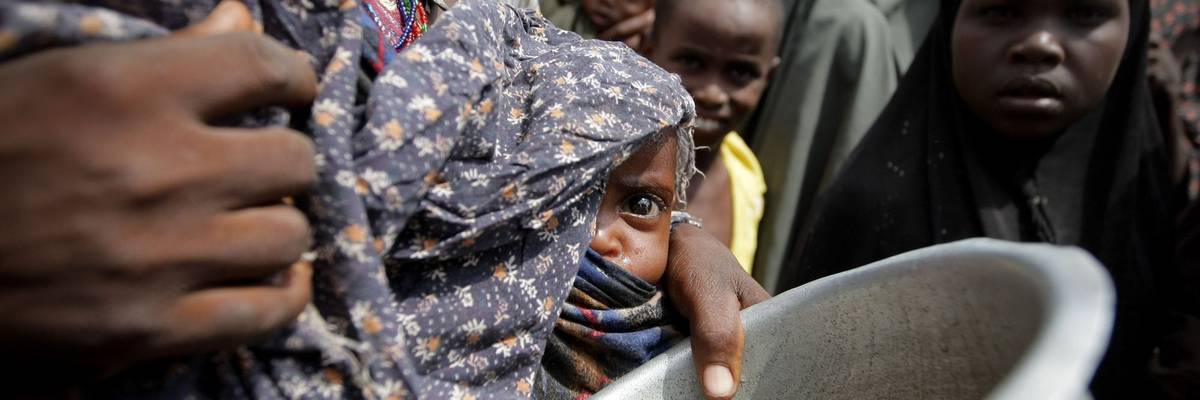
A woman holding her young malnourished baby queues for food at the Badbado camp for Internally Displaced Persons (IDPs). Famine has been declared in two regions of southern Somalia – southern Bakool and Lower Shabelle. The United Nations indicates that 3.7 million people across the country, that’s nearly half of the Somali population, are now in crisis and in urgent need of assistance. An estimated 2.8 million of those are in the south.
Photo ID 480645. 20/07/2011. Mogadishu, Somalia.
The retreat from global development by wealthy nations is an insult to the founding vision of the United Nations. But the problem of ending poverty is not a lack of data or policy solutions; it’s the fact that so few people are standing behind the cause of sharing the world’s resources.
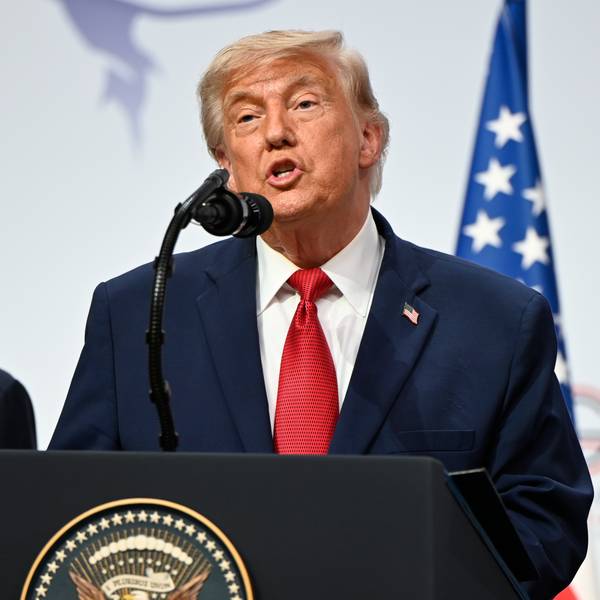
This year, the United Nations turned 80 years old. But as Secretary-General António Guterres launched his latest reform effort, the ‘UN80 Initiative’, there was little to be celebrating. At the same time as commemorative events praised the UN Charter and its foundational importance for peace, development and human rights, the UN system was facing draconian funding cuts that threatened to wipe out liquidity and undermine core operations. The Trump administration had dramatically withdrawn from the World Health Organisation earlier in January, then completely dismantled USAID shortly after. These were criminally inhumane acts when America is the UN’s largest single donor, and USAID—despite its flaws—still spent billions on vital health services, disaster relief and anti-poverty efforts.
The impact on the world’s developing nations is already devastating. Hundreds of aid organisations have shut down, leaving the humanitarian system at breaking point. The head of OCHA, the UN agency for coordinating emergency relief, spoke of funding cuts as a ‘seismic shock’ to a sector that suddenly contracted to one third of its size. The World Food Programme faced an alarming 40 percent drop in funding compared to last year, causing an unprecedented crisis for tens of millions across the globe reliant on food aid. UNICEF warned that the liquidity crunch is jeopardising lifesaving work, threatening to roll back advances in reducing child mortality. The UN refugee agency, UNHRC, announced that up to 11.6 million refugees and forcibly displaced people are at risk of losing access to direct humanitarian assistance. Many other UN health programmes that depended on U.S. funds received termination notices, including for HIV treatment, AIDS, malaria and tuberculosis.
Global development in reverse
But the blame for this crisis doesn’t rest with the cruel, heartless Trump administration alone. Two dozen of the world’s richest nations are pulling back from their obligations for global development, with many slashing aid budgets and funds channelled through multilateral lenders. Here in Britain, the Labour government is cutting its foreign aid budget from an already meagre 0.5 percent to 0.3 percent of GNI, amounting to a 40 percent reduction in coming years. The Lancet medical journal estimated in June that cuts to USAID alone could result in more than 14 million additional deaths by 2030. A recent study by the Barcelona Institute for Global Health says the combined US and European cuts could lead to 22.6 million additional deaths by 2030, reversing decades of progress in global health and poverty reduction.
We cannot end hunger or poverty when the yawning gap of inequality continues to increase every year, and our political institutions are skewed to the demands of the super-rich.
These decisions by our governments to drastically scale back the sharing of global resources is an insult to the founding vision of the United Nations. All year long, the UN has warned of a major hunger emergency with acute food insecurity set to worsen in 16 low-income countries, putting millions of lives at risk. Six are at the highest risk of famine or ‘catastrophic hunger’: Sudan, Palestine, South Sudan, Mali, Haiti and Yemen. Other countries of very high concern include the Democratic Republic of Congo, Myanmar, Nigeria, Somalia, Syria, and Afghanistan. Children in these ‘hotspots’ are particularly vulnerable as malnutrition weakens immunity, making them more susceptible to disease and death. Even before the aid cuts, the latest Global Report on Food Crises revealed that the number of starving people more than doubled in 2024 (mainly due to the horrifying weaponisation of hunger in the Gaza Strip and Sudan).
The causes of increasing food insecurity are complex and largely driven by an unrelenting wave of global crises including conflict, economic instability and climate-related emergencies. It is not due to a lack of global resources or population growth: FAO statistics show there is enough food produced to feed the world’s eight billion people, and a further three billion more. Indeed, the WFP estimates that less than one percent of the $21.9 trillion spent on military budgets over the past decade would be enough to end world hunger. Yet global military spending surged to a record high of $2.7 trillion in 2024, nearly 13 times the amount of official development assistance from the world’s wealthiest nations, and 750 times the UN regular budget in 2024. As Guterres remarked in a landmark UN report on The Security We Need: Rebalancing Military Spending for a Sustainable and Peaceful Future: ‘A more secure world begins by investing at least as much in fighting poverty as we do in fighting wars.’
An ‘inequality emergency’
This points to the basic reason why 733 million people face chronic hunger: they lack the money or resources to buy food. Almost half the world’s population (48%) live on less than $3 a day, the official extreme poverty line, meaning they are unable to meet basic survival needs like food, clean water, shelter and healthcare. One in four people globally (2.3 billion) face moderate or severe food insecurity, an increase of 335 million since 2019. No doubt, all the 3.4 billion people who live on less than $5.50 per day also struggle to provide themselves or their families with a varied and nutritious diet.
But there is approximately $432 trillion of total wealth in the world. It is often noted that the top 1 percent of the global adult population collectively own about half of that wealth; the bottom 50 percent own less than 1 percent of global wealth. Oxfam recently estimated that the richest 1 percent have seen their wealth surge over the past decade by around $34 trillion, which would be enough money to eliminate annual poverty 22 times over. A G20 committee of independent experts led by Joseph Stiglitz were right to describe these worsening trends as an ‘inequality emergency’, when 90 percent of the world population live under the World Bank’s definition of ‘high income inequality’. We cannot end hunger or poverty when the yawning gap of inequality continues to increase every year, and our political institutions are skewed to the demands of the super-rich.
The problem is not a lack of data or policy solutions. We know how the lowest-income nations can provide their populations with basic social rights, such as essential healthcare and income security, but the costs are out of reach due to heavy debt burdens. African governments spend an average of 17 percent of their revenues on servicing debts; as campaigners for Debt Justice Now argue, surely it is possible to cap the amount at 10 percent, unlocking enough money to provide clean water and sanitation to millions of people and avert roughly 23,000 under-5 deaths each year.
The UN’s special rapporteur on extreme poverty and human rights, Olivier De Schutter, has long campaigned for a global fund to provide poor countries with finance to cover basic social protection schemes. All the financing tools needed are meticulously detailed in a UN-endorsed policy roadmap, from upscaled official development assistance to international tax reforms, ‘solidarity levies’ and other innovative global measures. As Oxfam persistently argue, if global private wealth has grown by $342 trillion since 1995—eight times more than global public wealth—isn’t there a reasonable case for taxing that wealth to fund health, education and other public services?
The politics of hunger
If we’re talking about the politics of ending hunger, right-minded thinkers like the International Panel of Experts on Sustainable Food Systems (IPES) also tirelessly detail the pathway forwards by confronting and reversing gross inequities in wealth, power and access to land. Brazil under the Lula government is showing the way by implementing ‘people-first policies’ to guarantee food access like cash transfers to vulnerable families, support for farmers to transition to agroecological production, and improved access to affordable food in urban areas. Brazil is now officially removed from the UN Hunger Map, a historic achievement after years of rising hunger across the country. The larger picture, as IPES make clear, also requires challenging unfair trade rules and export patterns that trap poorer countries in dependency on food imports, making them vulnerable to price shocks.
The real problem, however, is that so few people are standing behind the cause of sharing the world’s resources to end life-threatening deprivation. A wave of ‘Gen Z’ protests against austerity may be sweeping the world, calling for a renewal of publicly funded services in healthcare, education and social protection within their respective countries. But we still lack a global movement to uphold the United Nations and its frontline agencies at a time when international law itself is under attack, leaving us with nothing but empty promises to ‘leave no-one behind’ and eradicate poverty and hunger by 2030. Many of these noble ambitions were repeated at the Second World Social Summit for Social Development in November, although they will remain implausible until governments fulfil the UN Charter’s intention to craft binding mechanisms and ‘employ international machinery for the promotion of the economic and social advancement of all peoples’.
The Universal Declaration of Human Rights is fast becoming a forgotten pledge of the international community since 1948, especially the 25th Article that proclaims the most basic right to an adequate standard of living. Where is our outrage for the 900 million children that still experience multidimensional poverty in the 21st century? Or the staggering 318 million people who, at this moment, are facing crisis levels of acute food insecurity? That’s why the time has come for millions of people to participate in huge, worldwide demonstrations that uphold the long-agreed rights of Article 25. It may be our last and only hope of saving the UN’s vision of promoting social progress and better standards of life for everyone.
Dear Common Dreams reader, It’s been nearly 30 years since I co-founded Common Dreams with my late wife, Lina Newhouser. We had the radical notion that journalism should serve the public good, not corporate profits. It was clear to us from the outset what it would take to build such a project. No paid advertisements. No corporate sponsors. No millionaire publisher telling us what to think or do. Many people said we wouldn't last a year, but we proved those doubters wrong. Together with a tremendous team of journalists and dedicated staff, we built an independent media outlet free from the constraints of profits and corporate control. Our mission has always been simple: To inform. To inspire. To ignite change for the common good. Building Common Dreams was not easy. Our survival was never guaranteed. When you take on the most powerful forces—Wall Street greed, fossil fuel industry destruction, Big Tech lobbyists, and uber-rich oligarchs who have spent billions upon billions rigging the economy and democracy in their favor—the only bulwark you have is supporters who believe in your work. But here’s the urgent message from me today. It's never been this bad out there. And it's never been this hard to keep us going. At the very moment Common Dreams is most needed, the threats we face are intensifying. We need your support now more than ever. We don't accept corporate advertising and never will. We don't have a paywall because we don't think people should be blocked from critical news based on their ability to pay. Everything we do is funded by the donations of readers like you. When everyone does the little they can afford, we are strong. But if that support retreats or dries up, so do we. Will you donate now to make sure Common Dreams not only survives but thrives? —Craig Brown, Co-founder |
This year, the United Nations turned 80 years old. But as Secretary-General António Guterres launched his latest reform effort, the ‘UN80 Initiative’, there was little to be celebrating. At the same time as commemorative events praised the UN Charter and its foundational importance for peace, development and human rights, the UN system was facing draconian funding cuts that threatened to wipe out liquidity and undermine core operations. The Trump administration had dramatically withdrawn from the World Health Organisation earlier in January, then completely dismantled USAID shortly after. These were criminally inhumane acts when America is the UN’s largest single donor, and USAID—despite its flaws—still spent billions on vital health services, disaster relief and anti-poverty efforts.
The impact on the world’s developing nations is already devastating. Hundreds of aid organisations have shut down, leaving the humanitarian system at breaking point. The head of OCHA, the UN agency for coordinating emergency relief, spoke of funding cuts as a ‘seismic shock’ to a sector that suddenly contracted to one third of its size. The World Food Programme faced an alarming 40 percent drop in funding compared to last year, causing an unprecedented crisis for tens of millions across the globe reliant on food aid. UNICEF warned that the liquidity crunch is jeopardising lifesaving work, threatening to roll back advances in reducing child mortality. The UN refugee agency, UNHRC, announced that up to 11.6 million refugees and forcibly displaced people are at risk of losing access to direct humanitarian assistance. Many other UN health programmes that depended on U.S. funds received termination notices, including for HIV treatment, AIDS, malaria and tuberculosis.
Global development in reverse
But the blame for this crisis doesn’t rest with the cruel, heartless Trump administration alone. Two dozen of the world’s richest nations are pulling back from their obligations for global development, with many slashing aid budgets and funds channelled through multilateral lenders. Here in Britain, the Labour government is cutting its foreign aid budget from an already meagre 0.5 percent to 0.3 percent of GNI, amounting to a 40 percent reduction in coming years. The Lancet medical journal estimated in June that cuts to USAID alone could result in more than 14 million additional deaths by 2030. A recent study by the Barcelona Institute for Global Health says the combined US and European cuts could lead to 22.6 million additional deaths by 2030, reversing decades of progress in global health and poverty reduction.
We cannot end hunger or poverty when the yawning gap of inequality continues to increase every year, and our political institutions are skewed to the demands of the super-rich.
These decisions by our governments to drastically scale back the sharing of global resources is an insult to the founding vision of the United Nations. All year long, the UN has warned of a major hunger emergency with acute food insecurity set to worsen in 16 low-income countries, putting millions of lives at risk. Six are at the highest risk of famine or ‘catastrophic hunger’: Sudan, Palestine, South Sudan, Mali, Haiti and Yemen. Other countries of very high concern include the Democratic Republic of Congo, Myanmar, Nigeria, Somalia, Syria, and Afghanistan. Children in these ‘hotspots’ are particularly vulnerable as malnutrition weakens immunity, making them more susceptible to disease and death. Even before the aid cuts, the latest Global Report on Food Crises revealed that the number of starving people more than doubled in 2024 (mainly due to the horrifying weaponisation of hunger in the Gaza Strip and Sudan).
The causes of increasing food insecurity are complex and largely driven by an unrelenting wave of global crises including conflict, economic instability and climate-related emergencies. It is not due to a lack of global resources or population growth: FAO statistics show there is enough food produced to feed the world’s eight billion people, and a further three billion more. Indeed, the WFP estimates that less than one percent of the $21.9 trillion spent on military budgets over the past decade would be enough to end world hunger. Yet global military spending surged to a record high of $2.7 trillion in 2024, nearly 13 times the amount of official development assistance from the world’s wealthiest nations, and 750 times the UN regular budget in 2024. As Guterres remarked in a landmark UN report on The Security We Need: Rebalancing Military Spending for a Sustainable and Peaceful Future: ‘A more secure world begins by investing at least as much in fighting poverty as we do in fighting wars.’
An ‘inequality emergency’
This points to the basic reason why 733 million people face chronic hunger: they lack the money or resources to buy food. Almost half the world’s population (48%) live on less than $3 a day, the official extreme poverty line, meaning they are unable to meet basic survival needs like food, clean water, shelter and healthcare. One in four people globally (2.3 billion) face moderate or severe food insecurity, an increase of 335 million since 2019. No doubt, all the 3.4 billion people who live on less than $5.50 per day also struggle to provide themselves or their families with a varied and nutritious diet.
But there is approximately $432 trillion of total wealth in the world. It is often noted that the top 1 percent of the global adult population collectively own about half of that wealth; the bottom 50 percent own less than 1 percent of global wealth. Oxfam recently estimated that the richest 1 percent have seen their wealth surge over the past decade by around $34 trillion, which would be enough money to eliminate annual poverty 22 times over. A G20 committee of independent experts led by Joseph Stiglitz were right to describe these worsening trends as an ‘inequality emergency’, when 90 percent of the world population live under the World Bank’s definition of ‘high income inequality’. We cannot end hunger or poverty when the yawning gap of inequality continues to increase every year, and our political institutions are skewed to the demands of the super-rich.
The problem is not a lack of data or policy solutions. We know how the lowest-income nations can provide their populations with basic social rights, such as essential healthcare and income security, but the costs are out of reach due to heavy debt burdens. African governments spend an average of 17 percent of their revenues on servicing debts; as campaigners for Debt Justice Now argue, surely it is possible to cap the amount at 10 percent, unlocking enough money to provide clean water and sanitation to millions of people and avert roughly 23,000 under-5 deaths each year.
The UN’s special rapporteur on extreme poverty and human rights, Olivier De Schutter, has long campaigned for a global fund to provide poor countries with finance to cover basic social protection schemes. All the financing tools needed are meticulously detailed in a UN-endorsed policy roadmap, from upscaled official development assistance to international tax reforms, ‘solidarity levies’ and other innovative global measures. As Oxfam persistently argue, if global private wealth has grown by $342 trillion since 1995—eight times more than global public wealth—isn’t there a reasonable case for taxing that wealth to fund health, education and other public services?
The politics of hunger
If we’re talking about the politics of ending hunger, right-minded thinkers like the International Panel of Experts on Sustainable Food Systems (IPES) also tirelessly detail the pathway forwards by confronting and reversing gross inequities in wealth, power and access to land. Brazil under the Lula government is showing the way by implementing ‘people-first policies’ to guarantee food access like cash transfers to vulnerable families, support for farmers to transition to agroecological production, and improved access to affordable food in urban areas. Brazil is now officially removed from the UN Hunger Map, a historic achievement after years of rising hunger across the country. The larger picture, as IPES make clear, also requires challenging unfair trade rules and export patterns that trap poorer countries in dependency on food imports, making them vulnerable to price shocks.
The real problem, however, is that so few people are standing behind the cause of sharing the world’s resources to end life-threatening deprivation. A wave of ‘Gen Z’ protests against austerity may be sweeping the world, calling for a renewal of publicly funded services in healthcare, education and social protection within their respective countries. But we still lack a global movement to uphold the United Nations and its frontline agencies at a time when international law itself is under attack, leaving us with nothing but empty promises to ‘leave no-one behind’ and eradicate poverty and hunger by 2030. Many of these noble ambitions were repeated at the Second World Social Summit for Social Development in November, although they will remain implausible until governments fulfil the UN Charter’s intention to craft binding mechanisms and ‘employ international machinery for the promotion of the economic and social advancement of all peoples’.
The Universal Declaration of Human Rights is fast becoming a forgotten pledge of the international community since 1948, especially the 25th Article that proclaims the most basic right to an adequate standard of living. Where is our outrage for the 900 million children that still experience multidimensional poverty in the 21st century? Or the staggering 318 million people who, at this moment, are facing crisis levels of acute food insecurity? That’s why the time has come for millions of people to participate in huge, worldwide demonstrations that uphold the long-agreed rights of Article 25. It may be our last and only hope of saving the UN’s vision of promoting social progress and better standards of life for everyone.
This year, the United Nations turned 80 years old. But as Secretary-General António Guterres launched his latest reform effort, the ‘UN80 Initiative’, there was little to be celebrating. At the same time as commemorative events praised the UN Charter and its foundational importance for peace, development and human rights, the UN system was facing draconian funding cuts that threatened to wipe out liquidity and undermine core operations. The Trump administration had dramatically withdrawn from the World Health Organisation earlier in January, then completely dismantled USAID shortly after. These were criminally inhumane acts when America is the UN’s largest single donor, and USAID—despite its flaws—still spent billions on vital health services, disaster relief and anti-poverty efforts.
The impact on the world’s developing nations is already devastating. Hundreds of aid organisations have shut down, leaving the humanitarian system at breaking point. The head of OCHA, the UN agency for coordinating emergency relief, spoke of funding cuts as a ‘seismic shock’ to a sector that suddenly contracted to one third of its size. The World Food Programme faced an alarming 40 percent drop in funding compared to last year, causing an unprecedented crisis for tens of millions across the globe reliant on food aid. UNICEF warned that the liquidity crunch is jeopardising lifesaving work, threatening to roll back advances in reducing child mortality. The UN refugee agency, UNHRC, announced that up to 11.6 million refugees and forcibly displaced people are at risk of losing access to direct humanitarian assistance. Many other UN health programmes that depended on U.S. funds received termination notices, including for HIV treatment, AIDS, malaria and tuberculosis.
Global development in reverse
But the blame for this crisis doesn’t rest with the cruel, heartless Trump administration alone. Two dozen of the world’s richest nations are pulling back from their obligations for global development, with many slashing aid budgets and funds channelled through multilateral lenders. Here in Britain, the Labour government is cutting its foreign aid budget from an already meagre 0.5 percent to 0.3 percent of GNI, amounting to a 40 percent reduction in coming years. The Lancet medical journal estimated in June that cuts to USAID alone could result in more than 14 million additional deaths by 2030. A recent study by the Barcelona Institute for Global Health says the combined US and European cuts could lead to 22.6 million additional deaths by 2030, reversing decades of progress in global health and poverty reduction.
We cannot end hunger or poverty when the yawning gap of inequality continues to increase every year, and our political institutions are skewed to the demands of the super-rich.
These decisions by our governments to drastically scale back the sharing of global resources is an insult to the founding vision of the United Nations. All year long, the UN has warned of a major hunger emergency with acute food insecurity set to worsen in 16 low-income countries, putting millions of lives at risk. Six are at the highest risk of famine or ‘catastrophic hunger’: Sudan, Palestine, South Sudan, Mali, Haiti and Yemen. Other countries of very high concern include the Democratic Republic of Congo, Myanmar, Nigeria, Somalia, Syria, and Afghanistan. Children in these ‘hotspots’ are particularly vulnerable as malnutrition weakens immunity, making them more susceptible to disease and death. Even before the aid cuts, the latest Global Report on Food Crises revealed that the number of starving people more than doubled in 2024 (mainly due to the horrifying weaponisation of hunger in the Gaza Strip and Sudan).
The causes of increasing food insecurity are complex and largely driven by an unrelenting wave of global crises including conflict, economic instability and climate-related emergencies. It is not due to a lack of global resources or population growth: FAO statistics show there is enough food produced to feed the world’s eight billion people, and a further three billion more. Indeed, the WFP estimates that less than one percent of the $21.9 trillion spent on military budgets over the past decade would be enough to end world hunger. Yet global military spending surged to a record high of $2.7 trillion in 2024, nearly 13 times the amount of official development assistance from the world’s wealthiest nations, and 750 times the UN regular budget in 2024. As Guterres remarked in a landmark UN report on The Security We Need: Rebalancing Military Spending for a Sustainable and Peaceful Future: ‘A more secure world begins by investing at least as much in fighting poverty as we do in fighting wars.’
An ‘inequality emergency’
This points to the basic reason why 733 million people face chronic hunger: they lack the money or resources to buy food. Almost half the world’s population (48%) live on less than $3 a day, the official extreme poverty line, meaning they are unable to meet basic survival needs like food, clean water, shelter and healthcare. One in four people globally (2.3 billion) face moderate or severe food insecurity, an increase of 335 million since 2019. No doubt, all the 3.4 billion people who live on less than $5.50 per day also struggle to provide themselves or their families with a varied and nutritious diet.
But there is approximately $432 trillion of total wealth in the world. It is often noted that the top 1 percent of the global adult population collectively own about half of that wealth; the bottom 50 percent own less than 1 percent of global wealth. Oxfam recently estimated that the richest 1 percent have seen their wealth surge over the past decade by around $34 trillion, which would be enough money to eliminate annual poverty 22 times over. A G20 committee of independent experts led by Joseph Stiglitz were right to describe these worsening trends as an ‘inequality emergency’, when 90 percent of the world population live under the World Bank’s definition of ‘high income inequality’. We cannot end hunger or poverty when the yawning gap of inequality continues to increase every year, and our political institutions are skewed to the demands of the super-rich.
The problem is not a lack of data or policy solutions. We know how the lowest-income nations can provide their populations with basic social rights, such as essential healthcare and income security, but the costs are out of reach due to heavy debt burdens. African governments spend an average of 17 percent of their revenues on servicing debts; as campaigners for Debt Justice Now argue, surely it is possible to cap the amount at 10 percent, unlocking enough money to provide clean water and sanitation to millions of people and avert roughly 23,000 under-5 deaths each year.
The UN’s special rapporteur on extreme poverty and human rights, Olivier De Schutter, has long campaigned for a global fund to provide poor countries with finance to cover basic social protection schemes. All the financing tools needed are meticulously detailed in a UN-endorsed policy roadmap, from upscaled official development assistance to international tax reforms, ‘solidarity levies’ and other innovative global measures. As Oxfam persistently argue, if global private wealth has grown by $342 trillion since 1995—eight times more than global public wealth—isn’t there a reasonable case for taxing that wealth to fund health, education and other public services?
The politics of hunger
If we’re talking about the politics of ending hunger, right-minded thinkers like the International Panel of Experts on Sustainable Food Systems (IPES) also tirelessly detail the pathway forwards by confronting and reversing gross inequities in wealth, power and access to land. Brazil under the Lula government is showing the way by implementing ‘people-first policies’ to guarantee food access like cash transfers to vulnerable families, support for farmers to transition to agroecological production, and improved access to affordable food in urban areas. Brazil is now officially removed from the UN Hunger Map, a historic achievement after years of rising hunger across the country. The larger picture, as IPES make clear, also requires challenging unfair trade rules and export patterns that trap poorer countries in dependency on food imports, making them vulnerable to price shocks.
The real problem, however, is that so few people are standing behind the cause of sharing the world’s resources to end life-threatening deprivation. A wave of ‘Gen Z’ protests against austerity may be sweeping the world, calling for a renewal of publicly funded services in healthcare, education and social protection within their respective countries. But we still lack a global movement to uphold the United Nations and its frontline agencies at a time when international law itself is under attack, leaving us with nothing but empty promises to ‘leave no-one behind’ and eradicate poverty and hunger by 2030. Many of these noble ambitions were repeated at the Second World Social Summit for Social Development in November, although they will remain implausible until governments fulfil the UN Charter’s intention to craft binding mechanisms and ‘employ international machinery for the promotion of the economic and social advancement of all peoples’.
The Universal Declaration of Human Rights is fast becoming a forgotten pledge of the international community since 1948, especially the 25th Article that proclaims the most basic right to an adequate standard of living. Where is our outrage for the 900 million children that still experience multidimensional poverty in the 21st century? Or the staggering 318 million people who, at this moment, are facing crisis levels of acute food insecurity? That’s why the time has come for millions of people to participate in huge, worldwide demonstrations that uphold the long-agreed rights of Article 25. It may be our last and only hope of saving the UN’s vision of promoting social progress and better standards of life for everyone.