
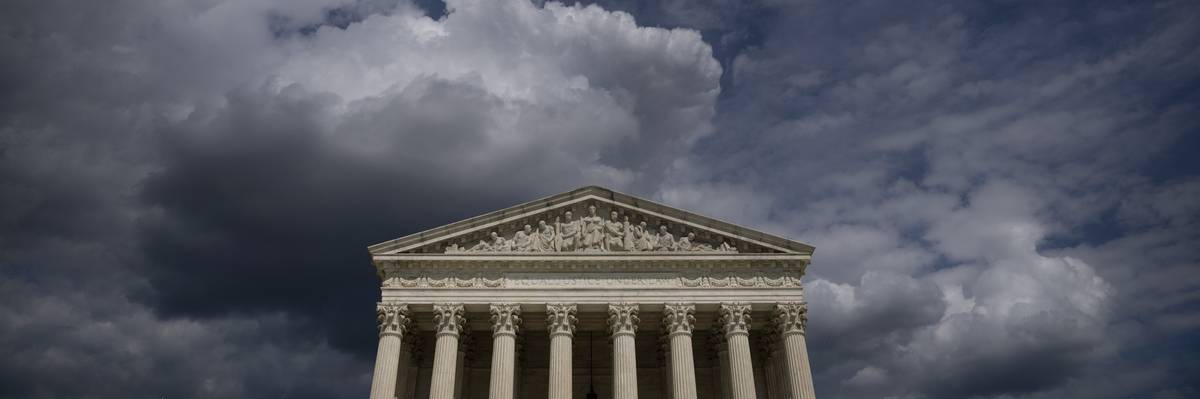
Clouds are seen above The US Supreme Court building on May 17, 2021 in Washington, DC.
The Supreme Court Is 1 Small Step From Infamy
If defending democracy and the constitutional separation of power is not enough to motivate them to push back against Trump’s authoritarian actions, perhaps their certain condemnation by history will be.
The losers in political battles often insist that history will prove them right and their opponents wrong. As comforting a thought as this may be for people licking their political wounds, it is rarely true. History forgets far more than it remembers. Apart from a few major players, even people who gain a degree of prominence in the politics of their time will eventually disappear into the black hole of advancing years. Their victories, defeats, glories, and disgraces—all blown away by the wind of time like dust on their gravestones.
If there is any group today who deserve the censure of history, it is the Republican members of Congress. Faced with the existential threat that President Donald Trump poses to our democracy, their nearly unanimous response has been to worshipfully give him whatever he wants—reducing their role to little more than handmaidens to a would-be tyrant. These people have been given the honor of serving as representatives in the United States Congress. And all the Constitution asks of them in return is to take and honor an oath to support and defend the Constitution.
One by one these Republicans raise their right hands and take the oath of office. Then one by one they quickly throw that oath away.
But as deserving as these Republican politicians are of history’s censure, most will likely escape it. There are just too many of them—535 total senators and representatives with approximately 272 of them currently Republican. Donald Trump will, of course, be remembered and judged severely. The same goes for a few prominent congressional leaders. But as for the rest, within a relatively brief time as measured by the long view of history, they will be forgotten, their sins forever interred with them in their graves.
This court isn’t about judicial philosophy and legal principles. It is about the raw application of power for political ends.
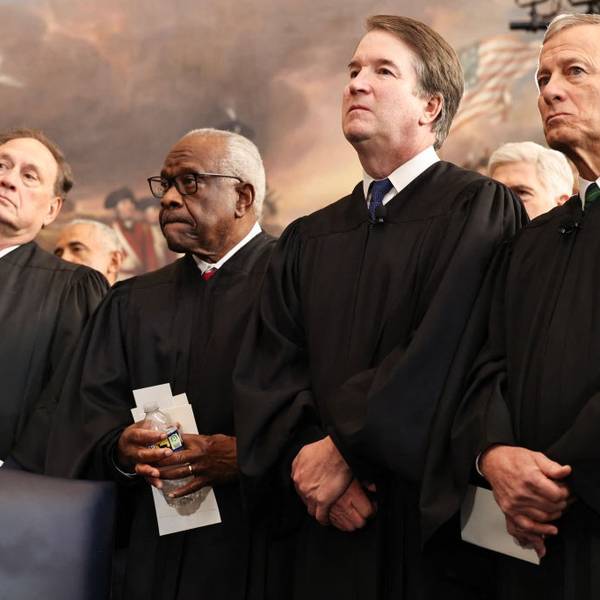
But for justices of the United States Supreme Court, it is a different story. Unlike the Congress, the Supreme Court is made up of only nine justices. And of those 9 current justices, only 6 have consistently supported Trump’s authoritarian actions. When it comes to the judgment of history, these few justices will have no place to hide and no crowd to be lost in. If they continue to support Trump’s ever-growing list of power grabs, their treachery, and yes it would be treachery, will never be forgotten and certainly never be forgiven.
The origin story of the current far-right Supreme Court majority begins 43 years ago in 1982, when Ronald Reagan was president and car radios blasted out songs like “Eye of the Tiger” and “I Love Rock and Roll.” That was also the year the Federalist Society was born. Best described as a breeding ground for right-wing judges, it has led a decades-long quest by wealthy conservatives to produce a dependably right-wing Supreme Court.
They knew doing this would take time, and they were prepared to play the long game. The Federalist Society’s core strategy is to embrace and groom conservative law students. With easy access to almost limitless funding from their wealthy conservative patrons, the society has had no need to pinch pennies.
They have helped to establish Federalist Society chapters in law schools across the country, financed scholarships to Federalist Society seminars, arranged social opportunities for student members to meet and converse with prominent judicial conservatives, and much more. Later, after law school, the group works to connect prized prospects with leading right-wing judges for prestigious clerkships, putting them on the path to future judicial appointments of their own.
All six of the current far-right justices have strong connections with the group. They grew up as lawyers in an environment that strongly encourages use of the law as a weapon to remake America into a far-right paradise. These six far-right justices are called conservatives, but this is true only in the political sense of the word. They are anything but conservative in the judicial sense. Traditional judicial conservatism is based upon things like respect for precedent and a commitment to judicial restraint, neither of which in any way describes the actions of these six justices. Not only have they repeatedly overruled well-established precedents; they have shown no consistent judicial philosophy in doing so. And even when they do purport to follow a particular judicial philosophy, such as originalism, it is often little more than a smokescreen.
One “good” example from an earlier time is District of Columbia v. Heller, decided in 2008, in which the Supreme Court, for the first time, held that the Second Amendment creates a private right to gun possession. In writing the majority opinion, Justice Antonin Scalia claimed to follow an originalist view of the Constitution and that history supported this view. The audaciousness of this claim led to a number of conservative as well as liberal constitutional scholars rejecting the court’s rationale.
Even then, it was the political result that mattered, not the jurisprudence. This court isn’t about judicial philosophy and legal principles. It is about the raw application of power for political ends—political ends that are largely contrary to the preferences of a majority of the American public.
But then, why would it be otherwise? Does anyone believe that the small collection of massively wealthy families who funded this conservative judicial revolution did so out of concern for judicial philosophy? Of course not. These wealthy families spent their hard-earned money—or perhaps more accurately in many cases their hard-inherited money—for concrete political ends. They wanted to increase their wealth and power even further by reducing government regulation, destroying labor unions, cutting worker protections, ending government protection of the environment, force feeding right-wing religious dogma, and the rest of the fat catalog of the daydreams of the greed-is-good crowd.
And if these ends can best be achieved by flushing functioning democracy down the toilet, they will shed few tears. And if one is to judge by their actions since Donald Trump returned to the presidency, the current right-wing justices seem ready to drive the train.
But there is a tenuous basis for hope. One characteristic shared by almost all Supreme Court justices is a profound concern over their historical legacy. These are smart people. Even living within the isolating fog of the far-right, at least a few of these justices must recognize they are dancing with a legacy of infamy. If defending democracy and the constitutional separation of power is not enough to motivate them to push back against Trump’s authoritarian actions, perhaps their certain condemnation by history will be.
The Dred Scott opinion was handed down almost 170 years ago, but the shame of the decision hasn’t lessened with time. The primarily legacy Chief Justice Roger B. Taney left behind was a full-throated defense of the evil of slavery and racism. And that is how history remembers and damns him.
Few things are guaranteed in this world, but one thing seems certain. If the Supreme Court majority continues down the road of aiding and abetting Donald Trump’s quest for dictatorial power, they are inviting an infamy far worse than Taney’s.
This is something the six justices should remember, because history will never forget.
We are at a crossroads
This country and this world are at a monumental crossroads. In a few short weeks, US voters will have an opportunity to beat back the forces of fascism and confront the billionaires who are rigging the economy, our media system, and our democracy, making it increasingly impossible for ordinary people to get by. We’re not just talking about the election. We’re talking about what must be done once these fascist elements are vanquished from power. We need a bolder set of solutions than what either major party has so far been willing to offer and a working-class movement ready to fight like hell for it. Trump didn't emerge from nowhere. The conditions that fueled MAGA authoritarianism were created by decades of radical neoliberal economic policies and a corrupt political system dominated by corporate interests. They slashed taxes on the super-rich, promising that the benefits would trickle down. They said giveaways to the corporate titans would make life more affordable for the rest of us. It was all bullshit. And when a bitter, betrayed populace searches for someone to blame, right-wing demagogues have little trouble finding scapegoats. People know when they're being lied to, but you won't hear any of this from the corporate media. Only independent journalism—powered and funded by people who believe in building a better world—can deliver truly trustworthy daily news. Our Fall Campaign is underway, and we need your help. To power our newsroom through the rest of the year, we need to raise $125,000 by midnight on October 31. So if you share our vision, please contribute whatever you can to sustain our work. |
The losers in political battles often insist that history will prove them right and their opponents wrong. As comforting a thought as this may be for people licking their political wounds, it is rarely true. History forgets far more than it remembers. Apart from a few major players, even people who gain a degree of prominence in the politics of their time will eventually disappear into the black hole of advancing years. Their victories, defeats, glories, and disgraces—all blown away by the wind of time like dust on their gravestones.
If there is any group today who deserve the censure of history, it is the Republican members of Congress. Faced with the existential threat that President Donald Trump poses to our democracy, their nearly unanimous response has been to worshipfully give him whatever he wants—reducing their role to little more than handmaidens to a would-be tyrant. These people have been given the honor of serving as representatives in the United States Congress. And all the Constitution asks of them in return is to take and honor an oath to support and defend the Constitution.
One by one these Republicans raise their right hands and take the oath of office. Then one by one they quickly throw that oath away.
But as deserving as these Republican politicians are of history’s censure, most will likely escape it. There are just too many of them—535 total senators and representatives with approximately 272 of them currently Republican. Donald Trump will, of course, be remembered and judged severely. The same goes for a few prominent congressional leaders. But as for the rest, within a relatively brief time as measured by the long view of history, they will be forgotten, their sins forever interred with them in their graves.
This court isn’t about judicial philosophy and legal principles. It is about the raw application of power for political ends.
But for justices of the United States Supreme Court, it is a different story. Unlike the Congress, the Supreme Court is made up of only nine justices. And of those 9 current justices, only 6 have consistently supported Trump’s authoritarian actions. When it comes to the judgment of history, these few justices will have no place to hide and no crowd to be lost in. If they continue to support Trump’s ever-growing list of power grabs, their treachery, and yes it would be treachery, will never be forgotten and certainly never be forgiven.
The origin story of the current far-right Supreme Court majority begins 43 years ago in 1982, when Ronald Reagan was president and car radios blasted out songs like “Eye of the Tiger” and “I Love Rock and Roll.” That was also the year the Federalist Society was born. Best described as a breeding ground for right-wing judges, it has led a decades-long quest by wealthy conservatives to produce a dependably right-wing Supreme Court.
They knew doing this would take time, and they were prepared to play the long game. The Federalist Society’s core strategy is to embrace and groom conservative law students. With easy access to almost limitless funding from their wealthy conservative patrons, the society has had no need to pinch pennies.
They have helped to establish Federalist Society chapters in law schools across the country, financed scholarships to Federalist Society seminars, arranged social opportunities for student members to meet and converse with prominent judicial conservatives, and much more. Later, after law school, the group works to connect prized prospects with leading right-wing judges for prestigious clerkships, putting them on the path to future judicial appointments of their own.
All six of the current far-right justices have strong connections with the group. They grew up as lawyers in an environment that strongly encourages use of the law as a weapon to remake America into a far-right paradise. These six far-right justices are called conservatives, but this is true only in the political sense of the word. They are anything but conservative in the judicial sense. Traditional judicial conservatism is based upon things like respect for precedent and a commitment to judicial restraint, neither of which in any way describes the actions of these six justices. Not only have they repeatedly overruled well-established precedents; they have shown no consistent judicial philosophy in doing so. And even when they do purport to follow a particular judicial philosophy, such as originalism, it is often little more than a smokescreen.
One “good” example from an earlier time is District of Columbia v. Heller, decided in 2008, in which the Supreme Court, for the first time, held that the Second Amendment creates a private right to gun possession. In writing the majority opinion, Justice Antonin Scalia claimed to follow an originalist view of the Constitution and that history supported this view. The audaciousness of this claim led to a number of conservative as well as liberal constitutional scholars rejecting the court’s rationale.
Even then, it was the political result that mattered, not the jurisprudence. This court isn’t about judicial philosophy and legal principles. It is about the raw application of power for political ends—political ends that are largely contrary to the preferences of a majority of the American public.
But then, why would it be otherwise? Does anyone believe that the small collection of massively wealthy families who funded this conservative judicial revolution did so out of concern for judicial philosophy? Of course not. These wealthy families spent their hard-earned money—or perhaps more accurately in many cases their hard-inherited money—for concrete political ends. They wanted to increase their wealth and power even further by reducing government regulation, destroying labor unions, cutting worker protections, ending government protection of the environment, force feeding right-wing religious dogma, and the rest of the fat catalog of the daydreams of the greed-is-good crowd.
And if these ends can best be achieved by flushing functioning democracy down the toilet, they will shed few tears. And if one is to judge by their actions since Donald Trump returned to the presidency, the current right-wing justices seem ready to drive the train.
But there is a tenuous basis for hope. One characteristic shared by almost all Supreme Court justices is a profound concern over their historical legacy. These are smart people. Even living within the isolating fog of the far-right, at least a few of these justices must recognize they are dancing with a legacy of infamy. If defending democracy and the constitutional separation of power is not enough to motivate them to push back against Trump’s authoritarian actions, perhaps their certain condemnation by history will be.
The Dred Scott opinion was handed down almost 170 years ago, but the shame of the decision hasn’t lessened with time. The primarily legacy Chief Justice Roger B. Taney left behind was a full-throated defense of the evil of slavery and racism. And that is how history remembers and damns him.
Few things are guaranteed in this world, but one thing seems certain. If the Supreme Court majority continues down the road of aiding and abetting Donald Trump’s quest for dictatorial power, they are inviting an infamy far worse than Taney’s.
This is something the six justices should remember, because history will never forget.
- Supreme Court Allows Trump to Impose Anti-Trans Passport Policy ›
- Supreme Court Lets Trump Freeze Millions in Funding to Tackle Teacher Shortages ›
- Supreme Court OKs Trump 'Third Country' Deportation of Men Held in Desert Shipping Container ›
- Another Gift to Trump: Supreme Court Lifts Lower Court Ban on 'Blatant Racial Profiling' by ICE Agents ›
- With Food Banks in 'Disaster Response Mode,' Supreme Court Lets Trump Pause SNAP Funds ›
- The Roberts Court Will Be Remembered for Surrendering to Trump ›
- Opinion | The Supreme Court's Latest Shadow-Docket Ruling Could Help the GOP Win the Midterms | Common Dreams ›
The losers in political battles often insist that history will prove them right and their opponents wrong. As comforting a thought as this may be for people licking their political wounds, it is rarely true. History forgets far more than it remembers. Apart from a few major players, even people who gain a degree of prominence in the politics of their time will eventually disappear into the black hole of advancing years. Their victories, defeats, glories, and disgraces—all blown away by the wind of time like dust on their gravestones.
If there is any group today who deserve the censure of history, it is the Republican members of Congress. Faced with the existential threat that President Donald Trump poses to our democracy, their nearly unanimous response has been to worshipfully give him whatever he wants—reducing their role to little more than handmaidens to a would-be tyrant. These people have been given the honor of serving as representatives in the United States Congress. And all the Constitution asks of them in return is to take and honor an oath to support and defend the Constitution.
One by one these Republicans raise their right hands and take the oath of office. Then one by one they quickly throw that oath away.
But as deserving as these Republican politicians are of history’s censure, most will likely escape it. There are just too many of them—535 total senators and representatives with approximately 272 of them currently Republican. Donald Trump will, of course, be remembered and judged severely. The same goes for a few prominent congressional leaders. But as for the rest, within a relatively brief time as measured by the long view of history, they will be forgotten, their sins forever interred with them in their graves.
This court isn’t about judicial philosophy and legal principles. It is about the raw application of power for political ends.
But for justices of the United States Supreme Court, it is a different story. Unlike the Congress, the Supreme Court is made up of only nine justices. And of those 9 current justices, only 6 have consistently supported Trump’s authoritarian actions. When it comes to the judgment of history, these few justices will have no place to hide and no crowd to be lost in. If they continue to support Trump’s ever-growing list of power grabs, their treachery, and yes it would be treachery, will never be forgotten and certainly never be forgiven.
The origin story of the current far-right Supreme Court majority begins 43 years ago in 1982, when Ronald Reagan was president and car radios blasted out songs like “Eye of the Tiger” and “I Love Rock and Roll.” That was also the year the Federalist Society was born. Best described as a breeding ground for right-wing judges, it has led a decades-long quest by wealthy conservatives to produce a dependably right-wing Supreme Court.
They knew doing this would take time, and they were prepared to play the long game. The Federalist Society’s core strategy is to embrace and groom conservative law students. With easy access to almost limitless funding from their wealthy conservative patrons, the society has had no need to pinch pennies.
They have helped to establish Federalist Society chapters in law schools across the country, financed scholarships to Federalist Society seminars, arranged social opportunities for student members to meet and converse with prominent judicial conservatives, and much more. Later, after law school, the group works to connect prized prospects with leading right-wing judges for prestigious clerkships, putting them on the path to future judicial appointments of their own.
All six of the current far-right justices have strong connections with the group. They grew up as lawyers in an environment that strongly encourages use of the law as a weapon to remake America into a far-right paradise. These six far-right justices are called conservatives, but this is true only in the political sense of the word. They are anything but conservative in the judicial sense. Traditional judicial conservatism is based upon things like respect for precedent and a commitment to judicial restraint, neither of which in any way describes the actions of these six justices. Not only have they repeatedly overruled well-established precedents; they have shown no consistent judicial philosophy in doing so. And even when they do purport to follow a particular judicial philosophy, such as originalism, it is often little more than a smokescreen.
One “good” example from an earlier time is District of Columbia v. Heller, decided in 2008, in which the Supreme Court, for the first time, held that the Second Amendment creates a private right to gun possession. In writing the majority opinion, Justice Antonin Scalia claimed to follow an originalist view of the Constitution and that history supported this view. The audaciousness of this claim led to a number of conservative as well as liberal constitutional scholars rejecting the court’s rationale.
Even then, it was the political result that mattered, not the jurisprudence. This court isn’t about judicial philosophy and legal principles. It is about the raw application of power for political ends—political ends that are largely contrary to the preferences of a majority of the American public.
But then, why would it be otherwise? Does anyone believe that the small collection of massively wealthy families who funded this conservative judicial revolution did so out of concern for judicial philosophy? Of course not. These wealthy families spent their hard-earned money—or perhaps more accurately in many cases their hard-inherited money—for concrete political ends. They wanted to increase their wealth and power even further by reducing government regulation, destroying labor unions, cutting worker protections, ending government protection of the environment, force feeding right-wing religious dogma, and the rest of the fat catalog of the daydreams of the greed-is-good crowd.
And if these ends can best be achieved by flushing functioning democracy down the toilet, they will shed few tears. And if one is to judge by their actions since Donald Trump returned to the presidency, the current right-wing justices seem ready to drive the train.
But there is a tenuous basis for hope. One characteristic shared by almost all Supreme Court justices is a profound concern over their historical legacy. These are smart people. Even living within the isolating fog of the far-right, at least a few of these justices must recognize they are dancing with a legacy of infamy. If defending democracy and the constitutional separation of power is not enough to motivate them to push back against Trump’s authoritarian actions, perhaps their certain condemnation by history will be.
The Dred Scott opinion was handed down almost 170 years ago, but the shame of the decision hasn’t lessened with time. The primarily legacy Chief Justice Roger B. Taney left behind was a full-throated defense of the evil of slavery and racism. And that is how history remembers and damns him.
Few things are guaranteed in this world, but one thing seems certain. If the Supreme Court majority continues down the road of aiding and abetting Donald Trump’s quest for dictatorial power, they are inviting an infamy far worse than Taney’s.
This is something the six justices should remember, because history will never forget.
- Supreme Court Allows Trump to Impose Anti-Trans Passport Policy ›
- Supreme Court Lets Trump Freeze Millions in Funding to Tackle Teacher Shortages ›
- Supreme Court OKs Trump 'Third Country' Deportation of Men Held in Desert Shipping Container ›
- Another Gift to Trump: Supreme Court Lifts Lower Court Ban on 'Blatant Racial Profiling' by ICE Agents ›
- With Food Banks in 'Disaster Response Mode,' Supreme Court Lets Trump Pause SNAP Funds ›
- The Roberts Court Will Be Remembered for Surrendering to Trump ›
- Opinion | The Supreme Court's Latest Shadow-Docket Ruling Could Help the GOP Win the Midterms | Common Dreams ›