SUBSCRIBE TO OUR FREE NEWSLETTER
Daily news & progressive opinion—funded by the people, not the corporations—delivered straight to your inbox.
5
#000000
#FFFFFF
To donate by check, phone, or other method, see our More Ways to Give page.
Daily news & progressive opinion—funded by the people, not the corporations—delivered straight to your inbox.
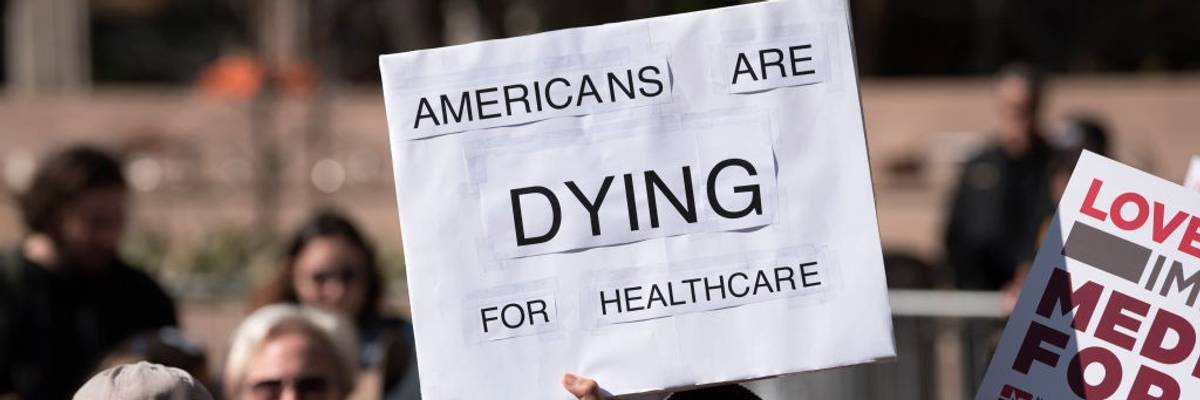
Participants attend the Medicare for All Rally in Los Angeles California on February 4, 2017.
Predictably, centrists are pushing the public option and “anything-but-single-payer” solutions before the midterms. Nothing short of taking control of the healthcare system and running it in the interest of the people instead of in the interest of profit will heal this nation.
On July 5, 1852, Frederick Douglass addressed the Rochester Ladies’ Anti-Slavery Society with an oration called, “What to the Slave Is the Fourth of July?” In 1852, the United States was a young country, only 76 years old, and given its youth, Douglass held out hope for the country that put him and 3 million Black men, women, and children in chains. He called Congress and judges “inhuman, disgraceful, and scandalous.” He accused the church of being the “bulwark of American slavery, and the shield of American slave-hunters.” Still, he held out hope. He admired the rebels of the American Colonies, respected their grit to side with the oppressed against the oppressor. He did not despair for America.
This year, as we celebrate the nation’s 250th anniversary, we find ourselves in dark times. We are heirs to a political system willing to promote wars, sanctions, occupation, slavery, and genocide around the globe, while accepting the mass suffering of a healthcare system that keeps many in chains in our own country. Violence abroad and austerity at home are part of the same ideological structure. Despair is understandable, but not inevitable.
On this 250th anniversary of the Declaration of Independence, we declare it is time for the people to rise up, organize, take control of the healthcare system, and run it in the interest of the people instead of in the interest of profit. It is time we declare our independence from the medical-industrial complex keeping us in chains.
What is the medical-industrial complex? A sprawling alliance of insurance companies and middlemen stealing from the public coffers, pharmaceutical companies holding us hostage, private equity and venture capital owning the delivery of care, profit-generating “nonprofit” health and hospital systems, compromised academic centers and endowed non-governmental organizations, unprincipled medical organizations that choose expediency over patients, and all politicians who accept financial contributions to work for the industry instead of for the people. Their profits depend on keeping healthcare commodified and the rest of us in chains.
Historic public support for a national health program, free from insurance companies and financed through progressive taxes, presents us with a new opening for National Single Payer Improved Medicare for All, free from profit.
Our lives depend on declaring our independence from their profits.
Historic public support for a national health program, free from insurance companies and financed through progressive taxes, presents us with a new opening for National Single Payer Improved Medicare for All, free from profit, guaranteeing all necessary medical coverage for everyone through community-governed delivery, permanently resolving our healthcare crises, lowering costs, and ending medical debt.
But instead of bold proposals, corporate Democrats and their allies are working overtime to come up with “anything-but-single-payer” solutions. Derailment by such Democrats might be a larger challenge than barriers posed by the rest of the medical-industrial complex.
Senate Finance Committee ranking member Ron Wyden (D-Ore.), and 11 Senate Democrats, announced a new initiative to lower the cost of healthcare and improve health coverage for American families. What is this “bold, meaningful change the American people seek”? First, blame Republicans for cost increases (as if Democrats were not also guilty); make healthcare simpler for families by keeping health insurance corporations still in charge of our healthcare; and then take on corporate greed by creating flimsy new guardrails, because naturally, corporations will suddenly decide to play by the rules!
The Center for Health and Democracy, which usually provides credible analysis, went off the rails, putting their money behind “Medicare by Choice,” a warmed-over version of the public option, which allows everyone the option of purchasing traditional Medicare regardless of age, and even allowing employers to select Medicare by Choice as their employees’ workplace benefit. Sadly (and somewhat opportunely) we have a natural experiment that shows us just how well a public option (i.e., traditional Medicare) would fare in the marketplace (i.e., Medicare Advantage). Spoiler alert: not well at all.
Any version of the public option would fail to reap administrative savings or control costs necessary to provide comprehensive universal coverage. A public option would preserve the Machiavellian system of thousands of private insurance plans; Medicaid; CHIP; the federal exchanges; Medicare Part A, B, and Dl MediGap; and Medicare Advantage—a hodgepodge system that has failed to either provide necessary health coverage for all or control costs.
A public option would add even greater complexity to this overwhelmingly complex system. Importantly, a public option would not lead to single payer, as magical thinking would have you believe, but toward a jaded triaging of patients according to their profitability, with profitable individuals going to the private plans and the unprofitable, chronically ill patients shunted to the public plan.
A profit-driven system cannot be repaired with incremental fixes. We have the hard facts from a century of failed attempts to prove it. Derailments offer Democrats an off-ramp in 2028, away from National Single Payer Improved Medicare for All, free from profit. These and similar proposals are guaranteed to set the burgeoning healthcare movement back another 15 years, just like the Affordable Care Act. In 2009, even the Congressional Progressive Caucus favored the public option over single payer. It makes no sense to replay this failure again.
These are the four bold demands we make to declare our independence from the medical-industrial complex:
If you wish to declare your independence from the medical-industrial complex, sign the Declaration as an individual or as an organization. We will inform your member of Congress that a constituent has signed the Declaration. Then join us October 14, 2026, for a virtual National Town Hall to hear how we will achieve our demands.
Let us not squander this opportunity to put national single payer on the nation’s agenda. Frederick Douglass did not despair, "The doom of slavery is certain. I therefore, leave off where I began, with hope.” Let us likewise use this opportunity to build an uncompromising movement capable of confronting the medical-industrial complex directly and achieving what we deserve and already pay for: National Single Payer Improved Medicare for All, Free From Profit.
Dear Common Dreams reader, It’s been nearly 30 years since I co-founded Common Dreams with my late wife, Lina Newhouser. We had the radical notion that journalism should serve the public good, not corporate profits. It was clear to us from the outset what it would take to build such a project. No paid advertisements. No corporate sponsors. No millionaire publisher telling us what to think or do. Many people said we wouldn't last a year, but we proved those doubters wrong. Together with a tremendous team of journalists and dedicated staff, we built an independent media outlet free from the constraints of profits and corporate control. Our mission has always been simple: To inform. To inspire. To ignite change for the common good. Building Common Dreams was not easy. Our survival was never guaranteed. When you take on the most powerful forces—Wall Street greed, fossil fuel industry destruction, Big Tech lobbyists, and uber-rich oligarchs who have spent billions upon billions rigging the economy and democracy in their favor—the only bulwark you have is supporters who believe in your work. But here’s the urgent message from me today. It's never been this bad out there. And it's never been this hard to keep us going. At the very moment Common Dreams is most needed, the threats we face are intensifying. We need your support now more than ever. We don't accept corporate advertising and never will. We don't have a paywall because we don't think people should be blocked from critical news based on their ability to pay. Everything we do is funded by the donations of readers like you. When everyone does the little they can afford, we are strong. But if that support retreats or dries up, so do we. Will you donate now to make sure Common Dreams not only survives but thrives? —Craig Brown, Co-founder |
On July 5, 1852, Frederick Douglass addressed the Rochester Ladies’ Anti-Slavery Society with an oration called, “What to the Slave Is the Fourth of July?” In 1852, the United States was a young country, only 76 years old, and given its youth, Douglass held out hope for the country that put him and 3 million Black men, women, and children in chains. He called Congress and judges “inhuman, disgraceful, and scandalous.” He accused the church of being the “bulwark of American slavery, and the shield of American slave-hunters.” Still, he held out hope. He admired the rebels of the American Colonies, respected their grit to side with the oppressed against the oppressor. He did not despair for America.
This year, as we celebrate the nation’s 250th anniversary, we find ourselves in dark times. We are heirs to a political system willing to promote wars, sanctions, occupation, slavery, and genocide around the globe, while accepting the mass suffering of a healthcare system that keeps many in chains in our own country. Violence abroad and austerity at home are part of the same ideological structure. Despair is understandable, but not inevitable.
On this 250th anniversary of the Declaration of Independence, we declare it is time for the people to rise up, organize, take control of the healthcare system, and run it in the interest of the people instead of in the interest of profit. It is time we declare our independence from the medical-industrial complex keeping us in chains.
What is the medical-industrial complex? A sprawling alliance of insurance companies and middlemen stealing from the public coffers, pharmaceutical companies holding us hostage, private equity and venture capital owning the delivery of care, profit-generating “nonprofit” health and hospital systems, compromised academic centers and endowed non-governmental organizations, unprincipled medical organizations that choose expediency over patients, and all politicians who accept financial contributions to work for the industry instead of for the people. Their profits depend on keeping healthcare commodified and the rest of us in chains.
Historic public support for a national health program, free from insurance companies and financed through progressive taxes, presents us with a new opening for National Single Payer Improved Medicare for All, free from profit.
Our lives depend on declaring our independence from their profits.
Historic public support for a national health program, free from insurance companies and financed through progressive taxes, presents us with a new opening for National Single Payer Improved Medicare for All, free from profit, guaranteeing all necessary medical coverage for everyone through community-governed delivery, permanently resolving our healthcare crises, lowering costs, and ending medical debt.
But instead of bold proposals, corporate Democrats and their allies are working overtime to come up with “anything-but-single-payer” solutions. Derailment by such Democrats might be a larger challenge than barriers posed by the rest of the medical-industrial complex.
Senate Finance Committee ranking member Ron Wyden (D-Ore.), and 11 Senate Democrats, announced a new initiative to lower the cost of healthcare and improve health coverage for American families. What is this “bold, meaningful change the American people seek”? First, blame Republicans for cost increases (as if Democrats were not also guilty); make healthcare simpler for families by keeping health insurance corporations still in charge of our healthcare; and then take on corporate greed by creating flimsy new guardrails, because naturally, corporations will suddenly decide to play by the rules!
The Center for Health and Democracy, which usually provides credible analysis, went off the rails, putting their money behind “Medicare by Choice,” a warmed-over version of the public option, which allows everyone the option of purchasing traditional Medicare regardless of age, and even allowing employers to select Medicare by Choice as their employees’ workplace benefit. Sadly (and somewhat opportunely) we have a natural experiment that shows us just how well a public option (i.e., traditional Medicare) would fare in the marketplace (i.e., Medicare Advantage). Spoiler alert: not well at all.
Any version of the public option would fail to reap administrative savings or control costs necessary to provide comprehensive universal coverage. A public option would preserve the Machiavellian system of thousands of private insurance plans; Medicaid; CHIP; the federal exchanges; Medicare Part A, B, and Dl MediGap; and Medicare Advantage—a hodgepodge system that has failed to either provide necessary health coverage for all or control costs.
A public option would add even greater complexity to this overwhelmingly complex system. Importantly, a public option would not lead to single payer, as magical thinking would have you believe, but toward a jaded triaging of patients according to their profitability, with profitable individuals going to the private plans and the unprofitable, chronically ill patients shunted to the public plan.
A profit-driven system cannot be repaired with incremental fixes. We have the hard facts from a century of failed attempts to prove it. Derailments offer Democrats an off-ramp in 2028, away from National Single Payer Improved Medicare for All, free from profit. These and similar proposals are guaranteed to set the burgeoning healthcare movement back another 15 years, just like the Affordable Care Act. In 2009, even the Congressional Progressive Caucus favored the public option over single payer. It makes no sense to replay this failure again.
These are the four bold demands we make to declare our independence from the medical-industrial complex:
If you wish to declare your independence from the medical-industrial complex, sign the Declaration as an individual or as an organization. We will inform your member of Congress that a constituent has signed the Declaration. Then join us October 14, 2026, for a virtual National Town Hall to hear how we will achieve our demands.
Let us not squander this opportunity to put national single payer on the nation’s agenda. Frederick Douglass did not despair, "The doom of slavery is certain. I therefore, leave off where I began, with hope.” Let us likewise use this opportunity to build an uncompromising movement capable of confronting the medical-industrial complex directly and achieving what we deserve and already pay for: National Single Payer Improved Medicare for All, Free From Profit.
On July 5, 1852, Frederick Douglass addressed the Rochester Ladies’ Anti-Slavery Society with an oration called, “What to the Slave Is the Fourth of July?” In 1852, the United States was a young country, only 76 years old, and given its youth, Douglass held out hope for the country that put him and 3 million Black men, women, and children in chains. He called Congress and judges “inhuman, disgraceful, and scandalous.” He accused the church of being the “bulwark of American slavery, and the shield of American slave-hunters.” Still, he held out hope. He admired the rebels of the American Colonies, respected their grit to side with the oppressed against the oppressor. He did not despair for America.
This year, as we celebrate the nation’s 250th anniversary, we find ourselves in dark times. We are heirs to a political system willing to promote wars, sanctions, occupation, slavery, and genocide around the globe, while accepting the mass suffering of a healthcare system that keeps many in chains in our own country. Violence abroad and austerity at home are part of the same ideological structure. Despair is understandable, but not inevitable.
On this 250th anniversary of the Declaration of Independence, we declare it is time for the people to rise up, organize, take control of the healthcare system, and run it in the interest of the people instead of in the interest of profit. It is time we declare our independence from the medical-industrial complex keeping us in chains.
What is the medical-industrial complex? A sprawling alliance of insurance companies and middlemen stealing from the public coffers, pharmaceutical companies holding us hostage, private equity and venture capital owning the delivery of care, profit-generating “nonprofit” health and hospital systems, compromised academic centers and endowed non-governmental organizations, unprincipled medical organizations that choose expediency over patients, and all politicians who accept financial contributions to work for the industry instead of for the people. Their profits depend on keeping healthcare commodified and the rest of us in chains.
Historic public support for a national health program, free from insurance companies and financed through progressive taxes, presents us with a new opening for National Single Payer Improved Medicare for All, free from profit.
Our lives depend on declaring our independence from their profits.
Historic public support for a national health program, free from insurance companies and financed through progressive taxes, presents us with a new opening for National Single Payer Improved Medicare for All, free from profit, guaranteeing all necessary medical coverage for everyone through community-governed delivery, permanently resolving our healthcare crises, lowering costs, and ending medical debt.
But instead of bold proposals, corporate Democrats and their allies are working overtime to come up with “anything-but-single-payer” solutions. Derailment by such Democrats might be a larger challenge than barriers posed by the rest of the medical-industrial complex.
Senate Finance Committee ranking member Ron Wyden (D-Ore.), and 11 Senate Democrats, announced a new initiative to lower the cost of healthcare and improve health coverage for American families. What is this “bold, meaningful change the American people seek”? First, blame Republicans for cost increases (as if Democrats were not also guilty); make healthcare simpler for families by keeping health insurance corporations still in charge of our healthcare; and then take on corporate greed by creating flimsy new guardrails, because naturally, corporations will suddenly decide to play by the rules!
The Center for Health and Democracy, which usually provides credible analysis, went off the rails, putting their money behind “Medicare by Choice,” a warmed-over version of the public option, which allows everyone the option of purchasing traditional Medicare regardless of age, and even allowing employers to select Medicare by Choice as their employees’ workplace benefit. Sadly (and somewhat opportunely) we have a natural experiment that shows us just how well a public option (i.e., traditional Medicare) would fare in the marketplace (i.e., Medicare Advantage). Spoiler alert: not well at all.
Any version of the public option would fail to reap administrative savings or control costs necessary to provide comprehensive universal coverage. A public option would preserve the Machiavellian system of thousands of private insurance plans; Medicaid; CHIP; the federal exchanges; Medicare Part A, B, and Dl MediGap; and Medicare Advantage—a hodgepodge system that has failed to either provide necessary health coverage for all or control costs.
A public option would add even greater complexity to this overwhelmingly complex system. Importantly, a public option would not lead to single payer, as magical thinking would have you believe, but toward a jaded triaging of patients according to their profitability, with profitable individuals going to the private plans and the unprofitable, chronically ill patients shunted to the public plan.
A profit-driven system cannot be repaired with incremental fixes. We have the hard facts from a century of failed attempts to prove it. Derailments offer Democrats an off-ramp in 2028, away from National Single Payer Improved Medicare for All, free from profit. These and similar proposals are guaranteed to set the burgeoning healthcare movement back another 15 years, just like the Affordable Care Act. In 2009, even the Congressional Progressive Caucus favored the public option over single payer. It makes no sense to replay this failure again.
These are the four bold demands we make to declare our independence from the medical-industrial complex:
If you wish to declare your independence from the medical-industrial complex, sign the Declaration as an individual or as an organization. We will inform your member of Congress that a constituent has signed the Declaration. Then join us October 14, 2026, for a virtual National Town Hall to hear how we will achieve our demands.
Let us not squander this opportunity to put national single payer on the nation’s agenda. Frederick Douglass did not despair, "The doom of slavery is certain. I therefore, leave off where I began, with hope.” Let us likewise use this opportunity to build an uncompromising movement capable of confronting the medical-industrial complex directly and achieving what we deserve and already pay for: National Single Payer Improved Medicare for All, Free From Profit.