SUBSCRIBE TO OUR FREE NEWSLETTER
Daily news & progressive opinion—funded by the people, not the corporations—delivered straight to your inbox.
5
#000000
#FFFFFF
To donate by check, phone, or other method, see our More Ways to Give page.
Daily news & progressive opinion—funded by the people, not the corporations—delivered straight to your inbox.
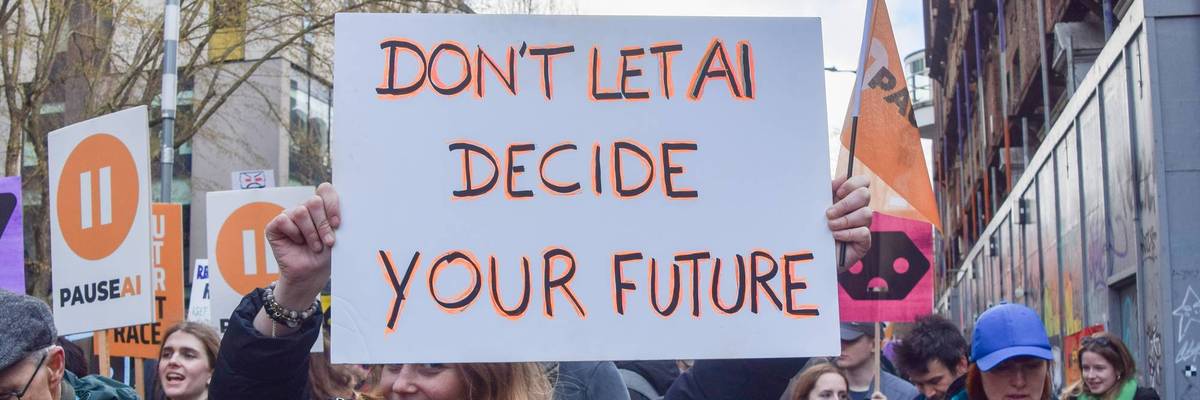
A protester holds an anti-AI placard outside OpenAI offices in King's Cross during a march against unregulated Artificial Intelligence (AI) and data centres.
Someone has the chance for a kind of career-defining stance, one that builds on the growing sense of unease with the overheating world and the rise of AI.
Obviously the story of the moment is the sudden, coordinated bout of cold feet in the AI industry, whose leaders expressed support over the weekend for some kind of effort to slow down the pace of their R&D. This is something that’s never happened in the 40 years of the climate fight, and so it shouldn’t be dismissed; in fact, it could conceivably provide an opening for common sense across the entire apocalypse front. So let’s try to game out how responsible political leaders—which means, I tremble to say, Democrats—might try to talk about it.
First, credit where due. The fact there’s an opening at all is owed to the remarkable citizen resistance to data centers that has sprung up in the last year, and also to the courage of a few kids in the AI industry. At Third Act-GrayPAC we’ve been a part of that resistance in place after place—if you want some insight on its roots and future, join us Wednesday night for a conversation with old friend Justin Pearson, the Tennessee state rep who helped kick it off with the fight against Elon Musk’s super-polluting Memphis facility.
Water wastage, noise, land use—the data center fight has often been routed in deeply local concerns. But it has two other dimensions. The first is about energy, both its costs and its pollution. As I’ve noted, one way to understand a data center is that it’s a device for burning natural gas, the latest excuse (after Ukraine and Iran) for the fuel that Big Oil is counting on to keep its business model afloat even as the world turns away from internal combustion cars and crude demand begins to drop. The degree to which this is becoming a climate disaster can hardly be overstated. Here’s the latest, from Bloomberg on Monday:
Natural gas consumption for electricity generation at data centers is forecast to increase by 15 billion cubic feet per day in the decade ending in 2035, even when accounting for planned projects that may never be completed. This volume exceeds the current gas consumption of all nations except China, Russia, Iran, and the United States, based on data from the US Energy Information Administration. The projection is more than double BloombergNEF's December forecast of 6.9 billion cubic feet per day.
In essence, American data centers are about to become a giant new fossil-fuel burning country, just when we need it least. And if you wonder whether the oil boys have figured this out, don’t. When Pennsylvania Gov. Josh Shapiro—long a big backer of AI—proposed some limits last week, the reaction went like this:
“We were disappointed in the announcement in that it sends the wrong message to these incredible economic opportunities that are presented for Pennsylvania and Pennsylvania’s economy,” said James D. Welty, president of the Marcellus Shale Coalition…
Marcellus producers are almost solely dependent on demand growth within their own producing region. Artificial intelligence data centers powered by gas-fired electricity are seen by Marcellus gas producers as a key source of that so-called in-basin demand.
But that data center resistance was driven by something else too, that’s been largely ignored—it was a chance to stand up to the oligarchs and this technology they’ve staked their future on. A few years ago Elon Musk and Mark Zuckerberg and the rest had a mixed reputation, admired by some and distrusted by others; now the loathing is much more universal, especially since they’ve allied themselves with the most unpopular president in recent history. They marketed their AI tech on the promise that it would destroy jobs; it’s also proven useful for making naked pictures of anyone you could imagine. They stole books to train it; now it produces a commodity universally reviled as slop.
Oh, and it might kill us all, which brings us back to those kids. Jacob Coxon is a 27-year-old former silver medalist at the International Mathematical Olympiad who worked first at Open AI and then Anthropic, and who resigned last week, kicking off this current storm with his tweeted fear that things were getting out of control. A top scientist at the company backed him up, tweeting: “We really do earnestly believe AI could kill all humans! I personally think it is >10% within the next decade.”
Which seems like kind of a big deal. Perhaps Sen. Bernie Sanders (I-Vt.) was on to something when, many months ago, he called for a moratorium on this kind of work, a call he’s repeated in recent days. But no one takes Bernie seriously (except the American people, for whom he remains the most popular active politician). So it’s a good sign that there seem to be some starting to follow suit. Sen. Jon Ossoff (D-Ga.) has been nimblest, and not for the first time—he got a start on the messaging by saying
On day one, Donald Trump rescinded the AI safety order meant to guard against catastrophic risks, including the engineering of bioweapons. Meanwhile, Don Jr's 1789 Capital bought big money stakes in data centers and AI labs... President Trump is compromised.
And Illinois Gov. JB Pritzker, another 2028 possibility:
It’s becoming more clear the threat AI poses to humanity, so I’m calling for immediate action from the industry and Washington.
But as Greg Sargent points out in a prescient piece today, the Dems are mostly playing small ball here, nibbling around the edges instead of biting. I think someone has the chance for a kind of career-defining stance here, one that builds on the growing sense of unease with the overheating world (an unease which is already quite broad and is going to deepen as the budding El Niño takes us ever deeper into the climate future). As we start to look forward to 2028, even Barack Obama—a cautious man—has called for Democrats to be more aggressive. Here’s a stab at what that might look like:
Elections usually turn on immediate, pocketbook issues—that makes sense, because we all need to eat, and right now the price of groceries is too high, the price of gas is too high, the rent is too high. We know why—tariffs, stupid wars, corruption. We’ve got lots to work on.
But there are also moments when need to think about larger questions, and this is clearly one. AI is not something any of us asked for—just about no one wants a data center in their neighborhood, and no one put up their hand to sacrifice their job to some computer bot. It’s been forced on us by some of the richest people on Earth, and it was obnoxious even before it started going on the attack—now, as even its creators say, it’s out of control and offers a very real risk to our health and safety, and maybe even our existence as a species.
So we need to rein it in, with serious government regulation that dramatically slows the pace of development until we can can understand and control it. And that includes making the companies that produce this, and the hedge funds who invest in them, liable for the havoc they create.
But we need to go beyond that. We need to step back and say: What are we doing here, people? Why are we running risks like this? Our civilization, especially in rich countries like this one, is capable of producing the things we need: We’ve never lived longer or better. If we didn’t concentrate wealth in a few hands, if we spread it our more widely, we could provide healthcare and housing for everyone. Natural human intelligence has produced plenty; the natural human sense of justice can help us figure out how to share it in ways that work for all. Things could be… okay.
So why would we run enormous risks—the ones that come with artificial super intelligence, and the ones that come with rapidly warming the planet? These are the dangers that could attack and impoverish us; no rational society would treat them as casually as the Trump administration has done. Instead we should be hard at work insuring against those risks—by, say, building out cheap and clean renewable energy. And by upgrading the education and the skills of our kids, instead of handing them screens and turning them over to AI teachers.
In some cases this would mean “slowing down progress”; in every case it would mean attacking concentrated wealth and power. But is it really progress? Is there any real reason we need to rush pell-mell into this chaotic and dystopian future? We’re told that medical advances await—but we’ve been making steady progress on this front for decades, with lifespans expanding and more and more diseases becoming manageable. (Or at least we were making progress till this administration decided to upend our scientific research institutions). We’re told that if we don’t rush ahead China will—but that seems more like an argument for negotiating with China about cooperative controls, just as we once negotiated with Russia about the control of nuclear weapons. It’s never easy, it’s always messy, and so far it’s been successful.
If this willingness to stick with the world as we’ve known it—a world where human intelligence prevails, and where we keep some ice near the poles—sounds “conservative” then so be it. There are moments when humans need to say, "Enough," and this is one. We are fools to endanger all that our ancestors have built in search of some new thing that will enrich a few. I know that the Trump administration wants to rush forward, that he has called AI fears a “hoax,” the exact same word he’s used about the climate crisis. But Trump and his colleagues are greed-seeking missiles, always looking for some way to grift, whether its from AI and crypto or from oil companies and Middle East princelings.
We are told that our destiny is constantly to rush forward—to head for Mars. But actually, one unique human gift is the ability to decide not to do things we’re capable of doing—to say Mars isn’t as important as getting things right on Earth. In fact, we’ve never had a better chance of getting things right. All of a sudden solar panels are the cheapest way to make power, for instance. It wasn’t AI that did that—it was smart people, at work in universities and companies around the world. They’ve given us a real gift, even if it’s going to cost Exxon some profits.
Humans don’t get many chances to make momentous decisions like this. Usually they get made for us. But across the country people have stood up to the data centers, and that’s given us the possibility for real change. Let’s take it.
Dear Common Dreams reader, It’s been nearly 30 years since I co-founded Common Dreams with my late wife, Lina Newhouser. We had the radical notion that journalism should serve the public good, not corporate profits. It was clear to us from the outset what it would take to build such a project. No paid advertisements. No corporate sponsors. No millionaire publisher telling us what to think or do. Many people said we wouldn't last a year, but we proved those doubters wrong. Together with a tremendous team of journalists and dedicated staff, we built an independent media outlet free from the constraints of profits and corporate control. Our mission has always been simple: To inform. To inspire. To ignite change for the common good. Building Common Dreams was not easy. Our survival was never guaranteed. When you take on the most powerful forces—Wall Street greed, fossil fuel industry destruction, Big Tech lobbyists, and uber-rich oligarchs who have spent billions upon billions rigging the economy and democracy in their favor—the only bulwark you have is supporters who believe in your work. But here’s the urgent message from me today. It's never been this bad out there. And it's never been this hard to keep us going. At the very moment Common Dreams is most needed, the threats we face are intensifying. We need your support now more than ever. We don't accept corporate advertising and never will. We don't have a paywall because we don't think people should be blocked from critical news based on their ability to pay. Everything we do is funded by the donations of readers like you. When everyone does the little they can afford, we are strong. But if that support retreats or dries up, so do we. Will you donate now to make sure Common Dreams not only survives but thrives? —Craig Brown, Co-founder |
Obviously the story of the moment is the sudden, coordinated bout of cold feet in the AI industry, whose leaders expressed support over the weekend for some kind of effort to slow down the pace of their R&D. This is something that’s never happened in the 40 years of the climate fight, and so it shouldn’t be dismissed; in fact, it could conceivably provide an opening for common sense across the entire apocalypse front. So let’s try to game out how responsible political leaders—which means, I tremble to say, Democrats—might try to talk about it.
First, credit where due. The fact there’s an opening at all is owed to the remarkable citizen resistance to data centers that has sprung up in the last year, and also to the courage of a few kids in the AI industry. At Third Act-GrayPAC we’ve been a part of that resistance in place after place—if you want some insight on its roots and future, join us Wednesday night for a conversation with old friend Justin Pearson, the Tennessee state rep who helped kick it off with the fight against Elon Musk’s super-polluting Memphis facility.
Water wastage, noise, land use—the data center fight has often been routed in deeply local concerns. But it has two other dimensions. The first is about energy, both its costs and its pollution. As I’ve noted, one way to understand a data center is that it’s a device for burning natural gas, the latest excuse (after Ukraine and Iran) for the fuel that Big Oil is counting on to keep its business model afloat even as the world turns away from internal combustion cars and crude demand begins to drop. The degree to which this is becoming a climate disaster can hardly be overstated. Here’s the latest, from Bloomberg on Monday:
Natural gas consumption for electricity generation at data centers is forecast to increase by 15 billion cubic feet per day in the decade ending in 2035, even when accounting for planned projects that may never be completed. This volume exceeds the current gas consumption of all nations except China, Russia, Iran, and the United States, based on data from the US Energy Information Administration. The projection is more than double BloombergNEF's December forecast of 6.9 billion cubic feet per day.
In essence, American data centers are about to become a giant new fossil-fuel burning country, just when we need it least. And if you wonder whether the oil boys have figured this out, don’t. When Pennsylvania Gov. Josh Shapiro—long a big backer of AI—proposed some limits last week, the reaction went like this:
“We were disappointed in the announcement in that it sends the wrong message to these incredible economic opportunities that are presented for Pennsylvania and Pennsylvania’s economy,” said James D. Welty, president of the Marcellus Shale Coalition…
Marcellus producers are almost solely dependent on demand growth within their own producing region. Artificial intelligence data centers powered by gas-fired electricity are seen by Marcellus gas producers as a key source of that so-called in-basin demand.
But that data center resistance was driven by something else too, that’s been largely ignored—it was a chance to stand up to the oligarchs and this technology they’ve staked their future on. A few years ago Elon Musk and Mark Zuckerberg and the rest had a mixed reputation, admired by some and distrusted by others; now the loathing is much more universal, especially since they’ve allied themselves with the most unpopular president in recent history. They marketed their AI tech on the promise that it would destroy jobs; it’s also proven useful for making naked pictures of anyone you could imagine. They stole books to train it; now it produces a commodity universally reviled as slop.
Oh, and it might kill us all, which brings us back to those kids. Jacob Coxon is a 27-year-old former silver medalist at the International Mathematical Olympiad who worked first at Open AI and then Anthropic, and who resigned last week, kicking off this current storm with his tweeted fear that things were getting out of control. A top scientist at the company backed him up, tweeting: “We really do earnestly believe AI could kill all humans! I personally think it is >10% within the next decade.”
Which seems like kind of a big deal. Perhaps Sen. Bernie Sanders (I-Vt.) was on to something when, many months ago, he called for a moratorium on this kind of work, a call he’s repeated in recent days. But no one takes Bernie seriously (except the American people, for whom he remains the most popular active politician). So it’s a good sign that there seem to be some starting to follow suit. Sen. Jon Ossoff (D-Ga.) has been nimblest, and not for the first time—he got a start on the messaging by saying
On day one, Donald Trump rescinded the AI safety order meant to guard against catastrophic risks, including the engineering of bioweapons. Meanwhile, Don Jr's 1789 Capital bought big money stakes in data centers and AI labs... President Trump is compromised.
And Illinois Gov. JB Pritzker, another 2028 possibility:
It’s becoming more clear the threat AI poses to humanity, so I’m calling for immediate action from the industry and Washington.
But as Greg Sargent points out in a prescient piece today, the Dems are mostly playing small ball here, nibbling around the edges instead of biting. I think someone has the chance for a kind of career-defining stance here, one that builds on the growing sense of unease with the overheating world (an unease which is already quite broad and is going to deepen as the budding El Niño takes us ever deeper into the climate future). As we start to look forward to 2028, even Barack Obama—a cautious man—has called for Democrats to be more aggressive. Here’s a stab at what that might look like:
Elections usually turn on immediate, pocketbook issues—that makes sense, because we all need to eat, and right now the price of groceries is too high, the price of gas is too high, the rent is too high. We know why—tariffs, stupid wars, corruption. We’ve got lots to work on.
But there are also moments when need to think about larger questions, and this is clearly one. AI is not something any of us asked for—just about no one wants a data center in their neighborhood, and no one put up their hand to sacrifice their job to some computer bot. It’s been forced on us by some of the richest people on Earth, and it was obnoxious even before it started going on the attack—now, as even its creators say, it’s out of control and offers a very real risk to our health and safety, and maybe even our existence as a species.
So we need to rein it in, with serious government regulation that dramatically slows the pace of development until we can can understand and control it. And that includes making the companies that produce this, and the hedge funds who invest in them, liable for the havoc they create.
But we need to go beyond that. We need to step back and say: What are we doing here, people? Why are we running risks like this? Our civilization, especially in rich countries like this one, is capable of producing the things we need: We’ve never lived longer or better. If we didn’t concentrate wealth in a few hands, if we spread it our more widely, we could provide healthcare and housing for everyone. Natural human intelligence has produced plenty; the natural human sense of justice can help us figure out how to share it in ways that work for all. Things could be… okay.
So why would we run enormous risks—the ones that come with artificial super intelligence, and the ones that come with rapidly warming the planet? These are the dangers that could attack and impoverish us; no rational society would treat them as casually as the Trump administration has done. Instead we should be hard at work insuring against those risks—by, say, building out cheap and clean renewable energy. And by upgrading the education and the skills of our kids, instead of handing them screens and turning them over to AI teachers.
In some cases this would mean “slowing down progress”; in every case it would mean attacking concentrated wealth and power. But is it really progress? Is there any real reason we need to rush pell-mell into this chaotic and dystopian future? We’re told that medical advances await—but we’ve been making steady progress on this front for decades, with lifespans expanding and more and more diseases becoming manageable. (Or at least we were making progress till this administration decided to upend our scientific research institutions). We’re told that if we don’t rush ahead China will—but that seems more like an argument for negotiating with China about cooperative controls, just as we once negotiated with Russia about the control of nuclear weapons. It’s never easy, it’s always messy, and so far it’s been successful.
If this willingness to stick with the world as we’ve known it—a world where human intelligence prevails, and where we keep some ice near the poles—sounds “conservative” then so be it. There are moments when humans need to say, "Enough," and this is one. We are fools to endanger all that our ancestors have built in search of some new thing that will enrich a few. I know that the Trump administration wants to rush forward, that he has called AI fears a “hoax,” the exact same word he’s used about the climate crisis. But Trump and his colleagues are greed-seeking missiles, always looking for some way to grift, whether its from AI and crypto or from oil companies and Middle East princelings.
We are told that our destiny is constantly to rush forward—to head for Mars. But actually, one unique human gift is the ability to decide not to do things we’re capable of doing—to say Mars isn’t as important as getting things right on Earth. In fact, we’ve never had a better chance of getting things right. All of a sudden solar panels are the cheapest way to make power, for instance. It wasn’t AI that did that—it was smart people, at work in universities and companies around the world. They’ve given us a real gift, even if it’s going to cost Exxon some profits.
Humans don’t get many chances to make momentous decisions like this. Usually they get made for us. But across the country people have stood up to the data centers, and that’s given us the possibility for real change. Let’s take it.
Obviously the story of the moment is the sudden, coordinated bout of cold feet in the AI industry, whose leaders expressed support over the weekend for some kind of effort to slow down the pace of their R&D. This is something that’s never happened in the 40 years of the climate fight, and so it shouldn’t be dismissed; in fact, it could conceivably provide an opening for common sense across the entire apocalypse front. So let’s try to game out how responsible political leaders—which means, I tremble to say, Democrats—might try to talk about it.
First, credit where due. The fact there’s an opening at all is owed to the remarkable citizen resistance to data centers that has sprung up in the last year, and also to the courage of a few kids in the AI industry. At Third Act-GrayPAC we’ve been a part of that resistance in place after place—if you want some insight on its roots and future, join us Wednesday night for a conversation with old friend Justin Pearson, the Tennessee state rep who helped kick it off with the fight against Elon Musk’s super-polluting Memphis facility.
Water wastage, noise, land use—the data center fight has often been routed in deeply local concerns. But it has two other dimensions. The first is about energy, both its costs and its pollution. As I’ve noted, one way to understand a data center is that it’s a device for burning natural gas, the latest excuse (after Ukraine and Iran) for the fuel that Big Oil is counting on to keep its business model afloat even as the world turns away from internal combustion cars and crude demand begins to drop. The degree to which this is becoming a climate disaster can hardly be overstated. Here’s the latest, from Bloomberg on Monday:
Natural gas consumption for electricity generation at data centers is forecast to increase by 15 billion cubic feet per day in the decade ending in 2035, even when accounting for planned projects that may never be completed. This volume exceeds the current gas consumption of all nations except China, Russia, Iran, and the United States, based on data from the US Energy Information Administration. The projection is more than double BloombergNEF's December forecast of 6.9 billion cubic feet per day.
In essence, American data centers are about to become a giant new fossil-fuel burning country, just when we need it least. And if you wonder whether the oil boys have figured this out, don’t. When Pennsylvania Gov. Josh Shapiro—long a big backer of AI—proposed some limits last week, the reaction went like this:
“We were disappointed in the announcement in that it sends the wrong message to these incredible economic opportunities that are presented for Pennsylvania and Pennsylvania’s economy,” said James D. Welty, president of the Marcellus Shale Coalition…
Marcellus producers are almost solely dependent on demand growth within their own producing region. Artificial intelligence data centers powered by gas-fired electricity are seen by Marcellus gas producers as a key source of that so-called in-basin demand.
But that data center resistance was driven by something else too, that’s been largely ignored—it was a chance to stand up to the oligarchs and this technology they’ve staked their future on. A few years ago Elon Musk and Mark Zuckerberg and the rest had a mixed reputation, admired by some and distrusted by others; now the loathing is much more universal, especially since they’ve allied themselves with the most unpopular president in recent history. They marketed their AI tech on the promise that it would destroy jobs; it’s also proven useful for making naked pictures of anyone you could imagine. They stole books to train it; now it produces a commodity universally reviled as slop.
Oh, and it might kill us all, which brings us back to those kids. Jacob Coxon is a 27-year-old former silver medalist at the International Mathematical Olympiad who worked first at Open AI and then Anthropic, and who resigned last week, kicking off this current storm with his tweeted fear that things were getting out of control. A top scientist at the company backed him up, tweeting: “We really do earnestly believe AI could kill all humans! I personally think it is >10% within the next decade.”
Which seems like kind of a big deal. Perhaps Sen. Bernie Sanders (I-Vt.) was on to something when, many months ago, he called for a moratorium on this kind of work, a call he’s repeated in recent days. But no one takes Bernie seriously (except the American people, for whom he remains the most popular active politician). So it’s a good sign that there seem to be some starting to follow suit. Sen. Jon Ossoff (D-Ga.) has been nimblest, and not for the first time—he got a start on the messaging by saying
On day one, Donald Trump rescinded the AI safety order meant to guard against catastrophic risks, including the engineering of bioweapons. Meanwhile, Don Jr's 1789 Capital bought big money stakes in data centers and AI labs... President Trump is compromised.
And Illinois Gov. JB Pritzker, another 2028 possibility:
It’s becoming more clear the threat AI poses to humanity, so I’m calling for immediate action from the industry and Washington.
But as Greg Sargent points out in a prescient piece today, the Dems are mostly playing small ball here, nibbling around the edges instead of biting. I think someone has the chance for a kind of career-defining stance here, one that builds on the growing sense of unease with the overheating world (an unease which is already quite broad and is going to deepen as the budding El Niño takes us ever deeper into the climate future). As we start to look forward to 2028, even Barack Obama—a cautious man—has called for Democrats to be more aggressive. Here’s a stab at what that might look like:
Elections usually turn on immediate, pocketbook issues—that makes sense, because we all need to eat, and right now the price of groceries is too high, the price of gas is too high, the rent is too high. We know why—tariffs, stupid wars, corruption. We’ve got lots to work on.
But there are also moments when need to think about larger questions, and this is clearly one. AI is not something any of us asked for—just about no one wants a data center in their neighborhood, and no one put up their hand to sacrifice their job to some computer bot. It’s been forced on us by some of the richest people on Earth, and it was obnoxious even before it started going on the attack—now, as even its creators say, it’s out of control and offers a very real risk to our health and safety, and maybe even our existence as a species.
So we need to rein it in, with serious government regulation that dramatically slows the pace of development until we can can understand and control it. And that includes making the companies that produce this, and the hedge funds who invest in them, liable for the havoc they create.
But we need to go beyond that. We need to step back and say: What are we doing here, people? Why are we running risks like this? Our civilization, especially in rich countries like this one, is capable of producing the things we need: We’ve never lived longer or better. If we didn’t concentrate wealth in a few hands, if we spread it our more widely, we could provide healthcare and housing for everyone. Natural human intelligence has produced plenty; the natural human sense of justice can help us figure out how to share it in ways that work for all. Things could be… okay.
So why would we run enormous risks—the ones that come with artificial super intelligence, and the ones that come with rapidly warming the planet? These are the dangers that could attack and impoverish us; no rational society would treat them as casually as the Trump administration has done. Instead we should be hard at work insuring against those risks—by, say, building out cheap and clean renewable energy. And by upgrading the education and the skills of our kids, instead of handing them screens and turning them over to AI teachers.
In some cases this would mean “slowing down progress”; in every case it would mean attacking concentrated wealth and power. But is it really progress? Is there any real reason we need to rush pell-mell into this chaotic and dystopian future? We’re told that medical advances await—but we’ve been making steady progress on this front for decades, with lifespans expanding and more and more diseases becoming manageable. (Or at least we were making progress till this administration decided to upend our scientific research institutions). We’re told that if we don’t rush ahead China will—but that seems more like an argument for negotiating with China about cooperative controls, just as we once negotiated with Russia about the control of nuclear weapons. It’s never easy, it’s always messy, and so far it’s been successful.
If this willingness to stick with the world as we’ve known it—a world where human intelligence prevails, and where we keep some ice near the poles—sounds “conservative” then so be it. There are moments when humans need to say, "Enough," and this is one. We are fools to endanger all that our ancestors have built in search of some new thing that will enrich a few. I know that the Trump administration wants to rush forward, that he has called AI fears a “hoax,” the exact same word he’s used about the climate crisis. But Trump and his colleagues are greed-seeking missiles, always looking for some way to grift, whether its from AI and crypto or from oil companies and Middle East princelings.
We are told that our destiny is constantly to rush forward—to head for Mars. But actually, one unique human gift is the ability to decide not to do things we’re capable of doing—to say Mars isn’t as important as getting things right on Earth. In fact, we’ve never had a better chance of getting things right. All of a sudden solar panels are the cheapest way to make power, for instance. It wasn’t AI that did that—it was smart people, at work in universities and companies around the world. They’ve given us a real gift, even if it’s going to cost Exxon some profits.
Humans don’t get many chances to make momentous decisions like this. Usually they get made for us. But across the country people have stood up to the data centers, and that’s given us the possibility for real change. Let’s take it.