
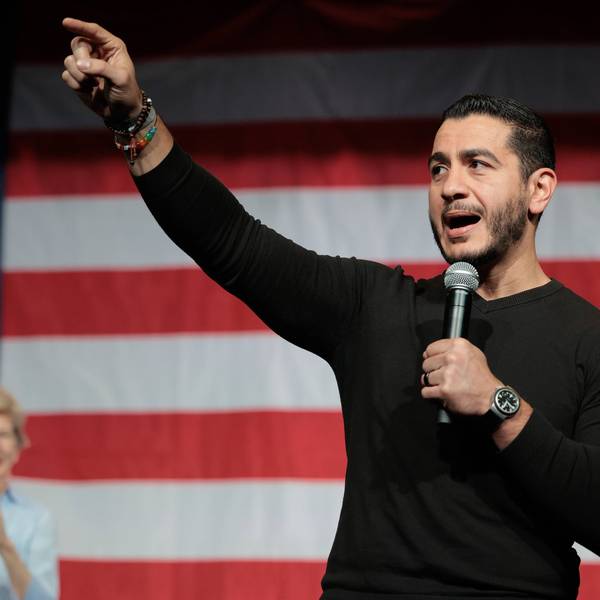
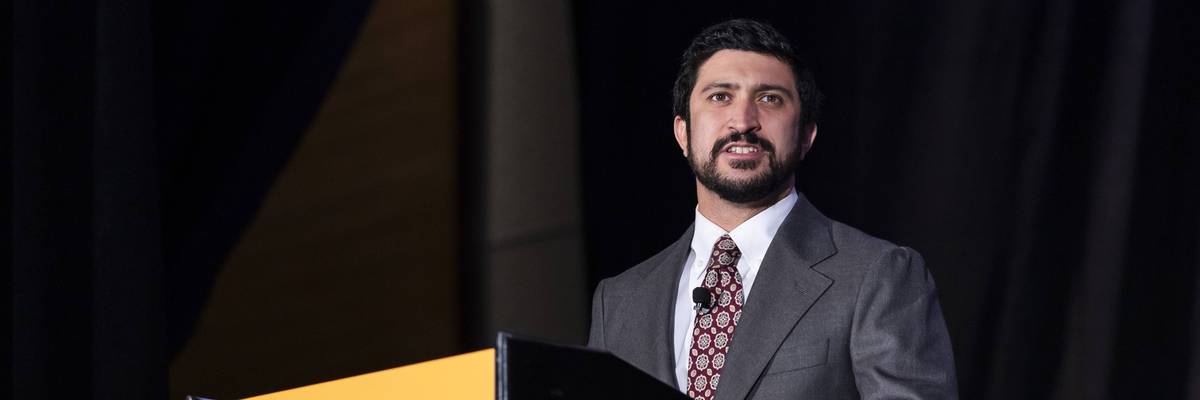
US Rep. Greg Casar (D-Texas), chair of the Congressional Progressive Caucus, speaks during the Pro-Human Assembly on September 15, 2026 in Washington, DC.
'We Cannot Let History Repeat Itself': Progressive US Lawmakers Oppose AI Bailouts
"The House Progressive Caucus is ready for the collapse of the AI bubble. The rest of us should be also," said one economist.
As a progressive US senator warned Wednesday that Anthropic going public could leave "Americans holding the bag" if the artificial intelligence bubble bursts, The American Prospect revealed that key Democrats in the House of Representatives have crafted a resolution opposing federal bailouts for AI giants like the ones "too-big-to-fail banks" got nearly two decades ago.
The seven-page resolution obtained by Prospect executive editor David Dayen frames the 2008 global financial crisis as a result of "profit-driven financial risk-taking, fueled by Wall Street's speculative fervor and unleashed by years of zealous deregulation," as well as an example of what not to do when it comes to the booming AI sector.
"The economic harm of a multitrillion-dollar housing bubble caused by predatory lending, reckless financialization and securitization, and off-balance-sheet lending led to a massive surge in layoffs, with the unemployment rate hitting almost 10% at the trough of the Great Recession in 2009," the seven-page measure recalls. "The weak labor market persisted for nearly a decade."
Now, AI firms "hold trillions of dollars in debt, much of which is raised in opaque and unregulated private credit markets," the resolution continues. Financing terms of many "data centers as well as the costs and revenues of major artificial intelligence firms are not publicly available and... corporate borrowing to fund data center investments are multiples higher than projected revenues."
AI-related stock prices "have inflated even more than the tech giants of the 1990s," the measure notes, warning that "a collapse of an artificial intelligence bubble could have serious consequences for the economy, similar if not more significant than the end of the 1990s tech bubble or the 2008 global financial crisis."
Thus, it argues, "Congress must refuse to provide any additional funds or exceptional regulatory support to companies or financial institutions facing insolvency or financial collapse due to exposures to acute stress within the artificial intelligence market and must provide support to all harmed Americans instead."
While politicians from both parties have been ripped for their ties to Big Tech and AI specifically, the resolution explicitly calls out related failures under Republican President Donald Trump, who recently gathered industry leaders at the White House to sign a "self-policing" accord that critics said was "as dangerous as it is absurd."
House progressives' measure points out that "federal regulators have avoided applying robust scrutiny and oversight regarding enormously complicated debt and equity schemes used by artificial intelligence firms or the circular financing mechanisms involved" in the AI data center build-out.
Additionally, "the White House's artificial intelligence and cryptocurrency czar was personally invested in at least 449
companies" tied to AI "while pushing to eliminate government obstacles," the resolution says, "reflecting the administration's broad deregulatory focus and conflicts of interest" when it comes to this industry.
The House Progressive Caucus is ready for the collapse of the AI bubble. The rest of us should be also. No bailouts for the AI billionaires prospect.org/2026/10/28/h...
[image or embed]
— Dean Baker (@deanbaker13.bsky.social) October 28, 2026 at 7:53 AM
Though the resolution has not yet been introduced, Dayen reported on it less than a week before the midterm elections that will determine control of Congress for the remainder of Trump's second term. It's spearheaded by Congressional Progressive Caucus Chair Greg Casar (D-Texas) and House Financial Services Committee Ranking Member Maxine Waters (D-Calif.).
"Big Tech and Wall Street are taking enormous risks with billions in borrowed money to fuel the AI boom, despite growing warning signs of a dangerous bubble," Waters told him. "We cannot let history repeat itself. The American people should never again be forced to foot the bill for billionaires' reckless bets."
Casar, a 37-year-old former labor organizer, highlighted that "many of us, myself included, came into political life watching as many people who caused the crisis in 2008 or cheered it on weren't held accountable."
"We know that the American people were appalled at these Wall Street executives nearly two decades ago, and they're even more pissed off at these tech oligarchs today. We shouldn't be trying to make them whole," said the congressman, who also leads the Ban Artificial Superintelligence Act with Sen. Bernie Sanders (I-Vt.).
Polling released this past summer by Data for Progress found that among the "bad actors" Americans blame for the country’s concerning conditions, billionaires rank No. 1, but AI companies and social media giants are in the top 10.
The progressives' proposal "is a nonbinding 'sense of the House' measure," Dayen explained. "But it sets a marker that no bailout funds should be made available to AI companies. Casar wants the measure to be voted on early in the next Congress if Democrats take power, if not sooner, to get everyone on the record about an AI bailout."
Welcoming the resolution on social media, economist Leslie Ehrlich called it "both correct and good politics," adding, "Let the Republicans vote against it and be pro-bailouts."
We are at a crossroads
This country and this world are at a monumental crossroads. In a few short weeks, US voters will have an opportunity to beat back the forces of fascism and confront the billionaires who are rigging the economy, our media system, and our democracy, making it increasingly impossible for ordinary people to get by. We’re not just talking about the election. We’re talking about what must be done once these fascist elements are vanquished from power. We need a bolder set of solutions than what either major party has so far been willing to offer and a working-class movement ready to fight like hell for it. Trump didn't emerge from nowhere. The conditions that fueled MAGA authoritarianism were created by decades of radical neoliberal economic policies and a corrupt political system dominated by corporate interests. They slashed taxes on the super-rich, promising that the benefits would trickle down. They said giveaways to the corporate titans would make life more affordable for the rest of us. It was all bullshit. And when a bitter, betrayed populace searches for someone to blame, right-wing demagogues have little trouble finding scapegoats. People know when they're being lied to, but you won't hear any of this from the corporate media. Only independent journalism—powered and funded by people who believe in building a better world—can deliver truly trustworthy daily news. Our Fall Campaign is underway, and we need your help. To power our newsroom through the rest of the year, we need to raise $125,000 by midnight on October 31. So if you share our vision, please contribute whatever you can to sustain our work. |
As a progressive US senator warned Wednesday that Anthropic going public could leave "Americans holding the bag" if the artificial intelligence bubble bursts, The American Prospect revealed that key Democrats in the House of Representatives have crafted a resolution opposing federal bailouts for AI giants like the ones "too-big-to-fail banks" got nearly two decades ago.
The seven-page resolution obtained by Prospect executive editor David Dayen frames the 2008 global financial crisis as a result of "profit-driven financial risk-taking, fueled by Wall Street's speculative fervor and unleashed by years of zealous deregulation," as well as an example of what not to do when it comes to the booming AI sector.
"The economic harm of a multitrillion-dollar housing bubble caused by predatory lending, reckless financialization and securitization, and off-balance-sheet lending led to a massive surge in layoffs, with the unemployment rate hitting almost 10% at the trough of the Great Recession in 2009," the seven-page measure recalls. "The weak labor market persisted for nearly a decade."
Now, AI firms "hold trillions of dollars in debt, much of which is raised in opaque and unregulated private credit markets," the resolution continues. Financing terms of many "data centers as well as the costs and revenues of major artificial intelligence firms are not publicly available and... corporate borrowing to fund data center investments are multiples higher than projected revenues."
AI-related stock prices "have inflated even more than the tech giants of the 1990s," the measure notes, warning that "a collapse of an artificial intelligence bubble could have serious consequences for the economy, similar if not more significant than the end of the 1990s tech bubble or the 2008 global financial crisis."
Thus, it argues, "Congress must refuse to provide any additional funds or exceptional regulatory support to companies or financial institutions facing insolvency or financial collapse due to exposures to acute stress within the artificial intelligence market and must provide support to all harmed Americans instead."
While politicians from both parties have been ripped for their ties to Big Tech and AI specifically, the resolution explicitly calls out related failures under Republican President Donald Trump, who recently gathered industry leaders at the White House to sign a "self-policing" accord that critics said was "as dangerous as it is absurd."
House progressives' measure points out that "federal regulators have avoided applying robust scrutiny and oversight regarding enormously complicated debt and equity schemes used by artificial intelligence firms or the circular financing mechanisms involved" in the AI data center build-out.
Additionally, "the White House's artificial intelligence and cryptocurrency czar was personally invested in at least 449
companies" tied to AI "while pushing to eliminate government obstacles," the resolution says, "reflecting the administration's broad deregulatory focus and conflicts of interest" when it comes to this industry.
The House Progressive Caucus is ready for the collapse of the AI bubble. The rest of us should be also. No bailouts for the AI billionaires prospect.org/2026/10/28/h...
[image or embed]
— Dean Baker (@deanbaker13.bsky.social) October 28, 2026 at 7:53 AM
Though the resolution has not yet been introduced, Dayen reported on it less than a week before the midterm elections that will determine control of Congress for the remainder of Trump's second term. It's spearheaded by Congressional Progressive Caucus Chair Greg Casar (D-Texas) and House Financial Services Committee Ranking Member Maxine Waters (D-Calif.).
"Big Tech and Wall Street are taking enormous risks with billions in borrowed money to fuel the AI boom, despite growing warning signs of a dangerous bubble," Waters told him. "We cannot let history repeat itself. The American people should never again be forced to foot the bill for billionaires' reckless bets."
Casar, a 37-year-old former labor organizer, highlighted that "many of us, myself included, came into political life watching as many people who caused the crisis in 2008 or cheered it on weren't held accountable."
"We know that the American people were appalled at these Wall Street executives nearly two decades ago, and they're even more pissed off at these tech oligarchs today. We shouldn't be trying to make them whole," said the congressman, who also leads the Ban Artificial Superintelligence Act with Sen. Bernie Sanders (I-Vt.).
Polling released this past summer by Data for Progress found that among the "bad actors" Americans blame for the country’s concerning conditions, billionaires rank No. 1, but AI companies and social media giants are in the top 10.
The progressives' proposal "is a nonbinding 'sense of the House' measure," Dayen explained. "But it sets a marker that no bailout funds should be made available to AI companies. Casar wants the measure to be voted on early in the next Congress if Democrats take power, if not sooner, to get everyone on the record about an AI bailout."
Welcoming the resolution on social media, economist Leslie Ehrlich called it "both correct and good politics," adding, "Let the Republicans vote against it and be pro-bailouts."
- When the AI Bubble Bursts, Working Families Will Pay the Price ›
- Despite Trump's Demand for AI Investment, Treasury Report Warns Industry Poses 'Significant Risk' to US Economy ›
- Warning Against Taxpayer Bailout for Big Tech, Critics Fume Over OpenAI Execs' Talk of Government Loans ›
- 'Working People Will Pay a High Price': Report Warns AI Bubble Is 'Primed to Pop' ›
- Ocasio-Cortez Says ‘We Should Not Be Entertaining a Bailout’ of AI Industry as Bubble Fears Grow ›