5
#000000
#FFFFFF
To donate by check, phone, or other method, see our More Ways to Give page.
Daily news & progressive opinion—funded by the people, not the corporations—delivered straight to your inbox.
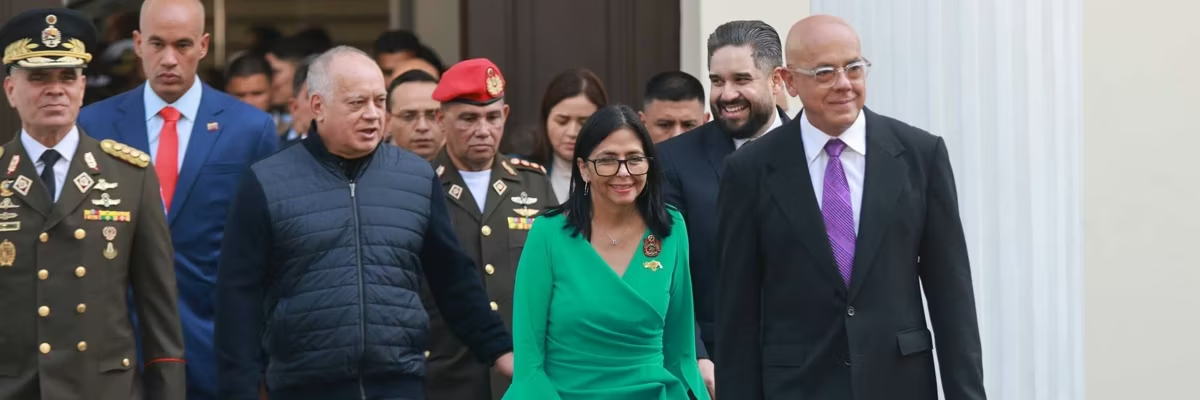
At the opening session of the National Assemblyâs new legislative term, Delcy Rodriguez (2nd R) is sworn in as acting president of Venezuela, pledging loyalty to Maduro and to Chavez in Caracas on January 5, 2026.
Will Delcy Rodriguez govern the country as a compliant and coerced US puppet, or as the leader of an undefeated and independent Venezuela?
As the Senate voted to advance a War Powers Resolution on Venezuela on January 8th, Republican Senator Susan Collins declared that she did not agree with “a sustained engagement 'running' Venezuela.”
The world was mystified when President Donald Trump first said that the United States would “run” Venezuela. He has since made it clear that he wants to control Venezuela by imposing a US monopoly on selling its oil to the rest of the world, to trap the Venezuelan government in a subservient relationship with the United States.
The US Energy Department has published a plan to sell Venezuelan oil already seized by the United States and then to use the same system for all future Venezuelan oil exports. The US would dictate how the revenues are divided between the US and Venezuela, and continue this form of control indefinitely. Trump is planning to meet with US oil company executives on Friday, January 9th, to discuss his plan.
Trump’s plan would cut off Venezuela’s trade with China, Russia, Iran and other countries, and force it to spend its oil revenues on goods and services from the United States. This new form of economic colonialism would also prevent Venezuela from continuing to spend the bulk of its oil revenues on its generous system of social spending, which has lifted millions of Venezuelans out of poverty.
However, on January 7th, the New York Times reported that Venezuela has other plans. “Venezuela’s state-run oil company, Petróleos de Venezuela, confirmed for the first time that it was negotiating the 'sale' of crude oil to the United States,” the Times reported. “It said in a statement on social media that it was using 'frameworks similar to those currently in effect with international companies, such as Chevron, and is based on a strictly commercial transaction.'”
Dealing with Trump is a difficult challenge for Delcy Rodriguez and other Latin American leaders, but they should all understand by now that caving to Trump or letting him pick them off one by one is a path to ruin.
Trump has threatened further military action to remove acting president Delcy Rodriguez from office if she does not comply with US plans for Venezuela. But Trump has already bowed to reality in his decision to cooperate with Rodriguez, recognizing that Maria Corina Machado, the previous US favorite, does not have popular support in Venezuela. The very presence of Delcy Rodriguez as acting president exposes the failure of Trump’s regime change operation and his well-grounded reluctance to unleash yet another unwinnable US war.
After the US invasion and abduction of President Maduro on January 3rd, Delcy Rodriguez was sworn in as Acting President, reaffirming her loyalty to President Maduro and taking charge of running the country in his absence. But who is Delcy Rodriguez, and how is she likely to govern Venezuela? As a compliant and coerced US puppet, or as the leader of an undefeated and independent Venezuela?
Delcy Rodriguez was seven years old in 1976, when her father was tortured and beaten to death as a political prisoner in Venezuela. Jorge Antonio Rodriguez was the 34-year-old co-founder of the Socialist League, a leftist political party, whom the government accused of a leading role in the kidnapping of William Niehous, a suspected CIA officer working under cover as an Owens Corning executive.
Jorge Rodríguez was arrested and died in state custody after interrogation by Venezuelan intelligence agents. While the official cause of death was listed as a heart attack, his autopsy found that he had suffered severe injuries consistent with torture, including seven broken ribs, a collapsed chest, and a detached liver.
Delcy studied law in Caracas and Paris and became a labor lawyer, while her older brother Jorge became a psychiatrist. Delcy and her mother, Delcy Gomez, were in London during the failed US-backed coup in Venezuela in 2003, and they denounced the coup from the Venezuelan embassy in interviews with the BBC and CNN.
Delcy and her older brother Jorge soon joined Hugo Chavez’s Bolivarian government, and rose to a series of senior positions under Chavez and then Maduro: Delcy served as Foreign Minister from 2014 to 2017, and Economy and Finance Minister from 2020 to 2024, as well as Oil Minister and Vice President; Jorge was Vice President for a year under Chavez and then Mayor of Caracas for 8 years.
On January 5th 2026, it fell to Jorge, now the president of the National Assembly, to swear in his sister as acting president, after the illegal US invasion and abduction of President Maduro. Delcy Rodriguez told her people and the world,
“I come as the executive vice president of the constitutional president of the Bolivarian Republic of Venezuela, Nicolas Maduro Moros, to take the oath of office. I come with pain for the suffering that has been caused to the Venezuelan people after an illegitimate military aggression against our homeland. I come with pain for the kidnapping of two heroes who are being held hostage in the United States of America, President Nicolas Maduro and the first combatant, first lady of our country, Cilia Flores. I come with pain, but I must say that I also come with honor to swear in the name of all Venezuelans. I come to swear by our father, liberator Simon Bolivar.”
In other public statements, acting president Rodriguez has struck a fine balance between fierce assertions of Venezuela’s independence and a pragmatic readiness to cooperate peacefully with the United States.
On January 3rd, Delcy Rodriguez declared that Venezuela would “never again be anyone’s colony.” However, after chairing her first cabinet meeting the next day, she said that Venezuela was looking for a “balanced and respectful” relationship with the United States. She went on to say, “We extend an invitation to the government of the US to work jointly on an agenda of cooperation, aimed at shared development, within the framework of international law, and that strengthens lasting peaceful coexistence,”
In a direct message to Trump, Rodriguez wrote, “President Donald Trump: our peoples and our region deserve peace and dialogue, not war. That has always been President Nicolás Maduro’s conviction and it is that of all Venezuela at this moment. This is the Venezuela I believe in and to which I have dedicated my life. My dream is for Venezuela to become a great power where all decent Venezuelans can come together. Venezuela has the right to peace, development, sovereignty and a future.”
Alan McPherson, who chairs the Center for the Study of Force and Diplomacy at Temple University in the US, calls Delcy Rodriguez “a pragmatist who helped stabilize the Venezuelan economy in recent times.” However, speaking to Al Jazeera, he cautioned that any perceived humiliation by the Trump administration or demands seen as excessive could “backfire and end the cooperation,” making the relationship a “difficult balance to achieve.”
After the US invasion on January 3rd, at least a dozen oil tankers set sail from Venezuela with their location transponders turned off, carrying 12 million barrels of oil, mostly to China, effectively breaking the US blockade. But then, on January 7th, US forces boarded and seized two more oil tankers with links to Venezuela, one in the Caribbean and a Russian one in the north Atlantic that they had been tracking for some time, making it clear that Trump is still intent on selectively enforcing the US blockade.
Chevron has recalled American employees to work in Venezuela and resumed normal shipments to US refineries after a four-day pause. But other US oil companies are not eager to charge into Venezuela, where Trump’s actions have so far only increased the political risks for any new US investments, amid a global surplus of oil supplies, low prices, and a world transitioning to cleaner, renewable energy.
Meanwhile, the US Department of Justice is scrambling to make a case against President Maduro, after Trump’s lawless war plan led to Maduro’s illegal arrest as the leader of a non-existent drug cartel in a foreign country where US domestic law does not apply. In his first court appearance in New York, Maduro identified himself as the president of Venezuela and a prisoner of war.
Continuing to seize ships at sea and trying to shake down Venezuela for control of its oil revenues are not the “balanced and respectful” relationship that Delcy Rodriguez and the government of Venezuela are looking for, and the US position is not as strong as Trump and Rubio’s threats suggest. Under the influence of neocons like Marco Rubio and Lindsey Graham, Trump has marched the US to the brink of a war in Latin America that very few Americans support and that most of the world is united against.
Mutual respect and cooperation with Rodriguez and other progressive Latin American leaders, like Lula in Brazil, Gustavo Petro in Colombia, and Mexico’s Claudia Scheinbaum, offer Trump face-saving ways out of the ever-escalating crisis that he and his clueless advisers have blundered into.
Trump has an eminently viable alternative to being manipulated into war by Marco Rubio: what the Chinese like to call “win-win cooperation.” Most Americans would favor that over the zero-sum game of hegemonic imperialism into which Rubio and Trump are draining our hard-earned tax dollars.
The main obstacle to the peaceful cooperation that Trump says he wants is his own blind belief in US militarism and military supremacy. He wants to redirect US imperialism away from Europe, Asia, and Africa toward Latin America, but this is no more winnable or any more legitimate under international law, and it’s just as unpopular with the American people.
If anything, there is greater public opposition to US aggression “in our backyard” than to US wars 10,000 miles away. Cuba, Venezuela, and Colombia are our close neighbors, and the consequences of plunging them into violence and chaos are more obvious to most Americans than the equally appalling human costs of more distant US wars.
Trump understands that endless war is unpopular, but he still seems to believe that he can get away with “one and done” operations like bombing Iran and kidnapping President Maduro and his first lady. These attacks, however, have only solved imaginary problems—Iran’s non-existent nuclear weapons and Maduro’s non-existent drug cartel—while exacerbating long-standing regional crises that US policy is largely responsible for, and which have no military solutions.
Dealing with Trump is a difficult challenge for Delcy Rodriguez and other Latin American leaders, but they should all understand by now that caving to Trump or letting him pick them off one by one is a path to ruin. The world must stand together to deter aggression and defend the basic principles and rules of the UN Charter, under which all countries agree to settle disputes peacefully and not to threaten or use military force against each other. Any chance for a more peaceful world depends on finally starting to take those commitments seriously, as Trump’s predecessors also failed to do.
There is a growing movement organizing nationwide protests to tell Trump that the American people reject his wars and threats of war against our neighbors in Latin America and around the world. This is a critical moment to raise your voice and help to turn the tide against endless war.
Dear Common Dreams reader, The U.S. is on a fast track to authoritarianism like nothing I've ever seen. Meanwhile, corporate news outlets are utterly capitulating to Trump, twisting their coverage to avoid drawing his ire while lining up to stuff cash in his pockets. That's why I believe that Common Dreams is doing the best and most consequential reporting that we've ever done. Our small but mighty team is a progressive reporting powerhouse, covering the news every day that the corporate media never will. Our mission has always been simple: To inform. To inspire. And to ignite change for the common good. Now here's the key piece that I want all our readers to understand: None of this would be possible without your financial support. That's not just some fundraising cliche. It's the absolute and literal truth. We don't accept corporate advertising and never will. We don't have a paywall because we don't think people should be blocked from critical news based on their ability to pay. Everything we do is funded by the donations of readers like you. Will you donate now to help power the nonprofit, independent reporting of Common Dreams? Thank you for being a vital member of our community. Together, we can keep independent journalism alive when it’s needed most. - Craig Brown, Co-founder |
As the Senate voted to advance a War Powers Resolution on Venezuela on January 8th, Republican Senator Susan Collins declared that she did not agree with “a sustained engagement 'running' Venezuela.”
The world was mystified when President Donald Trump first said that the United States would “run” Venezuela. He has since made it clear that he wants to control Venezuela by imposing a US monopoly on selling its oil to the rest of the world, to trap the Venezuelan government in a subservient relationship with the United States.
The US Energy Department has published a plan to sell Venezuelan oil already seized by the United States and then to use the same system for all future Venezuelan oil exports. The US would dictate how the revenues are divided between the US and Venezuela, and continue this form of control indefinitely. Trump is planning to meet with US oil company executives on Friday, January 9th, to discuss his plan.
Trump’s plan would cut off Venezuela’s trade with China, Russia, Iran and other countries, and force it to spend its oil revenues on goods and services from the United States. This new form of economic colonialism would also prevent Venezuela from continuing to spend the bulk of its oil revenues on its generous system of social spending, which has lifted millions of Venezuelans out of poverty.
However, on January 7th, the New York Times reported that Venezuela has other plans. “Venezuela’s state-run oil company, Petróleos de Venezuela, confirmed for the first time that it was negotiating the 'sale' of crude oil to the United States,” the Times reported. “It said in a statement on social media that it was using 'frameworks similar to those currently in effect with international companies, such as Chevron, and is based on a strictly commercial transaction.'”
Dealing with Trump is a difficult challenge for Delcy Rodriguez and other Latin American leaders, but they should all understand by now that caving to Trump or letting him pick them off one by one is a path to ruin.
Trump has threatened further military action to remove acting president Delcy Rodriguez from office if she does not comply with US plans for Venezuela. But Trump has already bowed to reality in his decision to cooperate with Rodriguez, recognizing that Maria Corina Machado, the previous US favorite, does not have popular support in Venezuela. The very presence of Delcy Rodriguez as acting president exposes the failure of Trump’s regime change operation and his well-grounded reluctance to unleash yet another unwinnable US war.
After the US invasion and abduction of President Maduro on January 3rd, Delcy Rodriguez was sworn in as Acting President, reaffirming her loyalty to President Maduro and taking charge of running the country in his absence. But who is Delcy Rodriguez, and how is she likely to govern Venezuela? As a compliant and coerced US puppet, or as the leader of an undefeated and independent Venezuela?
Delcy Rodriguez was seven years old in 1976, when her father was tortured and beaten to death as a political prisoner in Venezuela. Jorge Antonio Rodriguez was the 34-year-old co-founder of the Socialist League, a leftist political party, whom the government accused of a leading role in the kidnapping of William Niehous, a suspected CIA officer working under cover as an Owens Corning executive.
Jorge Rodríguez was arrested and died in state custody after interrogation by Venezuelan intelligence agents. While the official cause of death was listed as a heart attack, his autopsy found that he had suffered severe injuries consistent with torture, including seven broken ribs, a collapsed chest, and a detached liver.
Delcy studied law in Caracas and Paris and became a labor lawyer, while her older brother Jorge became a psychiatrist. Delcy and her mother, Delcy Gomez, were in London during the failed US-backed coup in Venezuela in 2003, and they denounced the coup from the Venezuelan embassy in interviews with the BBC and CNN.
Delcy and her older brother Jorge soon joined Hugo Chavez’s Bolivarian government, and rose to a series of senior positions under Chavez and then Maduro: Delcy served as Foreign Minister from 2014 to 2017, and Economy and Finance Minister from 2020 to 2024, as well as Oil Minister and Vice President; Jorge was Vice President for a year under Chavez and then Mayor of Caracas for 8 years.
On January 5th 2026, it fell to Jorge, now the president of the National Assembly, to swear in his sister as acting president, after the illegal US invasion and abduction of President Maduro. Delcy Rodriguez told her people and the world,
“I come as the executive vice president of the constitutional president of the Bolivarian Republic of Venezuela, Nicolas Maduro Moros, to take the oath of office. I come with pain for the suffering that has been caused to the Venezuelan people after an illegitimate military aggression against our homeland. I come with pain for the kidnapping of two heroes who are being held hostage in the United States of America, President Nicolas Maduro and the first combatant, first lady of our country, Cilia Flores. I come with pain, but I must say that I also come with honor to swear in the name of all Venezuelans. I come to swear by our father, liberator Simon Bolivar.”
In other public statements, acting president Rodriguez has struck a fine balance between fierce assertions of Venezuela’s independence and a pragmatic readiness to cooperate peacefully with the United States.
On January 3rd, Delcy Rodriguez declared that Venezuela would “never again be anyone’s colony.” However, after chairing her first cabinet meeting the next day, she said that Venezuela was looking for a “balanced and respectful” relationship with the United States. She went on to say, “We extend an invitation to the government of the US to work jointly on an agenda of cooperation, aimed at shared development, within the framework of international law, and that strengthens lasting peaceful coexistence,”
In a direct message to Trump, Rodriguez wrote, “President Donald Trump: our peoples and our region deserve peace and dialogue, not war. That has always been President Nicolás Maduro’s conviction and it is that of all Venezuela at this moment. This is the Venezuela I believe in and to which I have dedicated my life. My dream is for Venezuela to become a great power where all decent Venezuelans can come together. Venezuela has the right to peace, development, sovereignty and a future.”
Alan McPherson, who chairs the Center for the Study of Force and Diplomacy at Temple University in the US, calls Delcy Rodriguez “a pragmatist who helped stabilize the Venezuelan economy in recent times.” However, speaking to Al Jazeera, he cautioned that any perceived humiliation by the Trump administration or demands seen as excessive could “backfire and end the cooperation,” making the relationship a “difficult balance to achieve.”
After the US invasion on January 3rd, at least a dozen oil tankers set sail from Venezuela with their location transponders turned off, carrying 12 million barrels of oil, mostly to China, effectively breaking the US blockade. But then, on January 7th, US forces boarded and seized two more oil tankers with links to Venezuela, one in the Caribbean and a Russian one in the north Atlantic that they had been tracking for some time, making it clear that Trump is still intent on selectively enforcing the US blockade.
Chevron has recalled American employees to work in Venezuela and resumed normal shipments to US refineries after a four-day pause. But other US oil companies are not eager to charge into Venezuela, where Trump’s actions have so far only increased the political risks for any new US investments, amid a global surplus of oil supplies, low prices, and a world transitioning to cleaner, renewable energy.
Meanwhile, the US Department of Justice is scrambling to make a case against President Maduro, after Trump’s lawless war plan led to Maduro’s illegal arrest as the leader of a non-existent drug cartel in a foreign country where US domestic law does not apply. In his first court appearance in New York, Maduro identified himself as the president of Venezuela and a prisoner of war.
Continuing to seize ships at sea and trying to shake down Venezuela for control of its oil revenues are not the “balanced and respectful” relationship that Delcy Rodriguez and the government of Venezuela are looking for, and the US position is not as strong as Trump and Rubio’s threats suggest. Under the influence of neocons like Marco Rubio and Lindsey Graham, Trump has marched the US to the brink of a war in Latin America that very few Americans support and that most of the world is united against.
Mutual respect and cooperation with Rodriguez and other progressive Latin American leaders, like Lula in Brazil, Gustavo Petro in Colombia, and Mexico’s Claudia Scheinbaum, offer Trump face-saving ways out of the ever-escalating crisis that he and his clueless advisers have blundered into.
Trump has an eminently viable alternative to being manipulated into war by Marco Rubio: what the Chinese like to call “win-win cooperation.” Most Americans would favor that over the zero-sum game of hegemonic imperialism into which Rubio and Trump are draining our hard-earned tax dollars.
The main obstacle to the peaceful cooperation that Trump says he wants is his own blind belief in US militarism and military supremacy. He wants to redirect US imperialism away from Europe, Asia, and Africa toward Latin America, but this is no more winnable or any more legitimate under international law, and it’s just as unpopular with the American people.
If anything, there is greater public opposition to US aggression “in our backyard” than to US wars 10,000 miles away. Cuba, Venezuela, and Colombia are our close neighbors, and the consequences of plunging them into violence and chaos are more obvious to most Americans than the equally appalling human costs of more distant US wars.
Trump understands that endless war is unpopular, but he still seems to believe that he can get away with “one and done” operations like bombing Iran and kidnapping President Maduro and his first lady. These attacks, however, have only solved imaginary problems—Iran’s non-existent nuclear weapons and Maduro’s non-existent drug cartel—while exacerbating long-standing regional crises that US policy is largely responsible for, and which have no military solutions.
Dealing with Trump is a difficult challenge for Delcy Rodriguez and other Latin American leaders, but they should all understand by now that caving to Trump or letting him pick them off one by one is a path to ruin. The world must stand together to deter aggression and defend the basic principles and rules of the UN Charter, under which all countries agree to settle disputes peacefully and not to threaten or use military force against each other. Any chance for a more peaceful world depends on finally starting to take those commitments seriously, as Trump’s predecessors also failed to do.
There is a growing movement organizing nationwide protests to tell Trump that the American people reject his wars and threats of war against our neighbors in Latin America and around the world. This is a critical moment to raise your voice and help to turn the tide against endless war.
As the Senate voted to advance a War Powers Resolution on Venezuela on January 8th, Republican Senator Susan Collins declared that she did not agree with “a sustained engagement 'running' Venezuela.”
The world was mystified when President Donald Trump first said that the United States would “run” Venezuela. He has since made it clear that he wants to control Venezuela by imposing a US monopoly on selling its oil to the rest of the world, to trap the Venezuelan government in a subservient relationship with the United States.
The US Energy Department has published a plan to sell Venezuelan oil already seized by the United States and then to use the same system for all future Venezuelan oil exports. The US would dictate how the revenues are divided between the US and Venezuela, and continue this form of control indefinitely. Trump is planning to meet with US oil company executives on Friday, January 9th, to discuss his plan.
Trump’s plan would cut off Venezuela’s trade with China, Russia, Iran and other countries, and force it to spend its oil revenues on goods and services from the United States. This new form of economic colonialism would also prevent Venezuela from continuing to spend the bulk of its oil revenues on its generous system of social spending, which has lifted millions of Venezuelans out of poverty.
However, on January 7th, the New York Times reported that Venezuela has other plans. “Venezuela’s state-run oil company, Petróleos de Venezuela, confirmed for the first time that it was negotiating the 'sale' of crude oil to the United States,” the Times reported. “It said in a statement on social media that it was using 'frameworks similar to those currently in effect with international companies, such as Chevron, and is based on a strictly commercial transaction.'”
Dealing with Trump is a difficult challenge for Delcy Rodriguez and other Latin American leaders, but they should all understand by now that caving to Trump or letting him pick them off one by one is a path to ruin.
Trump has threatened further military action to remove acting president Delcy Rodriguez from office if she does not comply with US plans for Venezuela. But Trump has already bowed to reality in his decision to cooperate with Rodriguez, recognizing that Maria Corina Machado, the previous US favorite, does not have popular support in Venezuela. The very presence of Delcy Rodriguez as acting president exposes the failure of Trump’s regime change operation and his well-grounded reluctance to unleash yet another unwinnable US war.
After the US invasion and abduction of President Maduro on January 3rd, Delcy Rodriguez was sworn in as Acting President, reaffirming her loyalty to President Maduro and taking charge of running the country in his absence. But who is Delcy Rodriguez, and how is she likely to govern Venezuela? As a compliant and coerced US puppet, or as the leader of an undefeated and independent Venezuela?
Delcy Rodriguez was seven years old in 1976, when her father was tortured and beaten to death as a political prisoner in Venezuela. Jorge Antonio Rodriguez was the 34-year-old co-founder of the Socialist League, a leftist political party, whom the government accused of a leading role in the kidnapping of William Niehous, a suspected CIA officer working under cover as an Owens Corning executive.
Jorge Rodríguez was arrested and died in state custody after interrogation by Venezuelan intelligence agents. While the official cause of death was listed as a heart attack, his autopsy found that he had suffered severe injuries consistent with torture, including seven broken ribs, a collapsed chest, and a detached liver.
Delcy studied law in Caracas and Paris and became a labor lawyer, while her older brother Jorge became a psychiatrist. Delcy and her mother, Delcy Gomez, were in London during the failed US-backed coup in Venezuela in 2003, and they denounced the coup from the Venezuelan embassy in interviews with the BBC and CNN.
Delcy and her older brother Jorge soon joined Hugo Chavez’s Bolivarian government, and rose to a series of senior positions under Chavez and then Maduro: Delcy served as Foreign Minister from 2014 to 2017, and Economy and Finance Minister from 2020 to 2024, as well as Oil Minister and Vice President; Jorge was Vice President for a year under Chavez and then Mayor of Caracas for 8 years.
On January 5th 2026, it fell to Jorge, now the president of the National Assembly, to swear in his sister as acting president, after the illegal US invasion and abduction of President Maduro. Delcy Rodriguez told her people and the world,
“I come as the executive vice president of the constitutional president of the Bolivarian Republic of Venezuela, Nicolas Maduro Moros, to take the oath of office. I come with pain for the suffering that has been caused to the Venezuelan people after an illegitimate military aggression against our homeland. I come with pain for the kidnapping of two heroes who are being held hostage in the United States of America, President Nicolas Maduro and the first combatant, first lady of our country, Cilia Flores. I come with pain, but I must say that I also come with honor to swear in the name of all Venezuelans. I come to swear by our father, liberator Simon Bolivar.”
In other public statements, acting president Rodriguez has struck a fine balance between fierce assertions of Venezuela’s independence and a pragmatic readiness to cooperate peacefully with the United States.
On January 3rd, Delcy Rodriguez declared that Venezuela would “never again be anyone’s colony.” However, after chairing her first cabinet meeting the next day, she said that Venezuela was looking for a “balanced and respectful” relationship with the United States. She went on to say, “We extend an invitation to the government of the US to work jointly on an agenda of cooperation, aimed at shared development, within the framework of international law, and that strengthens lasting peaceful coexistence,”
In a direct message to Trump, Rodriguez wrote, “President Donald Trump: our peoples and our region deserve peace and dialogue, not war. That has always been President Nicolás Maduro’s conviction and it is that of all Venezuela at this moment. This is the Venezuela I believe in and to which I have dedicated my life. My dream is for Venezuela to become a great power where all decent Venezuelans can come together. Venezuela has the right to peace, development, sovereignty and a future.”
Alan McPherson, who chairs the Center for the Study of Force and Diplomacy at Temple University in the US, calls Delcy Rodriguez “a pragmatist who helped stabilize the Venezuelan economy in recent times.” However, speaking to Al Jazeera, he cautioned that any perceived humiliation by the Trump administration or demands seen as excessive could “backfire and end the cooperation,” making the relationship a “difficult balance to achieve.”
After the US invasion on January 3rd, at least a dozen oil tankers set sail from Venezuela with their location transponders turned off, carrying 12 million barrels of oil, mostly to China, effectively breaking the US blockade. But then, on January 7th, US forces boarded and seized two more oil tankers with links to Venezuela, one in the Caribbean and a Russian one in the north Atlantic that they had been tracking for some time, making it clear that Trump is still intent on selectively enforcing the US blockade.
Chevron has recalled American employees to work in Venezuela and resumed normal shipments to US refineries after a four-day pause. But other US oil companies are not eager to charge into Venezuela, where Trump’s actions have so far only increased the political risks for any new US investments, amid a global surplus of oil supplies, low prices, and a world transitioning to cleaner, renewable energy.
Meanwhile, the US Department of Justice is scrambling to make a case against President Maduro, after Trump’s lawless war plan led to Maduro’s illegal arrest as the leader of a non-existent drug cartel in a foreign country where US domestic law does not apply. In his first court appearance in New York, Maduro identified himself as the president of Venezuela and a prisoner of war.
Continuing to seize ships at sea and trying to shake down Venezuela for control of its oil revenues are not the “balanced and respectful” relationship that Delcy Rodriguez and the government of Venezuela are looking for, and the US position is not as strong as Trump and Rubio’s threats suggest. Under the influence of neocons like Marco Rubio and Lindsey Graham, Trump has marched the US to the brink of a war in Latin America that very few Americans support and that most of the world is united against.
Mutual respect and cooperation with Rodriguez and other progressive Latin American leaders, like Lula in Brazil, Gustavo Petro in Colombia, and Mexico’s Claudia Scheinbaum, offer Trump face-saving ways out of the ever-escalating crisis that he and his clueless advisers have blundered into.
Trump has an eminently viable alternative to being manipulated into war by Marco Rubio: what the Chinese like to call “win-win cooperation.” Most Americans would favor that over the zero-sum game of hegemonic imperialism into which Rubio and Trump are draining our hard-earned tax dollars.
The main obstacle to the peaceful cooperation that Trump says he wants is his own blind belief in US militarism and military supremacy. He wants to redirect US imperialism away from Europe, Asia, and Africa toward Latin America, but this is no more winnable or any more legitimate under international law, and it’s just as unpopular with the American people.
If anything, there is greater public opposition to US aggression “in our backyard” than to US wars 10,000 miles away. Cuba, Venezuela, and Colombia are our close neighbors, and the consequences of plunging them into violence and chaos are more obvious to most Americans than the equally appalling human costs of more distant US wars.
Trump understands that endless war is unpopular, but he still seems to believe that he can get away with “one and done” operations like bombing Iran and kidnapping President Maduro and his first lady. These attacks, however, have only solved imaginary problems—Iran’s non-existent nuclear weapons and Maduro’s non-existent drug cartel—while exacerbating long-standing regional crises that US policy is largely responsible for, and which have no military solutions.
Dealing with Trump is a difficult challenge for Delcy Rodriguez and other Latin American leaders, but they should all understand by now that caving to Trump or letting him pick them off one by one is a path to ruin. The world must stand together to deter aggression and defend the basic principles and rules of the UN Charter, under which all countries agree to settle disputes peacefully and not to threaten or use military force against each other. Any chance for a more peaceful world depends on finally starting to take those commitments seriously, as Trump’s predecessors also failed to do.
There is a growing movement organizing nationwide protests to tell Trump that the American people reject his wars and threats of war against our neighbors in Latin America and around the world. This is a critical moment to raise your voice and help to turn the tide against endless war.