SUBSCRIBE TO OUR FREE NEWSLETTER
Daily news & progressive opinion—funded by the people, not the corporations—delivered straight to your inbox.
5
#000000
#FFFFFF
To donate by check, phone, or other method, see our More Ways to Give page.
Daily news & progressive opinion—funded by the people, not the corporations—delivered straight to your inbox.
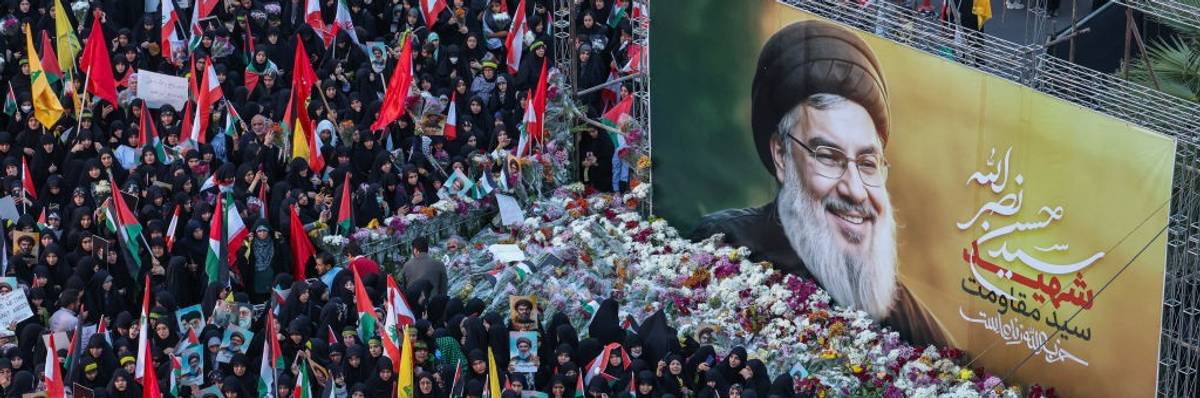
Iranians lay flowers beneath a billboard bearing a portrait of Hezbollah leader Hassan Nasrallah, who was killed in an Israeli air strike on Beirut's southern suburbs on September 27, during an anti-Israel protest in Palestine Square in Tehran on September 30, 2024.
Biden has been out of his depth throughout this crisis, relying on political instincts from an era when acting tough and blindly supporting Israel were politically safe positions for American politicians.
On October 1, Iran fired about 180 missiles at Israel in response to Israel’s recent assassinations of leaders of its Revolutionary Guard (IRGC), Hezbollah and Hamas. There are conflicting reports about how many of the missiles struck their targets and if there were any deaths. But Israel is now considering a counterattack that could propel it into an all-out war with Iran, with the U.S. in tow.
For years, Iran has been trying to avoid such a war. That is why it signed the 2015 JCPOA nuclear agreement with the United States, the U.K., France, Germany, Russia, China, and the European Union. Former U.S. President Donald Trump unilaterally pulled the U.S. out of the JCPOA in 2018, and despite President Joe Biden’s much-touted differences with Trump, he failed to restore U.S. compliance. Instead, he tried to use Trump’s violation of the treaty as leverage to demand further concessions from Iran. This only served to further aggravate the schism between the United States and Iran, which have had no diplomatic relations since 1980.
Now, Israeli Prime Minister Benjamin Netanyahu sees his long-awaited chance to draw the United States into war with Iran. By killing Iranian military leaders and Hamas leader Ismail Haniyeh on Iranian soil, as well as attacking Iran’s allies in Lebanon and Yemen, Netanyahu provoked a military response from Iran that has given him an excuse to widen the conflict even further. Tragically, there are warmongering U.S. officials who would welcome a war on Iran, and many more who would blindly go along with it.
Netanyahu has spent many years trying to draw the United States into a war with Iran, and has kept escalating the Gaza crisis for a year, at the cost of tens of thousands of innocent lives, with that goal clearly in mind.
Iran’s newly elected president, Masoud Pezeshkian, campaigned on a platform of reconciling with the West. When he came to New York to speak at the United Nations General Assembly on September 25, he was accompanied by three members of Iran’s JCPOA negotiating team: former foreign minister Javad Zarif; current foreign minister Abbas Araghchi; and deputy foreign minister Majid Ravanchi.
President Pezeshkian’s message in New York was conciliatory. With Zarif and Araghchi at his side at a press conference on September 23, he talked of peace, and of reviving the dormant nuclear agreement. “Vis-a-vis the JCPOA, we said 100 times we are willing to live up to our agreements,” he said. “We do hope we can sit at the table and hold discussions.”
On the crisis in the Middle East, Pezeshkian said that Iran wanted peace and had exercised restraint in the face of Israel’s genocide in Gaza, its assassinations of resistance leaders and Iranian officials, and its war on its neighbors.
“Let’s create a situation where we can coexist,” said Pezeshkian. “Let’s try to resolve tensions through dialogue… We are willing to put all of our weapons aside so long as Israel will do the same.” He added that Iran is a signatory to the Nuclear Non-Proliferation Treaty, while Israel is not, and that Israel’s nuclear arsenal is a serious threat to Iran.
Pezeshkian reiterated Iran’s desire for peace in his speech at the U.N. General Assembly.
“I am the president of a country that has endured threats, war, occupation, and sanctions throughout its modern history,” he said. “Others have neither come to our assistance nor respected our declared neutrality. Global powers have even sided with aggressors. We have learned that we can only rely on our own people and our own indigenous capabilities. The Islamic Republic of Iran seeks to safeguard its own security, not to create insecurity for others. We want peace for all and seek no war or quarrel with anyone.”
The U.S. response to Iran’s restraint throughout this crisis has been to keep sending destructive weapons to Israel, with which it has devastated Gaza, killed tens of thousands of women and children, bombed neighboring capitals, and beefed up the forces it would need to attack Iran.
That includes a new order for 50 F-15EX long-range bombers, with 750 gallon fuel tanks for the long journey to Iran. That arms deal still has to pass the Senate, where Sen. Bernie Sanders (I-Vt.) is leading the opposition.
On the diplomatic front, the U.S. vetoed successive cease-fire resolutions in the U.N. Security Council and hijacked Qatar and Egypt’s cease-fire negotiations to provide diplomatic cover for unrestricted genocide.
Military leaders in the United States and Israel appear to be arguing against war on Iran, as they have in the past. Even George W. Bush and Dick Cheney balked at launching another catastrophic war based on lies against Iran, after the CIA publicly admitted in its 2006 National Intelligence Estimate that Iran was not developing nuclear weapons.
When Trump threatened to attack Iran, Tulsi Gabbard warned him that a U.S. war on Iran would be so catastrophic that it would finally, retroactively, make the war on Iraq look like the “cakewalk” the neocons had promised it would be.But neither U.S. Defense Secretary Lloyd Austin nor Israeli Defense Minister Yoav Gallant can control their countries’ war policies, which are in the hands of political leaders with political agendas. Netanyahu has spent many years trying to draw the United States into a war with Iran, and has kept escalating the Gaza crisis for a year, at the cost of tens of thousands of innocent lives, with that goal clearly in mind.
Biden has been out of his depth throughout this crisis, relying on political instincts from an era when acting tough and blindly supporting Israel were politically safe positions for American politicians. Secretary of State Antony Blinken rose to power through the National Security Council and as a Senate staffer, not as a diplomat, riding Biden’s coattails into a senior position where he is as out of his depth as his boss.
Meanwhile, pro-Iran militia groups in Iraq warn that, if the U.S. joins in strikes on Iran, they will target U.S. bases in Iraq and the region.
So we are careening toward a catastrophic war with Iran, with no U.S. diplomatic leadership and only Trump and Harris waiting in the wings. As Trita Parsi wrote in Responsible Statecraft, “If U.S. service members find themselves in the line of fire in an expanding Iran-Israel conflict, it will be a direct result of this administration’s failure to use U.S. leverage to pursue America’s most core security interest here—avoiding war.”
Dear Common Dreams reader, It’s been nearly 30 years since I co-founded Common Dreams with my late wife, Lina Newhouser. We had the radical notion that journalism should serve the public good, not corporate profits. It was clear to us from the outset what it would take to build such a project. No paid advertisements. No corporate sponsors. No millionaire publisher telling us what to think or do. Many people said we wouldn't last a year, but we proved those doubters wrong. Together with a tremendous team of journalists and dedicated staff, we built an independent media outlet free from the constraints of profits and corporate control. Our mission has always been simple: To inform. To inspire. To ignite change for the common good. Building Common Dreams was not easy. Our survival was never guaranteed. When you take on the most powerful forces—Wall Street greed, fossil fuel industry destruction, Big Tech lobbyists, and uber-rich oligarchs who have spent billions upon billions rigging the economy and democracy in their favor—the only bulwark you have is supporters who believe in your work. But here’s the urgent message from me today. It's never been this bad out there. And it's never been this hard to keep us going. At the very moment Common Dreams is most needed, the threats we face are intensifying. We need your support now more than ever. We don't accept corporate advertising and never will. We don't have a paywall because we don't think people should be blocked from critical news based on their ability to pay. Everything we do is funded by the donations of readers like you. When everyone does the little they can afford, we are strong. But if that support retreats or dries up, so do we. Will you donate now to make sure Common Dreams not only survives but thrives? —Craig Brown, Co-founder |
On October 1, Iran fired about 180 missiles at Israel in response to Israel’s recent assassinations of leaders of its Revolutionary Guard (IRGC), Hezbollah and Hamas. There are conflicting reports about how many of the missiles struck their targets and if there were any deaths. But Israel is now considering a counterattack that could propel it into an all-out war with Iran, with the U.S. in tow.
For years, Iran has been trying to avoid such a war. That is why it signed the 2015 JCPOA nuclear agreement with the United States, the U.K., France, Germany, Russia, China, and the European Union. Former U.S. President Donald Trump unilaterally pulled the U.S. out of the JCPOA in 2018, and despite President Joe Biden’s much-touted differences with Trump, he failed to restore U.S. compliance. Instead, he tried to use Trump’s violation of the treaty as leverage to demand further concessions from Iran. This only served to further aggravate the schism between the United States and Iran, which have had no diplomatic relations since 1980.
Now, Israeli Prime Minister Benjamin Netanyahu sees his long-awaited chance to draw the United States into war with Iran. By killing Iranian military leaders and Hamas leader Ismail Haniyeh on Iranian soil, as well as attacking Iran’s allies in Lebanon and Yemen, Netanyahu provoked a military response from Iran that has given him an excuse to widen the conflict even further. Tragically, there are warmongering U.S. officials who would welcome a war on Iran, and many more who would blindly go along with it.
Netanyahu has spent many years trying to draw the United States into a war with Iran, and has kept escalating the Gaza crisis for a year, at the cost of tens of thousands of innocent lives, with that goal clearly in mind.
Iran’s newly elected president, Masoud Pezeshkian, campaigned on a platform of reconciling with the West. When he came to New York to speak at the United Nations General Assembly on September 25, he was accompanied by three members of Iran’s JCPOA negotiating team: former foreign minister Javad Zarif; current foreign minister Abbas Araghchi; and deputy foreign minister Majid Ravanchi.
President Pezeshkian’s message in New York was conciliatory. With Zarif and Araghchi at his side at a press conference on September 23, he talked of peace, and of reviving the dormant nuclear agreement. “Vis-a-vis the JCPOA, we said 100 times we are willing to live up to our agreements,” he said. “We do hope we can sit at the table and hold discussions.”
On the crisis in the Middle East, Pezeshkian said that Iran wanted peace and had exercised restraint in the face of Israel’s genocide in Gaza, its assassinations of resistance leaders and Iranian officials, and its war on its neighbors.
“Let’s create a situation where we can coexist,” said Pezeshkian. “Let’s try to resolve tensions through dialogue… We are willing to put all of our weapons aside so long as Israel will do the same.” He added that Iran is a signatory to the Nuclear Non-Proliferation Treaty, while Israel is not, and that Israel’s nuclear arsenal is a serious threat to Iran.
Pezeshkian reiterated Iran’s desire for peace in his speech at the U.N. General Assembly.
“I am the president of a country that has endured threats, war, occupation, and sanctions throughout its modern history,” he said. “Others have neither come to our assistance nor respected our declared neutrality. Global powers have even sided with aggressors. We have learned that we can only rely on our own people and our own indigenous capabilities. The Islamic Republic of Iran seeks to safeguard its own security, not to create insecurity for others. We want peace for all and seek no war or quarrel with anyone.”
The U.S. response to Iran’s restraint throughout this crisis has been to keep sending destructive weapons to Israel, with which it has devastated Gaza, killed tens of thousands of women and children, bombed neighboring capitals, and beefed up the forces it would need to attack Iran.
That includes a new order for 50 F-15EX long-range bombers, with 750 gallon fuel tanks for the long journey to Iran. That arms deal still has to pass the Senate, where Sen. Bernie Sanders (I-Vt.) is leading the opposition.
On the diplomatic front, the U.S. vetoed successive cease-fire resolutions in the U.N. Security Council and hijacked Qatar and Egypt’s cease-fire negotiations to provide diplomatic cover for unrestricted genocide.
Military leaders in the United States and Israel appear to be arguing against war on Iran, as they have in the past. Even George W. Bush and Dick Cheney balked at launching another catastrophic war based on lies against Iran, after the CIA publicly admitted in its 2006 National Intelligence Estimate that Iran was not developing nuclear weapons.
When Trump threatened to attack Iran, Tulsi Gabbard warned him that a U.S. war on Iran would be so catastrophic that it would finally, retroactively, make the war on Iraq look like the “cakewalk” the neocons had promised it would be.But neither U.S. Defense Secretary Lloyd Austin nor Israeli Defense Minister Yoav Gallant can control their countries’ war policies, which are in the hands of political leaders with political agendas. Netanyahu has spent many years trying to draw the United States into a war with Iran, and has kept escalating the Gaza crisis for a year, at the cost of tens of thousands of innocent lives, with that goal clearly in mind.
Biden has been out of his depth throughout this crisis, relying on political instincts from an era when acting tough and blindly supporting Israel were politically safe positions for American politicians. Secretary of State Antony Blinken rose to power through the National Security Council and as a Senate staffer, not as a diplomat, riding Biden’s coattails into a senior position where he is as out of his depth as his boss.
Meanwhile, pro-Iran militia groups in Iraq warn that, if the U.S. joins in strikes on Iran, they will target U.S. bases in Iraq and the region.
So we are careening toward a catastrophic war with Iran, with no U.S. diplomatic leadership and only Trump and Harris waiting in the wings. As Trita Parsi wrote in Responsible Statecraft, “If U.S. service members find themselves in the line of fire in an expanding Iran-Israel conflict, it will be a direct result of this administration’s failure to use U.S. leverage to pursue America’s most core security interest here—avoiding war.”
On October 1, Iran fired about 180 missiles at Israel in response to Israel’s recent assassinations of leaders of its Revolutionary Guard (IRGC), Hezbollah and Hamas. There are conflicting reports about how many of the missiles struck their targets and if there were any deaths. But Israel is now considering a counterattack that could propel it into an all-out war with Iran, with the U.S. in tow.
For years, Iran has been trying to avoid such a war. That is why it signed the 2015 JCPOA nuclear agreement with the United States, the U.K., France, Germany, Russia, China, and the European Union. Former U.S. President Donald Trump unilaterally pulled the U.S. out of the JCPOA in 2018, and despite President Joe Biden’s much-touted differences with Trump, he failed to restore U.S. compliance. Instead, he tried to use Trump’s violation of the treaty as leverage to demand further concessions from Iran. This only served to further aggravate the schism between the United States and Iran, which have had no diplomatic relations since 1980.
Now, Israeli Prime Minister Benjamin Netanyahu sees his long-awaited chance to draw the United States into war with Iran. By killing Iranian military leaders and Hamas leader Ismail Haniyeh on Iranian soil, as well as attacking Iran’s allies in Lebanon and Yemen, Netanyahu provoked a military response from Iran that has given him an excuse to widen the conflict even further. Tragically, there are warmongering U.S. officials who would welcome a war on Iran, and many more who would blindly go along with it.
Netanyahu has spent many years trying to draw the United States into a war with Iran, and has kept escalating the Gaza crisis for a year, at the cost of tens of thousands of innocent lives, with that goal clearly in mind.
Iran’s newly elected president, Masoud Pezeshkian, campaigned on a platform of reconciling with the West. When he came to New York to speak at the United Nations General Assembly on September 25, he was accompanied by three members of Iran’s JCPOA negotiating team: former foreign minister Javad Zarif; current foreign minister Abbas Araghchi; and deputy foreign minister Majid Ravanchi.
President Pezeshkian’s message in New York was conciliatory. With Zarif and Araghchi at his side at a press conference on September 23, he talked of peace, and of reviving the dormant nuclear agreement. “Vis-a-vis the JCPOA, we said 100 times we are willing to live up to our agreements,” he said. “We do hope we can sit at the table and hold discussions.”
On the crisis in the Middle East, Pezeshkian said that Iran wanted peace and had exercised restraint in the face of Israel’s genocide in Gaza, its assassinations of resistance leaders and Iranian officials, and its war on its neighbors.
“Let’s create a situation where we can coexist,” said Pezeshkian. “Let’s try to resolve tensions through dialogue… We are willing to put all of our weapons aside so long as Israel will do the same.” He added that Iran is a signatory to the Nuclear Non-Proliferation Treaty, while Israel is not, and that Israel’s nuclear arsenal is a serious threat to Iran.
Pezeshkian reiterated Iran’s desire for peace in his speech at the U.N. General Assembly.
“I am the president of a country that has endured threats, war, occupation, and sanctions throughout its modern history,” he said. “Others have neither come to our assistance nor respected our declared neutrality. Global powers have even sided with aggressors. We have learned that we can only rely on our own people and our own indigenous capabilities. The Islamic Republic of Iran seeks to safeguard its own security, not to create insecurity for others. We want peace for all and seek no war or quarrel with anyone.”
The U.S. response to Iran’s restraint throughout this crisis has been to keep sending destructive weapons to Israel, with which it has devastated Gaza, killed tens of thousands of women and children, bombed neighboring capitals, and beefed up the forces it would need to attack Iran.
That includes a new order for 50 F-15EX long-range bombers, with 750 gallon fuel tanks for the long journey to Iran. That arms deal still has to pass the Senate, where Sen. Bernie Sanders (I-Vt.) is leading the opposition.
On the diplomatic front, the U.S. vetoed successive cease-fire resolutions in the U.N. Security Council and hijacked Qatar and Egypt’s cease-fire negotiations to provide diplomatic cover for unrestricted genocide.
Military leaders in the United States and Israel appear to be arguing against war on Iran, as they have in the past. Even George W. Bush and Dick Cheney balked at launching another catastrophic war based on lies against Iran, after the CIA publicly admitted in its 2006 National Intelligence Estimate that Iran was not developing nuclear weapons.
When Trump threatened to attack Iran, Tulsi Gabbard warned him that a U.S. war on Iran would be so catastrophic that it would finally, retroactively, make the war on Iraq look like the “cakewalk” the neocons had promised it would be.But neither U.S. Defense Secretary Lloyd Austin nor Israeli Defense Minister Yoav Gallant can control their countries’ war policies, which are in the hands of political leaders with political agendas. Netanyahu has spent many years trying to draw the United States into a war with Iran, and has kept escalating the Gaza crisis for a year, at the cost of tens of thousands of innocent lives, with that goal clearly in mind.
Biden has been out of his depth throughout this crisis, relying on political instincts from an era when acting tough and blindly supporting Israel were politically safe positions for American politicians. Secretary of State Antony Blinken rose to power through the National Security Council and as a Senate staffer, not as a diplomat, riding Biden’s coattails into a senior position where he is as out of his depth as his boss.
Meanwhile, pro-Iran militia groups in Iraq warn that, if the U.S. joins in strikes on Iran, they will target U.S. bases in Iraq and the region.
So we are careening toward a catastrophic war with Iran, with no U.S. diplomatic leadership and only Trump and Harris waiting in the wings. As Trita Parsi wrote in Responsible Statecraft, “If U.S. service members find themselves in the line of fire in an expanding Iran-Israel conflict, it will be a direct result of this administration’s failure to use U.S. leverage to pursue America’s most core security interest here—avoiding war.”