

SUBSCRIBE TO OUR FREE NEWSLETTER
Daily news & progressive opinion—funded by the people, not the corporations—delivered straight to your inbox.
5
#000000
#FFFFFF
To donate by check, phone, or other method, see our More Ways to Give page.
Daily news & progressive opinion—funded by the people, not the corporations—delivered straight to your inbox.

Paige Knappenberger,
Media Relations Manager,
pknappenberger@climatenexus.org,
602-549-0344,
Just days after scientists named 2015 the hottest year on record, top environmental groups Greenpeace, Sierra Club, and 350.org have released a new report, Keep It In the Ground, identifying the top climate threats facing the planet. The report examines the fossil fuel reserves around the world that, if developed, would push the globe past 1.5degC and then 2@C of warming, the threshold beyond which the effects of climate change would make the Earth unlivable.
Fresh off a series of victories in 2015, these groups and others are taking on many of the challenges identified in the Keep It In the Ground report as part of a global push to stand up to the fossil fuel industry and accelerate a just transition to 100% renewable energy.
"Climate change is already bringing flood waters and wildfires right to our doorsteps," said May Boeve, Executive Director of 350.org. "At this point, continuing to burn fossil fuels is truly lethal. The effort by fossil fuel companies to dig up and burn coal, oil and gas despite the consequences is the biggest threat our planet faces. All around the world people are now mobilizing to keep fossil fuels in the ground."
Keep It in The Ground lays out the carbon risk of fossil fuel deposits in Africa, the Arctic, Australia, Brazil, Canada, China, India, Indonesia, Russia, Saudi Arabia, and the United States, measuring each against a global carbon budget meant to prevent catastrophic climate change. The report also assesses the changing public policies surrounding each fuel source, fossil fuel industry efforts to develop them, and citizens' ongoing efforts to keep them in the ground.
"With the historic climate accord set in Paris last year, nearly 200 nations from around the world set an expiration date for fossil fuels," said Lena Moffitt, Director of Sierra Club's Beyond Dirty Fuels campaign. "Now we must rise to the occasion by transitioning to 100 percent clean and renewable energy sources, and leave dirty fuels where they belong - in the ground."
According to the report, unless Canada's government implements strong environmental protections, the country's tar sands projects could add an expected 420 million metric tons of CO2 to the atmosphere each year by 2020--more than the entire annual emissions of Saudi Arabia. Tar sands are the fastest growing source of emissions in Canada, and the Trudeau government has yet to present a plan to reconcile new tar sands mines and pipelines with international commitments on greenhouse gas reductions. Beyond spewing an additional 700 million metric tons of CO2 into the atmosphere, expanded mining activity in Australia's Queensland region would devastate the Great Barrier Reef, which is already under severe stress from rising temperatures.
"The global climate movement is stronger than ever and we've seen important progress in the effort to keep fossil fuels in the ground, from Arctic oil to Powder River Basin coal," said Kelly Mitchell, Greenpeace US Climate Director. "We can't undo the damage that fossil fuel companies have caused already, but we can prevent further harm and build a more just world in the process. Our lives depend on it."
###
Download the report here: https://www.sierraclub.org/sites/www.sierraclub.org/files/blog/Keep%20It%20in%20the%20Ground%20-%20January%202016.pdf
The Sierra Club is America's largest grassroots environmental organization, with more than 2.4 million members and supporters nationwide.
350.org is a global campaign to address the climate crisis.
Greenpeace is the largest independent, direct action environmental organization in the world.
350 is building a future that's just, prosperous, equitable and safe from the effects of the climate crisis. We're an international movement of ordinary people working to end the age of fossil fuels and build a world of community-led renewable energy for all.
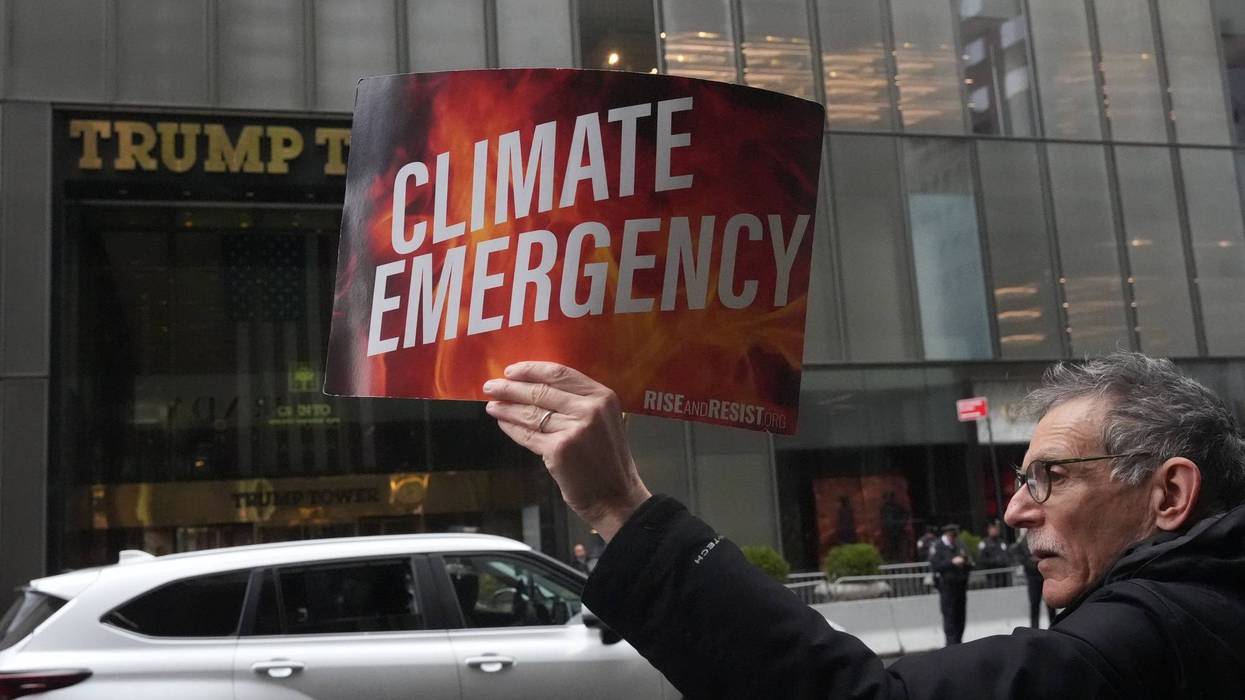
Putting an "utterly unqualified" person like Matthew Wielicki in charge of the National Climate Assessment, said one critic, “would jeopardize the integrity of one of the nation’s most important climate science resources.”
The Trump White House has quietly reconstituted the US Global Change Research Program—but that doesn't mean the administration has turned over a new leaf on combating the climate crisis.
According to a Thursday report from Politico, the administration decided to bring the USGCRP, which tracks the impact of manmade climate change and produces the country's National Climate Assessment report, back to life just a little more than a year after terminating its funding.
But there's a twist: A source has confirmed to Politico that the USGCRP is now being headed by Matthew Wielicki, a former University of Alabama geochemist and self-described "professor in exile" who frequently attacks climate science in social media posts.
In his role, Wielicki will be in charge of writing the National Climate Assessment, a congressionally mandated report outlining the impacts that climate change is having on US infrastructure and the economy.
In an interview with Politico, Wielicki revealed that he's been soliciting ideas for what to include in the next National Climate Assessment from X, the social media website owned by Elon Musk that is notorious for being awash in right-wing propaganda and scientific misinformation.
In the past, noted Politico, Wielicki dismissed climate research entirely, arguing that a "significant portion of the climate science literature is nothing more than stamp collecting," while suggesting that scientists are fabricating data to give a false impression of a warming planet.
Dr. Carlos Martinez, senior climate scientist for the Climate and Energy program at the Union of Concerned Scientists, wasted no time blasting Wielicki's appointment.
"Reconstituting the UCSGCRP only to place the National Climate Assessment under the auspices of an utterly unqualified climate science denier," Martinez said, "would jeopardize the integrity of one of the nation’s most important climate science resources."
Martinez emphasized that the National Climate Assessment "is not a political document" and is "supposed to be developed through a rigorous, transparent, multi-agency scientific process involving federal experts, external scientists, extensive review—including by the National Academies—and public input."
Ryan Katz-Rosene, professor at the School of Political Studies at the University of Ottawa, said Wielicki's appointment "sadly... is not a joke," and that it was "like putting a Flat Earther in charge of NASA."

A lawyer for former Olympian Davey Hearn said the indictment "reflects the administration's effort to scapegoat Davey and to shift blame for their own failures."
As supporters gathered outside the courthouse in support, former Olympic canoe racer David "Davey" Hearn pleaded not guilty on Thursday after being charged by the Trump administration with vandalizing the Lincoln Memorial Reflecting Pool.
Last week, Jeanine Pirro, the US Attorney for the District of Columbia, secured a criminal indictment for property destruction against the 67-year-old Hearn for allegedly “forcefully and violently pulling up and removing the bottom liner” of the pool in June.
Hearn, who could face up to 10 years in prison if convicted, has said he was not vandalizing the pool and was simply pulling up a piece of the lining that had already begun to peel off.
"Today, Davey Hearn pled not guilty—because he is not guilty," said his attorney, Norm Eisen. "If Mr. Hearn can be charged with a felony for touching the Reflecting Pool, every American is at risk, and every American should be alarmed about this prosecution."
As he attempted to renovate the Reflecting Pool in the lead-up to the nation's 250th anniversary on July 4, President Donald Trump alleged that the scourge of algae blooms and peeling lining that have plagued the pool were caused by vandals, though he has provided little evidence.
The White House has claimed that at least seven people have been arrested for vandalism, though it provided no public information about other cases.
The company that installed the blue coating had previously worked at a Trump golf club, and the company that installed the water-cleaning system was owned by an investment firm led by a reported top Trump donor. Both received no-bid contracts awarded by the Department of the Interior.
Eisen said that the attempt to prosecute Hearn "reflects the administration's effort to scapegoat Davey and to shift blame for their own failures."
Hearn previously told The Associated Press that he was detained by National Guard troops and US Park Police for five hours after he reached into the pool to examine the newly peeled lining and briefly touched a piece of it. The canoeist said he let go of the lining as soon as he was told to do so by a park employee.
"It is not a crime to touch the Reflecting Pool," Eisen said.
Ryan Goodman, the co-editor-in-chief of Just Security, has said Hearn's indictment fits a "pattern of abuse of power" by Pirro, who was plucked from her previous job as a pro-Trump Fox News host to become DC's top prosecutor last year.
Goodman noted that, in a similar fashion to Pirro's use of the law against Trump's enemies, like the investigation into former Federal Reserve Chair Jerome Powell and the attempt to prosecute members of Congress who encouraged the military not to obey unlawful orders, the indictment against Hearn came immediately after Trump posted on Truth Social that he should spend "years in jail."
"Here we have it again," he said. "It's in lock-step with the president on this particular instance in which it seemed like authorities thought this was just a misdemeanor in the first instance. It smells really bad."
As Hearn was arraigned Thursday morning, dozens of supporters, including former Olympians, gathered outside the DC Superior Court at a "Free Davey!" rally to show solidarity.
Adam Van Grack, who chaired the Olympic national governing body for canoe and kayak sports and was coached by Hearn, described his former mentor as "someone who has spent decades giving back to athletes, to our community, and to our nation."
Van Grack noted Hearn's decades of volunteer work to maintain property owned by the US National Park Service that canoeists used for training.
“This is a person who has devoted his life to representing the United States on an international stage, caring for the community and protecting and caring for National Park Service property,” Van Grack said. “So the idea that he is a malicious destroyer of federal property shocks the conscience and makes no sense to anybody who’s ever known Davey Hearn.”

“The swing voters who will decide the midterms are not asking Democrats to sound more like Republicans—they want Democrats to embrace progressive economic policies that will actually work to lower costs."
Democratic strategists have long clashed over whether the path to victory runs through "moderation" or bold progressive ideas, and a new analysis of 2026 swing voters boosts arguments for the latter, revealing the top policies that would sway them to vote Democrat include raising taxes on the wealthy and establishing a Medicare for All-type universal healthcare system.
On Thursday, Data for Progress published a new report identifying a relatively small but electorally crucial bloc comprising roughly 8% of likely 2026 voters who are genuinely persuadable heading into the November midterms. These swing voters, many of whom voted for President Donald Trump in 2024, identify as moderates or independents rather than conservatives, consume relatively little political news, and are primarily focused on one issue above all else: the cost of living.
"A plurality of swing voters aren’t sure which party they trust on the major issues, but Democrats hold a slight advantage on inflation and the cost of living, the top issue for swing voters," Data for Progress found. "Around 1 in 3 swing voters say their biggest issues with the Democratic Party are its 'old and out of touch' leadership and the party 'not doing enough to lower costs.'"
"The most popular proposal was simple: Raise taxes on the wealthy," the report states. "Twenty-eight percent selected it as one of their top three choices. Close behind, at 24%, was creating a Medicare for All healthcare system. Those weren't followed by tougher immigration policies or deficit reduction. Instead, voters also favored banning artificial intelligence from setting prices or wages based on personal data and preventing utility companies from passing unreasonable costs on to consumers."
NEW: Our first report on the swing voters of the 2026 midterms finds that when they are asked which policies would make them definitely vote for a Democrat, the most selected option is “raise taxes on the wealthy,” followed by “create a Medicare for All health care system.”
[image or embed]
— Data for Progress (@dataforprogress.org) July 9, 2026 at 6:30 AM
According to the report, swing voters currently favor a Democratic candidate for Congress over a Republican by a 12-point margin, with 46% undecided.
“The swing voters who will decide the midterms are not asking Democrats to sound more like Republicans—they want Democrats to embrace progressive economic policies that will actually work to lower costs and put workers first,” Data for Progress executive director Ryan O'Donnell said on Thursday. “Voters have been making clear for years that cost-of-living issues are the top priority. Taking more conservative stances is not what voters are asking for from their leaders right now.”