SUBSCRIBE TO OUR FREE NEWSLETTER
Daily news & progressive opinion—funded by the people, not the corporations—delivered straight to your inbox.
5
#000000
#FFFFFF
To donate by check, phone, or other method, see our More Ways to Give page.
Daily news & progressive opinion—funded by the people, not the corporations—delivered straight to your inbox.
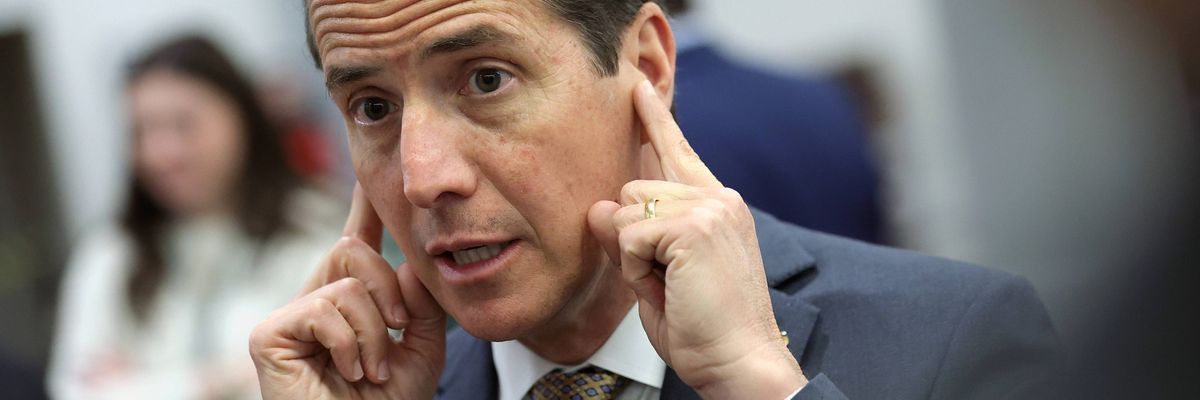
US Sen. Bernie Moreno (R-Ohio) speaks to members of the media after leaving a Republican Senate policy luncheon at the Capitol on January 13, 2026 in Washington, DC.
"Senate Republicans must pass this bipartisan legislation today, end the Republican healthcare crisis, and deliver immediate relief to American families," said one campaigner.
A week away from open enrollment ending in most states, 17 GOP members of the US House of Representatives helped Democrats pass a bill to restore lapsed Affordable Care Act premium tax credits—but senators have declined to act with that same urgency, and the deadline for many Americans to make coverage decisions for 2026 is Thursday.
Sen. Bernie Moreno (R-Ohio), a lead negotiator for a bipartisan Senate group working on a compromise for the expired ACA subsidies, told Politico on Tuesday that the legislative text will no longer be ready this week. Instead, it's now expected the last week of January—after not only the upper chamber's upcoming recess, but also when millions of people nationwide will have already had to choose a plan on an ACA marketplace or to forgo health insurance coverage due to surging premiums.
In response to the reporting, Unrig Our Economy campaign director Leor Tal highlighted in a statement that "millions of Americans are paying sky-high health insurance premiums after congressional Republicans ended the healthcare tax cuts working families depend on. A three-year extension has already cleared the House with bipartisan support."
"Any delay needlessly sticks millions of working people with higher costs; There is no excuse," Tal added. "Senate Republicans must pass this bipartisan legislation today, end the Republican healthcare crisis, and deliver immediate relief to American families."
Tal, Democratic lawmakers, labor leaders, and other supporters of reviving the ACA subsidies had similarly demanded Senate action following last Thursday's 230-196 vote—which came after multiple Republican lawmakers broke with party leadership and signed a Democratic discharge petition that enabled the bill's backers to bypass House Speaker Mike Johnson (R-La.).
Moreno's remarks on the Senate group's "punt," as Politico put it, came after Axios reported that congressional Democratic leadership on Sunday sent Republicans a proposal to renew ACA subsidies for three years, "paired with extensions of other expiring health programs."
Axios also noted that President Donald Trump told reporters late Sunday that he "might" veto a subsidy extension. Whether any will reach his desk, though, remains unclear—and even if one does, it is increasingly likely it'll be after Americans have to make choices about 2026 coverage. Amid the uncertainty over future ACA subsidies, Illinois and Pennsylvania extended the enrollment period through February 1.
The Centers for Medicare and Medicaid Services said Monday that nearly 22.8 million people have signed up for 2026 individual market health insurance coverage through the ACA marketplaces—around 19.9 million returning consumers and 2.8 million new ones.
The nonprofit Community Catalyst pointed out that the overall enrollment figure is down by about 1.4 million from last year. Michelle Sternthal, the advocacy group's interim senior director of policy and strategy, said that "these numbers confirm what people across the country are already feeling: We are in a healthcare affordability crisis."
"When Congress failed to extend the enhanced premium tax credits, premiums spiked overnight—from $921 to $1,998, or $121 to $373. Families are facing impossible choices," Sternthal stressed in her Tuesday statement.
"These outcomes aren't random. They are the direct result of policy decisions that have weakened our healthcare system over time," she continued. "Coverage works. Stability matters. Healthcare is not a luxury—it is shared infrastructure. When people are healthy, our communities and our economy are stronger. Congress created this crisis, and Congress has the power—and the responsibility—to act now."
The drawn-out debate over the ACA tax credits on Capitol Hill has spurred broader critiques of the US healthcare system, including fresh demands for Medicare for All. Even before the subsidies expired at the end of last year, the typical working US family spent $3,960 on healthcare annually, including premiums and out-of-pocket costs, according to research released Tuesday by the Center for Economic and Policy Research (CEPR).
"Ten percent of working families paid more than $14,800 on insurance premiums and other out-of-pocket healthcare expenses," says the CEPR report, which is based on 2024 data. "And more than 1 of every 8 workers (13.3%) are in families that spent greater than 10% of their annual income on healthcare."
The publication warns that "healthcare costs are rising faster than inflation, and future increases in premiums, ACA costs, and Medicaid cutbacks will worsen the burden."
Dear Common Dreams reader, It’s been nearly 30 years since I co-founded Common Dreams with my late wife, Lina Newhouser. We had the radical notion that journalism should serve the public good, not corporate profits. It was clear to us from the outset what it would take to build such a project. No paid advertisements. No corporate sponsors. No millionaire publisher telling us what to think or do. Many people said we wouldn't last a year, but we proved those doubters wrong. Together with a tremendous team of journalists and dedicated staff, we built an independent media outlet free from the constraints of profits and corporate control. Our mission has always been simple: To inform. To inspire. To ignite change for the common good. Building Common Dreams was not easy. Our survival was never guaranteed. When you take on the most powerful forces—Wall Street greed, fossil fuel industry destruction, Big Tech lobbyists, and uber-rich oligarchs who have spent billions upon billions rigging the economy and democracy in their favor—the only bulwark you have is supporters who believe in your work. But here’s the urgent message from me today. It's never been this bad out there. And it's never been this hard to keep us going. At the very moment Common Dreams is most needed, the threats we face are intensifying. We need your support now more than ever. We don't accept corporate advertising and never will. We don't have a paywall because we don't think people should be blocked from critical news based on their ability to pay. Everything we do is funded by the donations of readers like you. When everyone does the little they can afford, we are strong. But if that support retreats or dries up, so do we. Will you donate now to make sure Common Dreams not only survives but thrives? —Craig Brown, Co-founder |
A week away from open enrollment ending in most states, 17 GOP members of the US House of Representatives helped Democrats pass a bill to restore lapsed Affordable Care Act premium tax credits—but senators have declined to act with that same urgency, and the deadline for many Americans to make coverage decisions for 2026 is Thursday.
Sen. Bernie Moreno (R-Ohio), a lead negotiator for a bipartisan Senate group working on a compromise for the expired ACA subsidies, told Politico on Tuesday that the legislative text will no longer be ready this week. Instead, it's now expected the last week of January—after not only the upper chamber's upcoming recess, but also when millions of people nationwide will have already had to choose a plan on an ACA marketplace or to forgo health insurance coverage due to surging premiums.
In response to the reporting, Unrig Our Economy campaign director Leor Tal highlighted in a statement that "millions of Americans are paying sky-high health insurance premiums after congressional Republicans ended the healthcare tax cuts working families depend on. A three-year extension has already cleared the House with bipartisan support."
"Any delay needlessly sticks millions of working people with higher costs; There is no excuse," Tal added. "Senate Republicans must pass this bipartisan legislation today, end the Republican healthcare crisis, and deliver immediate relief to American families."
Tal, Democratic lawmakers, labor leaders, and other supporters of reviving the ACA subsidies had similarly demanded Senate action following last Thursday's 230-196 vote—which came after multiple Republican lawmakers broke with party leadership and signed a Democratic discharge petition that enabled the bill's backers to bypass House Speaker Mike Johnson (R-La.).
Moreno's remarks on the Senate group's "punt," as Politico put it, came after Axios reported that congressional Democratic leadership on Sunday sent Republicans a proposal to renew ACA subsidies for three years, "paired with extensions of other expiring health programs."
Axios also noted that President Donald Trump told reporters late Sunday that he "might" veto a subsidy extension. Whether any will reach his desk, though, remains unclear—and even if one does, it is increasingly likely it'll be after Americans have to make choices about 2026 coverage. Amid the uncertainty over future ACA subsidies, Illinois and Pennsylvania extended the enrollment period through February 1.
The Centers for Medicare and Medicaid Services said Monday that nearly 22.8 million people have signed up for 2026 individual market health insurance coverage through the ACA marketplaces—around 19.9 million returning consumers and 2.8 million new ones.
The nonprofit Community Catalyst pointed out that the overall enrollment figure is down by about 1.4 million from last year. Michelle Sternthal, the advocacy group's interim senior director of policy and strategy, said that "these numbers confirm what people across the country are already feeling: We are in a healthcare affordability crisis."
"When Congress failed to extend the enhanced premium tax credits, premiums spiked overnight—from $921 to $1,998, or $121 to $373. Families are facing impossible choices," Sternthal stressed in her Tuesday statement.
"These outcomes aren't random. They are the direct result of policy decisions that have weakened our healthcare system over time," she continued. "Coverage works. Stability matters. Healthcare is not a luxury—it is shared infrastructure. When people are healthy, our communities and our economy are stronger. Congress created this crisis, and Congress has the power—and the responsibility—to act now."
The drawn-out debate over the ACA tax credits on Capitol Hill has spurred broader critiques of the US healthcare system, including fresh demands for Medicare for All. Even before the subsidies expired at the end of last year, the typical working US family spent $3,960 on healthcare annually, including premiums and out-of-pocket costs, according to research released Tuesday by the Center for Economic and Policy Research (CEPR).
"Ten percent of working families paid more than $14,800 on insurance premiums and other out-of-pocket healthcare expenses," says the CEPR report, which is based on 2024 data. "And more than 1 of every 8 workers (13.3%) are in families that spent greater than 10% of their annual income on healthcare."
The publication warns that "healthcare costs are rising faster than inflation, and future increases in premiums, ACA costs, and Medicaid cutbacks will worsen the burden."
A week away from open enrollment ending in most states, 17 GOP members of the US House of Representatives helped Democrats pass a bill to restore lapsed Affordable Care Act premium tax credits—but senators have declined to act with that same urgency, and the deadline for many Americans to make coverage decisions for 2026 is Thursday.
Sen. Bernie Moreno (R-Ohio), a lead negotiator for a bipartisan Senate group working on a compromise for the expired ACA subsidies, told Politico on Tuesday that the legislative text will no longer be ready this week. Instead, it's now expected the last week of January—after not only the upper chamber's upcoming recess, but also when millions of people nationwide will have already had to choose a plan on an ACA marketplace or to forgo health insurance coverage due to surging premiums.
In response to the reporting, Unrig Our Economy campaign director Leor Tal highlighted in a statement that "millions of Americans are paying sky-high health insurance premiums after congressional Republicans ended the healthcare tax cuts working families depend on. A three-year extension has already cleared the House with bipartisan support."
"Any delay needlessly sticks millions of working people with higher costs; There is no excuse," Tal added. "Senate Republicans must pass this bipartisan legislation today, end the Republican healthcare crisis, and deliver immediate relief to American families."
Tal, Democratic lawmakers, labor leaders, and other supporters of reviving the ACA subsidies had similarly demanded Senate action following last Thursday's 230-196 vote—which came after multiple Republican lawmakers broke with party leadership and signed a Democratic discharge petition that enabled the bill's backers to bypass House Speaker Mike Johnson (R-La.).
Moreno's remarks on the Senate group's "punt," as Politico put it, came after Axios reported that congressional Democratic leadership on Sunday sent Republicans a proposal to renew ACA subsidies for three years, "paired with extensions of other expiring health programs."
Axios also noted that President Donald Trump told reporters late Sunday that he "might" veto a subsidy extension. Whether any will reach his desk, though, remains unclear—and even if one does, it is increasingly likely it'll be after Americans have to make choices about 2026 coverage. Amid the uncertainty over future ACA subsidies, Illinois and Pennsylvania extended the enrollment period through February 1.
The Centers for Medicare and Medicaid Services said Monday that nearly 22.8 million people have signed up for 2026 individual market health insurance coverage through the ACA marketplaces—around 19.9 million returning consumers and 2.8 million new ones.
The nonprofit Community Catalyst pointed out that the overall enrollment figure is down by about 1.4 million from last year. Michelle Sternthal, the advocacy group's interim senior director of policy and strategy, said that "these numbers confirm what people across the country are already feeling: We are in a healthcare affordability crisis."
"When Congress failed to extend the enhanced premium tax credits, premiums spiked overnight—from $921 to $1,998, or $121 to $373. Families are facing impossible choices," Sternthal stressed in her Tuesday statement.
"These outcomes aren't random. They are the direct result of policy decisions that have weakened our healthcare system over time," she continued. "Coverage works. Stability matters. Healthcare is not a luxury—it is shared infrastructure. When people are healthy, our communities and our economy are stronger. Congress created this crisis, and Congress has the power—and the responsibility—to act now."
The drawn-out debate over the ACA tax credits on Capitol Hill has spurred broader critiques of the US healthcare system, including fresh demands for Medicare for All. Even before the subsidies expired at the end of last year, the typical working US family spent $3,960 on healthcare annually, including premiums and out-of-pocket costs, according to research released Tuesday by the Center for Economic and Policy Research (CEPR).
"Ten percent of working families paid more than $14,800 on insurance premiums and other out-of-pocket healthcare expenses," says the CEPR report, which is based on 2024 data. "And more than 1 of every 8 workers (13.3%) are in families that spent greater than 10% of their annual income on healthcare."
The publication warns that "healthcare costs are rising faster than inflation, and future increases in premiums, ACA costs, and Medicaid cutbacks will worsen the burden."