SUBSCRIBE TO OUR FREE NEWSLETTER
Daily news & progressive opinion—funded by the people, not the corporations—delivered straight to your inbox.
5
#000000
#FFFFFF
To donate by check, phone, or other method, see our More Ways to Give page.
Daily news & progressive opinion—funded by the people, not the corporations—delivered straight to your inbox.
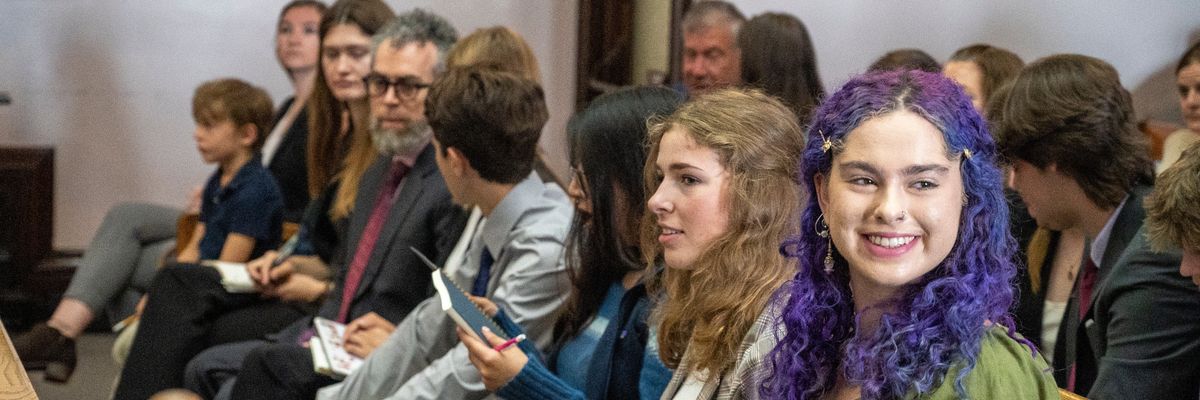
Youth plaintiffs await the start of the nation's first youth climate change trial at Montana's First Judicial District Court on June 12, 2023 in Helena, Montana.
"As fires rage in the West, fueled by fossil fuel pollution, today's ruling in Montana is a game-changer that marks a turning point in this generation's efforts to save the planet," said one attorney representing 16 young plaintiffs.
Climate advocates on Monday expressed hope that an unprecedented ruling by a state judge in Montana, siding with 16 young residents who argued the state violated their constitutional rights by promoting fossil fuel extraction, will mark a sea change in the outcomes of climate lawsuits.
In Held v. State of Montana, District Court Judge Kathy Seeley ruled that rights of the plaintiffs—who range in age from 5 to 22— have been violated by the Montana Environmental Policy Act because the law has prevented the state from assessing the climate impacts of mining projects.
Fossil fuel emissions including Montana's "have been proven to be a substantial factor" in heating the planet and causing pollution, Seeley said in the nation's first ruling on a constitutional, youth-led lawsuit regarding the climate.
Because the Montana Constitution guarantees residents a "clean and healthful environment," the state's environmental policy law violates the document, said Seeley.
"This is HUGE," said meteorologist Eric Holthaus.
"This is a landmark decision establishing enforceable principles of intergenerational justice."
Julia Olson, founder of Our Children's Trust, the non-profit law firm that helped represent the plaintiffs, called the victory a "sweeping win" that could have reverberating effects on the hundreds of lawsuits that have been filed in the U.S. arguing against the continued extraction of fossil fuels.
"As fires rage in the West, fueled by fossil fuel pollution, today's ruling in Montana is a game-changer that marks a turning point in this generation's efforts to save the planet from the devastating effects of human-caused climate chaos," said Olson in a statement.
In their defense, state attorneys argued that Montana's fossil fuel emissions are insignificant compared to global emissions, but Seeley said in her ruling that the state's per capita emissions are "disproportionately large" and rank in the top six per capita emissions in the United States.
The state also ultimately rested its case on the argument that the state legislature should take up the issue of the environmental law rather than the judiciary—an admission, said Michael Gerrard of the Sabin Center for Climate Change Law at Columbia University, that the climate science underpinning the plaintiffs' case was indisputable.
"Everyone expected them to put on a more vigorous defense," Gerrard told The Washington Post Monday. "And they may have concluded that the underlying science of climate change was so strong that they didn't want to contest it."
During the trial, the plaintiffs testified about their own suffering due to pollution and extreme weather, while climate experts explained the connection between the state's fossil fuel activities and planetary heating, the wildfires and scorching heat that have overwhelmed parts of the West, and other extreme weather.
"Judge Seeley's decision comes at a time when we're seeing the impacts of climate change accelerate—from low streamflows and lake levels to unprecedented heat waves, floods, and wildfires," said Melissa Hornbein, senior attorney at the Western Environmental Law Center, which along with McGarvey Law also represented the plaintiffs. "These are the climate realities the youth plaintiffs and expert witnesses told us about on the stand, while the state disclaimed any responsibility and dismissed them."
"We're relieved that the court recognized that these youth plaintiffs are already feeling the impacts of the climate crisis, as well as the dangers threatening their future if the state doesn't take meaningful action to address it," Hornbein added. "We're also delighted that Judge Seeley recognized Montana's significant role as an emitter on the global stage, as well as its ability—constrained only by a resistant government—to rectify its disproportionate contribution to the climate crisis."
The Sunrise Movement, the youth-led climate action organization, said the ruling is "proof that our generation is unstoppable—we have the power to bring down the fossil fuel industry and win a Green New Deal."
As Common Dreams reported last month, lawsuits around the world have emerged as a key driver of climate action as a wide range of plaintiffs—from children in the U.S. to senior citizens in Switzerland—have argued that their human rights have been violated by the companies and lawmakers that have promoted fossil fuel production despite scientific evidence of the danger it poses.
Out of approximately 2,200 worldwide climate cases, about three-quarters have been filed in the United States, according to the United Nations Environment Program and the Sabin Center, and the number of legal challenges has more than doubled since 2017.
The outcome of the Montana case could "open up the floodgates for more climate lawsuits," said Jamie Henn, director of Fossil Free Media.
Sen. Bernie Sanders (I-Vt.) said that the next plaintiff to file a case against the fossil fuel industry should be the federal government, to hold companies accountable "for their role in the climate crisis."
"This is a landmark decision establishing enforceable principles of intergenerational justice," said Roger Sullivan, an attorney at McGarvey Law. "Simply stated, the government elected by this generation must abide its obligation to pass on a stable climate system to future generations."
Dear Common Dreams reader, It’s been nearly 30 years since I co-founded Common Dreams with my late wife, Lina Newhouser. We had the radical notion that journalism should serve the public good, not corporate profits. It was clear to us from the outset what it would take to build such a project. No paid advertisements. No corporate sponsors. No millionaire publisher telling us what to think or do. Many people said we wouldn't last a year, but we proved those doubters wrong. Together with a tremendous team of journalists and dedicated staff, we built an independent media outlet free from the constraints of profits and corporate control. Our mission has always been simple: To inform. To inspire. To ignite change for the common good. Building Common Dreams was not easy. Our survival was never guaranteed. When you take on the most powerful forces—Wall Street greed, fossil fuel industry destruction, Big Tech lobbyists, and uber-rich oligarchs who have spent billions upon billions rigging the economy and democracy in their favor—the only bulwark you have is supporters who believe in your work. But here’s the urgent message from me today. It's never been this bad out there. And it's never been this hard to keep us going. At the very moment Common Dreams is most needed, the threats we face are intensifying. We need your support now more than ever. We don't accept corporate advertising and never will. We don't have a paywall because we don't think people should be blocked from critical news based on their ability to pay. Everything we do is funded by the donations of readers like you. When everyone does the little they can afford, we are strong. But if that support retreats or dries up, so do we. Will you donate now to make sure Common Dreams not only survives but thrives? —Craig Brown, Co-founder |
Climate advocates on Monday expressed hope that an unprecedented ruling by a state judge in Montana, siding with 16 young residents who argued the state violated their constitutional rights by promoting fossil fuel extraction, will mark a sea change in the outcomes of climate lawsuits.
In Held v. State of Montana, District Court Judge Kathy Seeley ruled that rights of the plaintiffs—who range in age from 5 to 22— have been violated by the Montana Environmental Policy Act because the law has prevented the state from assessing the climate impacts of mining projects.
Fossil fuel emissions including Montana's "have been proven to be a substantial factor" in heating the planet and causing pollution, Seeley said in the nation's first ruling on a constitutional, youth-led lawsuit regarding the climate.
Because the Montana Constitution guarantees residents a "clean and healthful environment," the state's environmental policy law violates the document, said Seeley.
"This is HUGE," said meteorologist Eric Holthaus.
"This is a landmark decision establishing enforceable principles of intergenerational justice."
Julia Olson, founder of Our Children's Trust, the non-profit law firm that helped represent the plaintiffs, called the victory a "sweeping win" that could have reverberating effects on the hundreds of lawsuits that have been filed in the U.S. arguing against the continued extraction of fossil fuels.
"As fires rage in the West, fueled by fossil fuel pollution, today's ruling in Montana is a game-changer that marks a turning point in this generation's efforts to save the planet from the devastating effects of human-caused climate chaos," said Olson in a statement.
In their defense, state attorneys argued that Montana's fossil fuel emissions are insignificant compared to global emissions, but Seeley said in her ruling that the state's per capita emissions are "disproportionately large" and rank in the top six per capita emissions in the United States.
The state also ultimately rested its case on the argument that the state legislature should take up the issue of the environmental law rather than the judiciary—an admission, said Michael Gerrard of the Sabin Center for Climate Change Law at Columbia University, that the climate science underpinning the plaintiffs' case was indisputable.
"Everyone expected them to put on a more vigorous defense," Gerrard told The Washington Post Monday. "And they may have concluded that the underlying science of climate change was so strong that they didn't want to contest it."
During the trial, the plaintiffs testified about their own suffering due to pollution and extreme weather, while climate experts explained the connection between the state's fossil fuel activities and planetary heating, the wildfires and scorching heat that have overwhelmed parts of the West, and other extreme weather.
"Judge Seeley's decision comes at a time when we're seeing the impacts of climate change accelerate—from low streamflows and lake levels to unprecedented heat waves, floods, and wildfires," said Melissa Hornbein, senior attorney at the Western Environmental Law Center, which along with McGarvey Law also represented the plaintiffs. "These are the climate realities the youth plaintiffs and expert witnesses told us about on the stand, while the state disclaimed any responsibility and dismissed them."
"We're relieved that the court recognized that these youth plaintiffs are already feeling the impacts of the climate crisis, as well as the dangers threatening their future if the state doesn't take meaningful action to address it," Hornbein added. "We're also delighted that Judge Seeley recognized Montana's significant role as an emitter on the global stage, as well as its ability—constrained only by a resistant government—to rectify its disproportionate contribution to the climate crisis."
The Sunrise Movement, the youth-led climate action organization, said the ruling is "proof that our generation is unstoppable—we have the power to bring down the fossil fuel industry and win a Green New Deal."
As Common Dreams reported last month, lawsuits around the world have emerged as a key driver of climate action as a wide range of plaintiffs—from children in the U.S. to senior citizens in Switzerland—have argued that their human rights have been violated by the companies and lawmakers that have promoted fossil fuel production despite scientific evidence of the danger it poses.
Out of approximately 2,200 worldwide climate cases, about three-quarters have been filed in the United States, according to the United Nations Environment Program and the Sabin Center, and the number of legal challenges has more than doubled since 2017.
The outcome of the Montana case could "open up the floodgates for more climate lawsuits," said Jamie Henn, director of Fossil Free Media.
Sen. Bernie Sanders (I-Vt.) said that the next plaintiff to file a case against the fossil fuel industry should be the federal government, to hold companies accountable "for their role in the climate crisis."
"This is a landmark decision establishing enforceable principles of intergenerational justice," said Roger Sullivan, an attorney at McGarvey Law. "Simply stated, the government elected by this generation must abide its obligation to pass on a stable climate system to future generations."
Climate advocates on Monday expressed hope that an unprecedented ruling by a state judge in Montana, siding with 16 young residents who argued the state violated their constitutional rights by promoting fossil fuel extraction, will mark a sea change in the outcomes of climate lawsuits.
In Held v. State of Montana, District Court Judge Kathy Seeley ruled that rights of the plaintiffs—who range in age from 5 to 22— have been violated by the Montana Environmental Policy Act because the law has prevented the state from assessing the climate impacts of mining projects.
Fossil fuel emissions including Montana's "have been proven to be a substantial factor" in heating the planet and causing pollution, Seeley said in the nation's first ruling on a constitutional, youth-led lawsuit regarding the climate.
Because the Montana Constitution guarantees residents a "clean and healthful environment," the state's environmental policy law violates the document, said Seeley.
"This is HUGE," said meteorologist Eric Holthaus.
"This is a landmark decision establishing enforceable principles of intergenerational justice."
Julia Olson, founder of Our Children's Trust, the non-profit law firm that helped represent the plaintiffs, called the victory a "sweeping win" that could have reverberating effects on the hundreds of lawsuits that have been filed in the U.S. arguing against the continued extraction of fossil fuels.
"As fires rage in the West, fueled by fossil fuel pollution, today's ruling in Montana is a game-changer that marks a turning point in this generation's efforts to save the planet from the devastating effects of human-caused climate chaos," said Olson in a statement.
In their defense, state attorneys argued that Montana's fossil fuel emissions are insignificant compared to global emissions, but Seeley said in her ruling that the state's per capita emissions are "disproportionately large" and rank in the top six per capita emissions in the United States.
The state also ultimately rested its case on the argument that the state legislature should take up the issue of the environmental law rather than the judiciary—an admission, said Michael Gerrard of the Sabin Center for Climate Change Law at Columbia University, that the climate science underpinning the plaintiffs' case was indisputable.
"Everyone expected them to put on a more vigorous defense," Gerrard told The Washington Post Monday. "And they may have concluded that the underlying science of climate change was so strong that they didn't want to contest it."
During the trial, the plaintiffs testified about their own suffering due to pollution and extreme weather, while climate experts explained the connection between the state's fossil fuel activities and planetary heating, the wildfires and scorching heat that have overwhelmed parts of the West, and other extreme weather.
"Judge Seeley's decision comes at a time when we're seeing the impacts of climate change accelerate—from low streamflows and lake levels to unprecedented heat waves, floods, and wildfires," said Melissa Hornbein, senior attorney at the Western Environmental Law Center, which along with McGarvey Law also represented the plaintiffs. "These are the climate realities the youth plaintiffs and expert witnesses told us about on the stand, while the state disclaimed any responsibility and dismissed them."
"We're relieved that the court recognized that these youth plaintiffs are already feeling the impacts of the climate crisis, as well as the dangers threatening their future if the state doesn't take meaningful action to address it," Hornbein added. "We're also delighted that Judge Seeley recognized Montana's significant role as an emitter on the global stage, as well as its ability—constrained only by a resistant government—to rectify its disproportionate contribution to the climate crisis."
The Sunrise Movement, the youth-led climate action organization, said the ruling is "proof that our generation is unstoppable—we have the power to bring down the fossil fuel industry and win a Green New Deal."
As Common Dreams reported last month, lawsuits around the world have emerged as a key driver of climate action as a wide range of plaintiffs—from children in the U.S. to senior citizens in Switzerland—have argued that their human rights have been violated by the companies and lawmakers that have promoted fossil fuel production despite scientific evidence of the danger it poses.
Out of approximately 2,200 worldwide climate cases, about three-quarters have been filed in the United States, according to the United Nations Environment Program and the Sabin Center, and the number of legal challenges has more than doubled since 2017.
The outcome of the Montana case could "open up the floodgates for more climate lawsuits," said Jamie Henn, director of Fossil Free Media.
Sen. Bernie Sanders (I-Vt.) said that the next plaintiff to file a case against the fossil fuel industry should be the federal government, to hold companies accountable "for their role in the climate crisis."
"This is a landmark decision establishing enforceable principles of intergenerational justice," said Roger Sullivan, an attorney at McGarvey Law. "Simply stated, the government elected by this generation must abide its obligation to pass on a stable climate system to future generations."