November, 29 2010, 11:21am EDT

For Immediate Release
Contact:
Kate Fried, Food & Water Watch: (202) 683-2500, kfried(at)fwwatch(dot)org.
Municipal Budgetary Constraints a Leading Factor in Water System Leases and Sales
Food & Water Watch Analysis Reveals Surge in Potential Privatization Deals in 2010
WASHINGTON
Ravaged by the recent economic recession, more municipalities are considering selling or leasing their water systems in order to quickly infuse dwindling coffers with much needed cash. Analysis released today by the national consumer advocacy group Food & Water Watch reveals that as of October 2010, at least 39 communities in the U.S. were considering selling or leasing their water systems to private operators--more than five times the number of completed privatization deals in a typical year over the last two decades.
The first comprehensive report to quantify and analyze municipal water system sales and concessions in the U.S., Trends in Water Privatization: The Post-Recession Economy and the Fight for Public Water in the United States also finds that the typical water system poised for privatization in 2010 served 45 times as many people as those leased or sold over the last twenty years. The average system up for privatization in 2010 served nearly 283,000 people, whereas those that had been privatized served an average of 6,285 customers.
"More and more U.S. towns and cities are eyeing their water systems as a potential source of revenue," said Food & Water Watch Executive Director Wenonah Hauter. "This means that more consumers than ever before are facing the prospect of higher rates and degraded service prevalent among private water providers. Unfortunately, such deals rarely ever succeed in balancing budgets and most just mean the loss of public control of an essential resource."
A Food & Water Watch review of five large cities considering leasing or selling their water assets in 2010 reveals that each also suffered from multi-million dollar budget deficits. Milwaukee, Wis., which had considered leasing its water system, projected a budget deficit of $100 million. Similarly, Nassau County, N.Y. is considering leasing its wastewater system while facing a deficit of $343 million.
While a tempting short-term solution to municipal budget problems, selling and leasing water assets to private companies could worsen a municipality's financial situation in the long-term. Food & Water Watch's analysis of concession fees and purchase payments made to municipalities by investor-owned private utilities found that such transactions amount to a loan with an 11 percent interest rate. Private utilities typically raise rates to recoup their capital investment with profit. In a review of the ten largest sales and concessions surveyed, the report also finds that household water rates increased an average of 15 percent a year following a privatization.
Despite the increased interest in water system privatizations, public backlash has kept privatizations at bay. From 2008 to 2010, community opposition halted at least seventeen proposed deals including those in Trenton, N.J.; Milwaukee, Wis.; Akron, Ohio; and Marion, Ind.
Food & Water Watch's review of 18 municipalities that ended contracts with private operators since 2007 found that public operation of water and sewer systems averaged 21 percent cheaper than private operation. Many towns also experienced improved service under public control.
"The data clearly shows that privatizing water systems is not a smart long-term solution to municipal budget problems. Such superficial measures only saddle consumers with debt while degrading the quality of these vital assets," notes Hauter.
According to the report, local governments can control costs for consumers and protect the quality of their water by keeping these systems in public hands. It further recommends that the federal government establish a dedicated source of funding in order to help communities across the U.S. modernize and maintain these essential systems.
Trends in Water Privatization: The Post-Recession Economy and the Fight for Public Water in the United States is available here.
Food & Water Watch mobilizes regular people to build political power to move bold and uncompromised solutions to the most pressing food, water, and climate problems of our time. We work to protect people's health, communities, and democracy from the growing destructive power of the most powerful economic interests.
(202) 683-2500LATEST NEWS
Report Exposes Instacart's Hidden AI Price Experiments That Could Cost Families $1,200 Per Year
"At a time when everyday Americans are struggling with high prices, it is particularly egregious to see corporations secretly conducting individual experiments to see how much a person is willing to pay," said one advocate.
Dec 09, 2025
Consumer advocates on Tuesday called on the Federal Trade Commission and state officials to investigate artificial intelligence-enabled pricing experiments used by Instacart, the grocery shopping app millions of Americans rely on, that charge up to 23% more for some shoppers than others when they buy the same item at the same store.
Consumer Reports joined the advocacy group Groundwork Collaborative and the labor-focused media organization More Perfect Union to uncover Instacart's pricing experiments enabled by Eversight, an AI pricing software that Instacart acquired in 2022. The company's CEO said last year that the experiments have helped the company “to really figure out which categories of products our customers [are] more price sensitive on"—in other words, to tailor prices based on a customer's shopping habits, whether they're near a competing store, and other factors.
The groups' study, Same Cart, Different Price, describes how researchers ran five tests with 437 participants, studying the prices of a basket of items bought at two Target stores and three Safeway stores using Instacart.
In one test at a Safeway in Washington, DC, shoppers logged on to the app to buy a carton of eggs from the same brand at the same time and found that the price they were given varied widely. Some shoppers were charged just $3.99 for the eggs, while others saw a price as high as $4.79—20% higher.
Shoppers at a Safeway in Seattle saw a 23% difference in prices for Skippy peanut butter, Oscar Mayer turkey, and Wheat Thins crackers. At two different Safeways in Washington, DC, Instacart quoted shoppers at one store a price that was 23% higher than at another for Signature Select Corn Flakes.
"It’s time for Instacart to close the lab. Americans shopping for groceries aren’t guinea pigs and shouldn't have to pay an Instacart tax.”
For the same basket of groceries, shoppers at the Seattle store were asked to pay as much as $123.93, while others were charged just $114.34.
"The average price variations observed in the study could cost a household of four about $1,200 per year," said Groundwork.
Justin Brookman, director of tech policy at Consumer Reports, said Instacart's tactics "hurt families who are simply trying to purchase essential groceries."
"At a time when everyday Americans are struggling with high prices, it is particularly egregious to see corporations secretly conducting individual experiments to see how much a person is willing to pay," said Brookman. "Companies must be transparent and upfront with people about pricing, so that they can make informed choices and keep more of their hard-earned money. We encourage the Federal Trade Commission and state attorneys general to investigate Instacart’s pricing tactics."
Groundwork noted that Instcart's website acknowledges that it runs price tests, but states that "shoppers are not aware that they’re in an experiment" and are having their grocery prices selected for them via algorithm.
While Instacart has claimed its price experiments are "negligible," the groups emphasized that they're being used "against the backdrop of the fastest increase in food prices since the late 1970s."
After previous reporting on companies' use of "shrinkflation," "dynamic pricing," and other practices that keep prices high even as pandemic-era labor and supply chain issues have subsided, "today’s report shows Instacart’s experiments are yet another way corporate pricing tactics are squeezing American families," said Groundwork.
The study did not find evidence that Instacart is giving shoppers different prices based on their ZIP code or income, as companies like Amazon, Delta Air Lines, and Home Deport have been accused of doing.
But the groups said Eversight gives the company the capability to use that data to make pricing decisions tailored to particular shoppers.
“Instacart is quietly running pricing experiments on millions of shoppers during the worst grocery affordability crisis in a generation, and it’s costing households as much as $1,200 a year,” said Groundwork Collaborative executive director Lindsay Owens. “They have turned the simple act of buying groceries into a high-tech game of pricing roulette. When the same box of Wheat Thins can jump 23% in price because of an algorithm, that’s not innovation or convenience, it’s unfair. It’s time for Instacart to close the lab. Americans shopping for groceries aren’t guinea pigs and shouldn't have to pay an Instacart tax.”
The groups credited some state and federal lawmakers who have begun to take notice of pricing practices like Instacart's; US Rep. Greg Casar (D-Texas) introduced the Stop AI Price Gouging and Wage Fixing Act in July with the aim of prohibiting the use of automated systems to set prices. New York has enacted the first-of-its-kind Algorithmic Pricing Disclosure Act, which requires companies to prominently disclose to customers, "This price was set by an algorithm using your personal data" when they use methods like Instacart's. Other state legislation has been introduced in Colorado, California, and Pennsylvania to ban the use of surveillance to set prices.
The groups called on the FTC to take action under Section 5 of the Federal Trade Commission Act, which bans "unfair methods of competition." Those could include “'price discrimination not justified by differences in cost or distribution,' which appears to match Instacart’s pricing experiments and fluctuations," the report reads.
The FTC could also bring enforcement cases or initiate rulemaking to officially label AI-enabled pricing strategies as an "unfair or deceptive practice," affirming that companies who use them are breaking a consumer protection standard.
"Fair and honest markets are the bedrock of a healthy economy," reads Tuesday's report. "Companies like Instacart offer great convenience, but they are increasingly pursuing corporate pricing practices that unfairly decouple the price of a product from its true cost. As more consumers learn about, and decry, these practices, perhaps companies will change course. But if they do not, policymakers should intervene and require them to change their practices."
Keep ReadingShow Less
Rights Group Warns US Allies Against Complicity in 'Criminal' Trump Boat Bombings
"The UK, Canada, and other allied nations who partner with the United States on counternarcotics efforts have ample evidence that the US is unlawfully killing people at sea," said Human Rights Watch.
Dec 09, 2025
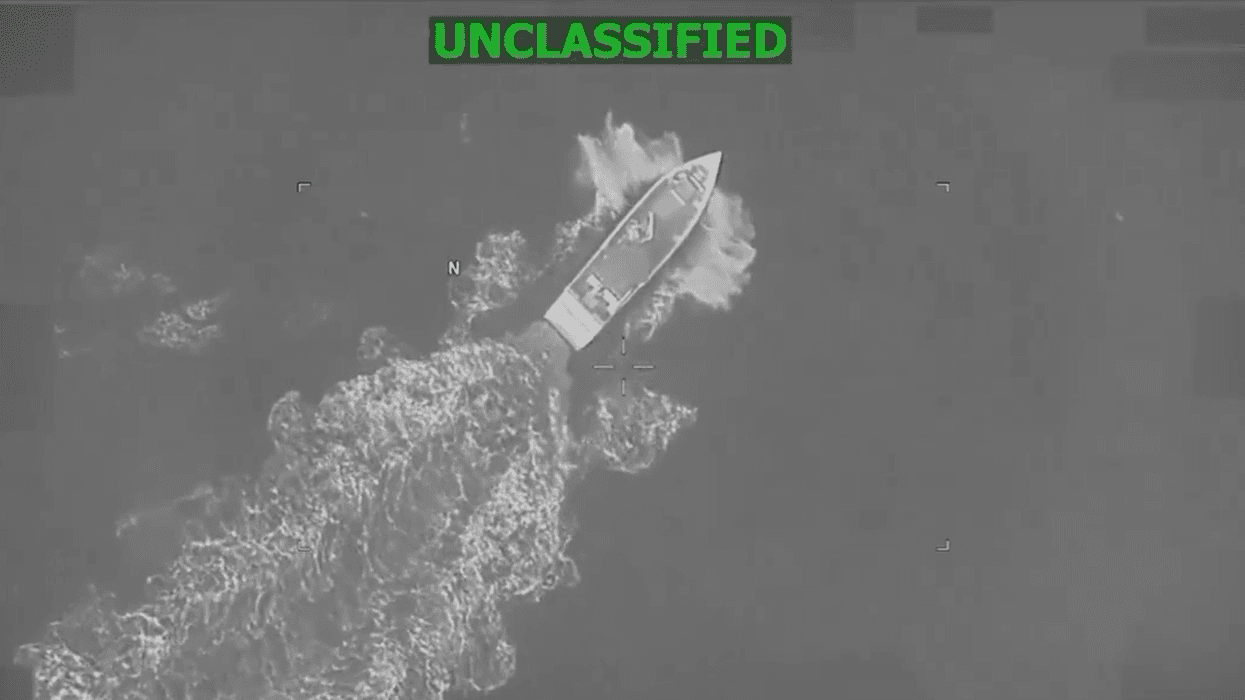
A leading human rights organization on Tuesday pushed allies of the United States to more forcefully condemn and take steps to stop President Donald Trump's deadly boat strikes in international waters, attacks that experts have characterized as extrajudicial killings.
"The UK, Canada, and other allied nations who partner with the United States on counternarcotics efforts have ample evidence that the US is unlawfully killing people at sea,” Sarah Yager, Washington director at Human Rights Watch (HRW), said in a statement. “The rules-based international order depends on countries speaking out against violations, even when they’re committed by powerful friends.”
HRW specifically urged countries at risk of complicity to closely examine their maritime cooperation and intelligence-sharing with the Trump administration, which claims—without evidence—that every vessel targeted was involved in drug smuggling operations that posed a threat to the US.
"The UK, France, and the Kingdom of the Netherlands have significant influence in the Caribbean due to their overseas territories in the region," the group said. "All three governments are also participants in Campaign Martillo, a multinational counternarcotics detection, monitoring, and interdiction operation that includes US Navy and Coast Guard vessels, along with military and law enforcement units from a dozen other nations, including Canada."
"Australia and New Zealand, which are part of the 'Five Eyes' intelligence sharing community with the United States, UK, and Canada where the governments share all signals and geospatial intelligence by default, may also find themselves implicated in the strikes and should take steps to evaluate their own risks," HRW added.
While officials from the nations named by HRW have criticized and distanced themselves from the Trump administration's strikes, their comments have largely been vague and tepid—especially when compared to the responses of some South American leaders. Australian Foreign Minister Penny Wong, for instance, said her country "is not involved in these US actions" and that "it is for the United States to articulate the legal basis of its actions."
HRW also pointed to Canadian Foreign Minister Anita Anand's statement that “the United States has made clear that it is using its own intelligence” to target the vessels in international waters.
"It is not sufficient to accept the US government’s assurances that it is not leveraging shared intelligence for its unlawful strikes," said HRW. "In contrast, when asked directly about the legality of the strikes, [Ahmed] declined to address the matter, saying instead that 'it is within the purview of US authorities to make that determination.'"
Last month, the UK reportedly suspended some intelligence sharing with the US due to the boat strikes. But US Secretary of State Marco Rubio called the CNN reporting a "fake story," and the UK's foreign secretary cited Rubio's comment when asked about the report.
HRW said major US allies "should make public any internal legal assessments as to whether the US strikes are violating international law, use their bilateral relationships to raise concerns directly with US officials, and push for individual criminal accountability for those responsible."
Keep ReadingShow Less
Israeli Raid on UNRWA Compound Slammed as 'Dangerous Precedent'
"This latest action represents a blatant disregard of Israel’s obligation as a United Nations member state to protect and respect the inviolability of UN premises," said UNRWA chief Philippe Lazzarini.
Dec 08, 2025
United Nations officials and others strongly condemned Monday's raid by Israeli authorities on a facility run by the UN's office for Palestinian refugees in occupied East Jerusalem—an act one rights group decried as part of an ongoing effort "to undermine and ultimately eliminate" the lifesaving agency.
Israeli police and other officials forcibly entered the UN Relief and Works Agency for Palestine Refugees in the Near East (UNRWA) compound early Monday, pulling down a UN flag on the facility's roof and replacing it with an Israeli one. Israeli officials said the raid was ordered over unpaid taxes.
"They call it 'debt collection'—we call it erasure," Claudia Webbe, a socialist former member of British Parliament, said on social media. "Over 70,000 dead in Gaza, they now seek to kill the memory of the living. The occupation must end."
Police vehicles including motorcycles, trucks, and forklifts entered the compound, while communications were cut and furniture, computer equipment, and other property were seized from the facility, according to UNRWA Commissioner-General Philippe Lazzarini.
"This latest action represents a blatant disregard of Israel’s obligation as a United Nations member state to protect and respect the inviolability of UN premises," Lazzarini said in a statement.
"To allow this represents a new challenge to international law, one that creates a dangerous precedent anywhere else the UN is present across the world," he added.
Secretary-General António Guterres was among the other senior UN officials who condemned Monday's raid.
“This compound remains United Nations premises and is inviolable and immune from any other form of interference,” he said.
“I urge Israel to immediately take all necessary steps to restore, preserve, and uphold the inviolability of UNRWA premises and to refrain from taking any further action with regard to UNRWA premises, in line with its obligations under the charter of the United Nations and its other obligations under international law," Guterres added.
In late 2024, Israeli lawmakers approved a ban on UNRWA in Israel over disproven allegations that some of its staffers were Hamas members who took part in the October 7, 2023 attack. Those accusations led to numerous nations suspending financial support for UNRWA, although most of the countries have since restored funding. Israel has also sought to ban UNRWA from Gaza since early 2024.
Israeli forces have killed more than 370 UNRWA staff members since October 2023 and destroyed or damaged over 300 of the agency's facilities in Gaza. Lazzarini and others have also accused Israeli forces of torturing UNRWA staffers in a bid to force false confessions of Hamas involvement.
In October, the International Court of Justice—which is currently weighing a genocide case against Israel—found that UNRWA has not been infiltrated by Hamas as claimed by Israeli leaders.
Others also condemned Monday's raid, including Human Rights Watch (HRW), which called the action part of an effort "to undermine and ultimately eliminate a United Nations agency providing vital services to millions of Palestinian refugees."
"Governments should condemn Israel's unlawful moves against UNRWA and urgently act to stop further abuses," HRW added.
Keep ReadingShow Less
Most Popular