SUBSCRIBE TO OUR FREE NEWSLETTER
Daily news & progressive opinion—funded by the people, not the corporations—delivered straight to your inbox.
5
#000000
#FFFFFF
To donate by check, phone, or other method, see our More Ways to Give page.
Daily news & progressive opinion—funded by the people, not the corporations—delivered straight to your inbox.
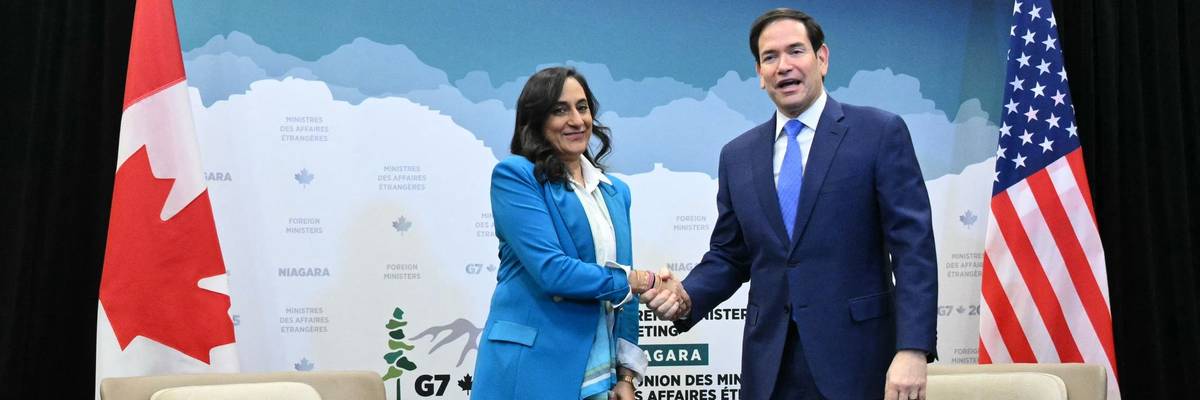
US Secretary of State Marco Rubio and Canadian Foreign Minister Anita Anand shake hands following talks at the G7 foreign ministers meeting on November 12, 2025.
"The UK, Canada, and other allied nations who partner with the United States on counternarcotics efforts have ample evidence that the US is unlawfully killing people at sea," said Human Rights Watch.
A leading human rights organization on Tuesday pushed allies of the United States to more forcefully condemn and take steps to stop President Donald Trump's deadly boat strikes in international waters, attacks that experts have characterized as extrajudicial killings.
"The UK, Canada, and other allied nations who partner with the United States on counternarcotics efforts have ample evidence that the US is unlawfully killing people at sea,” Sarah Yager, Washington director at Human Rights Watch (HRW), said in a statement. “The rules-based international order depends on countries speaking out against violations, even when they’re committed by powerful friends.”
HRW specifically urged countries at risk of complicity to closely examine their maritime cooperation and intelligence-sharing with the Trump administration, which claims—without evidence—that every vessel targeted was involved in drug smuggling operations that posed a threat to the US.
"The UK, France, and the Kingdom of the Netherlands have significant influence in the Caribbean due to their overseas territories in the region," the group said. "All three governments are also participants in Campaign Martillo, a multinational counternarcotics detection, monitoring, and interdiction operation that includes US Navy and Coast Guard vessels, along with military and law enforcement units from a dozen other nations, including Canada."
"Australia and New Zealand, which are part of the 'Five Eyes' intelligence sharing community with the United States, UK, and Canada where the governments share all signals and geospatial intelligence by default, may also find themselves implicated in the strikes and should take steps to evaluate their own risks," HRW added.
While officials from the nations named by HRW have criticized and distanced themselves from the Trump administration's strikes, their comments have largely been vague and tepid—especially when compared to the responses of some South American leaders. Australian Foreign Minister Penny Wong, for instance, said her country "is not involved in these US actions" and that "it is for the United States to articulate the legal basis of its actions."
HRW also pointed to Canadian Foreign Minister Anita Anand's statement that “the United States has made clear that it is using its own intelligence” to target the vessels in international waters.
"It is not sufficient to accept the US government’s assurances that it is not leveraging shared intelligence for its unlawful strikes," said HRW. "In contrast, when asked directly about the legality of the strikes, [Ahmed] declined to address the matter, saying instead that 'it is within the purview of US authorities to make that determination.'"
Last month, the UK reportedly suspended some intelligence sharing with the US due to the boat strikes. But US Secretary of State Marco Rubio called the CNN reporting a "fake story," and the UK's foreign secretary cited Rubio's comment when asked about the report.
HRW said major US allies "should make public any internal legal assessments as to whether the US strikes are violating international law, use their bilateral relationships to raise concerns directly with US officials, and push for individual criminal accountability for those responsible."
Dear Common Dreams reader, It’s been nearly 30 years since I co-founded Common Dreams with my late wife, Lina Newhouser. We had the radical notion that journalism should serve the public good, not corporate profits. It was clear to us from the outset what it would take to build such a project. No paid advertisements. No corporate sponsors. No millionaire publisher telling us what to think or do. Many people said we wouldn't last a year, but we proved those doubters wrong. Together with a tremendous team of journalists and dedicated staff, we built an independent media outlet free from the constraints of profits and corporate control. Our mission has always been simple: To inform. To inspire. To ignite change for the common good. Building Common Dreams was not easy. Our survival was never guaranteed. When you take on the most powerful forces—Wall Street greed, fossil fuel industry destruction, Big Tech lobbyists, and uber-rich oligarchs who have spent billions upon billions rigging the economy and democracy in their favor—the only bulwark you have is supporters who believe in your work. But here’s the urgent message from me today. It's never been this bad out there. And it's never been this hard to keep us going. At the very moment Common Dreams is most needed, the threats we face are intensifying. We need your support now more than ever. We don't accept corporate advertising and never will. We don't have a paywall because we don't think people should be blocked from critical news based on their ability to pay. Everything we do is funded by the donations of readers like you. When everyone does the little they can afford, we are strong. But if that support retreats or dries up, so do we. Will you donate now to make sure Common Dreams not only survives but thrives? —Craig Brown, Co-founder |
A leading human rights organization on Tuesday pushed allies of the United States to more forcefully condemn and take steps to stop President Donald Trump's deadly boat strikes in international waters, attacks that experts have characterized as extrajudicial killings.
"The UK, Canada, and other allied nations who partner with the United States on counternarcotics efforts have ample evidence that the US is unlawfully killing people at sea,” Sarah Yager, Washington director at Human Rights Watch (HRW), said in a statement. “The rules-based international order depends on countries speaking out against violations, even when they’re committed by powerful friends.”
HRW specifically urged countries at risk of complicity to closely examine their maritime cooperation and intelligence-sharing with the Trump administration, which claims—without evidence—that every vessel targeted was involved in drug smuggling operations that posed a threat to the US.
"The UK, France, and the Kingdom of the Netherlands have significant influence in the Caribbean due to their overseas territories in the region," the group said. "All three governments are also participants in Campaign Martillo, a multinational counternarcotics detection, monitoring, and interdiction operation that includes US Navy and Coast Guard vessels, along with military and law enforcement units from a dozen other nations, including Canada."
"Australia and New Zealand, which are part of the 'Five Eyes' intelligence sharing community with the United States, UK, and Canada where the governments share all signals and geospatial intelligence by default, may also find themselves implicated in the strikes and should take steps to evaluate their own risks," HRW added.
While officials from the nations named by HRW have criticized and distanced themselves from the Trump administration's strikes, their comments have largely been vague and tepid—especially when compared to the responses of some South American leaders. Australian Foreign Minister Penny Wong, for instance, said her country "is not involved in these US actions" and that "it is for the United States to articulate the legal basis of its actions."
HRW also pointed to Canadian Foreign Minister Anita Anand's statement that “the United States has made clear that it is using its own intelligence” to target the vessels in international waters.
"It is not sufficient to accept the US government’s assurances that it is not leveraging shared intelligence for its unlawful strikes," said HRW. "In contrast, when asked directly about the legality of the strikes, [Ahmed] declined to address the matter, saying instead that 'it is within the purview of US authorities to make that determination.'"
Last month, the UK reportedly suspended some intelligence sharing with the US due to the boat strikes. But US Secretary of State Marco Rubio called the CNN reporting a "fake story," and the UK's foreign secretary cited Rubio's comment when asked about the report.
HRW said major US allies "should make public any internal legal assessments as to whether the US strikes are violating international law, use their bilateral relationships to raise concerns directly with US officials, and push for individual criminal accountability for those responsible."
A leading human rights organization on Tuesday pushed allies of the United States to more forcefully condemn and take steps to stop President Donald Trump's deadly boat strikes in international waters, attacks that experts have characterized as extrajudicial killings.
"The UK, Canada, and other allied nations who partner with the United States on counternarcotics efforts have ample evidence that the US is unlawfully killing people at sea,” Sarah Yager, Washington director at Human Rights Watch (HRW), said in a statement. “The rules-based international order depends on countries speaking out against violations, even when they’re committed by powerful friends.”
HRW specifically urged countries at risk of complicity to closely examine their maritime cooperation and intelligence-sharing with the Trump administration, which claims—without evidence—that every vessel targeted was involved in drug smuggling operations that posed a threat to the US.
"The UK, France, and the Kingdom of the Netherlands have significant influence in the Caribbean due to their overseas territories in the region," the group said. "All three governments are also participants in Campaign Martillo, a multinational counternarcotics detection, monitoring, and interdiction operation that includes US Navy and Coast Guard vessels, along with military and law enforcement units from a dozen other nations, including Canada."
"Australia and New Zealand, which are part of the 'Five Eyes' intelligence sharing community with the United States, UK, and Canada where the governments share all signals and geospatial intelligence by default, may also find themselves implicated in the strikes and should take steps to evaluate their own risks," HRW added.
While officials from the nations named by HRW have criticized and distanced themselves from the Trump administration's strikes, their comments have largely been vague and tepid—especially when compared to the responses of some South American leaders. Australian Foreign Minister Penny Wong, for instance, said her country "is not involved in these US actions" and that "it is for the United States to articulate the legal basis of its actions."
HRW also pointed to Canadian Foreign Minister Anita Anand's statement that “the United States has made clear that it is using its own intelligence” to target the vessels in international waters.
"It is not sufficient to accept the US government’s assurances that it is not leveraging shared intelligence for its unlawful strikes," said HRW. "In contrast, when asked directly about the legality of the strikes, [Ahmed] declined to address the matter, saying instead that 'it is within the purview of US authorities to make that determination.'"
Last month, the UK reportedly suspended some intelligence sharing with the US due to the boat strikes. But US Secretary of State Marco Rubio called the CNN reporting a "fake story," and the UK's foreign secretary cited Rubio's comment when asked about the report.
HRW said major US allies "should make public any internal legal assessments as to whether the US strikes are violating international law, use their bilateral relationships to raise concerns directly with US officials, and push for individual criminal accountability for those responsible."