SUBSCRIBE TO OUR FREE NEWSLETTER
Daily news & progressive opinion—funded by the people, not the corporations—delivered straight to your inbox.
5
#000000
#FFFFFF
To donate by check, phone, or other method, see our More Ways to Give page.
Daily news & progressive opinion—funded by the people, not the corporations—delivered straight to your inbox.
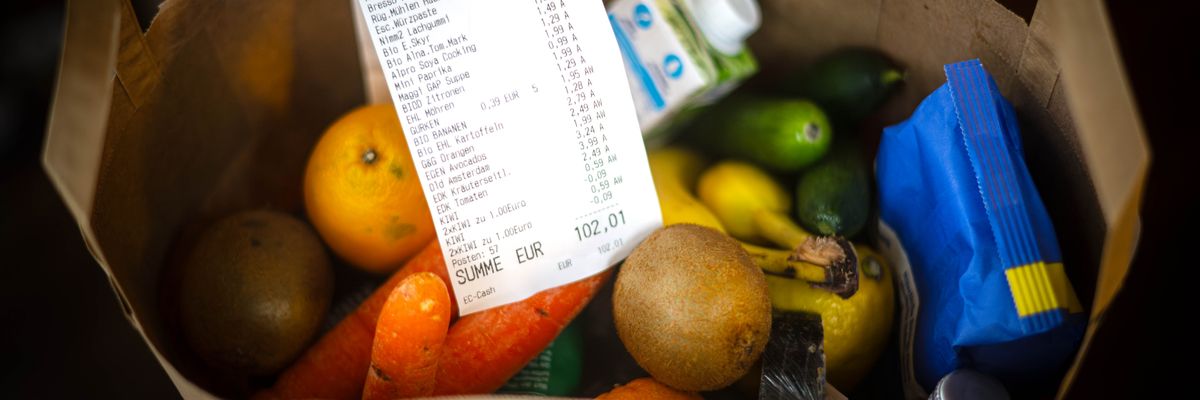
A receipt lies on top of the groceries in a shopping bag in Bremen, Germany on November 27, 2023.
The word, said one advocate, "rightly identifies who is responsible for this inflation crisis and opens up the range of policy solutions we have at our disposal to fight high prices and deliver relief for families."
Several of the 1,700 new or updated definitions Dictionary.com added to its online catalogue of terms on Thursday were inspired by recent news events.
"Climate breakdown" was identified by the website as "the collective effects of harmful and potentially irreversible trends in climate, specifically those resulting from unchecked global warming," while "energy poverty" is "a lack of adequate access to safe, affordable sources of electricity or fuel for warmth, light, cooking, etc."
Another, "greedflation," was informed by growing evidence that has shown in recent years how rising prices are not always the result of supply chain woes or other market pressures, but can be "caused by corporate executives or boards of directors, property owners, etc., solely to increase profits that are already healthy or excessive."
The dictionary's addition of the word, said economic justice think tank Groundwork Collaborative, solidifies "its place in how we understand" recent inflation.
As Common Dreams reported last month, a Groundwork analysis showed that corporate CEOs have "openly" bragged to their shareholders that they can continue raising prices to increase profits, even as the cost of doing business goes down.
According to the group, corporate profits were what drove 53% of price increases in the second and third quarters of 2023. Business costs rose just 1% in 2023—and went down in some sectors due to drops in transportation, warehousing, and fuel costs—but consumers saw the price of goods go up by 3.4% in the same time period.
Recent polling—and Dictionary.com's word addition—shows a growing understanding of greedflation among the public.
A Navigator Research survey showed on Wednesday that 4 in 5 people believe inflation is being caused by corporations raising prices, and 3 in 5 say greedflation is a "major" cause.
"So many people recognize that corporations are keeping prices artificially high that 'greedflation' is now a word on dictionary.com," said Lindsay Owens, executive director of Groundwork. "Greedflation rightly identifies who is responsible for this inflation crisis and opens up the range of policy solutions we have at our disposal to fight high prices and deliver relief for families."
Dear Common Dreams reader, It’s been nearly 30 years since I co-founded Common Dreams with my late wife, Lina Newhouser. We had the radical notion that journalism should serve the public good, not corporate profits. It was clear to us from the outset what it would take to build such a project. No paid advertisements. No corporate sponsors. No millionaire publisher telling us what to think or do. Many people said we wouldn't last a year, but we proved those doubters wrong. Together with a tremendous team of journalists and dedicated staff, we built an independent media outlet free from the constraints of profits and corporate control. Our mission has always been simple: To inform. To inspire. To ignite change for the common good. Building Common Dreams was not easy. Our survival was never guaranteed. When you take on the most powerful forces—Wall Street greed, fossil fuel industry destruction, Big Tech lobbyists, and uber-rich oligarchs who have spent billions upon billions rigging the economy and democracy in their favor—the only bulwark you have is supporters who believe in your work. But here’s the urgent message from me today. It's never been this bad out there. And it's never been this hard to keep us going. At the very moment Common Dreams is most needed, the threats we face are intensifying. We need your support now more than ever. We don't accept corporate advertising and never will. We don't have a paywall because we don't think people should be blocked from critical news based on their ability to pay. Everything we do is funded by the donations of readers like you. When everyone does the little they can afford, we are strong. But if that support retreats or dries up, so do we. Will you donate now to make sure Common Dreams not only survives but thrives? —Craig Brown, Co-founder |
Several of the 1,700 new or updated definitions Dictionary.com added to its online catalogue of terms on Thursday were inspired by recent news events.
"Climate breakdown" was identified by the website as "the collective effects of harmful and potentially irreversible trends in climate, specifically those resulting from unchecked global warming," while "energy poverty" is "a lack of adequate access to safe, affordable sources of electricity or fuel for warmth, light, cooking, etc."
Another, "greedflation," was informed by growing evidence that has shown in recent years how rising prices are not always the result of supply chain woes or other market pressures, but can be "caused by corporate executives or boards of directors, property owners, etc., solely to increase profits that are already healthy or excessive."
The dictionary's addition of the word, said economic justice think tank Groundwork Collaborative, solidifies "its place in how we understand" recent inflation.
As Common Dreams reported last month, a Groundwork analysis showed that corporate CEOs have "openly" bragged to their shareholders that they can continue raising prices to increase profits, even as the cost of doing business goes down.
According to the group, corporate profits were what drove 53% of price increases in the second and third quarters of 2023. Business costs rose just 1% in 2023—and went down in some sectors due to drops in transportation, warehousing, and fuel costs—but consumers saw the price of goods go up by 3.4% in the same time period.
Recent polling—and Dictionary.com's word addition—shows a growing understanding of greedflation among the public.
A Navigator Research survey showed on Wednesday that 4 in 5 people believe inflation is being caused by corporations raising prices, and 3 in 5 say greedflation is a "major" cause.
"So many people recognize that corporations are keeping prices artificially high that 'greedflation' is now a word on dictionary.com," said Lindsay Owens, executive director of Groundwork. "Greedflation rightly identifies who is responsible for this inflation crisis and opens up the range of policy solutions we have at our disposal to fight high prices and deliver relief for families."
Several of the 1,700 new or updated definitions Dictionary.com added to its online catalogue of terms on Thursday were inspired by recent news events.
"Climate breakdown" was identified by the website as "the collective effects of harmful and potentially irreversible trends in climate, specifically those resulting from unchecked global warming," while "energy poverty" is "a lack of adequate access to safe, affordable sources of electricity or fuel for warmth, light, cooking, etc."
Another, "greedflation," was informed by growing evidence that has shown in recent years how rising prices are not always the result of supply chain woes or other market pressures, but can be "caused by corporate executives or boards of directors, property owners, etc., solely to increase profits that are already healthy or excessive."
The dictionary's addition of the word, said economic justice think tank Groundwork Collaborative, solidifies "its place in how we understand" recent inflation.
As Common Dreams reported last month, a Groundwork analysis showed that corporate CEOs have "openly" bragged to their shareholders that they can continue raising prices to increase profits, even as the cost of doing business goes down.
According to the group, corporate profits were what drove 53% of price increases in the second and third quarters of 2023. Business costs rose just 1% in 2023—and went down in some sectors due to drops in transportation, warehousing, and fuel costs—but consumers saw the price of goods go up by 3.4% in the same time period.
Recent polling—and Dictionary.com's word addition—shows a growing understanding of greedflation among the public.
A Navigator Research survey showed on Wednesday that 4 in 5 people believe inflation is being caused by corporations raising prices, and 3 in 5 say greedflation is a "major" cause.
"So many people recognize that corporations are keeping prices artificially high that 'greedflation' is now a word on dictionary.com," said Lindsay Owens, executive director of Groundwork. "Greedflation rightly identifies who is responsible for this inflation crisis and opens up the range of policy solutions we have at our disposal to fight high prices and deliver relief for families."