March, 25 2009, 02:15pm EDT
For Immediate Release
Contact:
David Moryc, 503-307-1137
Caitlin Jennings, 202-347-7550 ext. 3100
Historic Wild and Scenic River Bill Heads to President's Desk
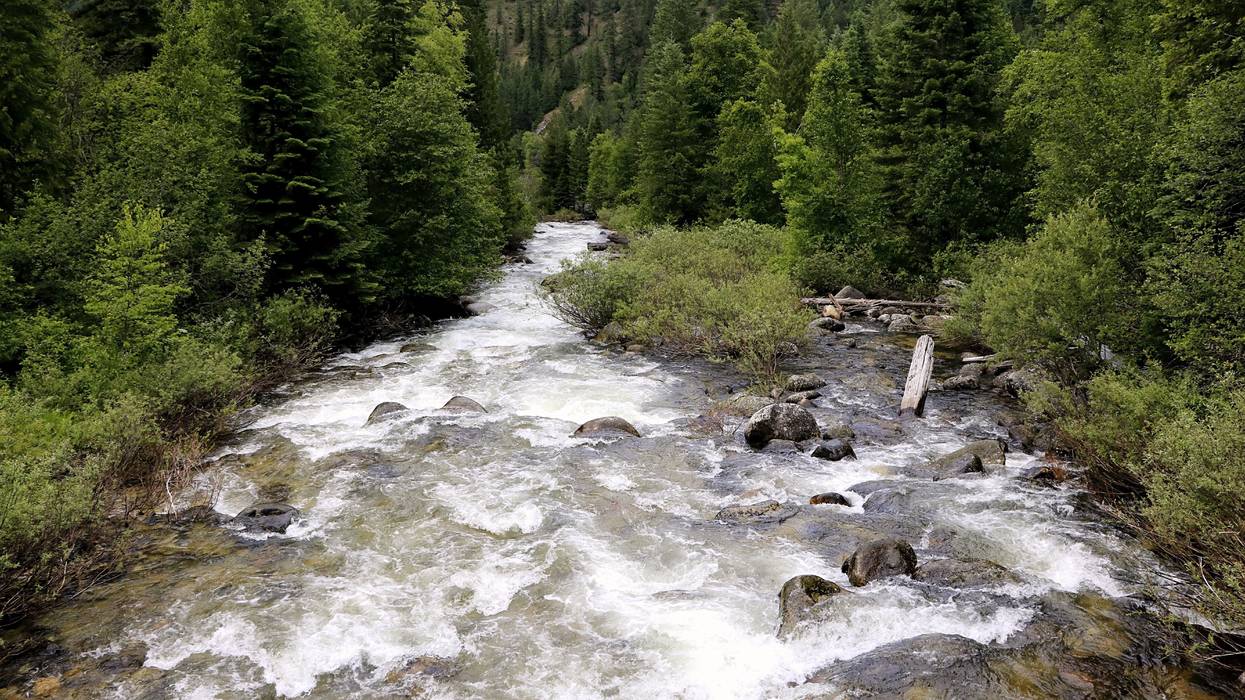
The second largest Wild and Scenic Rivers package in history now heads to President Obama's desk, after passing the House of Representatives today by a vote of 285-140. The bipartisan H.R. 146, the legislative vehicle for the Omnibus Public Land Management Act of 2009, will safeguard over 1,100 miles of rivers in Oregon, Idaho, Arizona, Wyoming, Utah, California, and Massachusetts. The legislation includes important protections for 350,000 acres of land along 86 new Wild and Scenic Rivers and it also contains new Wilderness designations for over two million acres of public land.
WASHINGTON
The second largest Wild and Scenic Rivers package in history now heads to President Obama's desk, after passing the House of Representatives today by a vote of 285-140. The bipartisan H.R. 146, the legislative vehicle for the Omnibus Public Land Management Act of 2009, will safeguard over 1,100 miles of rivers in Oregon, Idaho, Arizona, Wyoming, Utah, California, and Massachusetts. The legislation includes important protections for 350,000 acres of land along 86 new Wild and Scenic Rivers and it also contains new Wilderness designations for over two million acres of public land. Last week the bill passed the Senate by a vote of 77-20.
"Passage of this bill is an expression of the home grown support for one of the largest environmental protection measures in decades," said Rebecca Wodder, President of American Rivers. "Today congressional leaders established a legacy of clean water, outdoor recreation and the economic benefits of healthy rivers and wild places for our grandchildren."
American Rivers is extremely grateful to Senate Majority Leader Harry Reid, House Speaker Nancy Pelosi, House Majority Leader Steny Hoyer, Chairman Jeff Bingaman, Chairman Nick Rahall, and all the sponsors of the Wild and Scenic Rivers provisions. Without their determination to see this legislation through we could not have protected these national treasures for future generations of Americans.
A Wild and Scenic River designation protects riverside land along both sides of a river corridor, blocks dams and other harmful water projects, and preserves a river's free-flowing nature. It helps protect and improve clean water, as well as the river's unique historic, cultural, scenic, ecological, and recreational values.
The law was enacted in 1968 and three years ago American Rivers set the goal of designating 40 new Wild and Scenic Rivers by the 40th anniversary of the law. With passage of this package we more than double our goal by designating 86 new Wild and Scenic Rivers.
"From the Snake River headwaters in Wyoming to the desert Southwest's Fossil Creek, to the trout streams of the Rockies, and the popular fishing and paddling streams of the Pacific Northwest, local people--hikers, boaters, hunters and anglers--pushed for these historic protections," said Wodder. "These rivers are the lifeblood of the land and our communities and the Wild and Scenic River designations are a tremendous gift to future generations."
The details of the new Wild and Scenic designations can be found below:
Arizona
Area: Fossil Creek
Designated River Miles: 16.8
Rivers: Portions of Fossil Creek
Sponsored by: Sen. John McCain
California
Area: Eastern Sierra and Northern San Gabriel Wilderness
Designated River Miles: 66.9
Rivers: Portions of Amargosa River, Owens River Headwaters, and Cottenwood Creek.
Sponsored by: Sen. Barbara Boxer, Sen. Dianne Feinstein and Rep. Howard McKeon
Area: California Desert and Mountain Heritage
Designated River Miles: 31
Rivers: Portions of North Fork San Jacinto, Fuller Mill Creek, Palm Canyon Creek, and Bautista Creek.
Sponsored by: Rep. Mary Bono-Mack and Sen. Barbara Boxer, Sen. Dianne Feinstein
Idaho
Area: Owyhee Public Land Management
Designated River Miles: 316.3
Rivers: Portions of Battle Creek, Big Jacks Creek, Bruneau River, West Fork Bruneau, Cottonwood Creek, Deep Creek, Dickshooter Creek, Duncan Creek, Jarbidge River, Little Jacks Creek, North Fork Owyhee River, Owyhee River, Red Canyon, Sheep Creek, South Fork Owyhee, and Wickahoney Creek.
Sponsored by: Sen. Mike Crapo
Massachusetts
Area: Taunton River
Designated River Miles: 40
Rivers: Portions of the Taunton River.
Sponsored by: Rep. Barney Frank and Sen. Ted Kennedy
Oregon
Area: Mt. Hood Wilderness
Designated River Miles: 81
Rivers: Portions of South Fork Clackamas, Eagle Creek, Middle Fork Hood River, South Fork Roaring River, Zig Zag River, Fifteenmile Creek, East Fork Hood River, Collawash, and Fish Creek.
Sponsored by: Rep. Earl Blumenauer, Sen. Ron Wyden and Rep. Greg Walden
Area: Copper Salmon Wilderness
Designated River Miles: 11.2
Rivers: Portions of the North Fork Elk and South Fork Elk.
Sponsored by: Rep. Peter DeFazio and Sen. Ron Wyden
Utah
Area: Zion National Park Wild and Scenic Rivers
Designated River Miles: 165
Rivers: Portions of Taylor Creek, North Fork of Taylor Creek, Middle Fork Taylor Creek, South Fork of Taylor Creek, Timber creek and tributaries, Laverkin Creek, Willis Creek, Beartrap Canyon, Hop Valley, Current Creek, Cane Creek, Smith Creek, North Creek, Wildcat Canyon, Little Creek, Russell Gulch, Grapevine Wash, Pinespring Wash, Wolf Springs Wash, Kolok Creek, Oak Creek, Goose Creek, Deep Creek, North Fork of Virgin River, Imlay Canyon, Orderville Canyon, Mystery Canyon, Echo Canyon, Behunin Canyon, Heaps Canyon, Burch Creek, Clear Creek, Pine Creek, East Fork of Virgin River, and Shunes Creek.
Sponsored by: Sen. Robert Bennett
Vermont
Area: Missisquoi and Trout Rivers Study
Rivers: Portions of the Missisqoui and Trout rivers will be studied for Wild and Scenic eligibility.
Sponsored by: Rep. Peter Welch and Sen. Patrick Leahy
Wyoming
Area: Snake River Headwaters
Designated River Miles: 387.5
Rivers: Portions of Bailey Creek, Blackrock Creek, Buffalo Fork of Snake River, Crystal Creek, Granite Creek, Gros Ventre River, Hoback River, Lewis, Pacific Creek, Shoal Creek, Snake River, Willow Creek, and Wolf Creek.
Sponsored by: Sen. John Barrasso
American Rivers is the only national organization standing up for healthy rivers so our communities can thrive. Through national advocacy, innovative solutions and our growing network of strategic partners, we protect and promote our rivers as valuable assets that are vital to our health, safety and quality of life. Founded in 1973, American Rivers has more than 65,000 members and supporters nationwide, with offices in Washington, DC and the Mid-Atlantic, Northeast, Midwest, Southeast, California and Northwest regions.
LATEST NEWS
ICE Goons Pepper Spray Congresswoman Adelita Grijalva During Tucson Raid
"If federal agents are brazen enough to fire pellets directly at a member of Congress, imagine how they behave when encountering defenseless members of our community," Grijalva said.
Dec 05, 2025
In what Arizona's attorney general slammed as an "unacceptable and outrageous" act of "unchecked aggression," a federal immigration officer fired pepper spray toward recently sworn-in Congresswoman Adelita Grijalva during a Friday raid on a Tucson restaurant.
Grijalva (D-Ariz.) wrote on social media that US Immigration and Customs Enforcement (ICE) officers "just conducted a raid by Taco Giro in Tucson—a small mom-and-pop restaurant that has served our community for years."
"When I presented myself as a member of Congress asking for more information, I was pushed aside and pepper sprayed," she added.
Grijalva said in a video uploaded to the post that she was "sprayed in the face by a very aggressive agent, pushed around by others, when I literally was not being aggressive, I was asking for clarification, which is my right as a member of Congress."
The video shows Grijalva among a group of protesters who verbally confronted federal agents over the raid. Following an order to "clear," an agent is seen firing what appears to be a pepper ball at the ground very near the congresswoman's feet. Video footage also shows agents deploying gas against the crowd.
"They're targeting small mom-and-pop businesses that don't have the financial resources to fight back," Grijalva told reporters after the incident. "They're targeting small businesses and people that are helping in our communities in order to try to fill the quota that [President Donald] Trump has given them."
Mocking the incident on social media, Department of Homeland Security spokesperson Tricia McLaughlin contended that Grijalva "wasn’t pepper sprayed."
"She was in the vicinity of someone who *was* pepper sprayed as they were obstructing and assaulting law enforcement," she added. "In fact, two law enforcement officers were seriously injured by this mob that [Grijalva] joined."
McLaughlin provided no further details regarding the nature of those injuries.
Democrats in Arizona and beyond condemned Friday's incident, with US Sen. Ruben Gallego writing on social media that Grijalva "was doing her job, standing up for her community."
"Pepper spraying a sitting member of Congress is disgraceful, unacceptable, and absolutely not what we voted for," he added. "Period."
Democratic Arizona Attorney General Kris Mayes said on social media: "This is unacceptable and outrageous. Enforcing the rule of law does not mean pepper spraying a member of Congress for simply asking questions. Effective law enforcement requires restraint and accountability, not unchecked aggression."
Congresswoman Pramila Jayapal (D-Wash.) also weighed in on social media, calling the incident "outrageous."
"Rep. Grijalva was completely within her rights to stand up for her constituents," she added. "ICE is completely lawless."
Friday's incident follows federal agents' violent removal of Sen. Alexa Padilla (D-Calif.) from a June press conference held by Homeland Security Secretary Kristi Noem.
Congresswoman LaMonica McIver (D-NJ) was federally indicted in June for allegedly “forcibly impeding and interfering with federal officers" during an oversight visit at a privately operated migrant detention center in Newark, New Jersey and subsequent confrontation with ICE agents outside of the lockup in which US Reps. Bonnie Watson Coleman and Rob Menendez, both New Jersey Democrats, were also involved.
Violent assaults by federal agents on suspected undocumented immigrants—including US citizens—protesters, journalists, and others are a regular occurrence amid the Trump administration's mass deportation campaign.
"If federal agents are brazen enough to fire pellets directly at a member of Congress, imagine how they behave when encountering defenseless members of our community," Grijalva said late Friday on social media. "It’s time for Congress to rein in this rogue agency NOW."
Keep ReadingShow Less
Gavin Newsom Wants a 'Big Tent Party,' But Opposes Wealth Tax Supported by Large Majority of Americans
"A wealth tax is a big tent policy unless the only people you care about are billionaires," said one progressive organizer.
Dec 05, 2025
California Gov. Gavin Newsom, considered by some to be the frontrunner to be the next Democratic presidential nominee, said during a panel on Wednesday that he wants his party to be a “big tent” that welcomes large numbers of people into the fold. But he’s “adamantly against” one of the most popular proposals Democrats have to offer: a wealth tax.
In October, progressive economists Emmanuel Saez and Robert Reich joined forces with one of California's most powerful unions, the Service Employees International Union's (SEIU) United Healthcare Workers West, to propose that California put the nation’s first-ever wealth tax on the ballot in November 2026.
They described the measure as an "emergency billionaires tax" aimed at recouping the tens of billions of dollars that will be stripped from California's 15 million Medicaid recipients over the next five years, after Republicans enacted historic cuts to the program in July with President Donald Trump's One Big Beautiful Bill Act, which dramatically reduced taxes for the wealthiest Americans.
Among those beneficiaries were the approximately 200 billionaires living in California, whose average annual income, Saez pointed out, has risen by 7.5% per year, compared with 1.5% for median-income residents.
Under the proposal, they would pay a one-time 5% tax on their total net worth, which is estimated to raise $100 billion. The vast majority of the funds, about 90%, would be used to restore Medicaid funding, while the rest would go towards funding K-12 education, which the GOP has also slashed.
The proposal in California has strong support from unions and healthcare groups. But Newsom has called it “bad policy” and “another attempt to grab money for special purposes.”
Meanwhile, several of his longtime consultants, including Dan Newman and Brian Brokaw, have launched a campaign alongside “business and tech leaders” to kill the measure, which they’ve dubbed “Stop the Squeeze." They've issued familiar warnings that pinching the wealthy too hard will drive them from the state, along with the critical tax base they provide.
At Wednesday's New York Times DealBook Summit, Andrew Ross Sorkin asked Newsom about his opposition to the wealth tax idea, comparing it to a proposal by recent New York City Mayor-elect Zohran Mamdani, who pledged to increase the income taxes of New Yorkers who earn more than $1 million per year by 2% in order to fund his city-wide free buses, universal childcare, and city-owned grocery store programs.
Mamdani's proposal was met with a litany of similar warnings from Big Apple bigwigs who threatened to flee the city and others around the country who said they'd never move in.
But as Robin Kaiser-Schatzlein explained in October for the American Prospect: "The evidence for this is thin: mostly memes shared by tech and finance people... Research shows that the truth of the matter is closer to the opposite. Wealthy individuals and their income move at lower rates than other income brackets, even in response to an increase of personal income tax." Many of those who sulked about Mamdani's victory have notably begun making amends with the incoming mayor.
Moreover, the comparison between Mamdani's plan and the one proposed in California is faulty to begin with. As Harold Meyerson explained, also for the Prospect: "It is a one-time-only tax, to be levied exclusively on billionaires’ current (i.e., 2025) net worth. Even if they move to Tasmania, they will still be liable for 5% of this year’s net worth."
"Crucially, the tax won’t crimp the fortunes of any billionaire who moves into the state next year or any later year, as it only applies to the billionaires living in the state this year," he added. "Therefore... the horrific specter of billionaire flight can’t be levied against the California proposal."
Nevertheless, Sorkin framed Newsom as being in an existential battle of ideas with Mamdani, asking how the two could both represent the Democratic Party when they are so "diametrically opposed."
"Well, I want to be a big-tent party," Newsom replied. "It's about addition, not subtraction."
Pushed on the question of whether there should be a "unifying theory of the case," Newsom responded that “we all want to be protected, we all want to be respected, we all want to be connected to something bigger than ourselves. We have fundamental values that I think define our party, about social justice, economic justice.”
"We have pre-distribution Democrats, and we have re-distribution Democrats," he continued. "Therein lies the dialectic and therein lies the debate."
Polling is scarce so far on the likelihood of such a measure passing in California. But nationally, polls suggest that the vast majority of Democrats fall on the "re-distribution" side of Newsom's "dialectic." In fact, the majority of all Americans do, regardless of party affiliation.
Last year, Inequality.org examined 55 national and state polls about a number of different taxation policies and found:
A billionaire income tax garnered the most support across party identification. On average, two out of three (67%) of Americans supported the tax including 84% of Democrats, 64% of Independents, and 51% of Republicans.
In national polls, a wealth tax had similarly high levels of support. More than three out of five Americans supported the tax including 78% of Democrats, 62% of Independents, and 51% of Republicans.
That sentiment only seems to have grown since the return of President Donald Trump. An Economist/YouGov poll released in early November found that 72% of Americans said that taxes on billionaires should be raised—including 95% of Democrats, 75% of independents, and 48% of Republicans. Across the board, just 15% said they should not be raised.
Support remains high when the proposal is more specific as well. On the eve of Mamdani's election, despitre months of fearmongering, 64% of New Yorkers said they backed his proposal, including a slight plurality of self-identified conservatives, according to a Siena College poll.
Many observers were perplexed by how Newsom proposes to maintain a “big tent” while opposing policies supported by most of the people inside it.
"A wealth tax is a big tent policy unless the only people you care about are billionaires," wrote Jonathan Cohn, the political director for Progressive Mass, a grassroots organization in Massachusetts, on social media.
"Gavin Newsom—estimated net worth between $20 and $30 million—says he's opposed to a billionaire wealth tax. Color me shocked," wrote the Columbia University lecturer Anthony Zenkus. "Democrats holding him up as a potential savior for 2028 is a clear example of not reading the room."
Keep ReadingShow Less
Supreme Court Agrees to Hear Case That Could Bless Trump's Bid to End Birthright Citizenship
"That the Supreme Court is actually entertaining Trump’s unconstitutional attack on birthright citizenship is the clearest example yet that the Roberts Court is broken beyond repair," said one critic.
Dec 05, 2025
The United States Supreme Court on Friday agreed to decide whether US President Donald Trump's executive order ending birthright citizenship—as guaranteed under the 14th Amendment for more than 150 years—is constitutional.
Next spring, the justices will hear oral arguments in Trump's appeal of a lower court ruling that struck down parts of an executive order—titled Protecting the Meaning and Value of American Citizenship—signed on the first day of the president's second term. Under the directive, which has not taken effect due to legal challenges, people born in the United States would not be automatically entitled to US citizenship if their parents are in the country temporarily or without legal authorization.
Enacted in 1868, the 14th Amendment affirms that "all persons born or naturalized in the United States, and subject to the jurisdiction thereof, are citizens of the United States and of the state wherein they reside."
While the Trump administration argues that the 14th Amendment was adopted to grant US citizenship to freed slaves, not travelers or undocumented immigrants, two key Supreme Court cases have affirmed birthright citizenship under the Constitution—United States v. Wong Kim Ark (1898) and Afroyim v. Rusk (1967).
Here is the question presented. It's a relatively clean vehicle for the Supreme Court to finally decide whether it is lawful for the president to deny birthright citizenship to the children of immigrants. www.supremecourt.gov/DocketPDF/25...
[image or embed]
— Mark Joseph Stern (@mjsdc.bsky.social) December 5, 2025 at 10:55 AM
Several district court judges have issued universal preliminary injunctions to block Trump's order. However, the Supreme Court's right-wing supermajority found in June that “universal injunctions likely exceed the equitable authority that Congress has given to federal courts."
In July, a three-judge panel of the US Court of Appeals for the 9th Circuit unanimously ruled that executive order is an unconstitutional violation of the plain language of the 14th Amendment. In total, four federal courts and two appellate courts have blocked Trump's order.
“No president can change the 14th Amendment’s fundamental promise of citizenship,” Cecillia Wang, national legal director at the ACLU—which is leading the nationwide class action challenge to Trump's order—said in a statement Friday. “We look forward to putting this issue to rest once and for all in the Supreme Court this term.”
Brett Edkins, managing director of policy and political affairs at the advocacy group Stand Up America, was among those who suggested that the high court justices should have refused to hear the case given the long-settled precedent regarding the 14th Amendment.
“This case is a right-wing fantasy, full stop. That the Supreme Court is actually entertaining Trump’s unconstitutional attack on birthright citizenship is the clearest example yet that the Roberts Court is broken beyond repair," Edkins continued, referring to Chief Justice John Roberts.
"Even if the court ultimately rules against Trump, in a laughable display of its supposed independence, the fact that fringe attacks on our most basic rights as citizens are being seriously considered is outrageous and alarming," he added.
Aarti Kohli, executive director of the Asian Law Caucus, said that “it’s deeply troubling that we must waste precious judicial resources relitigating what has been settled constitutional law for over a century," adding that "every federal judge who has considered this executive order has found it unconstitutional."
Tianna Mays, legal director for Democracy Defenders Fund, asserted, “The attack on the fundamental right of birthright citizenship is an attack on the 14th Amendment and our Constitution."
"We are confident the court will affirm this basic right, which has stood for over a century," Mays added. "Millions of families across the country deserve and require that clarity and stability.”
Keep ReadingShow Less
Most Popular