SUBSCRIBE TO OUR FREE NEWSLETTER
Daily news & progressive opinion—funded by the people, not the corporations—delivered straight to your inbox.
5
#000000
#FFFFFF
To donate by check, phone, or other method, see our More Ways to Give page.



Daily news & progressive opinion—funded by the people, not the corporations—delivered straight to your inbox.
Update (8:56 pm EST):
Sen. Bernie Sanders on Tuesday night withdrew a Senate resolution to end U.S. involvement in the Saudi-led war on Yemen, but vowed to work with the Biden administration and congressional colleagues to keep trying.
"Today, I withdrew from consideration by the U.S. Senate my War Powers Resolution after the Biden administration agreed to continue working with my office on ending the war in Yemen," Sanders said in a statement.
"Let me be clear," Sanders continued: "If we do not reach agreement, I will, along with my colleagues, bring this resolution back for a vote in the near future and do everything possible to end this horrific conflict."
Earlier:
Anticipating an evening Senate vote on a resolution that, if passed, would block American support for the Saudi-led war in Yemen, human rights defenders on Tuesday implored lawmakers to approve the measure and end what they call the United States' unconstitutional participation in the conflict.
"Members of Congress can't afford to punt on this any longer, and grassroots activists won't let them."
"For over seven years, Americans have been providing military support and weapons for Saudi Arabia that the dictatorship has used against civilians in Yemen. Article I of the Constitution says Congress--and not the president--has the power to declare war," wrote progressive activist Isaac Evans-Frantz, a co-leader of a national coalition against the war, in VTDigger Tuesday. "The 1973 War Powers Act further asserts Congress' role."
In July, Sen. Bernie Sanders (I-Vt.), along with Sens. Patrick Leahy (D-Vt.) and Elizabeth Warren (D-Mass.), introduced a Senate war powers resolution (WPR) after a similar measure was put forth in the House by Reps. Peter DeFazio (D-Ore.), Pramila Jayapal (D-Wash.), Nancy Mace (R-S.C.), and Adam Schiff (D-Calif.) the previous month. A procedural vote on the Senate resolution is scheduled for Tuesday at approximately 7:00 pm local time.
"We applaud Sen. Sanders' move to hold a vote on this critical resolution, and encourage all senators to vote in support of the WPR," Cavan Kharrazian, the foreign policy adviser at the advocacy group Demand Progress, said in a statement Tuesday.
Kharrazian noted that President Joe Biden "has said he is looking to work with Congress to hold Saudi Arabia accountable for siding with [Russian President Vladimir] Putin in the war on Ukraine and its oil price hike for the United States."
"The Yemen WPR provides the last clear opportunity for Biden to hold Saudi Arabia accountable on these fronts, and is a direct, measured congressional response to Saudi Arabia and Mohammed bin Salman for their human rights violations, including the murder of journalist Jamal Khashoggi," he added.
The White House, however, is reportedly urging senators to vote down the resolution.
The Saudi-led intervention in support of the Yemeni government against Houthi rebels began several months after civil war broke out in the country in late 2014. According to United Nations humanitarian officials, nearly 400,000 people have died since then, and a Saudi blockade has exacerbated starvation and disease in the country of 30 million people--more than 23 million of whom required assistance in 2022.
Despite a promise to make Saudi Arabia a "pariah" due to its abysmal human rights record, an initial freeze on U.S. arms sales, and a pledge to end "offensive" support for the war, the administration of President Joe Biden--who infamously fist-bumped Saudi Crown Prince Mohammed bin Salman during a July visit--continues to back the war while also selling the repressive kingdom billions of dollars worth of weaponry and services.
In addition to providing intelligence, logistics, refueling, search-and-rescue, and diplomatic support to the Saudi-led coalition, the United States has also conducted more than 100 airstrikes and some ground raids in Yemen as part of its 21-year, open-ended so-called War on Terror.
"When [Donald] Trump was president, Bernie and his Democratic colleagues like Sen. Chris Murphy of Connecticut had no problem going all-out against Trump's support for the Saudi aggression in Yemen," Evans-Frantz said. "With a Democrat in the White House, Congress has been abdicating its constitutional responsibility over war. Congress has competing priorities, but members of Congress can't afford to punt on this any longer, and grassroots activists won't let them."
Indeed, hundreds of advocacy groups and activists have urged lawmakers to pass the Yemen WPR.
"We have a huge opportunity to remove unauthorized U.S. support for deadly and inhumane actions from Saudi Arabia, and Congress must act immediately," Kharrazian asserted. "The ceasefire in Yemen expired in October, and without a renewed peace agreement, Saudi Arabia could resume its bombing campaign in Yemen with crucial, unauthorized U.S. assistance."
"With uncertainty over what legislation will be able to pass in next year's Congress," he added, "this could be the last opportunity to pass the Yemen war powers resolution."
A coalition of more than 100 advocacy, faith-based, and news organizations on Wednesday urged members of Congress to adopt Sen. Bernie Sanders' War Powers Resolution to block U.S. support for the Saudi-led war in Yemen, where the recent expiry of a temporary cease-fire has renewed suffering in one of the world's worst humanitarian crises.
"We, the undersigned 105 organizations, welcomed news earlier this year that Yemen's warring parties agreed to a nationwide truce to halt military operations, lift fuel restrictions, and open Sanaa airport to commercial traffic," the signatories wrote in a letter to congressional lawmakers. "Unfortunately, it's been almost two months since the U.N.-brokered truce in Yemen expired, violence on the ground is escalating, and there is still no formal mechanism preventing a return to all-out war."
"In an effort to renew this truce and further incentivize Saudi Arabia to stay at the negotiating table, we urge you to bring the War Powers Resolutions to end U.S. military participation in the Saudi-led coalition's war on Yemen," the signers added.
In June, 48 bipartisan House lawmakers led by Reps. Peter DeFazio (D-Ore.), Pramila Jayapal (D-Wash.), Nancy Mace (R-S.C.), and Adam Schiff (D-Calif.) introduced a War Powers Resolution to end unauthorized U.S. support for a war in which nearly 400,000 people have been killed.
A Saudi-led blockade has also exacerbated starvation and disease in Yemen, where more than 23 million of the country's 30 million people required some form of assistance in 2022, according to United Nations humanitarian officials.
Sanders (I-Vt.), along with Sens. Patrick Leahy (D-Vt.) and Elizabeth Warren (D-Mass.), introduced a Senate version of the resolution in July, with the two-time Democratic presidential candidate declaring that "we must put an end to the unauthorized and unconstitutional involvement of U.S. armed forces in the catastrophic Saudi-led war in Yemen."
On Tuesday, Sanders said he believes he has enough support to pass a Senate resolution, and that he plans to bring the measure to a floor vote "hopefully next week."
The War Powers Resolution would require only a simple majority to pass in both the House and Senate.
Meanwhile, progressives are pushing President Joe Biden to hold Saudi leaders, especially Crown Prince and Prime Minister Mohammed bin Salman, accountable for atrocities including war crimes in Yemen and the murder of journalist Jamal Khashoggi.
As the groups' letter details:
With continued U.S. military support, Saudi Arabia escalated its campaign of collective punishment on the people of Yemen in recent months... Earlier this year, Saudi airstrikes targeting a migrant detention facility and vital communications infrastructure killed at least 90 civilians, wounded over 200, and triggered a nationwide internet blackout.
After seven years of direct and indirect involvement in the Yemen war, the United States must cease supplying weapons, spare parts, maintenance services, and logistical support to Saudi Arabia to ensure that there is no return of hostilities in Yemen and the conditions remain for the parties to achieve a lasting peace agreement.
In October, Rep. Ro Khanna (D-Calif.) and Sen. Richard Blumenthal (D-Conn.) introduced a bill to block all U.S. weapons sales to Saudi Arabia. After initially freezing arms sales to the kingdom and its coalition partner United Arab Emirates and promising to end all offensive support for the war shortly after taking office, Biden resumed hundreds of millions of dollars in arms and support sales to the countries.
The new letter's signatories include: American Friends Service Committee, Antiwar.com, Center for Constitutional Rights, CodePink, Defending Rights & Dissent, Demand Progress, Democracy for the Arab World Now, Evangelical Lutheran Church in America, Indivisible, Jewish Voice for Peace Action, MADRE, MoveOn, MPower Change, Muslim Justice League, National Council of Churches, Our Revolution, Pax Christi USA, Peace Action, Physicians for Social Responsibility, Presbyterian Church USA, Public Citizen, RootsAction, Sunrise Movement, Veterans for Peace, Win Without War, and World Beyond War.
On Friday, the seventh anniversary of the beginning of the Saudi-led war on Yemen, four members of the Congressional Progressive Caucus implored President Joe Biden to immediately end U.S. military support for the deadly assault--and vowed to pass a War Powers Resolution to make it happen if the White House refuses.
"With each passing day, the crisis in Yemen intensifies."
"Seven years ago today, the United States began unauthorized military participation in Saudi Arabia's devastating war in Yemen. In the time since, Saudi Arabia's airstrikes and air-and-sea blockade have cost hundreds of thousands of lives and threatened millions more with famine, triggering the worst humanitarian crisis in the world," CPC Chair Pramila Jayapal (D-Wash.), Sen. Bernie Sanders (I-Vt.), and Reps. Ro Khanna (D-Calif.) and Peter DeFazio (D-Ore.) said in a statement.
"On this grim anniversary--spanning seven years and three presidential administrations--we are calling for an immediate end to American involvement in the Saudi-led coalition's brutal military campaign," said the lawmakers. Time is of the essence, they stressed, because "with each passing day, the crisis in Yemen intensifies."
Biden promised over a year ago to end U.S. support for "offensive operations" in Yemen, but his administration has continued to offer hundreds of millions of dollars worth of weapons maintenance and billions in arms sales to Saudi and Emirati regimes accused of war crimes. Meanwhile, the United Nations Human Right Council in October voted not to renew the mandate of the independent monitoring group investigating potential violations of international law in the conflict.
"Saudi airstrikes have escalated in recent months," the lawmakers said Friday, "killing and injuring four times as many civilians as the previous year."
At the same time that civilian casualties are surging, humanitarian aid is drying up. "The Saudi blockade has reportedly prevented all fuel from arriving at Yemen's major port since January, causing massive shortages," said the lawmakers. "And with 30% of Yemen's wheat imports coming from Ukraine and food prices soaring, acute hunger is expected to increase five-fold."
Related Content

As Jayapal, Sanders, Khanna, and DeFazio noted, "Congress has repeatedly voted to end the United States' unconstitutional participation in this conflict."
"This past fall, for the third time in as many years, a bipartisan majority in the House of Representatives passed a measure in the National Defense Authorization Act to terminate ongoing military involvement," the lawmakers said. "Still, the flow of U.S. logistics, spare parts, and maintenance essential to Saudi Arabia's devastating bombings and aerial siege continues to this day."
"We remain committed to invoking Congress' constitutional authorities to pass a new Yemen War Powers Resolution to end unauthorized involvement in this conflict."
"We know that concern is not limited to Congress," said the lawmakers, who pointed out that when Biden was a presidential candidate in 2019, he urged Congress to override then-President Donald Trump's veto and pass a War Powers Resolution to end U.S. military involvement in Yemen.
Earlier this month, as the White House sought to contain a spike in oil prices amid Russia's war on Ukraine, the de facto rulers of Saudi Arabia and the United Arab Emirates declined to accept Biden's phone calls and reportedly demanded even deeper U.S. involvement in Yemen.
After that, the lawmakers said Friday, "there is no better time for the president to fulfill his promise: 'end U.S. support for the disastrous Saudi-led war in Yemen,' and 'make clear that America will never again check its principles at the door just to buy oil or sell weapons.'"
"While the United States may not be able to unilaterally end all fighting in Yemen, we can stop participating in Saudi Arabia's brutal campaign, and exert leverage to compel them to lift their blockade," said the lawmakers.
"Now, on this solemn anniversary, we urge the Biden administration to act," the lawmakers continued. "If not, we remain committed to invoking Congress' constitutional authorities to pass a new Yemen War Powers Resolution to end unauthorized involvement in this conflict."
"American complicity in this humanitarian disaster has persisted for too long," they added, "and we will not allow it to continue."
A pair of progressive U.S. lawmakers on Monday said that if President Joe Biden does not stop supporting the Saudi-led war against Yemen, they will work to pass a new war powers resolution to "end unconstitutional U.S. participation" in the conflict.
"We will not sit by as the Constitution is ignored and the Yemeni people suffer seven years into this unauthorized war."
"We will not sit by as the Constitution is ignored and the Yemeni people suffer seven years into this unauthorized war," Reps. Pramila Jayapal (D-Wash.)--who heads the Congressional Progressive Caucus--and Peter DeFazio (D-Ore.) wrote in The Nation. "If the administration refuses to act, Congress will force them to. In advance of the seventh anniversary of this war, we will work with our colleagues in Congress to pass a new Yemen War Powers Resolution."
"Our aim is clear: to reassert Congress's constitutional war powers authority, terminate unauthorized U.S. involvement in this endless war, reinvigorate diplomatic efforts, and ease this devastating humanitarian disaster," they continued. "American complicity has persisted in this conflict for too long--now it's time for Congress to act."
Progressive groups welcomed the lawmakers' resolve, with DemandProgress tweeting that "a war powers resolution is the best way to end ALL unauthorized U.S. support for the devastating Saudi-UAE-led war on Yemen. It's time for Congress to reclaim its authority over war!"
The lawmakers noted some of the war's grim realities: indiscriminate airstrikes that have killed thousands of civilians; the destruction of vital infrastructure; a crippling blockade on Yemen's ports that has restricted access to food, fuel, and medicines and has exacerbated a crisis in which 16 million Yemenis are on the edge of starvation and over two million children suffer from acute malnutrition.
Jayapal and Fazio continued:
A year ago last week, President Biden announced that he would withdraw U.S. support from the Saudi-led coalition's "offensive" operations in Yemen. This suggested there would be dramatic decreases in military logistical support and arms sales to Saudi Arabia. Yet the exact opposite has occurred. Last year, the administration provided over $1 billion in weaponry to Saudi Arabia, and the U.S. continues to provide logistical support that is essential to the Saudi air force's deadly bombings.
"Since 2015, the United States has directly participated in this war without authorization from Congress," the lawmakers wrote. "This is in clear violation of Article I of the Constitution and the War Powers Resolution of 1973, which grants Congress the power to declare war and authorize U.S. military involvement."
Related Content

"The disturbing truth," they added, "is that the United States, through its military involvement in the Saudi-led coalition's war against the Houthis in Yemen, has been directly participating in this horrific war for too long. It's time for this complicity to end."
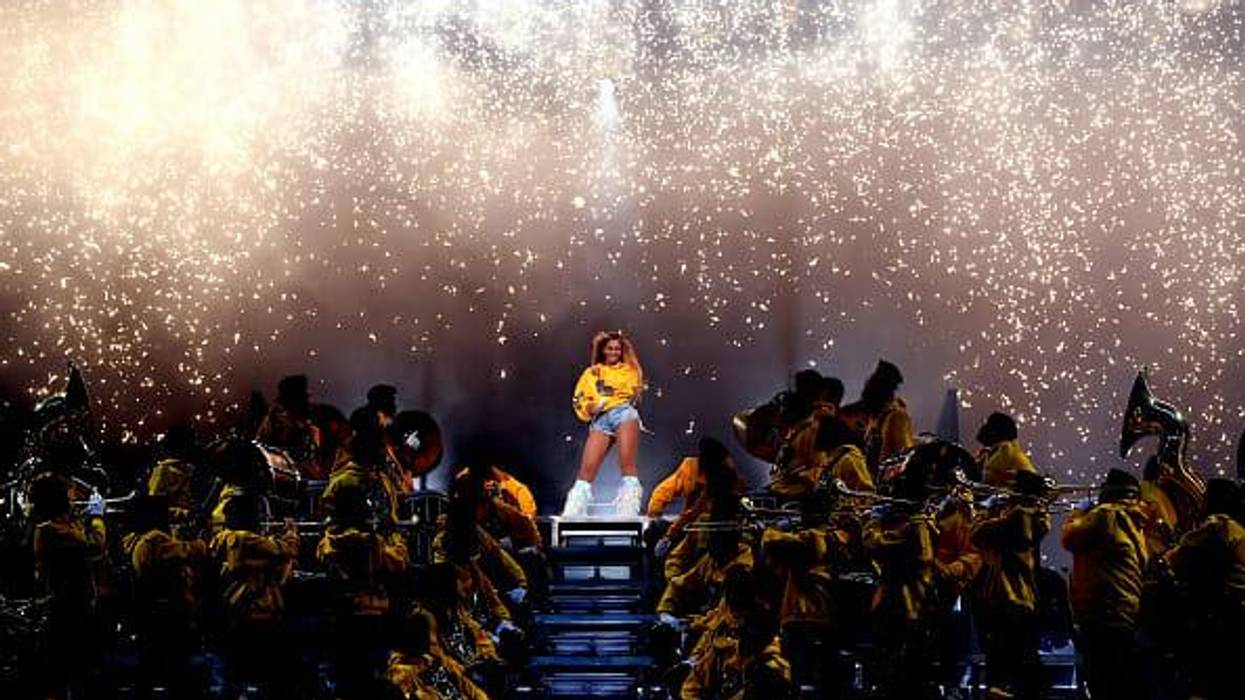
Internet bots immediately snapped up Beyonce's presale tickets last year. And when the resale price rose above $1,000, the Beyhive was mighty peeved.
Ticket scalpers are indeed frustrating. But their Wall Street cousins -- what UMass-Amherst professor Douglas Cliggott calls the "stock scalpers" -- are far more dangerous.
Like online ticket scalpers, these financial predators use advanced technology to cheat the rest of us. For huge sums, they buy the privilege of locating their computer servers as close as possible to market exchanges. This allows them to get trading information a split-second faster than traditional investors.
So when a mutual or pension fund makes a trade, the stock scalpers see that trade on its way to the market. "They hop in front of it, buy it, and bid up what we want to buy and sell it back to us at a higher price," explains Cliggott, a former JPMorgan Chase managing director.
The scalpers do this thousands of times a day, using computers programmed with algorithms that have no connection to the real economy. This "high frequency" trading makes up the majority of today's market activity.
Many financial experts, including a former CFTC chief economist, have warned that high speed trading siphons profits from traditional investors. For the minority of U.S. workers who have any money at all in a retirement fund, that's a bigger problem than missing out on a Beyonce concert.
Even more disturbing is the risk the high-speed traders pose for the global financial system. John Fullerton, another former JPMorgan Managing Director, points out that high frequency traders vanish from the market in a flash in times of crisis. "This can trigger a cascading effect as real money investors pull back in self-defense and at times flee in panic," explains Fullerton, who currently leads the Capital Institute.
Jean-Philippe Serbera, a financial markets expert at Sheffield Hallam University, views the threat of a major "flash crash" as more likely today than during the relatively calm bull market of the past several years. "In a more depressed market, where there's inevitably more volatility and traders are more downbeat," Serbera says, "the worry is that flash crashes are more likely to get out of hand -- possibly causing contagion around the world."
There's an easy solution to these problems: tax the stock scalpers.
Even a tiny levy on each trade of stocks, bonds, and derivatives would deliver a heavy blow to high frequency traders, which make huge profits, but on slim margins per trade. For ordinary investors whose portfolios have low turnover rates, the cost would be negligible -- like a tiny insurance fee against future crises.
Since the 2008 financial crisis, support for such proposals has been growing. In 2016, Senator Bernie Sanders (D-Vermont) pushed the issue into the center of the presidential primary debates, making the point that such taxes would both curb dangerous Wall Street speculation and generate significant revenue for important initiatives, like free higher education.
Even though Hillary Clinton never publicly supported the idea, progressive Democrats, along with strong support from labor unions and other movement groups, secured favorable language about it in the 2016 DNC platform.
This week, House and Senate Democrats are injecting fresh energy into these efforts with a new bill that would impose a 0.1% tax on financial market trades. This model has received the largest official revenue estimate of any such Wall Street tax bill to date. According to the Congressional Budget Office, the new bill would generate $777 billion over 10 years.
On the senate side, the bill signals that this is no longer a "Bernie-only" issue. The lead champion is Senator Brian Schatz (D-Hawaii), with Senators Chris Van Hollen, Jeff Merkley, and Kirsten Gillibrand as initial co-sponsors.*
And while she's declined so far to put her name on this bill, senator and presidential contender Kamala Harris (D-CA) expressed support in the last congressional session for a Sanders bill that includes a financial transaction tax. The Vermont senator has not yet reintroduced his model, which would tax some financial instruments at a higher rate and others at a lower rate than the Schatz proposal. His bill has not received an official revenue estimate.
On the House side, long-time supporter Rep. Peter DeFazio (D-OR) is the lead sponsor, with initial endorsements from more than a dozen members, including headline-maker Rep. Alexandria Ocasio-Cortez.
In a rational political world, Congress would've adopted this type of tax immediately after the 2008 crash, while the wounds of a financial system run amok were fresher and deeper than today. But in the current moment of surging support for taxing the wealthy, this sensible Wall Street tax may have a good shot. Scalpers may still cheat us out of the chance to see our favorite musicians, but they would no longer have the power they wield today to rig our financial system.
*Update: This post has be updated from its original version to indicate that Gillibrand became a co-sponsor just prior to the bill's release.
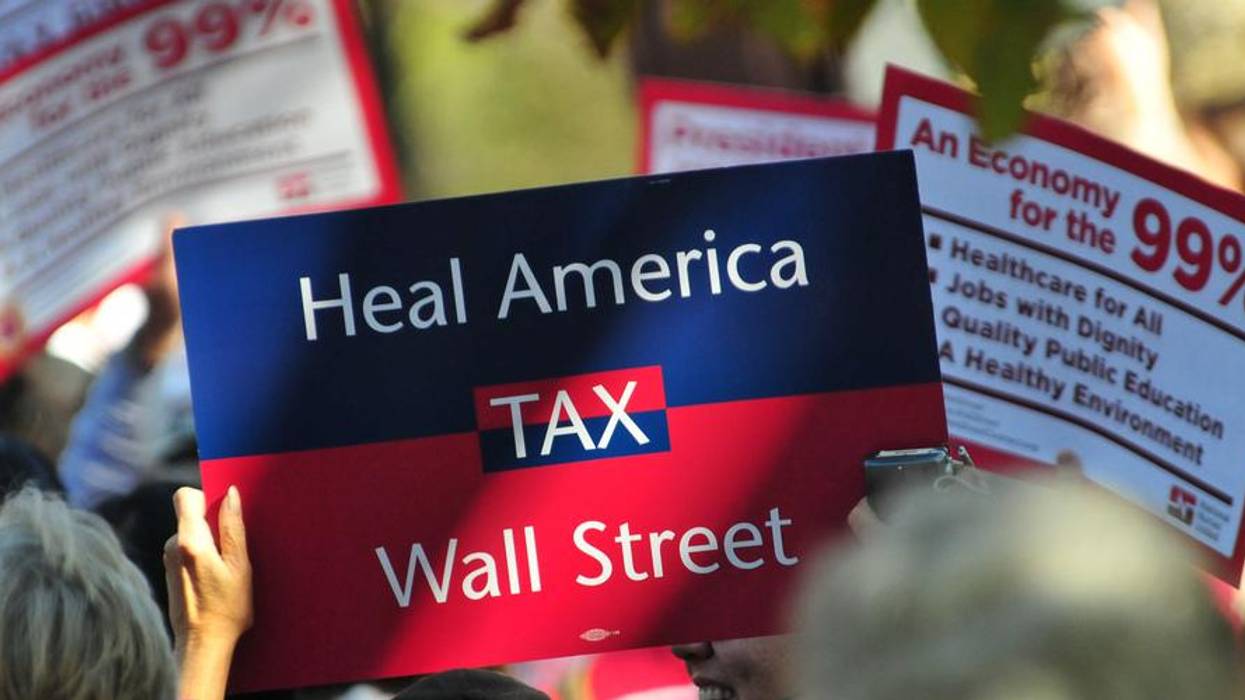
Democrats on Tuesday proposed a tax on Wall Street transactions which could stop another financial crash and bring in $777 billion over the next decade.
"The Wall Street Tax Act would tax the sale of stocks, bonds, and derivatives at 0.1 percent," said Sen. Brian Schatz (D-Hi.), who introduced the bill (pdf) with U.S. Senator Chris Van Hollen (D-Md.) as lead co-sponsor.
"A stock trade of $1,000 would incur a tax of just one dollar," Schatz added.
The bill was also cosponsored in the Senate by Sen. Kirsten Gillibrand (D-N.Y.), who is seeking the Democratic nomination for president, and Sen. Jeff Merkeley (D-Ore.), who is not.
The House version of the bill was introduced by U.S. Representative Peter DeFazio (D-Ore.) with the support of Representatives Rosa DeLauro (D-Conn.), Raul Grijalva (D-Ariz.), Pramila Jayapal (D-Wash.), Ro Khanna (D-Calif.), Grace Napolitano (D-Calif.), Alexandria Ocasio-Cortez (D-N.Y.), Chellie Pingree (D-Maine), Mark Pocan (D-Wis.), Jan Schakowsky (D-Ill.), and Peter Welch (D-Vt.).
In an opinion piece published Tuesday, Sarah Anderson, the director of the Global Economy Project of the Institute for Policy Studies, said the tax was needed for market stability. Citing the use of high frequency trades by "stock scalpers"--traders who, millions of times a day, use microsecond advantages to drive up stock prices in advance of trades--Anderson argued that the tax could stop those traders from fleeing a volatile market in the case of a downturn; an acceleration of financial disaster known as a "flash crash."
"Even a tiny levy on each trade of stocks, bonds, and derivatives would deliver a heavy blow to high frequency traders, which make huge profits, but on slim margins per trade," wrote Anderson. "For ordinary investors whose portfolios have low turnover rates, the cost would be negligible--like a tiny insurance fee against future crises."
Economist Dean Baker, in a statement from the the Center for Economic and Policy Research (CEPR), concurred.
"At a time when members of Congress are exploring ways to tax the wealthy and fight income and wealth inequality," said Baker, "a financial transactions tax that discourages pointless trading [and] is targeted at the financial industry and frees up resources for other spending, is a welcome policy tool."
On business network CNBC's "Squawk Box"program Tuesday, economist Jared Bernstein called the tax a "progressive revenue raiser."
Anderson put the bill into historical context.
"In a rational political world, Congress would've adopted this type of tax immediately after the 2008 crash, while the wounds of a financial system run amok were fresher and deeper than today," Anderson said.
That doesn't mean the bill is dead on arrival, she added:
"In the current moment of surging support for taxing the wealthy, this sensible Wall Street tax may have a good shot."
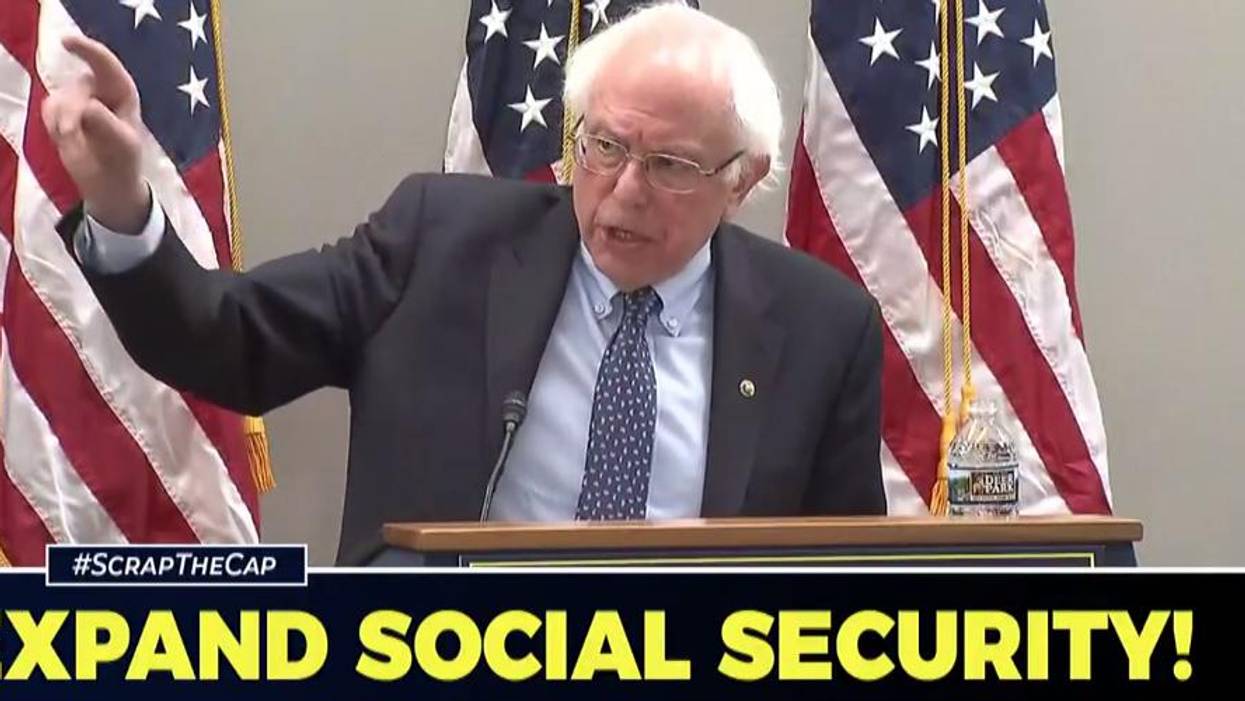
In an effort to strengthen one of the nation's most popular programs as the GOP pushes for cuts, Sen. Bernie Sanders (I-Vt.) and several congressional Democrats on Wednesday introduced the Social Security Expansion Act to ensure that seniors can retire in dignity and "everyone with a disability can live with the security they need."
"A great nation is not judged, historically, by the number of billionaires it has, or by the number of nuclear weapons it has. It is judged by how it treats the weakest and most vulnerable people amongst us."
--Sen. Bernie Sanders
Confronting an economic landscape in which half of older Americans have no retirement savings and 20 percent of seniors are forced to live on income that barely exceeds the federal poverty line, Sanders' legislation would significantly expand Social Security benefits and ensure the program remains solvent for at least the next five decades by subjecting all income over $250,000 to the Social Security payroll tax.
Sanders officially introduced his legislation at a press conference alongside Rep. Peter DeFazio (D-Ore.) and Democratic Sens. Kirsten Gillibrand (N.Y.), Jeff Merkley (Ore.), and Cory Booker (N.J.).
"You got a government that represents the wealthy and the powerful, our job is to get a government that represents all of us," the Vermont senator said. "And the only way we do that is when we mobilize millions of people to say that we're gonna protect our seniors."
Watch:
"In my humble opinion, a great nation is not judged, historically, by the number of billionaires it has, or by the number of nuclear weapons it has," Sanders' said. "It is judged by how it treats the weakest and most vulnerable people amongst us."
"And when we talk about vulnerable people," Sanders continued, "these are folks who are in their 80s and their 90s, people who have worked their entire lives, people who have raised us as children... What we are saying today, to those senior citizens who are struggling economically to live out their last years with dignity: We will no longer turn our backs on you."
Arguing that Republican leaders who want to slash Social Security after giving tax breaks to the rich have "their priorities backwards," Sanders declared, "We're gonna tax the billionaires and expand Social Security."
According to a fact sheet put out by Sanders' office, the legislation would:
The Social Security Expansion Act is backed by unions and progressive advocacy groups like Social Security Works, which applauded the legislation as a "profoundly wise" and necessary step toward ensuring a dignified retirement for all.
"Expanding Social Security as this legislation does is a solution to our looming retirement income crisis and to growing inequality between the wealthy and everyone else, as well as to the financial squeeze confronting working families," Nancy Altman, president of Social Security Works, said in a statement. "Not only is expanding Social Security, financed by requiring the wealthy to pay their fair share, extremely wise policy, it is overwhelmingly supported by voters across the political spectrum. That makes it powerfully winning politics, as well."
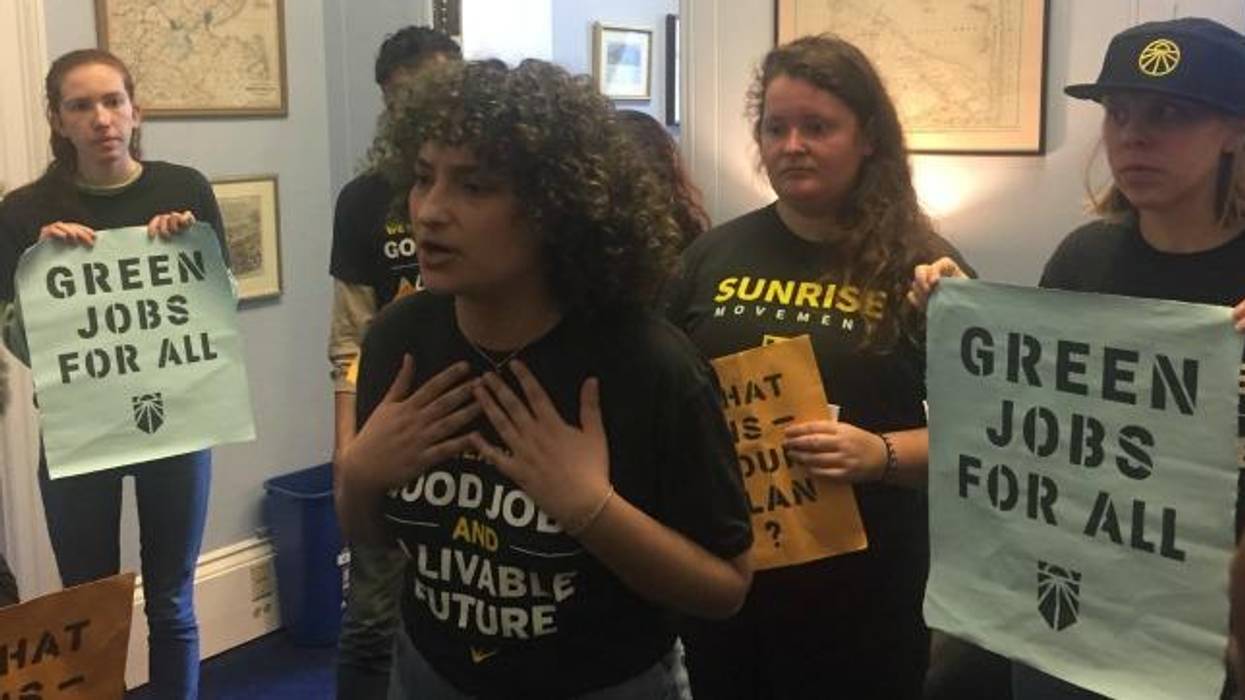
Days after it targeted the Democratic leader in the House, Nancy Pelosi, the youth-led Sunrise Movement sustained its pressure on the party Friday morning as roughly three dozen climate activists with the group occupied the Washington, D.C. office of Rep. Frank Pallone (N.J.) to demand he back a "Green New Deal" as they called such a plan humanity's "best chance at survival."
"Our generation is done waiting," said one protester named Ben, a 21-year-old. "If not now, when?"
In addition to supporting Representative-elect Alexandria Ocasio-Cortez's proposed Select Committee for a Green New Deal--an idea backed by other newly-elected Democrats including Ilhan Omar but deemed "not necessary" by Pallone, the group sporting t-shirts demanding their rights to "good jobs and a livable future" also urged the incoming chair of the House Energy and Commerce Committee to sign on to the "No Fossil Fuel Money Pledge."
"Our generation needs proof that you will fight with us," added Ben.
Pallone listened to the activists, and said that while he "largely agrees with" the agenda of the Green New Deal, he disagreed with the legislative process of the select committee.
"You've been in office for 25 years, longer than I've been alive, and you have not supported a #GreenNewDeal which addressed the scope of the crisis," said another activist identified as Beverly. She told Pallone to back the proposed committee, and added, "it's our best chance at survival."
Friday's action--which drew support from Rep. John Lewis (D-Ga.)--comes the same week dozens of Sunrise Movement activists staged a sit-in at Pelosi's Washington, D.C. office to demand that party leadership get behind the Green New Deal.
Alexandria Ocasio-Cortez herself joined that protest and told the group, "I just want to let you all know how proud I am of each and every single one of you for putting yourselves and your bodies and everything on the line to make sure that we save our planet, our generation, and our future."
Her plan of action, however, is getting push-back from establishment Democrats. Rep. Henry Cuellar (D-Texas), for example, warned about going "too extreme," while Rep. Peter DeFazio (D-Ore.) declared it "technologically impossible" that "in five years or 10 years we're not going to consume any more fossil fuels."
But 19-year-old Sunrise Movement activist Olivia stressed the urgency of climate action. She said before departing Pallone's office: "We do not have time for committees to talk and research. We have the solutions and we need a Green New Deal now. Frank Pallone needs to stand with us or step aside."
Praising the direct action and echoing the fact that there's no time to spare, Anna Galland, executive director of civic action at MoveOn.org, tweeted that the Sunrise activists are "beautifully modeling the ferocious urgency we need."
Amid reports that civilian deaths have "surged dramatically" in Yemen since June, when the Saudi-led coalition launched an offensive to take control of the port city Hodeidah, Rep. Ro Khanna (D-Calif.) on Wednesday officially introduced a highly anticipated resolution invoking the War Powers Act of 1973, in hopes of ending American support for the coalition's attacks and the resulting humanitarian crisis.
The resolution (pdf) "directs the president to remove United States Armed Forces from hostilities in the Republic of Yemen, except United States Armed Forces engaged in operations authorized under the 2001 Authorization for Use of Military Force...not later than 30 days after the date of the adoption of this concurrent resolution unless and until a declaration of war or specific authorization for such use of United States Armed Forces has been enacted into law."
"The unauthorized U.S. role in the war has given rise to the worst humanitarian disaster in the world, made the U.S. complicit in countless war crimes and violations of international law, and undermined our national security interests."
--Paul Kawika Martin, Peace Action
The measure was immediately applauded by peace advocates and human rights groups that have long charged, as Paul Kawika Martin of Peace Action outlined Wednesday, that "the unauthorized U.S. role in the war has given rise to the worst humanitarian disaster in the world, made the U.S. complicit in countless war crimes and violations of international law, and undermined our national security interests."
"This House resolution offers a glimmer of hope to the suffering people of Yemen because if the U.S. withdraws its support for the Saudi-led bombing, a negotiated settlement is sure to follow," responded CODEPINK co-director Medea Benjamin.
"Let's make sure the August bombing of a busload of children marks a turning point in U.S. policy," she added, referencing an August attack that killed 40 boys aged six to 11.
"This resolution should be a no-brainer for Congress. What more do they need to finally end this tragedy?" said Elizabeth Beavers, associate policy director for Indivisible. "If they're not persuaded by the fact that the U.S. is engaging in unauthorized warfare, the growing civilian body count should demand their attention."
William D. Hartung, director of the Arms and Security Project at the Center for International Policy, noted: "Rarely does Congress have an opportunity make a difference in the lives of millions of people. This legislation is one such chance, and the time to act is now."
"Rarely does Congress have an opportunity make a difference in the lives of millions of people. This legislation is one such chance, and the time to act is now."
--William D. Hartung, Center for International Policy
Last year, Khanna was part of a small group of House members who were demanding an end to U.S. complicity in the war and introduced a similar measure. "One year later, the bloodshed continues with widespread destruction and disease contributing to the world's worst humanitarian crisis. U.S.-fueled planes continue to drop U.S.-made bombs on innocent victims," he said in a statement Wednesday. "This time around, our coalition to end the war has expanded and the call for withdrawing U.S. involvement is louder."
Backed by a bipartisan group of nearly two dozen lawmakers, Khanna asserted that withdrawing U.S. support for the coalition "is now a mainstream position within the Democratic Party," and that he is "confident the House Republican leadership will allow this resolution to come to a vote and that members of the House will hear from their constituents in support of our position against this unauthorized war contributing to Yemen's humanitarian catastrophe."
Rep. Adam Smith (D-Wash.), ranking member of the House Armed Services Committee, is one of the resolution's co-sponsors. "The U.S. should be aggressively pushing a peaceful solution to end this civil war instead of supporting the Saudi-led coalition military campaign that has only destabilized the crisis further," the congressman charged on Twitter Wednesday.
The resolution's other co-sponsors--which include the ranking members of the House Foreign Affairs Committee as well as the Rules Committee--are: Reps. Steny Hoyer (D-Md.), Mark Pocan (D-Wis.), Jim McGovern (D-Mass.), Eliot Engel (D-N.Y.), Raul Grijalva (D-Ariz.), Jan Schakowsky (D-Ill.), Tulsi Gabbard (D-Hawaii), Thomas Massie (R-Ky.), Michael Capuano (D-Mass.), Yvette Clarke (D-N.Y.), Ted Lieu (D-Calif.), Barbara Lee (D-Calif.), Beto O'Rourke (D-Texas), Adriano Espaillat (D-N.Y.), Joe Kennedy (D-Mass.), Joe Courtney (D-Conn.), Gwen Moore (D-Wis.), Walter Jones (R-N.C.), Debbie Dingell (D-Mich.), Pramila Jayapal (D-Wash.), Peter DeFazio (D-Ore.), and Earl Blumenauer (D-Ore.).
In a move characterized as an effort to prevent large pharmaceutical companies from "goug[ing] American consumers after taking billions in taxpayer money," Sen. Bernie Sanders (I-Vt.) on Monday introduced a new rule that would require drugmakers to agree to set reasonable prices before being granted exclusive rights to produce vaccines and other life-saving drugs.
"Americans should not be forced to pay the highest prices in the world for a vaccine we spent more than $1 billion to help develop."
--Sen Bernie SandersSanders was joined by Rep. Peter DeFazio (D-Ore.) in crafting and unveiling the rule, which the pair of lawmakers "first proposed two decades ago with bipartisan support." The rule currently has 21 co-sponsors.
In the face of new developments, Sanders said in a statement, a rule addressing soaring prescription drug prices is as necessary as ever.
While the new rule would have broad implications, Sanders specifically takes aim at Sanofi, a French pharmaceutical giant that the U.S. Army has offered an exclusive license to develop a vaccine for the Zika virus.
"American taxpayers have already spent more than $1 billion on Zika research and prevention efforts, including millions to develop a vaccine. The Department of Health and Human Services gave Sanofi $43 million to develop the vaccine with $130 million in federal funding still to come," Sanders' office said in a statement. "But Sanofi has refused to agree to sell the drug back to Americans at a fair price. Without a fair pricing agreement, the company can charge Americans whatever astronomical price it wants for its vaccine."
Sanders, who spent much of his 2016 presidential campaign railing against the greed of the pharmaceutical industry, called such an arrangement "simply unacceptable."
"Americans should not be forced to pay the highest prices in the world for a vaccine we spent more than $1 billion to help develop," Sanders said. "Sanofi gets more than one-third of its roughly $34 billion in revenues from the United States alone, and its CEO made nearly $5 million in salary last year. Yet they have rejected the U.S. Army's request for fair pricing."
Sanders continued:
Sanofi and the rest of the pharmaceutical industry cannot be allowed to make huge profits on the backs of working class Americans, many of whom cannot afford the medication they are prescribed. The days of allowing Sanofi and other drug makers to gouge American consumers after taking billions in taxpayer money must end. That is why I am introducing legislation to demand fairer, lower prices for the Zika vaccine and for every drug developed with government resources. This is a fight that we cannot afford to lose.
An analysis (PDF) of the rule by the Congressional Budget Office found that the rule would save the federal government $6 billion over the next decade.
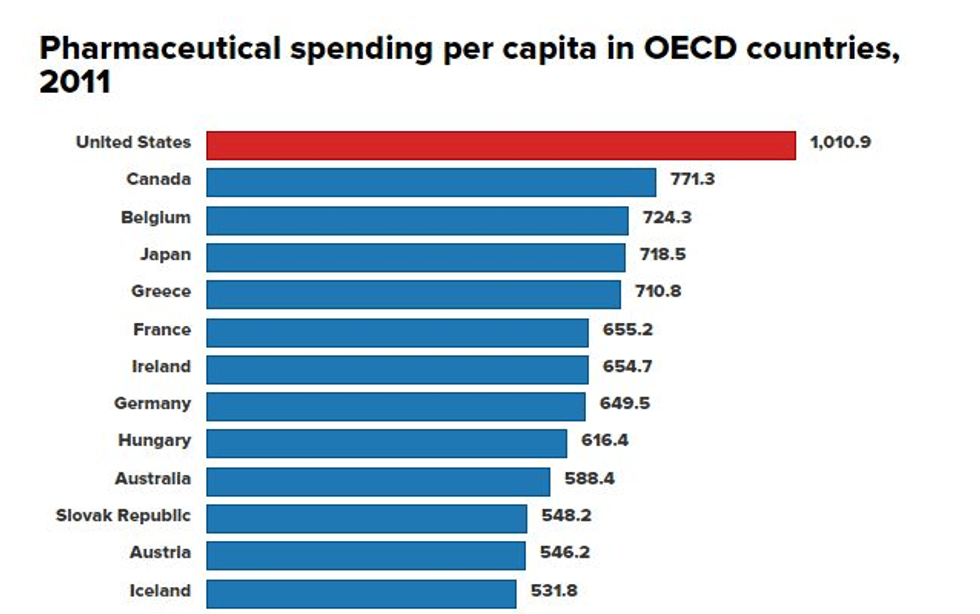
As Sanders often points out, the United States spends far more on pharmaceutical drugs--and on healthcare more broadly--than other industrialized nations.