5
#000000
#FFFFFF
To donate by check, phone, or other method, see our More Ways to Give page.
Daily news & progressive opinion—funded by the people, not the corporations—delivered straight to your inbox.
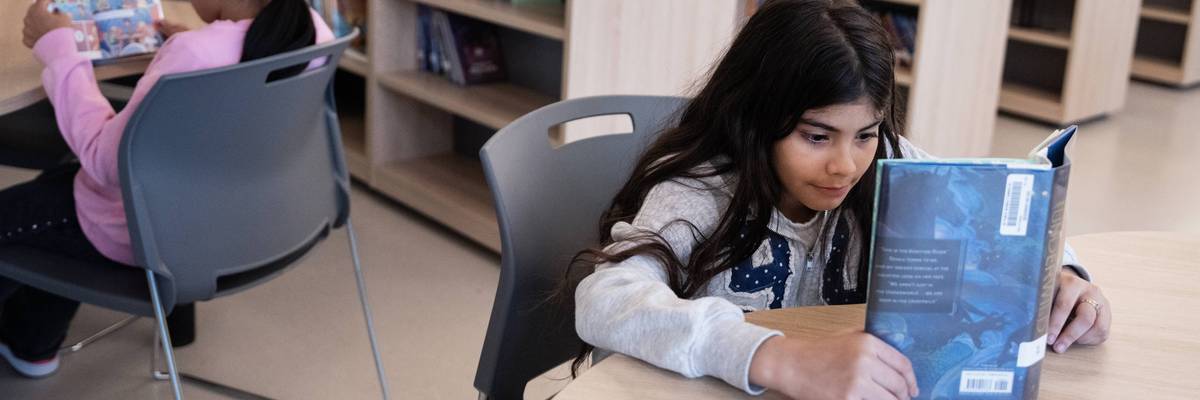
Students read in the library of Harriet Tubman Elementary School in Washington, DC after an event to celebrate the completion of a $91 million modernization project on September 28, 2026.
"Instead of strengthening public education," said one union leader, "Trump is diverting $500 billion in taxpayer cash into private hands, with everyone else left fighting for scraps in a real-life Hunger Games."
The US Department of the Treasury this week released proposed regulations for the first federal "school choice" program, as proponents call it, drawing a fresh wave of condemnation from critics who have expressed concerns since President Donald Trump signed last year's Republican budget package.
"The Trump administration's proposed rules confirm what we expected, that their federal private school voucher program is designed to direct public resources to private schools and organizations and will provide little benefit to the 90% of children who attend public schools," said Demetria McCain, director of policy at the Legal Defense Fund, in a Friday statement.
"Instead of using federal resources to serve all children, this administration has dismantled the Department of Education, weakened long-standing civil rights protections, and worked to build a two-tiered system of education that benefits a select few," McCain continued. "Our children deserve better."
The One Big Beautiful Bill Act established the Education Freedom Tax Credit, which is set to begin next year. According to the Treasury Department, under the proposed rules, eligible taxpayers could claim an annual credit of up to $1,700—or $3,400 for married couples filing jointly—for contributions to scholarship granting organizations (SGOs).
The program is widely seen as a scheme to funnel tax dollars toward private school tuition, but the department noted that the rules would also allow scholarships to support "academic tutoring, special needs services, books, supplies, computers and other equipment, and other qualifying expenses connected with a student's enrollment or attendance."
That "aspect of the program has put Democratic governors in a bind," The Washington Post reported Thursday. There is no cost to states that participate, but "governors must approve all SGOs that meet the rules. States that want to opt into the program for the benefit of public school students will have to allow private school vouchers as well, and vice versa."
As the Post detailed:
Governors have until January 1 to opt in. Thirty mostly Republican-led states have already joined. Most of the remaining states that have not rejected the plan are led by Democrats.
The proposed regulations include income limits for eligible families, protections for scholarship funds, and details on how the funds can be used. States cannot restrict the types of schools that benefit, Treasury and Education department officials said, meaning public funds could go toward a religious school that bars LGBTQ students or a private school that doesn't have certified teachers.
Among the Democrats facing some calls to opt out are New York Gov. Kathy Hochul—who, as Chalkbeat pointed out, "has said she plans to participate unless she finds a 'poison pill' in the program," but "declined Thursday to make it official."
New York State United Teachers president Melinda Person declared Thursday that "the regulations are loaded with poison pills. If New York opts in, the state would be prohibited from setting standards for scholarship organizations, deciding which organizations can participate, or limiting the types of schools and expenses that receive these federal tax dollars."
"That means New York could be forced to help funnel taxpayer-subsidized dollars to private schools that have admissions policies and practices that would never be acceptable in our public schools, while being denied the authority to put stronger safeguards around the program," Person warned. "New York puts its name on the program, but Washington writes the rules."
"We take responsibility for participating, but surrender much of our ability to determine where the money goes and what standards recipients must meet," she added. "This isn't local control. It is a one-way door into a federally designed voucher program, one that could use public resources to support schools that discriminate, while stripping New York of the ability to provide the protections New Yorkers expect. Gov. Hochul should make clear now that New York will not walk through that door."
Josh Cowen, a Michigan State University education policy professor who authored the book The Privateers: How Billionaires Created a Culture War and Sold School Vouchers, laid out the "good" and "bad" of the regulations on social media Thursday.
It’s striking that the FSTC has clear revenue streams for public schools and families, guided by sensible rules to promote service access and quality—such as you might expect from progressive policymakers——jammed Frankenstein-style alongside rules permitting anything-goes on the private side.
[image or embed]
— Josh Cowen (@joshcowenmi.bsky.social) October 1, 2026 at 5:37 PM
So the decision basically comes down to eating a sh-t sandwich with some stuff we really don’t like in the private sector, with some meaningful money that you might expect any number of progressive lawmakers to have crafted.
— Josh Cowen (@joshcowenmi.bsky.social) October 1, 2026 at 5:37 PM
Leaders at the nation's two largest teachers unions also weighed in. National Education Association president Princess Moss said that "with back-to-school in the rearview mirror, more Americans are struggling to make ends meet as the cost of school supplies, packed lunches, and gas continues to outpace salaries and paychecks."
"Instead of helping families make ends meet, the Trump administration is once again putting its thumb on the scale for private school vouchers at the expense of the public schools that serve 90% of America's students," she asserted. "At a time when educators, students, and families are calling for more resources to strengthen neighborhood public schools, this administration is advancing a plan to divert taxpayer dollars to subsidize private education for a select few."
"We will closely review the Treasury Department's new voucher regulations and continue fighting to ensure public funds remain invested in public schools where every student—regardless of their race, ZIP code, disability, family income, or immigration status—can learn, grow, and thrive," Moss pledged. "America's students deserve policies that expand opportunity, not vouchers that leave most children behind."
American Federation of Teachers president Randi Weingarten similarly charged that "this scheme is a poison pill for the 90% of American children who attend public schools. Instead of strengthening public education, President Trump is diverting $500 billion in taxpayer cash into private hands, with everyone else left fighting for scraps in a real-life Hunger Games."
While the Congressional Budget Office estimated the program would cost the federal government $26 billion in lost revenue over the next decade, the Institute on Taxation and Economic Policy has found it could cost up to $51 billion per year. A January report from US Senate Health, Education, Labor, and Pensions Committee Ranking Member Bernie Sanders (I-Vt.) noted that's more than the combined federal spending on programs to support students with disabilities and those who are from low-income backgrounds.
Weingarten said that "state governors should reject it—not least of all because they will have no say or oversight over how the vouchers operate. The reality is that for every precious public dollar funneled to private schools—money that could be spent on instruction, lowering class sizes, modern buildings, or new books in the library—public school parents will be hunting for pennies on the floor."
"This isn't about 'school choice'; it's the about the school's choice: Private schools can simply refuse to accept poor kids, those with special needs, or those with different religions. And they can refuse to submit to the basic accountability measures their backers hypocritically demand of public schools," she stressed. "If this were really about 'choice' then the administration would be trying to help public schools succeed, rather than eviscerating them."
"This is yet another cruel chapter in the Trump's administration's war on families after the Big, Ugly Bill slashed trillions in support for young people by gutting Medicaid, food assistance, and student loans," she continued. "If we are serious about the promise of education, then we have an obligation to make every public school a place where parents want to send their kids, educators want to work, and kids thrive."
The union leader argued that "instead of this voucher scheme, we should commit to creating safe and welcoming schools with a curriculum that is engaging, relevant, and rigorous. That means multiple pathways to career and college, expanding community schools, focusing on literacy and critical thinking, and protecting children against the perils of artificial intelligence while harnessing its potential. These regulations do the exact opposite."
Dear Common Dreams reader, It’s been nearly 30 years since I co-founded Common Dreams with my late wife, Lina Newhouser. We had the radical notion that journalism should serve the public good, not corporate profits. It was clear to us from the outset what it would take to build such a project. No paid advertisements. No corporate sponsors. No millionaire publisher telling us what to think or do. Many people said we wouldn't last a year, but we proved those doubters wrong. Together with a tremendous team of journalists and dedicated staff, we built an independent media outlet free from the constraints of profits and corporate control. Our mission has always been simple: To inform. To inspire. To ignite change for the common good. Building Common Dreams was not easy. Our survival was never guaranteed. When you take on the most powerful forces—Wall Street greed, fossil fuel industry destruction, Big Tech lobbyists, and uber-rich oligarchs who have spent billions upon billions rigging the economy and democracy in their favor—the only bulwark you have is supporters who believe in your work. But here’s the urgent message from me today. It's never been this bad out there. And it's never been this hard to keep us going. At the very moment Common Dreams is most needed, the threats we face are intensifying. We need your support now more than ever. We don't accept corporate advertising and never will. We don't have a paywall because we don't think people should be blocked from critical news based on their ability to pay. Everything we do is funded by the donations of readers like you. When everyone does the little they can afford, we are strong. But if that support retreats or dries up, so do we. Will you donate now to make sure Common Dreams not only survives but thrives? —Craig Brown, Co-founder |
The US Department of the Treasury this week released proposed regulations for the first federal "school choice" program, as proponents call it, drawing a fresh wave of condemnation from critics who have expressed concerns since President Donald Trump signed last year's Republican budget package.
"The Trump administration's proposed rules confirm what we expected, that their federal private school voucher program is designed to direct public resources to private schools and organizations and will provide little benefit to the 90% of children who attend public schools," said Demetria McCain, director of policy at the Legal Defense Fund, in a Friday statement.
"Instead of using federal resources to serve all children, this administration has dismantled the Department of Education, weakened long-standing civil rights protections, and worked to build a two-tiered system of education that benefits a select few," McCain continued. "Our children deserve better."
The One Big Beautiful Bill Act established the Education Freedom Tax Credit, which is set to begin next year. According to the Treasury Department, under the proposed rules, eligible taxpayers could claim an annual credit of up to $1,700—or $3,400 for married couples filing jointly—for contributions to scholarship granting organizations (SGOs).
The program is widely seen as a scheme to funnel tax dollars toward private school tuition, but the department noted that the rules would also allow scholarships to support "academic tutoring, special needs services, books, supplies, computers and other equipment, and other qualifying expenses connected with a student's enrollment or attendance."
That "aspect of the program has put Democratic governors in a bind," The Washington Post reported Thursday. There is no cost to states that participate, but "governors must approve all SGOs that meet the rules. States that want to opt into the program for the benefit of public school students will have to allow private school vouchers as well, and vice versa."
As the Post detailed:
Governors have until January 1 to opt in. Thirty mostly Republican-led states have already joined. Most of the remaining states that have not rejected the plan are led by Democrats.
The proposed regulations include income limits for eligible families, protections for scholarship funds, and details on how the funds can be used. States cannot restrict the types of schools that benefit, Treasury and Education department officials said, meaning public funds could go toward a religious school that bars LGBTQ students or a private school that doesn't have certified teachers.
Among the Democrats facing some calls to opt out are New York Gov. Kathy Hochul—who, as Chalkbeat pointed out, "has said she plans to participate unless she finds a 'poison pill' in the program," but "declined Thursday to make it official."
New York State United Teachers president Melinda Person declared Thursday that "the regulations are loaded with poison pills. If New York opts in, the state would be prohibited from setting standards for scholarship organizations, deciding which organizations can participate, or limiting the types of schools and expenses that receive these federal tax dollars."
"That means New York could be forced to help funnel taxpayer-subsidized dollars to private schools that have admissions policies and practices that would never be acceptable in our public schools, while being denied the authority to put stronger safeguards around the program," Person warned. "New York puts its name on the program, but Washington writes the rules."
"We take responsibility for participating, but surrender much of our ability to determine where the money goes and what standards recipients must meet," she added. "This isn't local control. It is a one-way door into a federally designed voucher program, one that could use public resources to support schools that discriminate, while stripping New York of the ability to provide the protections New Yorkers expect. Gov. Hochul should make clear now that New York will not walk through that door."
Josh Cowen, a Michigan State University education policy professor who authored the book The Privateers: How Billionaires Created a Culture War and Sold School Vouchers, laid out the "good" and "bad" of the regulations on social media Thursday.
It’s striking that the FSTC has clear revenue streams for public schools and families, guided by sensible rules to promote service access and quality—such as you might expect from progressive policymakers——jammed Frankenstein-style alongside rules permitting anything-goes on the private side.
[image or embed]
— Josh Cowen (@joshcowenmi.bsky.social) October 1, 2026 at 5:37 PM
So the decision basically comes down to eating a sh-t sandwich with some stuff we really don’t like in the private sector, with some meaningful money that you might expect any number of progressive lawmakers to have crafted.
— Josh Cowen (@joshcowenmi.bsky.social) October 1, 2026 at 5:37 PM
Leaders at the nation's two largest teachers unions also weighed in. National Education Association president Princess Moss said that "with back-to-school in the rearview mirror, more Americans are struggling to make ends meet as the cost of school supplies, packed lunches, and gas continues to outpace salaries and paychecks."
"Instead of helping families make ends meet, the Trump administration is once again putting its thumb on the scale for private school vouchers at the expense of the public schools that serve 90% of America's students," she asserted. "At a time when educators, students, and families are calling for more resources to strengthen neighborhood public schools, this administration is advancing a plan to divert taxpayer dollars to subsidize private education for a select few."
"We will closely review the Treasury Department's new voucher regulations and continue fighting to ensure public funds remain invested in public schools where every student—regardless of their race, ZIP code, disability, family income, or immigration status—can learn, grow, and thrive," Moss pledged. "America's students deserve policies that expand opportunity, not vouchers that leave most children behind."
American Federation of Teachers president Randi Weingarten similarly charged that "this scheme is a poison pill for the 90% of American children who attend public schools. Instead of strengthening public education, President Trump is diverting $500 billion in taxpayer cash into private hands, with everyone else left fighting for scraps in a real-life Hunger Games."
While the Congressional Budget Office estimated the program would cost the federal government $26 billion in lost revenue over the next decade, the Institute on Taxation and Economic Policy has found it could cost up to $51 billion per year. A January report from US Senate Health, Education, Labor, and Pensions Committee Ranking Member Bernie Sanders (I-Vt.) noted that's more than the combined federal spending on programs to support students with disabilities and those who are from low-income backgrounds.
Weingarten said that "state governors should reject it—not least of all because they will have no say or oversight over how the vouchers operate. The reality is that for every precious public dollar funneled to private schools—money that could be spent on instruction, lowering class sizes, modern buildings, or new books in the library—public school parents will be hunting for pennies on the floor."
"This isn't about 'school choice'; it's the about the school's choice: Private schools can simply refuse to accept poor kids, those with special needs, or those with different religions. And they can refuse to submit to the basic accountability measures their backers hypocritically demand of public schools," she stressed. "If this were really about 'choice' then the administration would be trying to help public schools succeed, rather than eviscerating them."
"This is yet another cruel chapter in the Trump's administration's war on families after the Big, Ugly Bill slashed trillions in support for young people by gutting Medicaid, food assistance, and student loans," she continued. "If we are serious about the promise of education, then we have an obligation to make every public school a place where parents want to send their kids, educators want to work, and kids thrive."
The union leader argued that "instead of this voucher scheme, we should commit to creating safe and welcoming schools with a curriculum that is engaging, relevant, and rigorous. That means multiple pathways to career and college, expanding community schools, focusing on literacy and critical thinking, and protecting children against the perils of artificial intelligence while harnessing its potential. These regulations do the exact opposite."
The US Department of the Treasury this week released proposed regulations for the first federal "school choice" program, as proponents call it, drawing a fresh wave of condemnation from critics who have expressed concerns since President Donald Trump signed last year's Republican budget package.
"The Trump administration's proposed rules confirm what we expected, that their federal private school voucher program is designed to direct public resources to private schools and organizations and will provide little benefit to the 90% of children who attend public schools," said Demetria McCain, director of policy at the Legal Defense Fund, in a Friday statement.
"Instead of using federal resources to serve all children, this administration has dismantled the Department of Education, weakened long-standing civil rights protections, and worked to build a two-tiered system of education that benefits a select few," McCain continued. "Our children deserve better."
The One Big Beautiful Bill Act established the Education Freedom Tax Credit, which is set to begin next year. According to the Treasury Department, under the proposed rules, eligible taxpayers could claim an annual credit of up to $1,700—or $3,400 for married couples filing jointly—for contributions to scholarship granting organizations (SGOs).
The program is widely seen as a scheme to funnel tax dollars toward private school tuition, but the department noted that the rules would also allow scholarships to support "academic tutoring, special needs services, books, supplies, computers and other equipment, and other qualifying expenses connected with a student's enrollment or attendance."
That "aspect of the program has put Democratic governors in a bind," The Washington Post reported Thursday. There is no cost to states that participate, but "governors must approve all SGOs that meet the rules. States that want to opt into the program for the benefit of public school students will have to allow private school vouchers as well, and vice versa."
As the Post detailed:
Governors have until January 1 to opt in. Thirty mostly Republican-led states have already joined. Most of the remaining states that have not rejected the plan are led by Democrats.
The proposed regulations include income limits for eligible families, protections for scholarship funds, and details on how the funds can be used. States cannot restrict the types of schools that benefit, Treasury and Education department officials said, meaning public funds could go toward a religious school that bars LGBTQ students or a private school that doesn't have certified teachers.
Among the Democrats facing some calls to opt out are New York Gov. Kathy Hochul—who, as Chalkbeat pointed out, "has said she plans to participate unless she finds a 'poison pill' in the program," but "declined Thursday to make it official."
New York State United Teachers president Melinda Person declared Thursday that "the regulations are loaded with poison pills. If New York opts in, the state would be prohibited from setting standards for scholarship organizations, deciding which organizations can participate, or limiting the types of schools and expenses that receive these federal tax dollars."
"That means New York could be forced to help funnel taxpayer-subsidized dollars to private schools that have admissions policies and practices that would never be acceptable in our public schools, while being denied the authority to put stronger safeguards around the program," Person warned. "New York puts its name on the program, but Washington writes the rules."
"We take responsibility for participating, but surrender much of our ability to determine where the money goes and what standards recipients must meet," she added. "This isn't local control. It is a one-way door into a federally designed voucher program, one that could use public resources to support schools that discriminate, while stripping New York of the ability to provide the protections New Yorkers expect. Gov. Hochul should make clear now that New York will not walk through that door."
Josh Cowen, a Michigan State University education policy professor who authored the book The Privateers: How Billionaires Created a Culture War and Sold School Vouchers, laid out the "good" and "bad" of the regulations on social media Thursday.
It’s striking that the FSTC has clear revenue streams for public schools and families, guided by sensible rules to promote service access and quality—such as you might expect from progressive policymakers——jammed Frankenstein-style alongside rules permitting anything-goes on the private side.
[image or embed]
— Josh Cowen (@joshcowenmi.bsky.social) October 1, 2026 at 5:37 PM
So the decision basically comes down to eating a sh-t sandwich with some stuff we really don’t like in the private sector, with some meaningful money that you might expect any number of progressive lawmakers to have crafted.
— Josh Cowen (@joshcowenmi.bsky.social) October 1, 2026 at 5:37 PM
Leaders at the nation's two largest teachers unions also weighed in. National Education Association president Princess Moss said that "with back-to-school in the rearview mirror, more Americans are struggling to make ends meet as the cost of school supplies, packed lunches, and gas continues to outpace salaries and paychecks."
"Instead of helping families make ends meet, the Trump administration is once again putting its thumb on the scale for private school vouchers at the expense of the public schools that serve 90% of America's students," she asserted. "At a time when educators, students, and families are calling for more resources to strengthen neighborhood public schools, this administration is advancing a plan to divert taxpayer dollars to subsidize private education for a select few."
"We will closely review the Treasury Department's new voucher regulations and continue fighting to ensure public funds remain invested in public schools where every student—regardless of their race, ZIP code, disability, family income, or immigration status—can learn, grow, and thrive," Moss pledged. "America's students deserve policies that expand opportunity, not vouchers that leave most children behind."
American Federation of Teachers president Randi Weingarten similarly charged that "this scheme is a poison pill for the 90% of American children who attend public schools. Instead of strengthening public education, President Trump is diverting $500 billion in taxpayer cash into private hands, with everyone else left fighting for scraps in a real-life Hunger Games."
While the Congressional Budget Office estimated the program would cost the federal government $26 billion in lost revenue over the next decade, the Institute on Taxation and Economic Policy has found it could cost up to $51 billion per year. A January report from US Senate Health, Education, Labor, and Pensions Committee Ranking Member Bernie Sanders (I-Vt.) noted that's more than the combined federal spending on programs to support students with disabilities and those who are from low-income backgrounds.
Weingarten said that "state governors should reject it—not least of all because they will have no say or oversight over how the vouchers operate. The reality is that for every precious public dollar funneled to private schools—money that could be spent on instruction, lowering class sizes, modern buildings, or new books in the library—public school parents will be hunting for pennies on the floor."
"This isn't about 'school choice'; it's the about the school's choice: Private schools can simply refuse to accept poor kids, those with special needs, or those with different religions. And they can refuse to submit to the basic accountability measures their backers hypocritically demand of public schools," she stressed. "If this were really about 'choice' then the administration would be trying to help public schools succeed, rather than eviscerating them."
"This is yet another cruel chapter in the Trump's administration's war on families after the Big, Ugly Bill slashed trillions in support for young people by gutting Medicaid, food assistance, and student loans," she continued. "If we are serious about the promise of education, then we have an obligation to make every public school a place where parents want to send their kids, educators want to work, and kids thrive."
The union leader argued that "instead of this voucher scheme, we should commit to creating safe and welcoming schools with a curriculum that is engaging, relevant, and rigorous. That means multiple pathways to career and college, expanding community schools, focusing on literacy and critical thinking, and protecting children against the perils of artificial intelligence while harnessing its potential. These regulations do the exact opposite."