5
#000000
#FFFFFF
To donate by check, phone, or other method, see our More Ways to Give page.
Daily news & progressive opinion—funded by the people, not the corporations—delivered straight to your inbox.
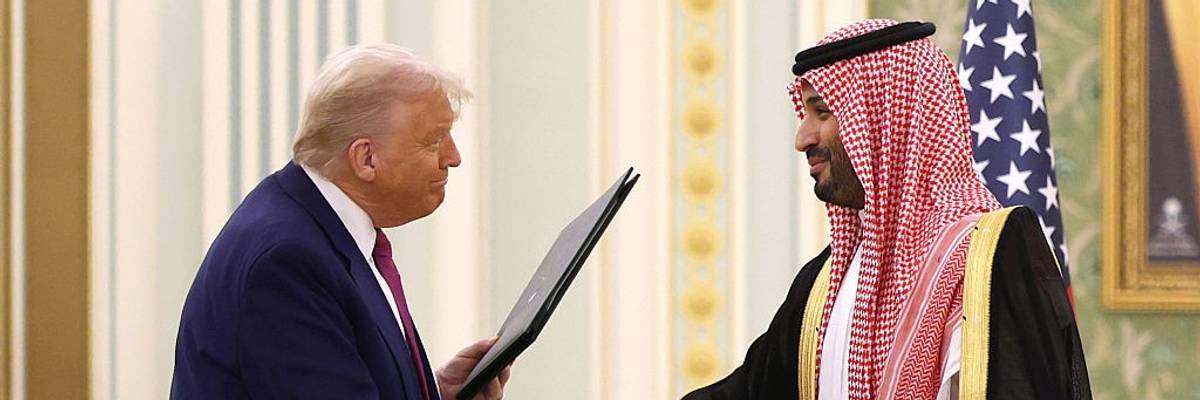
US President Donald Trump and Saudi Crown Prince Mohammed bin Salman attend a signing ceremony on May 13, 2025, in Riyadh, Saudi Arabia.
The effort comes as senators also sound the alarm about a possible nuclear energy agreement and the administration continues to greenlight arms sales to the kingdom.
A trio of progressive US senators this week introduced legislation to block a $5 billion conventional weapons sale to Saudi Arabia while also pushing for the release of more details about President Donald Trump's proposed nuclear cooperation agreement with the Middle Eastern kingdom.
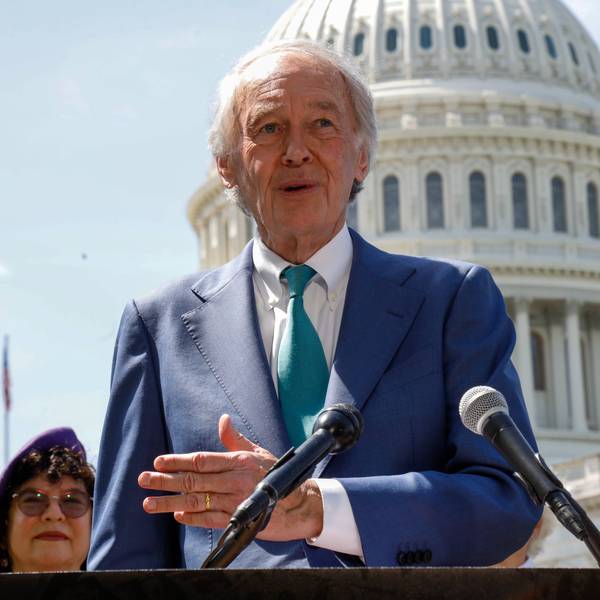
"The United States must not send thousands of conventional weapons to Saudi Arabia or allow it to develop a nuclear program," said Sen. Ed Markey (D-Mass.) in a Thursday statement—a day after he partnered with Sens. Jeff Merkley (D-Ore.) and Bernie Sanders (I-Vt.) to introduce the joint resolution of disapproval, which was referred to the Senate Foreign Relations Committee.
"I am deeply concerned by the kingdom's human rights abuses, the security of the region as the war in Iran rages on, and the proxy war that is escalating between Iran and Saudi Arabia in Yemen," Markey explained. "Further escalation in the Saudi-Iran proxy war will worsen an already dire humanitarian catastrophe in Yemen and risks setting off a nuclear arms race between Iran and Saudi Arabia."
The resolution targets a sale approved by the US State Department on September 4 that includes over 10,000 joint direct attack munition (JDAM) guidance kits. As Breaking Defense detailed, "The prospective transaction includes a similar number of dumb bombs—split almost evenly between 500 lb. and 2,000 lb. munitions—which, when equipped with a JDAM, can be used as a precision weapon."
The bill does not apply to the other possible sale to Saudi Arabia endorsed by the department that same day—$750 million for AGT-1500 engines and related equipment—or the $24.3 billion deal for F-35 Lightning II fighter jets, which the Trump administration greenlit Thursday, after the resolution was introduced.
The latest approval "comes nearly two months after Saudi Defense Minister Khalid bin Salman traveled to Washington to lobby senior Trump administration officials on the sale, with Riyadh hoping to advance the deal ahead of the midterms," Semafor noted. The upcoming US elections could lead to Trump's Republican Party losing control of Congress.
The warplanes sale could also face pushback from Congress. According to Politico, Rep. Raja Krishnamoorthi (D-Ill.), who sits on the House Intelligence Committee, warned that "it could put the crown jewels of American military technology within reach of the Chinese Communist Party."
US approves $24.3 billion sale of 48 F-35 stealth warplanes to Saudi Arabia.US intelligence analysts have raised the possibility that China could acquire F-35 technology through its partnerships with Saudi. Israel had been the only country in the Middle East to operate the jetsu.afp.com/SjRn
[image or embed]
— AFP News Agency (@en.afp.com) September 17, 2026 at 9:41 PM
In addition to unveiling their resolution about the JDAMs and bombs on Wednesday, Markey and Merkley, co-chairs of the bicameral Nuclear Weapons and Arms Control Working Group, led a bipartisan group of senators—including Sanders—in urging a pair of Trump Cabinet members to declassify two side letters associated with the administration's proposed nuclear deal.
The administration submitted the pending 30-year agreement—which would allow US companies to share nuclear power technology with the kingdom—to Congress after it was signed by US Energy Secretary Chris Wright and Saudi Energy Minister Prince Abdulaziz bin Salman in July.
Under Section 123 of the Atomic Energy Act, Congress has 90 days of continuous session to review the deal and either move to block it or let it take effect. The senators' new letter to Wright and Secretary of State Marco Rubio notes that "in previous 123 agreements, the executive branch publicly released the agreement along with side letters and related documents."
"Access to the full text is required for the Senate and the public to have a clear understanding of the commitments being made on the nation's behalf and those being made by Saudi Arabia to the United States," the senators argued. "Their public release would also allow civil society, independent experts, and other affected stakeholders to scrutinize the deal."
"Transparency and open debate are cornerstones of our democracy," they emphasized. "Congress and the American public must have a meaningful opportunity to review and debate the key components of the US-Saudi nuclear deal before it potentially enters into force. To that end, we call on you to declassify and release the two side letters without delay."
Dear Common Dreams reader, It’s been nearly 30 years since I co-founded Common Dreams with my late wife, Lina Newhouser. We had the radical notion that journalism should serve the public good, not corporate profits. It was clear to us from the outset what it would take to build such a project. No paid advertisements. No corporate sponsors. No millionaire publisher telling us what to think or do. Many people said we wouldn't last a year, but we proved those doubters wrong. Together with a tremendous team of journalists and dedicated staff, we built an independent media outlet free from the constraints of profits and corporate control. Our mission has always been simple: To inform. To inspire. To ignite change for the common good. Building Common Dreams was not easy. Our survival was never guaranteed. When you take on the most powerful forces—Wall Street greed, fossil fuel industry destruction, Big Tech lobbyists, and uber-rich oligarchs who have spent billions upon billions rigging the economy and democracy in their favor—the only bulwark you have is supporters who believe in your work. But here’s the urgent message from me today. It's never been this bad out there. And it's never been this hard to keep us going. At the very moment Common Dreams is most needed, the threats we face are intensifying. We need your support now more than ever. We don't accept corporate advertising and never will. We don't have a paywall because we don't think people should be blocked from critical news based on their ability to pay. Everything we do is funded by the donations of readers like you. When everyone does the little they can afford, we are strong. But if that support retreats or dries up, so do we. Will you donate now to make sure Common Dreams not only survives but thrives? —Craig Brown, Co-founder |
A trio of progressive US senators this week introduced legislation to block a $5 billion conventional weapons sale to Saudi Arabia while also pushing for the release of more details about President Donald Trump's proposed nuclear cooperation agreement with the Middle Eastern kingdom.
"The United States must not send thousands of conventional weapons to Saudi Arabia or allow it to develop a nuclear program," said Sen. Ed Markey (D-Mass.) in a Thursday statement—a day after he partnered with Sens. Jeff Merkley (D-Ore.) and Bernie Sanders (I-Vt.) to introduce the joint resolution of disapproval, which was referred to the Senate Foreign Relations Committee.
"I am deeply concerned by the kingdom's human rights abuses, the security of the region as the war in Iran rages on, and the proxy war that is escalating between Iran and Saudi Arabia in Yemen," Markey explained. "Further escalation in the Saudi-Iran proxy war will worsen an already dire humanitarian catastrophe in Yemen and risks setting off a nuclear arms race between Iran and Saudi Arabia."
The resolution targets a sale approved by the US State Department on September 4 that includes over 10,000 joint direct attack munition (JDAM) guidance kits. As Breaking Defense detailed, "The prospective transaction includes a similar number of dumb bombs—split almost evenly between 500 lb. and 2,000 lb. munitions—which, when equipped with a JDAM, can be used as a precision weapon."
The bill does not apply to the other possible sale to Saudi Arabia endorsed by the department that same day—$750 million for AGT-1500 engines and related equipment—or the $24.3 billion deal for F-35 Lightning II fighter jets, which the Trump administration greenlit Thursday, after the resolution was introduced.
The latest approval "comes nearly two months after Saudi Defense Minister Khalid bin Salman traveled to Washington to lobby senior Trump administration officials on the sale, with Riyadh hoping to advance the deal ahead of the midterms," Semafor noted. The upcoming US elections could lead to Trump's Republican Party losing control of Congress.
The warplanes sale could also face pushback from Congress. According to Politico, Rep. Raja Krishnamoorthi (D-Ill.), who sits on the House Intelligence Committee, warned that "it could put the crown jewels of American military technology within reach of the Chinese Communist Party."
US approves $24.3 billion sale of 48 F-35 stealth warplanes to Saudi Arabia.US intelligence analysts have raised the possibility that China could acquire F-35 technology through its partnerships with Saudi. Israel had been the only country in the Middle East to operate the jetsu.afp.com/SjRn
[image or embed]
— AFP News Agency (@en.afp.com) September 17, 2026 at 9:41 PM
In addition to unveiling their resolution about the JDAMs and bombs on Wednesday, Markey and Merkley, co-chairs of the bicameral Nuclear Weapons and Arms Control Working Group, led a bipartisan group of senators—including Sanders—in urging a pair of Trump Cabinet members to declassify two side letters associated with the administration's proposed nuclear deal.
The administration submitted the pending 30-year agreement—which would allow US companies to share nuclear power technology with the kingdom—to Congress after it was signed by US Energy Secretary Chris Wright and Saudi Energy Minister Prince Abdulaziz bin Salman in July.
Under Section 123 of the Atomic Energy Act, Congress has 90 days of continuous session to review the deal and either move to block it or let it take effect. The senators' new letter to Wright and Secretary of State Marco Rubio notes that "in previous 123 agreements, the executive branch publicly released the agreement along with side letters and related documents."
"Access to the full text is required for the Senate and the public to have a clear understanding of the commitments being made on the nation's behalf and those being made by Saudi Arabia to the United States," the senators argued. "Their public release would also allow civil society, independent experts, and other affected stakeholders to scrutinize the deal."
"Transparency and open debate are cornerstones of our democracy," they emphasized. "Congress and the American public must have a meaningful opportunity to review and debate the key components of the US-Saudi nuclear deal before it potentially enters into force. To that end, we call on you to declassify and release the two side letters without delay."
A trio of progressive US senators this week introduced legislation to block a $5 billion conventional weapons sale to Saudi Arabia while also pushing for the release of more details about President Donald Trump's proposed nuclear cooperation agreement with the Middle Eastern kingdom.
"The United States must not send thousands of conventional weapons to Saudi Arabia or allow it to develop a nuclear program," said Sen. Ed Markey (D-Mass.) in a Thursday statement—a day after he partnered with Sens. Jeff Merkley (D-Ore.) and Bernie Sanders (I-Vt.) to introduce the joint resolution of disapproval, which was referred to the Senate Foreign Relations Committee.
"I am deeply concerned by the kingdom's human rights abuses, the security of the region as the war in Iran rages on, and the proxy war that is escalating between Iran and Saudi Arabia in Yemen," Markey explained. "Further escalation in the Saudi-Iran proxy war will worsen an already dire humanitarian catastrophe in Yemen and risks setting off a nuclear arms race between Iran and Saudi Arabia."
The resolution targets a sale approved by the US State Department on September 4 that includes over 10,000 joint direct attack munition (JDAM) guidance kits. As Breaking Defense detailed, "The prospective transaction includes a similar number of dumb bombs—split almost evenly between 500 lb. and 2,000 lb. munitions—which, when equipped with a JDAM, can be used as a precision weapon."
The bill does not apply to the other possible sale to Saudi Arabia endorsed by the department that same day—$750 million for AGT-1500 engines and related equipment—or the $24.3 billion deal for F-35 Lightning II fighter jets, which the Trump administration greenlit Thursday, after the resolution was introduced.
The latest approval "comes nearly two months after Saudi Defense Minister Khalid bin Salman traveled to Washington to lobby senior Trump administration officials on the sale, with Riyadh hoping to advance the deal ahead of the midterms," Semafor noted. The upcoming US elections could lead to Trump's Republican Party losing control of Congress.
The warplanes sale could also face pushback from Congress. According to Politico, Rep. Raja Krishnamoorthi (D-Ill.), who sits on the House Intelligence Committee, warned that "it could put the crown jewels of American military technology within reach of the Chinese Communist Party."
US approves $24.3 billion sale of 48 F-35 stealth warplanes to Saudi Arabia.US intelligence analysts have raised the possibility that China could acquire F-35 technology through its partnerships with Saudi. Israel had been the only country in the Middle East to operate the jetsu.afp.com/SjRn
[image or embed]
— AFP News Agency (@en.afp.com) September 17, 2026 at 9:41 PM
In addition to unveiling their resolution about the JDAMs and bombs on Wednesday, Markey and Merkley, co-chairs of the bicameral Nuclear Weapons and Arms Control Working Group, led a bipartisan group of senators—including Sanders—in urging a pair of Trump Cabinet members to declassify two side letters associated with the administration's proposed nuclear deal.
The administration submitted the pending 30-year agreement—which would allow US companies to share nuclear power technology with the kingdom—to Congress after it was signed by US Energy Secretary Chris Wright and Saudi Energy Minister Prince Abdulaziz bin Salman in July.
Under Section 123 of the Atomic Energy Act, Congress has 90 days of continuous session to review the deal and either move to block it or let it take effect. The senators' new letter to Wright and Secretary of State Marco Rubio notes that "in previous 123 agreements, the executive branch publicly released the agreement along with side letters and related documents."
"Access to the full text is required for the Senate and the public to have a clear understanding of the commitments being made on the nation's behalf and those being made by Saudi Arabia to the United States," the senators argued. "Their public release would also allow civil society, independent experts, and other affected stakeholders to scrutinize the deal."
"Transparency and open debate are cornerstones of our democracy," they emphasized. "Congress and the American public must have a meaningful opportunity to review and debate the key components of the US-Saudi nuclear deal before it potentially enters into force. To that end, we call on you to declassify and release the two side letters without delay."