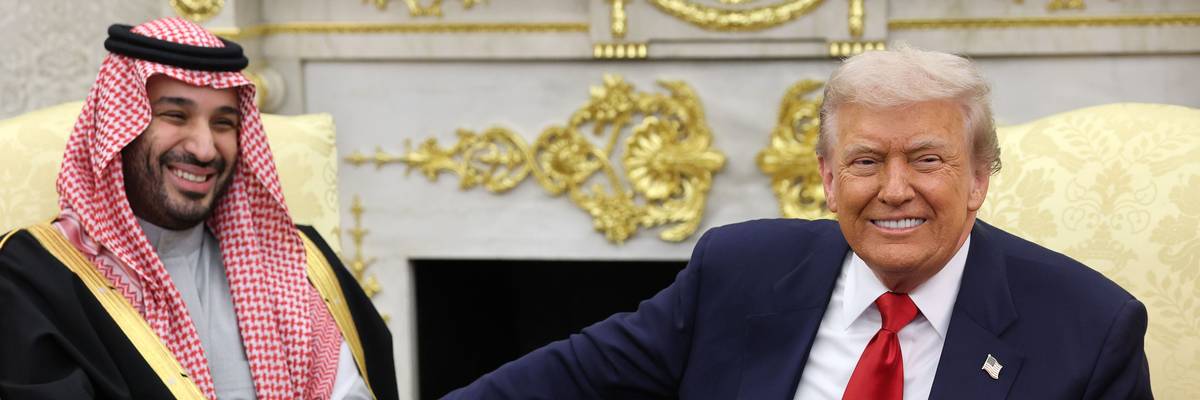
President Donald Trump takes the hand of Crown Prince and Prime Minister Mohammed bin Salman of Saudi Arabia during a bilateral meeting on November 18, 2025 in Washington, DC.
Nonproliferation Experts Say Congress Must Reject Trump-Saudi Nuclear Deal
One expert described the reported deal as "tantamount to the United States giving up on nonproliferation."
Nonproliferation experts are raising alarms after Reuters reported on Tuesday that President Donald Trump's administration plans to ask Congress to approve a deal that could allow Saudi Arabia to develop nuclear weapons.
According to Reuters, an agreement crafted by the Trump administration would allow the US to share nuclear power technology with the Saudis without proper safeguards that "would stop materials being used in nuclear weapons programs."
Specifically, Reuters' sources said the deal "does not include the 'Gold Standard' that would block the kingdom from enriching uranium and reprocessing spent nuclear fuel, both of which are potential pathways to nuclear weapons."
Kelsey Davenport, director for nonprolifertion policy at the Arms Control Association, warned in a Tuesday social media post that the reported agreement "sets a terrible precedent" because it "goes against long-standing bipartisan support for negotiating nuclear cooperation agreements that prohibit enrichment and reprocessing."
"If the deal is inadequate, which it seems to be," Davenport added, "Congress should vote to disapprove it."
Andrea Stricker, deputy director and research fellow at the Foundation for Defense of Democracies' Nonproliferation Program, said that "Congress should block" the deal, which she warned could lead other states in the region to seek their own nuclear weapons.
If Congress fails to block the deal, Stricker added, then "one hopes the policy will be reversed by a subsequent administration before too much damage is done in terms of watering down safeguards, setting negative precedents for other states, and failing to contain the spread of enrichment and reprocessing."
James Acton, co-director of the Carnegie Endowment for International Peace's Nuclear Policy Program, said the reported Saudi nuclear deal is "tantamount to the United States giving up on nonproliferation."
"Saudi officials are open about a potential interest in nuclear weapons," Acton said. "The United States should do nothing to facilitate enrichment or reprocessing in the Kingdom."
Emma Ashford, senior fellow at the Stimson Center, agreed that the reported agreement would mean the end of US attempts to curtail the spread of nuclear weapons, and noted the irony of the Trump administration "bombing Iran to prevent them ever having enrichment, while giving it to the Saudis."
Rosemary Kelanic, director of the Middle East Program at Defense Priorities, called the reported deal a "terrible idea" that "goes against decades of US policy to give enrichment technology to a country that doesn't already possess it."
Kelanic also warned that the agreement would empower the Saudi government in ways that could come back to bite the US.
"Aside from the proliferation risks, uranium enrichment would give Saudi Arabia a potent source of leverage to extract future concessions from Washington," Kelanic explained, "including new security guarantees, by threatening to weaponize its program unless the United States promises enhanced military protection. That has happened before, for instance in South Korea and West Germany, where the U.S. traded protection to persuade partners to abandon nuclear programs."
Rep. Gregory Meeks (D-NY), ranking member of the House Foreign Relations Committee, expressed "deep concerns" about the reported deal, which he said "would significantly erode existing nonproliferation standards."
"Any agreement must include appropriate limits on enrichment and reprocessing," Meeks emphasized, "as well as the [International Atomic Energy Agency's] Additional Protocol."
We are at a crossroads
This country and this world are at a monumental crossroads. In a few short weeks, US voters will have an opportunity to beat back the forces of fascism and confront the billionaires who are rigging the economy, our media system, and our democracy, making it increasingly impossible for ordinary people to get by. We’re not just talking about the election. We’re talking about what must be done once these fascist elements are vanquished from power. We need a bolder set of solutions than what either major party has so far been willing to offer and a working-class movement ready to fight like hell for it. Trump didn't emerge from nowhere. The conditions that fueled MAGA authoritarianism were created by decades of radical neoliberal economic policies and a corrupt political system dominated by corporate interests. They slashed taxes on the super-rich, promising that the benefits would trickle down. They said giveaways to the corporate titans would make life more affordable for the rest of us. It was all bullshit. And when a bitter, betrayed populace searches for someone to blame, right-wing demagogues have little trouble finding scapegoats. People know when they're being lied to, but you won't hear any of this from the corporate media. Only independent journalism—powered and funded by people who believe in building a better world—can deliver truly trustworthy daily news. Our Fall Campaign is underway, and we need your help. To power our newsroom through the rest of the year, we need to raise $125,000 by midnight on October 31. So if you share our vision, please contribute whatever you can to sustain our work. |
Nonproliferation experts are raising alarms after Reuters reported on Tuesday that President Donald Trump's administration plans to ask Congress to approve a deal that could allow Saudi Arabia to develop nuclear weapons.
According to Reuters, an agreement crafted by the Trump administration would allow the US to share nuclear power technology with the Saudis without proper safeguards that "would stop materials being used in nuclear weapons programs."
Specifically, Reuters' sources said the deal "does not include the 'Gold Standard' that would block the kingdom from enriching uranium and reprocessing spent nuclear fuel, both of which are potential pathways to nuclear weapons."
Kelsey Davenport, director for nonprolifertion policy at the Arms Control Association, warned in a Tuesday social media post that the reported agreement "sets a terrible precedent" because it "goes against long-standing bipartisan support for negotiating nuclear cooperation agreements that prohibit enrichment and reprocessing."
"If the deal is inadequate, which it seems to be," Davenport added, "Congress should vote to disapprove it."
Andrea Stricker, deputy director and research fellow at the Foundation for Defense of Democracies' Nonproliferation Program, said that "Congress should block" the deal, which she warned could lead other states in the region to seek their own nuclear weapons.
If Congress fails to block the deal, Stricker added, then "one hopes the policy will be reversed by a subsequent administration before too much damage is done in terms of watering down safeguards, setting negative precedents for other states, and failing to contain the spread of enrichment and reprocessing."
James Acton, co-director of the Carnegie Endowment for International Peace's Nuclear Policy Program, said the reported Saudi nuclear deal is "tantamount to the United States giving up on nonproliferation."
"Saudi officials are open about a potential interest in nuclear weapons," Acton said. "The United States should do nothing to facilitate enrichment or reprocessing in the Kingdom."
Emma Ashford, senior fellow at the Stimson Center, agreed that the reported agreement would mean the end of US attempts to curtail the spread of nuclear weapons, and noted the irony of the Trump administration "bombing Iran to prevent them ever having enrichment, while giving it to the Saudis."
Rosemary Kelanic, director of the Middle East Program at Defense Priorities, called the reported deal a "terrible idea" that "goes against decades of US policy to give enrichment technology to a country that doesn't already possess it."
Kelanic also warned that the agreement would empower the Saudi government in ways that could come back to bite the US.
"Aside from the proliferation risks, uranium enrichment would give Saudi Arabia a potent source of leverage to extract future concessions from Washington," Kelanic explained, "including new security guarantees, by threatening to weaponize its program unless the United States promises enhanced military protection. That has happened before, for instance in South Korea and West Germany, where the U.S. traded protection to persuade partners to abandon nuclear programs."
Rep. Gregory Meeks (D-NY), ranking member of the House Foreign Relations Committee, expressed "deep concerns" about the reported deal, which he said "would significantly erode existing nonproliferation standards."
"Any agreement must include appropriate limits on enrichment and reprocessing," Meeks emphasized, "as well as the [International Atomic Energy Agency's] Additional Protocol."
- Warning of US Unreliability and Israeli 'Sabotage,' Iran Refutes Trump Claim of Peace Deal ›
- For Trump, Authoritarian Saudi Arabia Is Good But Authoritarian Iran and Venezuela Are Bad ›
- In Bonanza for Arms Industry, Trump Announces Record $142 Billion Weapons Sale to Saudis ›
- Markey Urges Congress to Block Trump-Saudi Deal, a 'Starting Gun for a Middle East Nuclear Arms Race' | Common Dreams ›
- Markey, Merkley, and Sanders Lead Charge Against Trump's $5 Billion Saudi Weapons Deal | Common Dreams ›
- Democratic Senators Aim to Block Trump Nuclear Deal With Saudi Arabia | Common Dreams ›
Nonproliferation experts are raising alarms after Reuters reported on Tuesday that President Donald Trump's administration plans to ask Congress to approve a deal that could allow Saudi Arabia to develop nuclear weapons.
According to Reuters, an agreement crafted by the Trump administration would allow the US to share nuclear power technology with the Saudis without proper safeguards that "would stop materials being used in nuclear weapons programs."
Specifically, Reuters' sources said the deal "does not include the 'Gold Standard' that would block the kingdom from enriching uranium and reprocessing spent nuclear fuel, both of which are potential pathways to nuclear weapons."
Kelsey Davenport, director for nonprolifertion policy at the Arms Control Association, warned in a Tuesday social media post that the reported agreement "sets a terrible precedent" because it "goes against long-standing bipartisan support for negotiating nuclear cooperation agreements that prohibit enrichment and reprocessing."
"If the deal is inadequate, which it seems to be," Davenport added, "Congress should vote to disapprove it."
Andrea Stricker, deputy director and research fellow at the Foundation for Defense of Democracies' Nonproliferation Program, said that "Congress should block" the deal, which she warned could lead other states in the region to seek their own nuclear weapons.
If Congress fails to block the deal, Stricker added, then "one hopes the policy will be reversed by a subsequent administration before too much damage is done in terms of watering down safeguards, setting negative precedents for other states, and failing to contain the spread of enrichment and reprocessing."
James Acton, co-director of the Carnegie Endowment for International Peace's Nuclear Policy Program, said the reported Saudi nuclear deal is "tantamount to the United States giving up on nonproliferation."
"Saudi officials are open about a potential interest in nuclear weapons," Acton said. "The United States should do nothing to facilitate enrichment or reprocessing in the Kingdom."
Emma Ashford, senior fellow at the Stimson Center, agreed that the reported agreement would mean the end of US attempts to curtail the spread of nuclear weapons, and noted the irony of the Trump administration "bombing Iran to prevent them ever having enrichment, while giving it to the Saudis."
Rosemary Kelanic, director of the Middle East Program at Defense Priorities, called the reported deal a "terrible idea" that "goes against decades of US policy to give enrichment technology to a country that doesn't already possess it."
Kelanic also warned that the agreement would empower the Saudi government in ways that could come back to bite the US.
"Aside from the proliferation risks, uranium enrichment would give Saudi Arabia a potent source of leverage to extract future concessions from Washington," Kelanic explained, "including new security guarantees, by threatening to weaponize its program unless the United States promises enhanced military protection. That has happened before, for instance in South Korea and West Germany, where the U.S. traded protection to persuade partners to abandon nuclear programs."
Rep. Gregory Meeks (D-NY), ranking member of the House Foreign Relations Committee, expressed "deep concerns" about the reported deal, which he said "would significantly erode existing nonproliferation standards."
"Any agreement must include appropriate limits on enrichment and reprocessing," Meeks emphasized, "as well as the [International Atomic Energy Agency's] Additional Protocol."
- Warning of US Unreliability and Israeli 'Sabotage,' Iran Refutes Trump Claim of Peace Deal ›
- For Trump, Authoritarian Saudi Arabia Is Good But Authoritarian Iran and Venezuela Are Bad ›
- In Bonanza for Arms Industry, Trump Announces Record $142 Billion Weapons Sale to Saudis ›
- Markey Urges Congress to Block Trump-Saudi Deal, a 'Starting Gun for a Middle East Nuclear Arms Race' | Common Dreams ›
- Markey, Merkley, and Sanders Lead Charge Against Trump's $5 Billion Saudi Weapons Deal | Common Dreams ›
- Democratic Senators Aim to Block Trump Nuclear Deal With Saudi Arabia | Common Dreams ›