SUBSCRIBE TO OUR FREE NEWSLETTER
Daily news & progressive opinion—funded by the people, not the corporations—delivered straight to your inbox.
5
#000000
#FFFFFF
To donate by check, phone, or other method, see our More Ways to Give page.
Daily news & progressive opinion—funded by the people, not the corporations—delivered straight to your inbox.
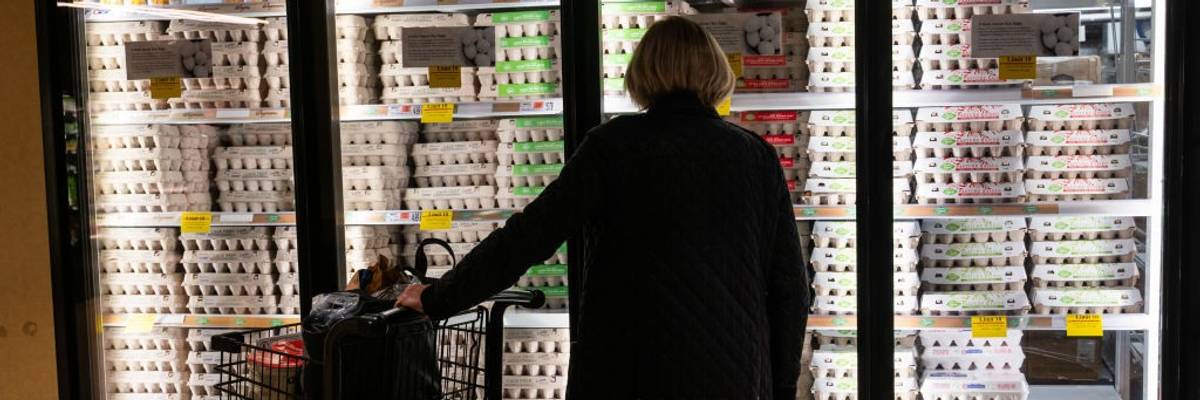
Eggs are displayed for sale in a Manhattan grocery store on February 25, 2025 in New York City.
"Bloodbath of a consumer sentiment print," said one policy expert. "People hate the Trump economy."
Data published Friday shows that U.S. consumer sentiment cratered in early March to its lowest level since late 2022 as President Donald Trump's erratic tariff policies and assault on the federal government—the nation's largest employer—spurred far-reaching economic chaos.
The University of Michigan's closely watched consumer confidence gauge shows that sentiment "slid another 11% this month, with declines seen consistently across all groups by age, education, income, wealth, political affiliations, and geographic regions."
"While current economic conditions were little changed, expectations for the future deteriorated across multiple facets of the economy, including personal finances, labor markets, inflation, business conditions, and stock markets," said Joanne Hsu, director of the university's Surveys of Consumers. "Many consumers cited the high level of uncertainty around policy and other economic factors; frequent gyrations in economic policies make it very difficult for consumers to plan for the future, regardless of one's policy preferences."
"Consumers from all three political affiliations are in agreement that the outlook has weakened since February," Hsu added. "Despite their greater confidence following the election, Republicans posted a sizable 10% decline in their expectations index in March. For Independents and Democrats, the expectations index declined an even steeper 12% and 24%, respectively."
The survey also found that consumer inflation expectations jumped to their highest level since November 2022, an indication that Americans are concerned about the impact that Trump's trade war will have on prices, which the president promised during his campaign to bring down.
Alex Jacquez, chief of policy and advocacy at the Groundwork Collaborative, said in a statement that the "shocking consumer sentiment numbers are a referendum on the president’s mishandling of the economy, just 54 days into office."
"Working families are longing for stability as their grocery bills and rent payments continue to climb, but Trump's chaotic approach to the economy has them feeling more uncertain than ever," said Jacquez. "Consumers are rightly terrified about what lies ahead. The administration is more focused on gutting Social Security to pay for tax giveaways to billionaires and corporations than they are making life more affordable for working families."
The new consumer survey data comes a week after a Labor Department report showed that the U.S. added significantly fewer jobs than expected in February, which one economist described as "the calm before the storm" as the Trump administration fires tens of thousands of federal workers, fuels widespread unease and confusion with his tariff threats, and backs devastating cuts to Medicaid and other key programs.
"The administration seems determined to squander and wreck the strong economy," Josh Bivens, chief economist at the Economic Policy Institute, wrote earlier this week. "Each of the individual policies they are pursuing—illegal layoffs of federal workers, mass deportations, constant threats and retractions of broad-based tariffs, and Medicaid spending cuts—would be bad for the economy. But each policy is also being pursued with maximum levels of chaos and incoordination, creating unprecedented levels of economic uncertainty. This uncertainty is itself a serious economic threat."
"Absent a radical reversal of the current policy agenda, the U.S. will be a poorer country at the end of Trump's term than it should have been," Bivens added. "The only open question is how rapidly this de-growth will happen, whether more quickly through a sharp recession or more slowly as the supply destruction outpaces demand destruction."
Dear Common Dreams reader, It’s been nearly 30 years since I co-founded Common Dreams with my late wife, Lina Newhouser. We had the radical notion that journalism should serve the public good, not corporate profits. It was clear to us from the outset what it would take to build such a project. No paid advertisements. No corporate sponsors. No millionaire publisher telling us what to think or do. Many people said we wouldn't last a year, but we proved those doubters wrong. Together with a tremendous team of journalists and dedicated staff, we built an independent media outlet free from the constraints of profits and corporate control. Our mission has always been simple: To inform. To inspire. To ignite change for the common good. Building Common Dreams was not easy. Our survival was never guaranteed. When you take on the most powerful forces—Wall Street greed, fossil fuel industry destruction, Big Tech lobbyists, and uber-rich oligarchs who have spent billions upon billions rigging the economy and democracy in their favor—the only bulwark you have is supporters who believe in your work. But here’s the urgent message from me today. It's never been this bad out there. And it's never been this hard to keep us going. At the very moment Common Dreams is most needed, the threats we face are intensifying. We need your support now more than ever. We don't accept corporate advertising and never will. We don't have a paywall because we don't think people should be blocked from critical news based on their ability to pay. Everything we do is funded by the donations of readers like you. When everyone does the little they can afford, we are strong. But if that support retreats or dries up, so do we. Will you donate now to make sure Common Dreams not only survives but thrives? —Craig Brown, Co-founder |
Data published Friday shows that U.S. consumer sentiment cratered in early March to its lowest level since late 2022 as President Donald Trump's erratic tariff policies and assault on the federal government—the nation's largest employer—spurred far-reaching economic chaos.
The University of Michigan's closely watched consumer confidence gauge shows that sentiment "slid another 11% this month, with declines seen consistently across all groups by age, education, income, wealth, political affiliations, and geographic regions."
"While current economic conditions were little changed, expectations for the future deteriorated across multiple facets of the economy, including personal finances, labor markets, inflation, business conditions, and stock markets," said Joanne Hsu, director of the university's Surveys of Consumers. "Many consumers cited the high level of uncertainty around policy and other economic factors; frequent gyrations in economic policies make it very difficult for consumers to plan for the future, regardless of one's policy preferences."
"Consumers from all three political affiliations are in agreement that the outlook has weakened since February," Hsu added. "Despite their greater confidence following the election, Republicans posted a sizable 10% decline in their expectations index in March. For Independents and Democrats, the expectations index declined an even steeper 12% and 24%, respectively."
The survey also found that consumer inflation expectations jumped to their highest level since November 2022, an indication that Americans are concerned about the impact that Trump's trade war will have on prices, which the president promised during his campaign to bring down.
Alex Jacquez, chief of policy and advocacy at the Groundwork Collaborative, said in a statement that the "shocking consumer sentiment numbers are a referendum on the president’s mishandling of the economy, just 54 days into office."
"Working families are longing for stability as their grocery bills and rent payments continue to climb, but Trump's chaotic approach to the economy has them feeling more uncertain than ever," said Jacquez. "Consumers are rightly terrified about what lies ahead. The administration is more focused on gutting Social Security to pay for tax giveaways to billionaires and corporations than they are making life more affordable for working families."
The new consumer survey data comes a week after a Labor Department report showed that the U.S. added significantly fewer jobs than expected in February, which one economist described as "the calm before the storm" as the Trump administration fires tens of thousands of federal workers, fuels widespread unease and confusion with his tariff threats, and backs devastating cuts to Medicaid and other key programs.
"The administration seems determined to squander and wreck the strong economy," Josh Bivens, chief economist at the Economic Policy Institute, wrote earlier this week. "Each of the individual policies they are pursuing—illegal layoffs of federal workers, mass deportations, constant threats and retractions of broad-based tariffs, and Medicaid spending cuts—would be bad for the economy. But each policy is also being pursued with maximum levels of chaos and incoordination, creating unprecedented levels of economic uncertainty. This uncertainty is itself a serious economic threat."
"Absent a radical reversal of the current policy agenda, the U.S. will be a poorer country at the end of Trump's term than it should have been," Bivens added. "The only open question is how rapidly this de-growth will happen, whether more quickly through a sharp recession or more slowly as the supply destruction outpaces demand destruction."
Data published Friday shows that U.S. consumer sentiment cratered in early March to its lowest level since late 2022 as President Donald Trump's erratic tariff policies and assault on the federal government—the nation's largest employer—spurred far-reaching economic chaos.
The University of Michigan's closely watched consumer confidence gauge shows that sentiment "slid another 11% this month, with declines seen consistently across all groups by age, education, income, wealth, political affiliations, and geographic regions."
"While current economic conditions were little changed, expectations for the future deteriorated across multiple facets of the economy, including personal finances, labor markets, inflation, business conditions, and stock markets," said Joanne Hsu, director of the university's Surveys of Consumers. "Many consumers cited the high level of uncertainty around policy and other economic factors; frequent gyrations in economic policies make it very difficult for consumers to plan for the future, regardless of one's policy preferences."
"Consumers from all three political affiliations are in agreement that the outlook has weakened since February," Hsu added. "Despite their greater confidence following the election, Republicans posted a sizable 10% decline in their expectations index in March. For Independents and Democrats, the expectations index declined an even steeper 12% and 24%, respectively."
The survey also found that consumer inflation expectations jumped to their highest level since November 2022, an indication that Americans are concerned about the impact that Trump's trade war will have on prices, which the president promised during his campaign to bring down.
Alex Jacquez, chief of policy and advocacy at the Groundwork Collaborative, said in a statement that the "shocking consumer sentiment numbers are a referendum on the president’s mishandling of the economy, just 54 days into office."
"Working families are longing for stability as their grocery bills and rent payments continue to climb, but Trump's chaotic approach to the economy has them feeling more uncertain than ever," said Jacquez. "Consumers are rightly terrified about what lies ahead. The administration is more focused on gutting Social Security to pay for tax giveaways to billionaires and corporations than they are making life more affordable for working families."
The new consumer survey data comes a week after a Labor Department report showed that the U.S. added significantly fewer jobs than expected in February, which one economist described as "the calm before the storm" as the Trump administration fires tens of thousands of federal workers, fuels widespread unease and confusion with his tariff threats, and backs devastating cuts to Medicaid and other key programs.
"The administration seems determined to squander and wreck the strong economy," Josh Bivens, chief economist at the Economic Policy Institute, wrote earlier this week. "Each of the individual policies they are pursuing—illegal layoffs of federal workers, mass deportations, constant threats and retractions of broad-based tariffs, and Medicaid spending cuts—would be bad for the economy. But each policy is also being pursued with maximum levels of chaos and incoordination, creating unprecedented levels of economic uncertainty. This uncertainty is itself a serious economic threat."
"Absent a radical reversal of the current policy agenda, the U.S. will be a poorer country at the end of Trump's term than it should have been," Bivens added. "The only open question is how rapidly this de-growth will happen, whether more quickly through a sharp recession or more slowly as the supply destruction outpaces demand destruction."