SUBSCRIBE TO OUR FREE NEWSLETTER
Daily news & progressive opinion—funded by the people, not the corporations—delivered straight to your inbox.
5
#000000
#FFFFFF
To donate by check, phone, or other method, see our More Ways to Give page.
Daily news & progressive opinion—funded by the people, not the corporations—delivered straight to your inbox.
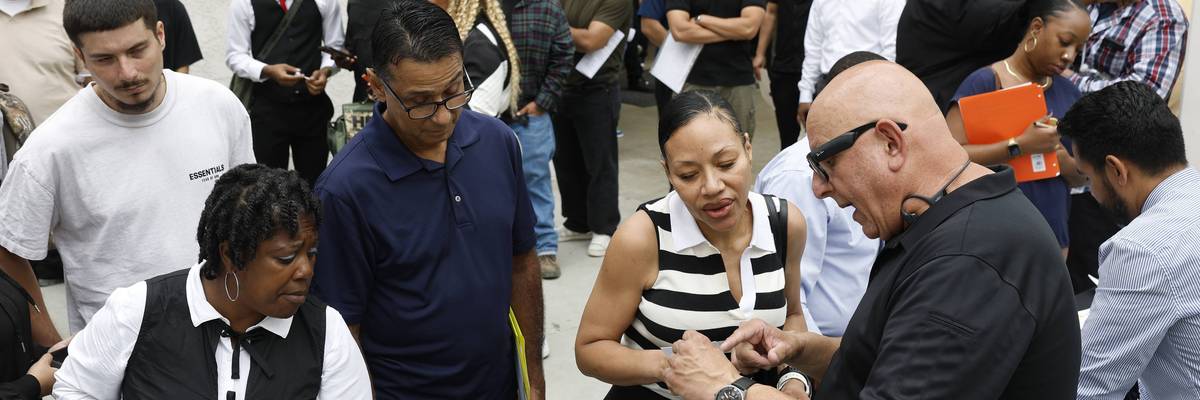
Thousands of job seekers meet with recruiters during the HIRE360 Diversity Hiring Expo & Mega Career Expo on June 30, 2026, in Carson, California.
"Working Americans increasingly report that their paychecks can't keep up with Trump's high prices, but are not confident they’ll be able to find better opportunities," noted one Groundwork Collaborative expert.
As President Donald Trump's team on Thursday tried to paint the June jobs report as positive, economists and congressional Democrats called it "weak" and "disappointing," with some also ripping the Republican administration's harmful policies, from sweeping tariffs and the Iran War to the mass detention and deportation of immigrants.
The nation's economy added just 57,000 jobs in June, or roughly half of what economists had anticipated, according to the latest monthly report from the US Bureau of Labor Statistics. BLS noted that "both the unemployment rate, at 4.2%, and the number of unemployed people, at 7.1 million, changed little in June."
The Department of Labor (DOL) agency also revised job gains down for May by 43,000 and April by 31,000, and said that "over the year, average hourly earnings have increased by 3.5%." That's notably lower than the 4.2% annual inflation rate detailed by BLS a few weeks ago, as Americans struggle to afford groceries, housing, and other basic necessities during Trump's second term.
"Today's weak jobs numbers are grim warning signs of a struggling labor market," Alex Jacquez, a former Obama administration official who is now Groundwork Collaborative's chief of policy and advocacy, said in a statement.
"Job gains reflect temporary seasonal hires and other workers separated from the broader economy while the majority of the labor force is frozen," he explained. "Working Americans increasingly report that their paychecks can't keep up with Trump's high prices, but are not confident they'll be able to find better opportunities. They're instead focused on trying to keep up with the president's price hikes."
Angela Hanks, a former DOL senior official who's now chief of policy programs at The Century Foundation, similarly called the report "yet more evidence of a fragile economy under President Trump, with job growth coming in well below expectations and sizable downward revisions to the last two months."
"While the unemployment rate dipped slightly to 4.2%, this number only tells us how many people are working—it doesn't tell you whether people can afford to live," she stressed. "The reality behind today's jobs numbers is that the cost of living continues to outpace paychecks: 43% of Americans now say they're worse off financially than they were a year ago, and year-over-year wage growth came in at 3.5%, below overall inflation of 4.2%—meaning that real wages are falling."
"Looking beyond the topline numbers, more than half of all June job growth was concentrated in healthcare and social assistance, continuing a trend of these sectors propping up much of our economy," she pointed out. "The labor force participation rate declined sharply and widely, with nearly every demographic group seeing declines, which partially explains the drop in the unemployment rate. Moreover, certain racial and age disparities actually worsened: Black youth unemployment rate rose to a whopping 26.8%, as did Hispanic youth unemployment, coming in at 20.1%—a reminder that this economy is not delivering for workers who are struggling the most."
Hanks added that “while Trump will surely tout this moderate job growth as a win, not long ago numbers like today's would have prompted serious concern. But families aren't grading Trump on a curve: They feel the impacts of this administration's chaotic and costly economic policies every day. Until working people can actually afford their lives—groceries, housing, healthcare, childcare—claims of a 'strong economy' will continue to ring hollow."
In line with Hanks' prediction, Trump's messengers attempted to frame the figures positively, with his press secretary, Karoline Leavitt, celebrating the declining foreign-born labor force amid the administration's deadly crackdown on immigrants, and her deputy, Kush Desai, claiming the report "reinforces that the American labor market remains solid."
Acting Secretary of Labor Keith Sonderling—whom the president earlier this week nominated for the permanent post—said that "Trump's America first agenda continues to provide greater wages for workers and certainty to the sectors which will fuel the next 250 years of US economic security."
Meanwhile, with the midterm elections just four months away, the Democratic National Committee's rapid response director, Kendall Witmer, declared that "Donald Trump's failed economic agenda has driven working families into a corner as Americans worry about how to find a job and keep up with sky-high prices. The reality for working families is undeniable: Trump has wrecked the economy, leaving millions wondering how they will make ends meet with no relief in sight."
"But Trump doesn't give a shit—he's only focused on building his vanity projects and using the power of the presidency to get even richer," added Witmer, just two days after the president's annual financial disclosures revealed that he pocketed an unprecedented $2.2 billion—over half of it from his family’s cryptocurrency grift—during his first year back in the Oval Office.
Congressman Ted Lieu (D-Calif.) took to social media over "another disappointing jobs report" and also called out GOP priorities, from erecting a giant arch in Trump's honor to putting his name on various items, including passports and the $250 bill.
As Lieu concluded, "November is coming."
Dear Common Dreams reader, It’s been nearly 30 years since I co-founded Common Dreams with my late wife, Lina Newhouser. We had the radical notion that journalism should serve the public good, not corporate profits. It was clear to us from the outset what it would take to build such a project. No paid advertisements. No corporate sponsors. No millionaire publisher telling us what to think or do. Many people said we wouldn't last a year, but we proved those doubters wrong. Together with a tremendous team of journalists and dedicated staff, we built an independent media outlet free from the constraints of profits and corporate control. Our mission has always been simple: To inform. To inspire. To ignite change for the common good. Building Common Dreams was not easy. Our survival was never guaranteed. When you take on the most powerful forces—Wall Street greed, fossil fuel industry destruction, Big Tech lobbyists, and uber-rich oligarchs who have spent billions upon billions rigging the economy and democracy in their favor—the only bulwark you have is supporters who believe in your work. But here’s the urgent message from me today. It's never been this bad out there. And it's never been this hard to keep us going. At the very moment Common Dreams is most needed, the threats we face are intensifying. We need your support now more than ever. We don't accept corporate advertising and never will. We don't have a paywall because we don't think people should be blocked from critical news based on their ability to pay. Everything we do is funded by the donations of readers like you. When everyone does the little they can afford, we are strong. But if that support retreats or dries up, so do we. Will you donate now to make sure Common Dreams not only survives but thrives? —Craig Brown, Co-founder |
As President Donald Trump's team on Thursday tried to paint the June jobs report as positive, economists and congressional Democrats called it "weak" and "disappointing," with some also ripping the Republican administration's harmful policies, from sweeping tariffs and the Iran War to the mass detention and deportation of immigrants.
The nation's economy added just 57,000 jobs in June, or roughly half of what economists had anticipated, according to the latest monthly report from the US Bureau of Labor Statistics. BLS noted that "both the unemployment rate, at 4.2%, and the number of unemployed people, at 7.1 million, changed little in June."
The Department of Labor (DOL) agency also revised job gains down for May by 43,000 and April by 31,000, and said that "over the year, average hourly earnings have increased by 3.5%." That's notably lower than the 4.2% annual inflation rate detailed by BLS a few weeks ago, as Americans struggle to afford groceries, housing, and other basic necessities during Trump's second term.
"Today's weak jobs numbers are grim warning signs of a struggling labor market," Alex Jacquez, a former Obama administration official who is now Groundwork Collaborative's chief of policy and advocacy, said in a statement.
"Job gains reflect temporary seasonal hires and other workers separated from the broader economy while the majority of the labor force is frozen," he explained. "Working Americans increasingly report that their paychecks can't keep up with Trump's high prices, but are not confident they'll be able to find better opportunities. They're instead focused on trying to keep up with the president's price hikes."
Angela Hanks, a former DOL senior official who's now chief of policy programs at The Century Foundation, similarly called the report "yet more evidence of a fragile economy under President Trump, with job growth coming in well below expectations and sizable downward revisions to the last two months."
"While the unemployment rate dipped slightly to 4.2%, this number only tells us how many people are working—it doesn't tell you whether people can afford to live," she stressed. "The reality behind today's jobs numbers is that the cost of living continues to outpace paychecks: 43% of Americans now say they're worse off financially than they were a year ago, and year-over-year wage growth came in at 3.5%, below overall inflation of 4.2%—meaning that real wages are falling."
"Looking beyond the topline numbers, more than half of all June job growth was concentrated in healthcare and social assistance, continuing a trend of these sectors propping up much of our economy," she pointed out. "The labor force participation rate declined sharply and widely, with nearly every demographic group seeing declines, which partially explains the drop in the unemployment rate. Moreover, certain racial and age disparities actually worsened: Black youth unemployment rate rose to a whopping 26.8%, as did Hispanic youth unemployment, coming in at 20.1%—a reminder that this economy is not delivering for workers who are struggling the most."
Hanks added that “while Trump will surely tout this moderate job growth as a win, not long ago numbers like today's would have prompted serious concern. But families aren't grading Trump on a curve: They feel the impacts of this administration's chaotic and costly economic policies every day. Until working people can actually afford their lives—groceries, housing, healthcare, childcare—claims of a 'strong economy' will continue to ring hollow."
In line with Hanks' prediction, Trump's messengers attempted to frame the figures positively, with his press secretary, Karoline Leavitt, celebrating the declining foreign-born labor force amid the administration's deadly crackdown on immigrants, and her deputy, Kush Desai, claiming the report "reinforces that the American labor market remains solid."
Acting Secretary of Labor Keith Sonderling—whom the president earlier this week nominated for the permanent post—said that "Trump's America first agenda continues to provide greater wages for workers and certainty to the sectors which will fuel the next 250 years of US economic security."
Meanwhile, with the midterm elections just four months away, the Democratic National Committee's rapid response director, Kendall Witmer, declared that "Donald Trump's failed economic agenda has driven working families into a corner as Americans worry about how to find a job and keep up with sky-high prices. The reality for working families is undeniable: Trump has wrecked the economy, leaving millions wondering how they will make ends meet with no relief in sight."
"But Trump doesn't give a shit—he's only focused on building his vanity projects and using the power of the presidency to get even richer," added Witmer, just two days after the president's annual financial disclosures revealed that he pocketed an unprecedented $2.2 billion—over half of it from his family’s cryptocurrency grift—during his first year back in the Oval Office.
Congressman Ted Lieu (D-Calif.) took to social media over "another disappointing jobs report" and also called out GOP priorities, from erecting a giant arch in Trump's honor to putting his name on various items, including passports and the $250 bill.
As Lieu concluded, "November is coming."
As President Donald Trump's team on Thursday tried to paint the June jobs report as positive, economists and congressional Democrats called it "weak" and "disappointing," with some also ripping the Republican administration's harmful policies, from sweeping tariffs and the Iran War to the mass detention and deportation of immigrants.
The nation's economy added just 57,000 jobs in June, or roughly half of what economists had anticipated, according to the latest monthly report from the US Bureau of Labor Statistics. BLS noted that "both the unemployment rate, at 4.2%, and the number of unemployed people, at 7.1 million, changed little in June."
The Department of Labor (DOL) agency also revised job gains down for May by 43,000 and April by 31,000, and said that "over the year, average hourly earnings have increased by 3.5%." That's notably lower than the 4.2% annual inflation rate detailed by BLS a few weeks ago, as Americans struggle to afford groceries, housing, and other basic necessities during Trump's second term.
"Today's weak jobs numbers are grim warning signs of a struggling labor market," Alex Jacquez, a former Obama administration official who is now Groundwork Collaborative's chief of policy and advocacy, said in a statement.
"Job gains reflect temporary seasonal hires and other workers separated from the broader economy while the majority of the labor force is frozen," he explained. "Working Americans increasingly report that their paychecks can't keep up with Trump's high prices, but are not confident they'll be able to find better opportunities. They're instead focused on trying to keep up with the president's price hikes."
Angela Hanks, a former DOL senior official who's now chief of policy programs at The Century Foundation, similarly called the report "yet more evidence of a fragile economy under President Trump, with job growth coming in well below expectations and sizable downward revisions to the last two months."
"While the unemployment rate dipped slightly to 4.2%, this number only tells us how many people are working—it doesn't tell you whether people can afford to live," she stressed. "The reality behind today's jobs numbers is that the cost of living continues to outpace paychecks: 43% of Americans now say they're worse off financially than they were a year ago, and year-over-year wage growth came in at 3.5%, below overall inflation of 4.2%—meaning that real wages are falling."
"Looking beyond the topline numbers, more than half of all June job growth was concentrated in healthcare and social assistance, continuing a trend of these sectors propping up much of our economy," she pointed out. "The labor force participation rate declined sharply and widely, with nearly every demographic group seeing declines, which partially explains the drop in the unemployment rate. Moreover, certain racial and age disparities actually worsened: Black youth unemployment rate rose to a whopping 26.8%, as did Hispanic youth unemployment, coming in at 20.1%—a reminder that this economy is not delivering for workers who are struggling the most."
Hanks added that “while Trump will surely tout this moderate job growth as a win, not long ago numbers like today's would have prompted serious concern. But families aren't grading Trump on a curve: They feel the impacts of this administration's chaotic and costly economic policies every day. Until working people can actually afford their lives—groceries, housing, healthcare, childcare—claims of a 'strong economy' will continue to ring hollow."
In line with Hanks' prediction, Trump's messengers attempted to frame the figures positively, with his press secretary, Karoline Leavitt, celebrating the declining foreign-born labor force amid the administration's deadly crackdown on immigrants, and her deputy, Kush Desai, claiming the report "reinforces that the American labor market remains solid."
Acting Secretary of Labor Keith Sonderling—whom the president earlier this week nominated for the permanent post—said that "Trump's America first agenda continues to provide greater wages for workers and certainty to the sectors which will fuel the next 250 years of US economic security."
Meanwhile, with the midterm elections just four months away, the Democratic National Committee's rapid response director, Kendall Witmer, declared that "Donald Trump's failed economic agenda has driven working families into a corner as Americans worry about how to find a job and keep up with sky-high prices. The reality for working families is undeniable: Trump has wrecked the economy, leaving millions wondering how they will make ends meet with no relief in sight."
"But Trump doesn't give a shit—he's only focused on building his vanity projects and using the power of the presidency to get even richer," added Witmer, just two days after the president's annual financial disclosures revealed that he pocketed an unprecedented $2.2 billion—over half of it from his family’s cryptocurrency grift—during his first year back in the Oval Office.
Congressman Ted Lieu (D-Calif.) took to social media over "another disappointing jobs report" and also called out GOP priorities, from erecting a giant arch in Trump's honor to putting his name on various items, including passports and the $250 bill.
As Lieu concluded, "November is coming."