SUBSCRIBE TO OUR FREE NEWSLETTER
Daily news & progressive opinion—funded by the people, not the corporations—delivered straight to your inbox.
5
#000000
#FFFFFF
To donate by check, phone, or other method, see our More Ways to Give page.
Daily news & progressive opinion—funded by the people, not the corporations—delivered straight to your inbox.
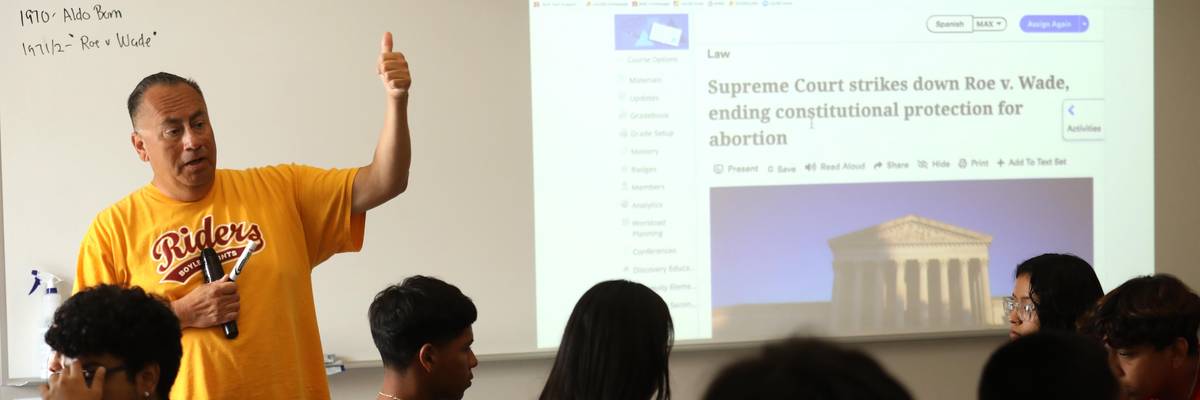
Roosevelt High School 12th grade government teacher Aldo Parral uses the News Literacy Project's materials to teach his students about how to read the news in Los Angeles, California on September 15, 2022.
"They are battling education funding cuts, out-of-control Immigration and Customs Enforcement agents, limitations on what they can say, much less teach, and an affordability crisis," said one union leader.
As the academic year kicks off, survey results released Wednesday by the second-largest teachers union in the United States show how educators are struggling because of underinvestment in schools and high prices under a Republican-controlled White House and Congress.
In the lead-up to classes resuming, Grow Progress last month surveyed 2,112 American Federation of Teachers (AFT) members who teach kindergarten through 12th grade about spending, stress, President Donald Trump's policies, and more.
The pollsters found that a majority of respondents anticipate spending at least $100 to $600 on supplies for their classrooms without being reimbursed. Over a quarter said that school funding issues shift costs to teachers, and supply prices keep rising.
While 61% said they are buying basic supplies, that's not all that teachers are shopping for this year. Nearly a third are spending on food, hygiene, and student care items, and around a quarter are purchasing specialized tools and accessibility supports as well as items for classroom setup, organization, and decor. Roughly a fifth are buying books and rewards for students.
Half of the teachers surveyed said they anticipate needing to buy food for their students at some point during this school year.
Over three-quarters of them reported seeing negative impacts of the Trump administration's policies in their schools and communities, with 61% selecting "very negative." They pointed to funding cuts and privatization of schooling, immigration enforcement that "traumatizes students and families," rising costs, vulnerable students losing support and protection, political pressure that restricts teaching and inclusion, and issues with bigotry and hostility.
Gasoline prices have stayed at record highs lately thanks to Trump's illegal war on Iran, which has responded by restricting traffic through the Strait of Hormuz, a key trade route. Just 15% of teachers said their commute will cost about the same this year, compared with 36% who expect it to be "a little more" and 47% worried it will be "much more."
A plurality—48%—blamed Trump and Republicans specifically for "the rising costs of groceries, gas, and other goods," while 28% pointed to government policies and leadership, 18% said tariffs and global instability, and 11% cited corporate greed and profiteering.
Prices for everything are climbing while the national debt races past $40 trillion. The bottom line? The current economy is not working for hardworking Americans. www.nytimes.com/2026/08/29/u...
[image or embed]
— AFT (@aft.org) September 2, 2026 at 9:45 AM
Asked to rank their stress level on a 1-10 scale, with 10 being extremely stressed, 62% selected somewhere in the 7-10 range.
Almost a third of teachers said they were somewhat or very likely to leave the profession in the next year. While over half of all respondents said they can't afford to lose their salary, pension, and benefits, and a quarter pointed to their love for teaching and students, nearly a fifth said the stress and workload make the job unsustainable.
"Teachers are at a breaking point," said AFT president Randi Weingarten said in a statement. "Many work more than one job to make ends meet, and they still dig into their pockets each year for basic classroom supplies, from books to art materials and even food for their students."
"They are battling education funding cuts, out-of-control Immigration and Customs Enforcement agents, limitations on what they can say, much less teach, and an affordability crisis that's making it even harder for working families to get by, let alone get ahead," she emphasized. "No wonder they're stressed and talking about leaving the profession. All of this is taking its toll."
The survey results followed a report released late last month by the Center for Economic and Policy Research and the Economic Policy Institute that suggests leaving the field could lead to a pay boost. Sylvia Allegretto, a senior economist at CEPR and research associate at EPI, found that "in 2025, the teacher pay penalty stood at an estimated 25.2%—meaning teachers earned about a quarter less than comparable college graduates in other professions."
"Inflation-adjusted weekly wages for public school teachers fell 6.2% over the last three decades, while wages for other college graduates rose 28.8% over the same period," according to the report. "Teachers typically receive better benefits packages than other professionals, but after accounting for the difference in benefits, teachers' total compensation penalty was 14.5% in 2025."
Allegretto said in a statement that "the decades-long teacher pay penalty has taken a heavy toll on public education. Yet, policymakers have failed to make the needed investments to reverse course. That failure is especially troubling in a country as wealthy as the United States, with more than enough resources for its public schools to be the envy of the world."
It's not just teachers who are contending with soaring costs as school resumes; parents and students are also facing high prices for academic supplies and other essentials, including food, fuel, healthcare, and housing, due to the Iran War, Trump's tariffs, and GOP cuts to key programs.
With the midterm elections just two months away, Senate Democrats on Wednesday released a roundup of recent reporting on how families are struggling with back-to-school season, and said that "as Trump continues to claim affordability is a 'hoax' and a 'con job,' Americans are feeling the strain of Trump's policies on their pocketbooks."
"Headlines from across the country this summer lay bare Trump's cost-of-living crisis as families get ready to send their kids back to school," Senate Democrats stressed. "Parents are worried about the cost of school supplies and their kids' lunches, gas prices are at an all-time high for August, and families' vacations had to be cut short as rising inflation and the cost of airfare hit wallets."
"Trump's attempts to pass the buck belie Americans' reality: His illegal war in Iran, his tariffs, and the rest of Republicans' failed economic policies have made life unaffordable for families nationwide," they added. "Because of President Trump and Republicans' broken promises, working families across the country are now paying more but getting less—and they're fed up."
Dear Common Dreams reader, It’s been nearly 30 years since I co-founded Common Dreams with my late wife, Lina Newhouser. We had the radical notion that journalism should serve the public good, not corporate profits. It was clear to us from the outset what it would take to build such a project. No paid advertisements. No corporate sponsors. No millionaire publisher telling us what to think or do. Many people said we wouldn't last a year, but we proved those doubters wrong. Together with a tremendous team of journalists and dedicated staff, we built an independent media outlet free from the constraints of profits and corporate control. Our mission has always been simple: To inform. To inspire. To ignite change for the common good. Building Common Dreams was not easy. Our survival was never guaranteed. When you take on the most powerful forces—Wall Street greed, fossil fuel industry destruction, Big Tech lobbyists, and uber-rich oligarchs who have spent billions upon billions rigging the economy and democracy in their favor—the only bulwark you have is supporters who believe in your work. But here’s the urgent message from me today. It's never been this bad out there. And it's never been this hard to keep us going. At the very moment Common Dreams is most needed, the threats we face are intensifying. We need your support now more than ever. We don't accept corporate advertising and never will. We don't have a paywall because we don't think people should be blocked from critical news based on their ability to pay. Everything we do is funded by the donations of readers like you. When everyone does the little they can afford, we are strong. But if that support retreats or dries up, so do we. Will you donate now to make sure Common Dreams not only survives but thrives? —Craig Brown, Co-founder |
As the academic year kicks off, survey results released Wednesday by the second-largest teachers union in the United States show how educators are struggling because of underinvestment in schools and high prices under a Republican-controlled White House and Congress.
In the lead-up to classes resuming, Grow Progress last month surveyed 2,112 American Federation of Teachers (AFT) members who teach kindergarten through 12th grade about spending, stress, President Donald Trump's policies, and more.
The pollsters found that a majority of respondents anticipate spending at least $100 to $600 on supplies for their classrooms without being reimbursed. Over a quarter said that school funding issues shift costs to teachers, and supply prices keep rising.
While 61% said they are buying basic supplies, that's not all that teachers are shopping for this year. Nearly a third are spending on food, hygiene, and student care items, and around a quarter are purchasing specialized tools and accessibility supports as well as items for classroom setup, organization, and decor. Roughly a fifth are buying books and rewards for students.
Half of the teachers surveyed said they anticipate needing to buy food for their students at some point during this school year.
Over three-quarters of them reported seeing negative impacts of the Trump administration's policies in their schools and communities, with 61% selecting "very negative." They pointed to funding cuts and privatization of schooling, immigration enforcement that "traumatizes students and families," rising costs, vulnerable students losing support and protection, political pressure that restricts teaching and inclusion, and issues with bigotry and hostility.
Gasoline prices have stayed at record highs lately thanks to Trump's illegal war on Iran, which has responded by restricting traffic through the Strait of Hormuz, a key trade route. Just 15% of teachers said their commute will cost about the same this year, compared with 36% who expect it to be "a little more" and 47% worried it will be "much more."
A plurality—48%—blamed Trump and Republicans specifically for "the rising costs of groceries, gas, and other goods," while 28% pointed to government policies and leadership, 18% said tariffs and global instability, and 11% cited corporate greed and profiteering.
Prices for everything are climbing while the national debt races past $40 trillion. The bottom line? The current economy is not working for hardworking Americans. www.nytimes.com/2026/08/29/u...
[image or embed]
— AFT (@aft.org) September 2, 2026 at 9:45 AM
Asked to rank their stress level on a 1-10 scale, with 10 being extremely stressed, 62% selected somewhere in the 7-10 range.
Almost a third of teachers said they were somewhat or very likely to leave the profession in the next year. While over half of all respondents said they can't afford to lose their salary, pension, and benefits, and a quarter pointed to their love for teaching and students, nearly a fifth said the stress and workload make the job unsustainable.
"Teachers are at a breaking point," said AFT president Randi Weingarten said in a statement. "Many work more than one job to make ends meet, and they still dig into their pockets each year for basic classroom supplies, from books to art materials and even food for their students."
"They are battling education funding cuts, out-of-control Immigration and Customs Enforcement agents, limitations on what they can say, much less teach, and an affordability crisis that's making it even harder for working families to get by, let alone get ahead," she emphasized. "No wonder they're stressed and talking about leaving the profession. All of this is taking its toll."
The survey results followed a report released late last month by the Center for Economic and Policy Research and the Economic Policy Institute that suggests leaving the field could lead to a pay boost. Sylvia Allegretto, a senior economist at CEPR and research associate at EPI, found that "in 2025, the teacher pay penalty stood at an estimated 25.2%—meaning teachers earned about a quarter less than comparable college graduates in other professions."
"Inflation-adjusted weekly wages for public school teachers fell 6.2% over the last three decades, while wages for other college graduates rose 28.8% over the same period," according to the report. "Teachers typically receive better benefits packages than other professionals, but after accounting for the difference in benefits, teachers' total compensation penalty was 14.5% in 2025."
Allegretto said in a statement that "the decades-long teacher pay penalty has taken a heavy toll on public education. Yet, policymakers have failed to make the needed investments to reverse course. That failure is especially troubling in a country as wealthy as the United States, with more than enough resources for its public schools to be the envy of the world."
It's not just teachers who are contending with soaring costs as school resumes; parents and students are also facing high prices for academic supplies and other essentials, including food, fuel, healthcare, and housing, due to the Iran War, Trump's tariffs, and GOP cuts to key programs.
With the midterm elections just two months away, Senate Democrats on Wednesday released a roundup of recent reporting on how families are struggling with back-to-school season, and said that "as Trump continues to claim affordability is a 'hoax' and a 'con job,' Americans are feeling the strain of Trump's policies on their pocketbooks."
"Headlines from across the country this summer lay bare Trump's cost-of-living crisis as families get ready to send their kids back to school," Senate Democrats stressed. "Parents are worried about the cost of school supplies and their kids' lunches, gas prices are at an all-time high for August, and families' vacations had to be cut short as rising inflation and the cost of airfare hit wallets."
"Trump's attempts to pass the buck belie Americans' reality: His illegal war in Iran, his tariffs, and the rest of Republicans' failed economic policies have made life unaffordable for families nationwide," they added. "Because of President Trump and Republicans' broken promises, working families across the country are now paying more but getting less—and they're fed up."
As the academic year kicks off, survey results released Wednesday by the second-largest teachers union in the United States show how educators are struggling because of underinvestment in schools and high prices under a Republican-controlled White House and Congress.
In the lead-up to classes resuming, Grow Progress last month surveyed 2,112 American Federation of Teachers (AFT) members who teach kindergarten through 12th grade about spending, stress, President Donald Trump's policies, and more.
The pollsters found that a majority of respondents anticipate spending at least $100 to $600 on supplies for their classrooms without being reimbursed. Over a quarter said that school funding issues shift costs to teachers, and supply prices keep rising.
While 61% said they are buying basic supplies, that's not all that teachers are shopping for this year. Nearly a third are spending on food, hygiene, and student care items, and around a quarter are purchasing specialized tools and accessibility supports as well as items for classroom setup, organization, and decor. Roughly a fifth are buying books and rewards for students.
Half of the teachers surveyed said they anticipate needing to buy food for their students at some point during this school year.
Over three-quarters of them reported seeing negative impacts of the Trump administration's policies in their schools and communities, with 61% selecting "very negative." They pointed to funding cuts and privatization of schooling, immigration enforcement that "traumatizes students and families," rising costs, vulnerable students losing support and protection, political pressure that restricts teaching and inclusion, and issues with bigotry and hostility.
Gasoline prices have stayed at record highs lately thanks to Trump's illegal war on Iran, which has responded by restricting traffic through the Strait of Hormuz, a key trade route. Just 15% of teachers said their commute will cost about the same this year, compared with 36% who expect it to be "a little more" and 47% worried it will be "much more."
A plurality—48%—blamed Trump and Republicans specifically for "the rising costs of groceries, gas, and other goods," while 28% pointed to government policies and leadership, 18% said tariffs and global instability, and 11% cited corporate greed and profiteering.
Prices for everything are climbing while the national debt races past $40 trillion. The bottom line? The current economy is not working for hardworking Americans. www.nytimes.com/2026/08/29/u...
[image or embed]
— AFT (@aft.org) September 2, 2026 at 9:45 AM
Asked to rank their stress level on a 1-10 scale, with 10 being extremely stressed, 62% selected somewhere in the 7-10 range.
Almost a third of teachers said they were somewhat or very likely to leave the profession in the next year. While over half of all respondents said they can't afford to lose their salary, pension, and benefits, and a quarter pointed to their love for teaching and students, nearly a fifth said the stress and workload make the job unsustainable.
"Teachers are at a breaking point," said AFT president Randi Weingarten said in a statement. "Many work more than one job to make ends meet, and they still dig into their pockets each year for basic classroom supplies, from books to art materials and even food for their students."
"They are battling education funding cuts, out-of-control Immigration and Customs Enforcement agents, limitations on what they can say, much less teach, and an affordability crisis that's making it even harder for working families to get by, let alone get ahead," she emphasized. "No wonder they're stressed and talking about leaving the profession. All of this is taking its toll."
The survey results followed a report released late last month by the Center for Economic and Policy Research and the Economic Policy Institute that suggests leaving the field could lead to a pay boost. Sylvia Allegretto, a senior economist at CEPR and research associate at EPI, found that "in 2025, the teacher pay penalty stood at an estimated 25.2%—meaning teachers earned about a quarter less than comparable college graduates in other professions."
"Inflation-adjusted weekly wages for public school teachers fell 6.2% over the last three decades, while wages for other college graduates rose 28.8% over the same period," according to the report. "Teachers typically receive better benefits packages than other professionals, but after accounting for the difference in benefits, teachers' total compensation penalty was 14.5% in 2025."
Allegretto said in a statement that "the decades-long teacher pay penalty has taken a heavy toll on public education. Yet, policymakers have failed to make the needed investments to reverse course. That failure is especially troubling in a country as wealthy as the United States, with more than enough resources for its public schools to be the envy of the world."
It's not just teachers who are contending with soaring costs as school resumes; parents and students are also facing high prices for academic supplies and other essentials, including food, fuel, healthcare, and housing, due to the Iran War, Trump's tariffs, and GOP cuts to key programs.
With the midterm elections just two months away, Senate Democrats on Wednesday released a roundup of recent reporting on how families are struggling with back-to-school season, and said that "as Trump continues to claim affordability is a 'hoax' and a 'con job,' Americans are feeling the strain of Trump's policies on their pocketbooks."
"Headlines from across the country this summer lay bare Trump's cost-of-living crisis as families get ready to send their kids back to school," Senate Democrats stressed. "Parents are worried about the cost of school supplies and their kids' lunches, gas prices are at an all-time high for August, and families' vacations had to be cut short as rising inflation and the cost of airfare hit wallets."
"Trump's attempts to pass the buck belie Americans' reality: His illegal war in Iran, his tariffs, and the rest of Republicans' failed economic policies have made life unaffordable for families nationwide," they added. "Because of President Trump and Republicans' broken promises, working families across the country are now paying more but getting less—and they're fed up."