SUBSCRIBE TO OUR FREE NEWSLETTER
Daily news & progressive opinion—funded by the people, not the corporations—delivered straight to your inbox.
5
#000000
#FFFFFF
To donate by check, phone, or other method, see our More Ways to Give page.
Daily news & progressive opinion—funded by the people, not the corporations—delivered straight to your inbox.
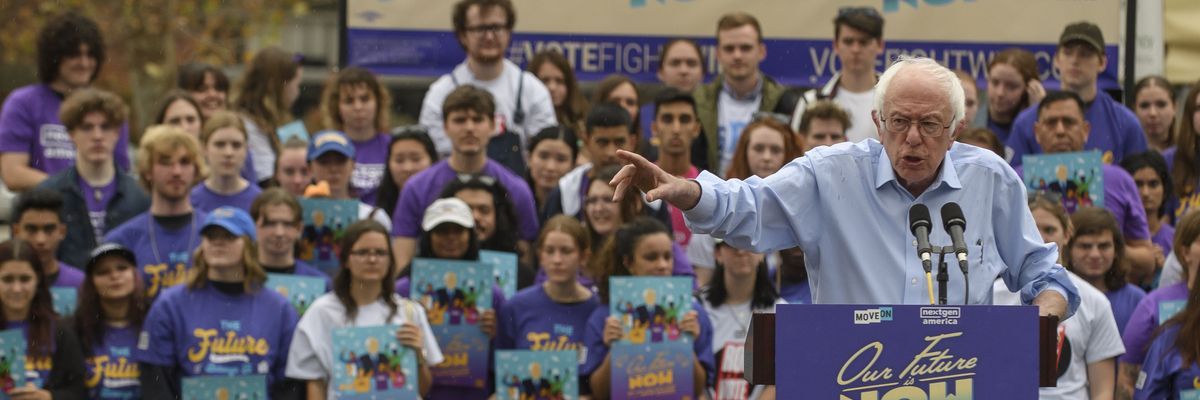
Sen. Bernie Sanders speaks at a rally on November 6, 2022 in Pittsburgh, Pennsylvania. (Photo: Jeff Swensen/Getty Images)
"If we can provide over a trillion dollars in tax breaks to the top 1% and large corporations, please don't tell me that we cannot afford to make sure that every teacher in America is paid at least $60,000 a year."
Sen. Bernie Sanders announced this week that he will soon introduce legislation to set the minimum annual salary for U.S. public school teachers at $60,000, a change the senator said could be fully financed with progressive changes to the estate tax.
At a town hall with educators and union leaders, Sanders called low teacher pay a national "crisis" that has gotten substantially worse during the coronavirus pandemic, which has placed massive additional strain on school staff across the country.
A survey released last year by the National Education Association (NEA) found that 55% of U.S. educators are considering leaving the profession earlier than they had planned, citing pandemic-related stress and burnout as well as inadequate pay.
"In America today, hundreds of thousands of public school teachers are forced to work two or three jobs during the school year. Maybe they are driving an Uber. Maybe they are waiting on tables. Maybe they are parking cars," Sanders said. "In the richest country in the history of the world, we have got to do better than that. It is time to end the international embarrassment of America ranking 29th out of 30 countries in the pay middle school teachers receive."
The Vermont senator, who chairs the upper chamber's Health, Education, Labor, and Pensions Committee, said his Pay Teachers Act would "triple" funding for low-income schools, "ensure all starting teachers across the country are paid at least $60,000 a year," and boost the salaries of those "who have made teaching their profession—working on the job for 10, 20, 30 years."
As Education Week noted Tuesday, the average starting salary for U.S. teachers is less than $42,000 a year. Sanders said during the town hall that "43% of all teachers in America make less than $60,000 a year."
Sanders estimated that his legislation would cost $450 billion over the next decade, exactly how much his proposed estate tax overhaul would raise. The bill, titled the For the 99.5 Percent Act, would impose a 65% top tax rate on estates worth more than $1 billion and reduce the estate tax exemption to $3.5 million, down from around $13 million.
"If we can provide over a trillion dollars in tax breaks to the top 1% and large corporations, please don't tell me that we cannot afford to make sure that every teacher in America is paid at least $60,000 a year," the senator said. "If we can spend close to $900 billion last year on the military, more than the next 11 nations combined, please don't tell me that we cannot make sure that every teacher in America is treated with dignity and respect."
According to recent research from the Economic Policy Institute (EPI), "teachers are paid less (in weekly wages and total compensation) than their nonteacher college-educated counterparts, and the situation has worsened considerably over time"—a gap that has been dubbed the "teacher pay penalty."
"The average weekly wages of public school teachers (adjusted only for inflation) increased just $29 from 1996 to 2021, from $1,319 to $1,348 (in 2021 dollars)," EPI found. "In contrast, inflation-adjusted weekly wages of other college graduates rose from $1,564 to $2,009 over the same period—a $445 increase."
EPI stressed that "providing teachers with compensation commensurate with that of other similarly educated professionals is not simply a matter of fairness but is necessary to improve educational outcomes and foster future economic stability of workers, their families, and communities across the U.S."—a point Sanders echoed during his town hall address.
"Raising teacher salaries to at least $60,000 a year and ensuring competitive pay for all of our teachers," Sanders argued, "is one of the most important steps we can take to address the teacher shortage in America and to improve the quality of our public school systems."
Dear Common Dreams reader, It’s been nearly 30 years since I co-founded Common Dreams with my late wife, Lina Newhouser. We had the radical notion that journalism should serve the public good, not corporate profits. It was clear to us from the outset what it would take to build such a project. No paid advertisements. No corporate sponsors. No millionaire publisher telling us what to think or do. Many people said we wouldn't last a year, but we proved those doubters wrong. Together with a tremendous team of journalists and dedicated staff, we built an independent media outlet free from the constraints of profits and corporate control. Our mission has always been simple: To inform. To inspire. To ignite change for the common good. Building Common Dreams was not easy. Our survival was never guaranteed. When you take on the most powerful forces—Wall Street greed, fossil fuel industry destruction, Big Tech lobbyists, and uber-rich oligarchs who have spent billions upon billions rigging the economy and democracy in their favor—the only bulwark you have is supporters who believe in your work. But here’s the urgent message from me today. It's never been this bad out there. And it's never been this hard to keep us going. At the very moment Common Dreams is most needed, the threats we face are intensifying. We need your support now more than ever. We don't accept corporate advertising and never will. We don't have a paywall because we don't think people should be blocked from critical news based on their ability to pay. Everything we do is funded by the donations of readers like you. When everyone does the little they can afford, we are strong. But if that support retreats or dries up, so do we. Will you donate now to make sure Common Dreams not only survives but thrives? —Craig Brown, Co-founder |
Sen. Bernie Sanders announced this week that he will soon introduce legislation to set the minimum annual salary for U.S. public school teachers at $60,000, a change the senator said could be fully financed with progressive changes to the estate tax.
At a town hall with educators and union leaders, Sanders called low teacher pay a national "crisis" that has gotten substantially worse during the coronavirus pandemic, which has placed massive additional strain on school staff across the country.
A survey released last year by the National Education Association (NEA) found that 55% of U.S. educators are considering leaving the profession earlier than they had planned, citing pandemic-related stress and burnout as well as inadequate pay.
"In America today, hundreds of thousands of public school teachers are forced to work two or three jobs during the school year. Maybe they are driving an Uber. Maybe they are waiting on tables. Maybe they are parking cars," Sanders said. "In the richest country in the history of the world, we have got to do better than that. It is time to end the international embarrassment of America ranking 29th out of 30 countries in the pay middle school teachers receive."
The Vermont senator, who chairs the upper chamber's Health, Education, Labor, and Pensions Committee, said his Pay Teachers Act would "triple" funding for low-income schools, "ensure all starting teachers across the country are paid at least $60,000 a year," and boost the salaries of those "who have made teaching their profession—working on the job for 10, 20, 30 years."
As Education Week noted Tuesday, the average starting salary for U.S. teachers is less than $42,000 a year. Sanders said during the town hall that "43% of all teachers in America make less than $60,000 a year."
Sanders estimated that his legislation would cost $450 billion over the next decade, exactly how much his proposed estate tax overhaul would raise. The bill, titled the For the 99.5 Percent Act, would impose a 65% top tax rate on estates worth more than $1 billion and reduce the estate tax exemption to $3.5 million, down from around $13 million.
"If we can provide over a trillion dollars in tax breaks to the top 1% and large corporations, please don't tell me that we cannot afford to make sure that every teacher in America is paid at least $60,000 a year," the senator said. "If we can spend close to $900 billion last year on the military, more than the next 11 nations combined, please don't tell me that we cannot make sure that every teacher in America is treated with dignity and respect."
According to recent research from the Economic Policy Institute (EPI), "teachers are paid less (in weekly wages and total compensation) than their nonteacher college-educated counterparts, and the situation has worsened considerably over time"—a gap that has been dubbed the "teacher pay penalty."
"The average weekly wages of public school teachers (adjusted only for inflation) increased just $29 from 1996 to 2021, from $1,319 to $1,348 (in 2021 dollars)," EPI found. "In contrast, inflation-adjusted weekly wages of other college graduates rose from $1,564 to $2,009 over the same period—a $445 increase."
EPI stressed that "providing teachers with compensation commensurate with that of other similarly educated professionals is not simply a matter of fairness but is necessary to improve educational outcomes and foster future economic stability of workers, their families, and communities across the U.S."—a point Sanders echoed during his town hall address.
"Raising teacher salaries to at least $60,000 a year and ensuring competitive pay for all of our teachers," Sanders argued, "is one of the most important steps we can take to address the teacher shortage in America and to improve the quality of our public school systems."
Sen. Bernie Sanders announced this week that he will soon introduce legislation to set the minimum annual salary for U.S. public school teachers at $60,000, a change the senator said could be fully financed with progressive changes to the estate tax.
At a town hall with educators and union leaders, Sanders called low teacher pay a national "crisis" that has gotten substantially worse during the coronavirus pandemic, which has placed massive additional strain on school staff across the country.
A survey released last year by the National Education Association (NEA) found that 55% of U.S. educators are considering leaving the profession earlier than they had planned, citing pandemic-related stress and burnout as well as inadequate pay.
"In America today, hundreds of thousands of public school teachers are forced to work two or three jobs during the school year. Maybe they are driving an Uber. Maybe they are waiting on tables. Maybe they are parking cars," Sanders said. "In the richest country in the history of the world, we have got to do better than that. It is time to end the international embarrassment of America ranking 29th out of 30 countries in the pay middle school teachers receive."
The Vermont senator, who chairs the upper chamber's Health, Education, Labor, and Pensions Committee, said his Pay Teachers Act would "triple" funding for low-income schools, "ensure all starting teachers across the country are paid at least $60,000 a year," and boost the salaries of those "who have made teaching their profession—working on the job for 10, 20, 30 years."
As Education Week noted Tuesday, the average starting salary for U.S. teachers is less than $42,000 a year. Sanders said during the town hall that "43% of all teachers in America make less than $60,000 a year."
Sanders estimated that his legislation would cost $450 billion over the next decade, exactly how much his proposed estate tax overhaul would raise. The bill, titled the For the 99.5 Percent Act, would impose a 65% top tax rate on estates worth more than $1 billion and reduce the estate tax exemption to $3.5 million, down from around $13 million.
"If we can provide over a trillion dollars in tax breaks to the top 1% and large corporations, please don't tell me that we cannot afford to make sure that every teacher in America is paid at least $60,000 a year," the senator said. "If we can spend close to $900 billion last year on the military, more than the next 11 nations combined, please don't tell me that we cannot make sure that every teacher in America is treated with dignity and respect."
According to recent research from the Economic Policy Institute (EPI), "teachers are paid less (in weekly wages and total compensation) than their nonteacher college-educated counterparts, and the situation has worsened considerably over time"—a gap that has been dubbed the "teacher pay penalty."
"The average weekly wages of public school teachers (adjusted only for inflation) increased just $29 from 1996 to 2021, from $1,319 to $1,348 (in 2021 dollars)," EPI found. "In contrast, inflation-adjusted weekly wages of other college graduates rose from $1,564 to $2,009 over the same period—a $445 increase."
EPI stressed that "providing teachers with compensation commensurate with that of other similarly educated professionals is not simply a matter of fairness but is necessary to improve educational outcomes and foster future economic stability of workers, their families, and communities across the U.S."—a point Sanders echoed during his town hall address.
"Raising teacher salaries to at least $60,000 a year and ensuring competitive pay for all of our teachers," Sanders argued, "is one of the most important steps we can take to address the teacher shortage in America and to improve the quality of our public school systems."