SUBSCRIBE TO OUR FREE NEWSLETTER
Daily news & progressive opinion—funded by the people, not the corporations—delivered straight to your inbox.
5
#000000
#FFFFFF
To donate by check, phone, or other method, see our More Ways to Give page.
Daily news & progressive opinion—funded by the people, not the corporations—delivered straight to your inbox.

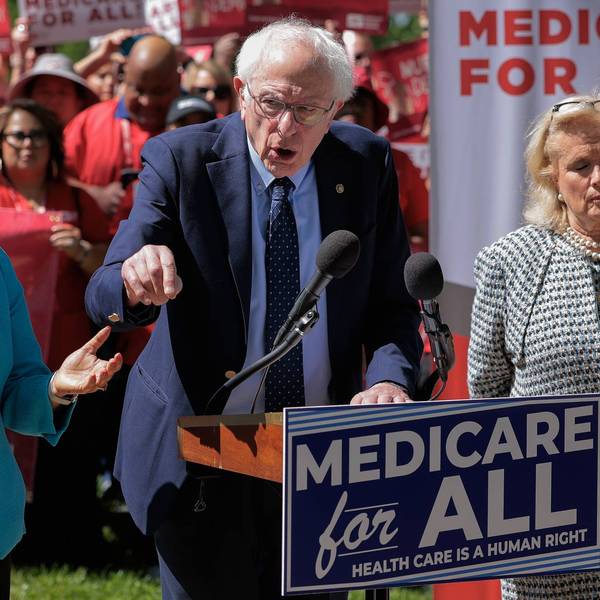
US Senator Bernie Sanders (I-Vt.) speaks during a midterm campaign rally with Abdul El-Sayed in Ann Arbor, Michigan on October 26, 2026.
"It is no longer—from a political point of view, from a policy point of view—good enough to tinker around the edges," said Sen. Bernie Sanders.
US Sen. Bernie Sanders said Wednesday that he intends to push "very aggressively" for Medicare for All legislation in the new Congress, when the progressive senator is set to take charge of the chamber's Senate Health, Education, Labor, and Pensions Committee.
"The word is getting out that it is no longer—from a political point of view, from a policy point of view—good enough to tinker around the edges," Sanders (I-Vt.) said during a news conference outlining his legislative agenda, which also includes a $20-an-hour federal minimum wage and the pro-union Protecting the Right to Organize (PRO) Act. "Increasingly, the American people and elected officials understand that the current healthcare system is broken."
Sanders emphasized that he supports rolling back the unprecedented Medicaid cuts that President Donald Trump and congressional Republicans enacted last year, as well as helping those suffering from massive Affordable Care Act premium increases.
But the senator said that "restoring the status quo to pre-Trump" would be wholly inadequate. According to a report published Wednesday by the Center for Economic and Policy Research, around 16 million American workers were uninsured before Trump and the GOP pushed their budget measure through Congress in the summer of 2025.
"I want it on the floor," Sanders said of his Medicare for All bill, which would transition the US to a single-payer healthcare system over a four-year period.
The Senate HELP Committee, which Sanders will chair in the new Congress, does not have jurisdiction over Medicare. But the Senate Finance Committee does, and that panel will be led by Sen. Ron Wyden (D-Ore.)—a cosponsor of Sanders' Medicare for All bill.
Wyden said last week that he and Sanders are "aligned on their efforts to move the party toward Medicare for All," according to STAT.
In an interview with The Associated Press on Wednesday, Sanders said that a country in which every person is guaranteed comprehensive health coverage as a right "is no longer a utopian vision."
"This is where the American people are," the senator said.
A KFF poll released ahead of the November midterms found that 66% of Americans support a Medicare for All system, and voters demonstrated that support earlier this month by electing a slew of Medicare for All backers to Congress—from Abdul El-Sayed in Michigan and Troy Jackson in Maine to Melat Kiros in Colorado.
“I think the election, in my opinion, was a crying out for fundamental change in the way the government does business and the absolute need to protect a struggling working class,” said Sanders. “I think this is a time to bring about very significant changes in policies so that we can actually improve the lives of working families.”
Neither the current leader of the Senate Democratic caucus, Chuck Schumer (NY), nor House Minority Leader Hakeem Jeffries (NY)—whose caucus nominated him on Wednesday to be the next House speaker—support Medicare for All, but both have said they back incremental changes such as lowering Medicare's eligibility age.
Sanders said during his news conference on Wednesday that he was "very pleased" to see Jeffries express support for lowering Medicare's eligibility age, expanding coverage to kids, and adding dental, vision, and hearing benefits. Sanders described that step as "the first year" of his Medicare for All plan.
"I want to see that passed as soon as possible," said the Vermont senator.
This country and this world are at a monumental crossroads. US voters have an opportunity to beat back the forces of fascism and confront the billionaires who are rigging the economy, our media system, and our democracy, making it increasingly impossible for ordinary people to get by. We’re not just talking about the election. We’re talking about what must be done once these fascist elements are vanquished from power. We need a bolder set of solutions than what either major party has so far been willing to offer and a working-class movement ready to fight like hell for it. Trump didn't emerge from nowhere. The conditions that fueled MAGA authoritarianism were created by decades of radical neoliberal economic policies and a corrupt political system dominated by corporate interests. They slashed taxes on the super-rich, promising that the benefits would trickle down. They said giveaways to the corporate titans would make life more affordable for the rest of us. It was all bullshit. And when a bitter, betrayed populace searches for someone to blame, right-wing demagogues have little trouble finding scapegoats. People know when they're being lied to, but you won't hear any of this from the corporate media. Only independent journalism—powered and funded by people who believe in building a better world—can deliver truly trustworthy daily news. If you share our vision, please contribute whatever you can to sustain our work. |
US Sen. Bernie Sanders said Wednesday that he intends to push "very aggressively" for Medicare for All legislation in the new Congress, when the progressive senator is set to take charge of the chamber's Senate Health, Education, Labor, and Pensions Committee.
"The word is getting out that it is no longer—from a political point of view, from a policy point of view—good enough to tinker around the edges," Sanders (I-Vt.) said during a news conference outlining his legislative agenda, which also includes a $20-an-hour federal minimum wage and the pro-union Protecting the Right to Organize (PRO) Act. "Increasingly, the American people and elected officials understand that the current healthcare system is broken."
Sanders emphasized that he supports rolling back the unprecedented Medicaid cuts that President Donald Trump and congressional Republicans enacted last year, as well as helping those suffering from massive Affordable Care Act premium increases.
But the senator said that "restoring the status quo to pre-Trump" would be wholly inadequate. According to a report published Wednesday by the Center for Economic and Policy Research, around 16 million American workers were uninsured before Trump and the GOP pushed their budget measure through Congress in the summer of 2025.
"I want it on the floor," Sanders said of his Medicare for All bill, which would transition the US to a single-payer healthcare system over a four-year period.
The Senate HELP Committee, which Sanders will chair in the new Congress, does not have jurisdiction over Medicare. But the Senate Finance Committee does, and that panel will be led by Sen. Ron Wyden (D-Ore.)—a cosponsor of Sanders' Medicare for All bill.
Wyden said last week that he and Sanders are "aligned on their efforts to move the party toward Medicare for All," according to STAT.
In an interview with The Associated Press on Wednesday, Sanders said that a country in which every person is guaranteed comprehensive health coverage as a right "is no longer a utopian vision."
"This is where the American people are," the senator said.
A KFF poll released ahead of the November midterms found that 66% of Americans support a Medicare for All system, and voters demonstrated that support earlier this month by electing a slew of Medicare for All backers to Congress—from Abdul El-Sayed in Michigan and Troy Jackson in Maine to Melat Kiros in Colorado.
“I think the election, in my opinion, was a crying out for fundamental change in the way the government does business and the absolute need to protect a struggling working class,” said Sanders. “I think this is a time to bring about very significant changes in policies so that we can actually improve the lives of working families.”
Neither the current leader of the Senate Democratic caucus, Chuck Schumer (NY), nor House Minority Leader Hakeem Jeffries (NY)—whose caucus nominated him on Wednesday to be the next House speaker—support Medicare for All, but both have said they back incremental changes such as lowering Medicare's eligibility age.
Sanders said during his news conference on Wednesday that he was "very pleased" to see Jeffries express support for lowering Medicare's eligibility age, expanding coverage to kids, and adding dental, vision, and hearing benefits. Sanders described that step as "the first year" of his Medicare for All plan.
"I want to see that passed as soon as possible," said the Vermont senator.