SUBSCRIBE TO OUR FREE NEWSLETTER
Daily news & progressive opinion—funded by the people, not the corporations—delivered straight to your inbox.
5
#000000
#FFFFFF
To donate by check, phone, or other method, see our More Ways to Give page.
Daily news & progressive opinion—funded by the people, not the corporations—delivered straight to your inbox.
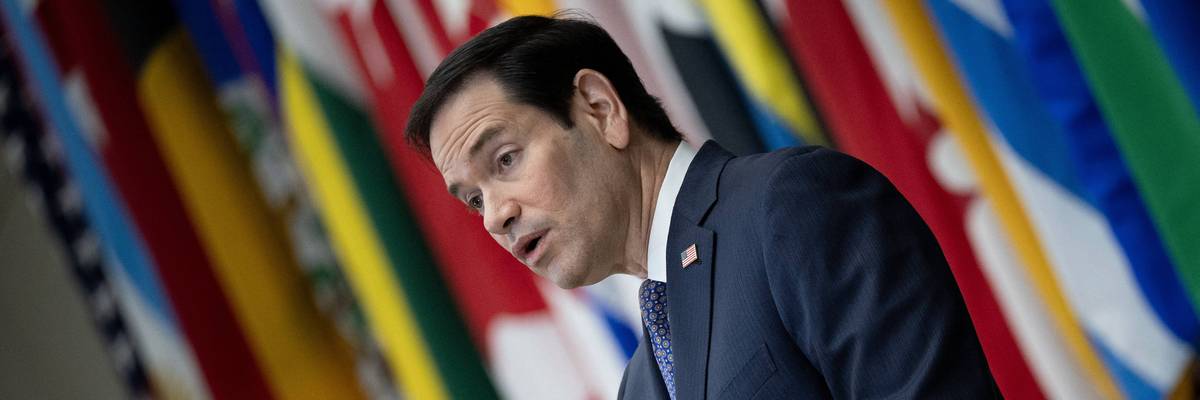
US Secretary of State Marco Rubio makes opening statement during an event at the US Department of State on July 16, 2026, in Washington, DC.
"When you are shameless, contemptuous of international law, and morally bankrupt, you boast of disgrace as though it were an achievement," said one critic.
US Secretary of State Marco Rubio on Tuesday drew an outraged reaction from critics after he unveiled sanctions against Tomoko Akane, president of the International Criminal Court.
In announcing the sanctions, Rubio described the ICC as "a corrupt and fatally politicized" institution that has supposedly "abused its authority and exceeded its mandate."
Rubio said the ICC "has repeatedly attempt to assert authority over... the United States and other countries that have not consented to its jurisdiction," which he said "sets a dangerous precedent for all nations."
In addition to sanctioning Akane, Rubio said the US would also be sanctioning ICC senior trial lawyer Abdoulaye Saye.
While Rubio did not mention what specific actions the ICC has taken to warrant such sanctions, a Tuesday report in The Guardian noted that Saye was charged with investigating war crimes allegedly committed by Israel during its years-long assault on Gaza.
The Trump administration had previously sanctioned then-ICC prosecutor Karim Khan—who obtained arrest warrants for Israeli Prime Minister Benjamin Netanyahu and former Israeli Defense Minister Yoav Gallant—and an additional eight ICC officials.
The social media account of Drop Site News accused Rubio of attacking the court solely to protect Netanyahu from war crimes prosecution, pointing out that "there is currently not a single American citizen under indictment, investigation, or facing an arrest warrant" from the ICC.
The sanctions earned the praise of the Israeli American Public Affairs Committee (AIPAC), which accused the ICC of conducting "politically motivated investigations and prosecutions targeting America and Israel."
Rutgers Law School professor Adil Haque said the ICC sanctions showed the US was acting like a "rogue government" and engaged in "deranged behavior."
Michael Karanicolas, law professor at Dalhousie University, didn't just point fingers at the US over the sanctions, but at US allies who have sat back as international institutions have come under assault.
"I’m no longer surprised by the Trump administration’s efforts to destroy the ICC," wrote Karanicolas. "What I keep waiting for is any response from Canada or the European governments who ostensibly still believe in international law to defend these institutions."
War correspondent and international political analyst Elijah Magnier delivered a withering rebuke of Rubio's announcement.
"When you are shameless, contemptuous of international law, and morally bankrupt," wrote Magnier, "you boast of disgrace as though it were an achievement."
Dear Common Dreams reader, It’s been nearly 30 years since I co-founded Common Dreams with my late wife, Lina Newhouser. We had the radical notion that journalism should serve the public good, not corporate profits. It was clear to us from the outset what it would take to build such a project. No paid advertisements. No corporate sponsors. No millionaire publisher telling us what to think or do. Many people said we wouldn't last a year, but we proved those doubters wrong. Together with a tremendous team of journalists and dedicated staff, we built an independent media outlet free from the constraints of profits and corporate control. Our mission has always been simple: To inform. To inspire. To ignite change for the common good. Building Common Dreams was not easy. Our survival was never guaranteed. When you take on the most powerful forces—Wall Street greed, fossil fuel industry destruction, Big Tech lobbyists, and uber-rich oligarchs who have spent billions upon billions rigging the economy and democracy in their favor—the only bulwark you have is supporters who believe in your work. But here’s the urgent message from me today. It's never been this bad out there. And it's never been this hard to keep us going. At the very moment Common Dreams is most needed, the threats we face are intensifying. We need your support now more than ever. We don't accept corporate advertising and never will. We don't have a paywall because we don't think people should be blocked from critical news based on their ability to pay. Everything we do is funded by the donations of readers like you. When everyone does the little they can afford, we are strong. But if that support retreats or dries up, so do we. Will you donate now to make sure Common Dreams not only survives but thrives? —Craig Brown, Co-founder |
US Secretary of State Marco Rubio on Tuesday drew an outraged reaction from critics after he unveiled sanctions against Tomoko Akane, president of the International Criminal Court.
In announcing the sanctions, Rubio described the ICC as "a corrupt and fatally politicized" institution that has supposedly "abused its authority and exceeded its mandate."
Rubio said the ICC "has repeatedly attempt to assert authority over... the United States and other countries that have not consented to its jurisdiction," which he said "sets a dangerous precedent for all nations."
In addition to sanctioning Akane, Rubio said the US would also be sanctioning ICC senior trial lawyer Abdoulaye Saye.
While Rubio did not mention what specific actions the ICC has taken to warrant such sanctions, a Tuesday report in The Guardian noted that Saye was charged with investigating war crimes allegedly committed by Israel during its years-long assault on Gaza.
The Trump administration had previously sanctioned then-ICC prosecutor Karim Khan—who obtained arrest warrants for Israeli Prime Minister Benjamin Netanyahu and former Israeli Defense Minister Yoav Gallant—and an additional eight ICC officials.
The social media account of Drop Site News accused Rubio of attacking the court solely to protect Netanyahu from war crimes prosecution, pointing out that "there is currently not a single American citizen under indictment, investigation, or facing an arrest warrant" from the ICC.
The sanctions earned the praise of the Israeli American Public Affairs Committee (AIPAC), which accused the ICC of conducting "politically motivated investigations and prosecutions targeting America and Israel."
Rutgers Law School professor Adil Haque said the ICC sanctions showed the US was acting like a "rogue government" and engaged in "deranged behavior."
Michael Karanicolas, law professor at Dalhousie University, didn't just point fingers at the US over the sanctions, but at US allies who have sat back as international institutions have come under assault.
"I’m no longer surprised by the Trump administration’s efforts to destroy the ICC," wrote Karanicolas. "What I keep waiting for is any response from Canada or the European governments who ostensibly still believe in international law to defend these institutions."
War correspondent and international political analyst Elijah Magnier delivered a withering rebuke of Rubio's announcement.
"When you are shameless, contemptuous of international law, and morally bankrupt," wrote Magnier, "you boast of disgrace as though it were an achievement."
US Secretary of State Marco Rubio on Tuesday drew an outraged reaction from critics after he unveiled sanctions against Tomoko Akane, president of the International Criminal Court.
In announcing the sanctions, Rubio described the ICC as "a corrupt and fatally politicized" institution that has supposedly "abused its authority and exceeded its mandate."
Rubio said the ICC "has repeatedly attempt to assert authority over... the United States and other countries that have not consented to its jurisdiction," which he said "sets a dangerous precedent for all nations."
In addition to sanctioning Akane, Rubio said the US would also be sanctioning ICC senior trial lawyer Abdoulaye Saye.
While Rubio did not mention what specific actions the ICC has taken to warrant such sanctions, a Tuesday report in The Guardian noted that Saye was charged with investigating war crimes allegedly committed by Israel during its years-long assault on Gaza.
The Trump administration had previously sanctioned then-ICC prosecutor Karim Khan—who obtained arrest warrants for Israeli Prime Minister Benjamin Netanyahu and former Israeli Defense Minister Yoav Gallant—and an additional eight ICC officials.
The social media account of Drop Site News accused Rubio of attacking the court solely to protect Netanyahu from war crimes prosecution, pointing out that "there is currently not a single American citizen under indictment, investigation, or facing an arrest warrant" from the ICC.
The sanctions earned the praise of the Israeli American Public Affairs Committee (AIPAC), which accused the ICC of conducting "politically motivated investigations and prosecutions targeting America and Israel."
Rutgers Law School professor Adil Haque said the ICC sanctions showed the US was acting like a "rogue government" and engaged in "deranged behavior."
Michael Karanicolas, law professor at Dalhousie University, didn't just point fingers at the US over the sanctions, but at US allies who have sat back as international institutions have come under assault.
"I’m no longer surprised by the Trump administration’s efforts to destroy the ICC," wrote Karanicolas. "What I keep waiting for is any response from Canada or the European governments who ostensibly still believe in international law to defend these institutions."
War correspondent and international political analyst Elijah Magnier delivered a withering rebuke of Rubio's announcement.
"When you are shameless, contemptuous of international law, and morally bankrupt," wrote Magnier, "you boast of disgrace as though it were an achievement."