SUBSCRIBE TO OUR FREE NEWSLETTER
Daily news & progressive opinion—funded by the people, not the corporations—delivered straight to your inbox.
5
#000000
#FFFFFF
To donate by check, phone, or other method, see our More Ways to Give page.
Daily news & progressive opinion—funded by the people, not the corporations—delivered straight to your inbox.
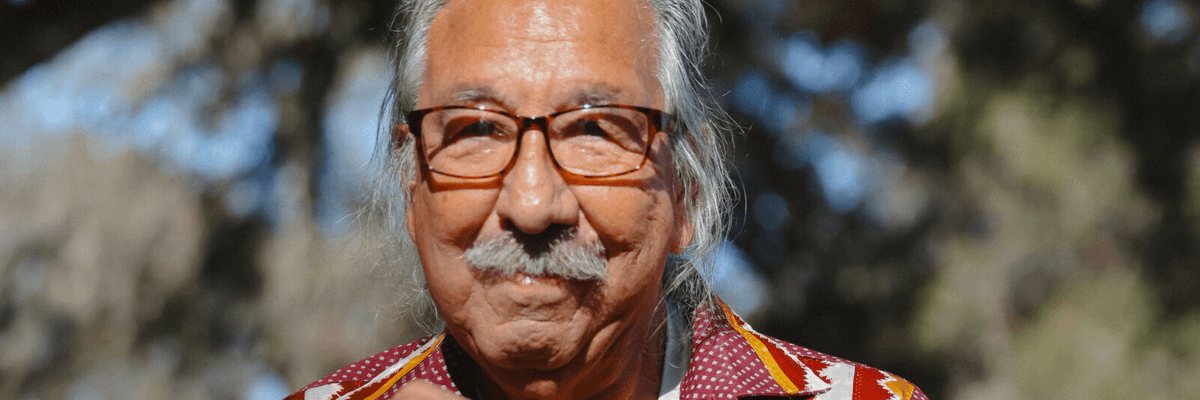
Longtime political prisoner and Indigenous rights defender Leonard Peltier is seen following his 2025 release.
"We just want to be left alone," the former longtime political prisoner said. "We don’t want to be part of a government that’s killing women, children, babies, and bombing every damn thing that they can."
Leonard Peltier, the Indigenous activist who spent nearly half a century in prison for murders he says he did not commit before outgoing President Joe Biden commuted his sentence last year, vowed Monday that Native Americans would resist the Trump administration's attacks on Indian rights and tribal sovereignty.
“We’re not free yet. We are in danger,” Peltier, 82, told Democracy Now! in an interview released Monday to mark Indigenous Peoples’ Day. “Trump and these organizations, they’re talking about doing away with our reservations and our treaties and everything else.”
Peltier—whose freedom struggle is the subject of a new documentary, Free Leonard Peltier, directed by David France and Jesse Short Bull—said: "Some people became greedy and selfish and murderous, and they tried to exterminate us because they wanted it all for themselves. Well, 500 years later, we’re still here, and I’m still talking, and I’m going to talk 'til I die."
"We just want to be left alone," Peltier said of Indigenous peoples. "Let us live our own lives. Let us have our own society we’ve had for thousands of years. What the hell? I mean, we don’t want to be part of a government that’s killing women, children, babies, and bombing every damn thing that they can, and talking about annihilating a race of people."
Peltier's remarks came as Indigenous communities across the United States face numerous federal policies and actions affecting their lands, cultures, civil rights, and access to critical services.
In Arizona, the Trump administration is moving ahead with a border wall opposed by the Tohono O’odham Nation, whose ancestral homeland straddles the US-Mexico border. A recent Arizona Luminaria investigation revealed that federal authorities used drones, surveillance equipment, and masked agents to monitor Tohono O’odham members and a prayer camp as the Trump administration moved forward with border wall construction through their ancestral lands.
The Arizona border wall and a similar barrier project in Texas' Big Bend region are among the numerous conflicts over Native lands and treaty rights under attack by the government. According to the National Indian Law Library’s 2026 roundup of Indigenous land disputes, tribes are fighting to protect sacred sites, recover ancestral territory, and oppose mining and development projects.
The Trump administration has also moved to shrink the Bears Ears and Grand Staircase-Escalante national monuments in Utah, drawing tribal leaders' condemnation of the loss of protections for culturally significant landscapes.
Education is also under attack, as Trump seeks to dramatically slash federal funding for tribal colleges and universities.
Meanwhile, the administration’s proposed changes to the 2030 census could make Native Americans less visible in federal data by removing questions about race and ethnicity from the decennial questionnaire, raising concerns about the consequences for federal funding, voting rights, and civil rights enforcement.
Peltier—who supporters long said was framed for the murder of two federal agents during a 1975 shootout at the Oglala Sioux Reservation in South Dakota—sounded a note of defiant perseverance during his Democracy Now! interview.
“We’re going to stay here,” he said of Indigenous peoples. “You’re not going to get rid of us.”
Dear Common Dreams reader, It’s been nearly 30 years since I co-founded Common Dreams with my late wife, Lina Newhouser. We had the radical notion that journalism should serve the public good, not corporate profits. It was clear to us from the outset what it would take to build such a project. No paid advertisements. No corporate sponsors. No millionaire publisher telling us what to think or do. Many people said we wouldn't last a year, but we proved those doubters wrong. Together with a tremendous team of journalists and dedicated staff, we built an independent media outlet free from the constraints of profits and corporate control. Our mission has always been simple: To inform. To inspire. To ignite change for the common good. Building Common Dreams was not easy. Our survival was never guaranteed. When you take on the most powerful forces—Wall Street greed, fossil fuel industry destruction, Big Tech lobbyists, and uber-rich oligarchs who have spent billions upon billions rigging the economy and democracy in their favor—the only bulwark you have is supporters who believe in your work. But here’s the urgent message from me today. It's never been this bad out there. And it's never been this hard to keep us going. At the very moment Common Dreams is most needed, the threats we face are intensifying. We need your support now more than ever. We don't accept corporate advertising and never will. We don't have a paywall because we don't think people should be blocked from critical news based on their ability to pay. Everything we do is funded by the donations of readers like you. When everyone does the little they can afford, we are strong. But if that support retreats or dries up, so do we. Will you donate now to make sure Common Dreams not only survives but thrives? —Craig Brown, Co-founder |
Leonard Peltier, the Indigenous activist who spent nearly half a century in prison for murders he says he did not commit before outgoing President Joe Biden commuted his sentence last year, vowed Monday that Native Americans would resist the Trump administration's attacks on Indian rights and tribal sovereignty.
“We’re not free yet. We are in danger,” Peltier, 82, told Democracy Now! in an interview released Monday to mark Indigenous Peoples’ Day. “Trump and these organizations, they’re talking about doing away with our reservations and our treaties and everything else.”
Peltier—whose freedom struggle is the subject of a new documentary, Free Leonard Peltier, directed by David France and Jesse Short Bull—said: "Some people became greedy and selfish and murderous, and they tried to exterminate us because they wanted it all for themselves. Well, 500 years later, we’re still here, and I’m still talking, and I’m going to talk 'til I die."
"We just want to be left alone," Peltier said of Indigenous peoples. "Let us live our own lives. Let us have our own society we’ve had for thousands of years. What the hell? I mean, we don’t want to be part of a government that’s killing women, children, babies, and bombing every damn thing that they can, and talking about annihilating a race of people."
Peltier's remarks came as Indigenous communities across the United States face numerous federal policies and actions affecting their lands, cultures, civil rights, and access to critical services.
In Arizona, the Trump administration is moving ahead with a border wall opposed by the Tohono O’odham Nation, whose ancestral homeland straddles the US-Mexico border. A recent Arizona Luminaria investigation revealed that federal authorities used drones, surveillance equipment, and masked agents to monitor Tohono O’odham members and a prayer camp as the Trump administration moved forward with border wall construction through their ancestral lands.
The Arizona border wall and a similar barrier project in Texas' Big Bend region are among the numerous conflicts over Native lands and treaty rights under attack by the government. According to the National Indian Law Library’s 2026 roundup of Indigenous land disputes, tribes are fighting to protect sacred sites, recover ancestral territory, and oppose mining and development projects.
The Trump administration has also moved to shrink the Bears Ears and Grand Staircase-Escalante national monuments in Utah, drawing tribal leaders' condemnation of the loss of protections for culturally significant landscapes.
Education is also under attack, as Trump seeks to dramatically slash federal funding for tribal colleges and universities.
Meanwhile, the administration’s proposed changes to the 2030 census could make Native Americans less visible in federal data by removing questions about race and ethnicity from the decennial questionnaire, raising concerns about the consequences for federal funding, voting rights, and civil rights enforcement.
Peltier—who supporters long said was framed for the murder of two federal agents during a 1975 shootout at the Oglala Sioux Reservation in South Dakota—sounded a note of defiant perseverance during his Democracy Now! interview.
“We’re going to stay here,” he said of Indigenous peoples. “You’re not going to get rid of us.”
Leonard Peltier, the Indigenous activist who spent nearly half a century in prison for murders he says he did not commit before outgoing President Joe Biden commuted his sentence last year, vowed Monday that Native Americans would resist the Trump administration's attacks on Indian rights and tribal sovereignty.
“We’re not free yet. We are in danger,” Peltier, 82, told Democracy Now! in an interview released Monday to mark Indigenous Peoples’ Day. “Trump and these organizations, they’re talking about doing away with our reservations and our treaties and everything else.”
Peltier—whose freedom struggle is the subject of a new documentary, Free Leonard Peltier, directed by David France and Jesse Short Bull—said: "Some people became greedy and selfish and murderous, and they tried to exterminate us because they wanted it all for themselves. Well, 500 years later, we’re still here, and I’m still talking, and I’m going to talk 'til I die."
"We just want to be left alone," Peltier said of Indigenous peoples. "Let us live our own lives. Let us have our own society we’ve had for thousands of years. What the hell? I mean, we don’t want to be part of a government that’s killing women, children, babies, and bombing every damn thing that they can, and talking about annihilating a race of people."
Peltier's remarks came as Indigenous communities across the United States face numerous federal policies and actions affecting their lands, cultures, civil rights, and access to critical services.
In Arizona, the Trump administration is moving ahead with a border wall opposed by the Tohono O’odham Nation, whose ancestral homeland straddles the US-Mexico border. A recent Arizona Luminaria investigation revealed that federal authorities used drones, surveillance equipment, and masked agents to monitor Tohono O’odham members and a prayer camp as the Trump administration moved forward with border wall construction through their ancestral lands.
The Arizona border wall and a similar barrier project in Texas' Big Bend region are among the numerous conflicts over Native lands and treaty rights under attack by the government. According to the National Indian Law Library’s 2026 roundup of Indigenous land disputes, tribes are fighting to protect sacred sites, recover ancestral territory, and oppose mining and development projects.
The Trump administration has also moved to shrink the Bears Ears and Grand Staircase-Escalante national monuments in Utah, drawing tribal leaders' condemnation of the loss of protections for culturally significant landscapes.
Education is also under attack, as Trump seeks to dramatically slash federal funding for tribal colleges and universities.
Meanwhile, the administration’s proposed changes to the 2030 census could make Native Americans less visible in federal data by removing questions about race and ethnicity from the decennial questionnaire, raising concerns about the consequences for federal funding, voting rights, and civil rights enforcement.
Peltier—who supporters long said was framed for the murder of two federal agents during a 1975 shootout at the Oglala Sioux Reservation in South Dakota—sounded a note of defiant perseverance during his Democracy Now! interview.
“We’re going to stay here,” he said of Indigenous peoples. “You’re not going to get rid of us.”