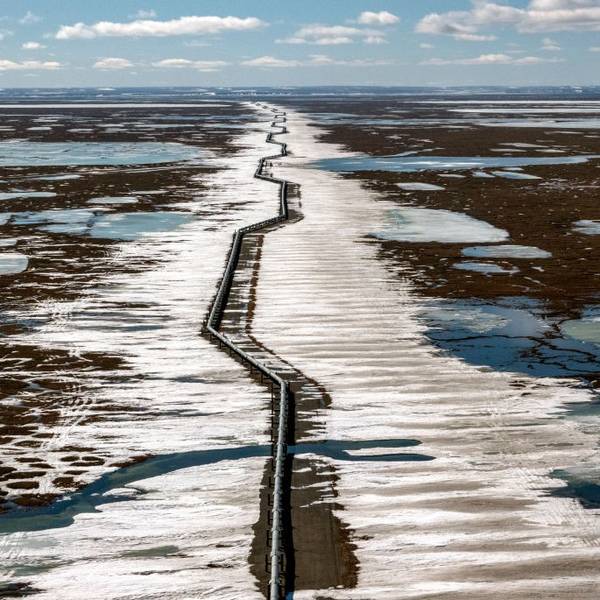

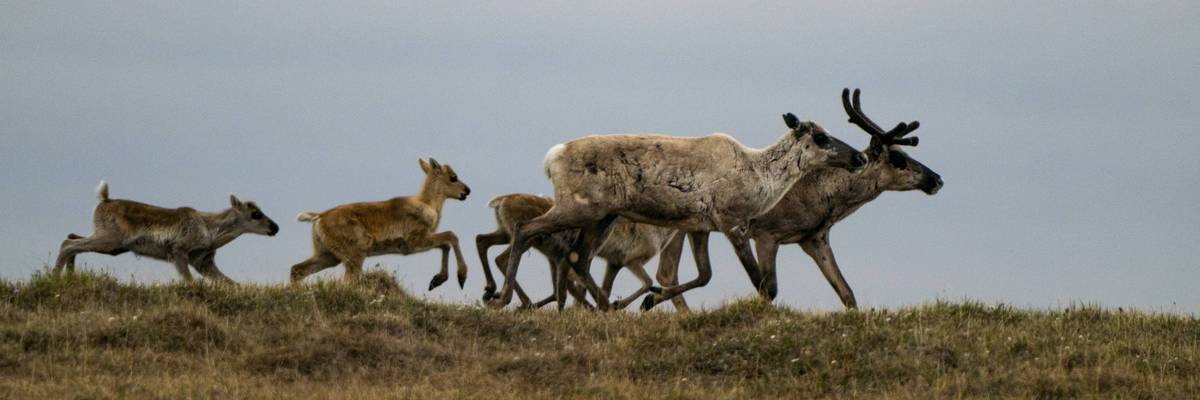
Caribou migrate in the Arctic National Wildlife Refuge in Alaska on June 29, 2024.
Climate, Indigenous Groups Rip Trump GOP for 'Handing Over the Arctic Refuge to Big Oil'
"The oil industry's allies in Congress are ignoring public opinion and the undeniable realities of the climate crisis by moving to drill on the sacred Coastal Plain and endanger the freedom of local communities."
Indigenous leaders joined with climate and wildlife defenders on Friday to blast President Donald Trump's administration and Republicans in Congress over the newly announced fossil fuel lease sale for the Arctic National Wildlife Refuge's Coastal Plain in Alaska.
The US Department of the Interior's Bureau of Land Management revealed Friday that it will hold the first of four legally mandated lease sales on June 5. The so-called One Big Beautiful Bill Act—which congressional Republicans passed and Trump signed last summer—requires BLM to hold the other three sales by 2035.
ANWR's Coastal Plain spans over 1.5 million acres and is known for its biodiversity. As a BLM webpage details, it is also believed to contain 4.25-11.8 billion barrels of "technically recoverable oil," according to US Geological Survey estimates.
Trump returned to the White House last year backed by Big Oil's campaign cash, and his deputy interior secretary, Kate MacGregor, said Friday that "after three acts of Congress and several successful lawsuits making it abundantly clear that oil and gas leasing in this area of Alaska is lawful, it is a great honor to once again announce another Coastal Plain lease sale."
MacGregor framed the forthcoming sale as just one piece of the administration's pro-fossil fuel agenda, adding that "President Trump has long supported Alaska's important contribution to American energy dominance, and Interior is proud to take the necessary and durable steps to unleash these important resources on behalf of the American people."
Earlier attempts to open up ANWR to drilling suggest that the sale may not draw much industry interest. Taxpayers for Common Sense pointed out Friday that two previous ones required by the Trump GOP's Tax Cut and Jobs Act "were originally estimated to bring taxpayers almost $1 billion in revenue but fell far short of this projection. The first lease sale, held in January 2021, brought in just $16.5 million. The second lease sale, held in January 2025, attracted no bidders and generated no revenue."
However, as the Anchorage Daily News reported, the plan for the next sale "comes on the heels of another recent lease sale, in the National Petroleum Reserve-Alaska to the west of the refuge, that drew heavy interest from oil companies," which "raises questions about how much bidding might occur in the refuge," particularly as Trump's war on Iran has driven up global oil prices.
Still, critics highlighted the previous ANWR sales—including the Wilderness Society's Alaska senior manager, Meda DeWitt, who said: "Once again, the oil industry's allies in Congress are ignoring public opinion and the undeniable realities of the climate crisis by moving to drill on the sacred Coastal Plain and endanger the freedom of local communities to sustain their cultures and lifestyles for generations to come."
"Two previous lease sales have already been economic failures, proving that the absurd Arctic Refuge leasing program should be eliminated and permanent protection must be provided for the calving grounds of the Porcupine Caribou herd," DeWitt argued.
The Arctic Refuge is the crown jewel of the American National Wildlife Refuge System – opening it up to drilling endangers the wildlife and the indigenous communities who have called the refuge their home for thousands of years.
— Senate Energy Dems (@energydems.senate.gov) April 17, 2026 at 1:24 PM
America Fitzpatrick of the League of Conservation Voters (LCV) similarly said that "time and again, the American people have said that they oppose drilling in the Arctic Refuge. The last lease sale in 2024 yielded no bids. Drilling here is not only bad economic—it's reckless and wildly unpopular. Instead of further handcuffing us to be more dependent on fossil fuels, the administration should focus on prioritizing cleaner, more affordable, and more reliable energy sources like clean energy."
"We simply cannot drill our way out of high energy costs," declared Fitzpatrick, the group's conservation program director. "The US is already producing more oil and gas than ever before, but when Trump forced a global energy crisis, prices skyrocketed once again. LCV stands with the Gwich'in people in their fight to ensure there is no drilling in the Arctic Refuge. Not now, not ever."
The Gwich'in, Indigenous people who live in Alaska and Canada, have long defended the refuge from fossil fuel intrusion, and are currently engaged in litigation over the Trump Interior Department's leasing program for the Coastal Plain.
"The Neets'ąįį Gwich'in have made our position clear that any development on the Coastal Plain would have irreversible, adverse effects on our people, our culture, and our way of life," Raeann Garnett, first chief of the Native Village of Venetie Tribal Government, said Friday. "This lease sale, once again, disregards our sovereignty and is a direct threat to the sacred land that sustains our people."
Karlas Norman, first chief of the Venetie Village Council, stressed that "no amount of money will make this land any less sacred to our people or any less vital to our way of life. The Trump administration's most recent actions to advance oil and gas development on the Coastal Plain does not change the fact that this land is sacred, that industry has walked away, and that the Gwich'in people will never stop fighting to protect it."
Galen Gilbert, first chief of the Arctic Village Council, charged that "the Trump administration's relentless push to auction off this sacred land despite overwhelming public opposition and industry that has already signaled they are not interested, makes clear that this administration values corporate interests over the rights and lives of Indigenous peoples."
Gilbert also vowed that "we will continue to fight with every tool available to protect the Coastal Plain for our children and all future generations."
Kristen Moreland, executive director of the Gwich'in Steering Committee, also pledged that "the Gwich’in Nation remains committed to be a voice for the caribou, and to fight oil and gas development in the Arctic Refuge."
"We condemn these efforts by the Trump administration to exploit the calving grounds of the Porcupine Caribou herd for short-term gain, and we know that the majority of Americans stand beside us in opposing development in this cherished and irreplaceable landscape," Moreland continued. "We have been raising our voices and fight[ing] for the protection of this sacred land and our way of life for decades—and we are not backing down now."
Also noting the US public's position, Andy Moderow, senior director of policy at Alaska Wilderness League, put pressure on the industry to stay away from the lease sale later this spring.
"For decades, the American people have recognized that the Arctic Refuge is not an industrial zone for oil development, and this sale simply runs counter to common sense," said Moderow. "Any oil and gas company that is even thinking about buying these leases should know that, if they do, they will be sending a clear message to the American people—that no place in Alaska is too sacred to drill in a quest for corporate profits. We urge companies to take a pass on the Arctic Refuge lease sale, and we look forward to rightfully restoring protections for this landscape in the years to come."
According to the Anchorage Daily News, "Elizabeth Manning, a spokesperson with Earthjustice, said in an email Friday that any new leases will be subject to a lawsuit brought by Natural Resources Defense Council, Center for Biological Diversity, and Friends of the Earth."
We are at a crossroads
This country and this world are at a monumental crossroads. In a few short weeks, US voters will have an opportunity to beat back the forces of fascism and confront the billionaires who are rigging the economy, our media system, and our democracy, making it increasingly impossible for ordinary people to get by. We’re not just talking about the election. We’re talking about what must be done once these fascist elements are vanquished from power. We need a bolder set of solutions than what either major party has so far been willing to offer and a working-class movement ready to fight like hell for it. Trump didn't emerge from nowhere. The conditions that fueled MAGA authoritarianism were created by decades of radical neoliberal economic policies and a corrupt political system dominated by corporate interests. They slashed taxes on the super-rich, promising that the benefits would trickle down. They said giveaways to the corporate titans would make life more affordable for the rest of us. It was all bullshit. And when a bitter, betrayed populace searches for someone to blame, right-wing demagogues have little trouble finding scapegoats. People know when they're being lied to, but you won't hear any of this from the corporate media. Only independent journalism—powered and funded by people who believe in building a better world—can deliver truly trustworthy daily news. Our Fall Campaign is underway, and we need your help. To power our newsroom through the rest of the year, we need to raise $125,000 by midnight on October 31. So if you share our vision, please contribute whatever you can to sustain our work. |
Indigenous leaders joined with climate and wildlife defenders on Friday to blast President Donald Trump's administration and Republicans in Congress over the newly announced fossil fuel lease sale for the Arctic National Wildlife Refuge's Coastal Plain in Alaska.
The US Department of the Interior's Bureau of Land Management revealed Friday that it will hold the first of four legally mandated lease sales on June 5. The so-called One Big Beautiful Bill Act—which congressional Republicans passed and Trump signed last summer—requires BLM to hold the other three sales by 2035.
ANWR's Coastal Plain spans over 1.5 million acres and is known for its biodiversity. As a BLM webpage details, it is also believed to contain 4.25-11.8 billion barrels of "technically recoverable oil," according to US Geological Survey estimates.
Trump returned to the White House last year backed by Big Oil's campaign cash, and his deputy interior secretary, Kate MacGregor, said Friday that "after three acts of Congress and several successful lawsuits making it abundantly clear that oil and gas leasing in this area of Alaska is lawful, it is a great honor to once again announce another Coastal Plain lease sale."
MacGregor framed the forthcoming sale as just one piece of the administration's pro-fossil fuel agenda, adding that "President Trump has long supported Alaska's important contribution to American energy dominance, and Interior is proud to take the necessary and durable steps to unleash these important resources on behalf of the American people."
Earlier attempts to open up ANWR to drilling suggest that the sale may not draw much industry interest. Taxpayers for Common Sense pointed out Friday that two previous ones required by the Trump GOP's Tax Cut and Jobs Act "were originally estimated to bring taxpayers almost $1 billion in revenue but fell far short of this projection. The first lease sale, held in January 2021, brought in just $16.5 million. The second lease sale, held in January 2025, attracted no bidders and generated no revenue."
However, as the Anchorage Daily News reported, the plan for the next sale "comes on the heels of another recent lease sale, in the National Petroleum Reserve-Alaska to the west of the refuge, that drew heavy interest from oil companies," which "raises questions about how much bidding might occur in the refuge," particularly as Trump's war on Iran has driven up global oil prices.
Still, critics highlighted the previous ANWR sales—including the Wilderness Society's Alaska senior manager, Meda DeWitt, who said: "Once again, the oil industry's allies in Congress are ignoring public opinion and the undeniable realities of the climate crisis by moving to drill on the sacred Coastal Plain and endanger the freedom of local communities to sustain their cultures and lifestyles for generations to come."
"Two previous lease sales have already been economic failures, proving that the absurd Arctic Refuge leasing program should be eliminated and permanent protection must be provided for the calving grounds of the Porcupine Caribou herd," DeWitt argued.
The Arctic Refuge is the crown jewel of the American National Wildlife Refuge System – opening it up to drilling endangers the wildlife and the indigenous communities who have called the refuge their home for thousands of years.
— Senate Energy Dems (@energydems.senate.gov) April 17, 2026 at 1:24 PM
America Fitzpatrick of the League of Conservation Voters (LCV) similarly said that "time and again, the American people have said that they oppose drilling in the Arctic Refuge. The last lease sale in 2024 yielded no bids. Drilling here is not only bad economic—it's reckless and wildly unpopular. Instead of further handcuffing us to be more dependent on fossil fuels, the administration should focus on prioritizing cleaner, more affordable, and more reliable energy sources like clean energy."
"We simply cannot drill our way out of high energy costs," declared Fitzpatrick, the group's conservation program director. "The US is already producing more oil and gas than ever before, but when Trump forced a global energy crisis, prices skyrocketed once again. LCV stands with the Gwich'in people in their fight to ensure there is no drilling in the Arctic Refuge. Not now, not ever."
The Gwich'in, Indigenous people who live in Alaska and Canada, have long defended the refuge from fossil fuel intrusion, and are currently engaged in litigation over the Trump Interior Department's leasing program for the Coastal Plain.
"The Neets'ąįį Gwich'in have made our position clear that any development on the Coastal Plain would have irreversible, adverse effects on our people, our culture, and our way of life," Raeann Garnett, first chief of the Native Village of Venetie Tribal Government, said Friday. "This lease sale, once again, disregards our sovereignty and is a direct threat to the sacred land that sustains our people."
Karlas Norman, first chief of the Venetie Village Council, stressed that "no amount of money will make this land any less sacred to our people or any less vital to our way of life. The Trump administration's most recent actions to advance oil and gas development on the Coastal Plain does not change the fact that this land is sacred, that industry has walked away, and that the Gwich'in people will never stop fighting to protect it."
Galen Gilbert, first chief of the Arctic Village Council, charged that "the Trump administration's relentless push to auction off this sacred land despite overwhelming public opposition and industry that has already signaled they are not interested, makes clear that this administration values corporate interests over the rights and lives of Indigenous peoples."
Gilbert also vowed that "we will continue to fight with every tool available to protect the Coastal Plain for our children and all future generations."
Kristen Moreland, executive director of the Gwich'in Steering Committee, also pledged that "the Gwich’in Nation remains committed to be a voice for the caribou, and to fight oil and gas development in the Arctic Refuge."
"We condemn these efforts by the Trump administration to exploit the calving grounds of the Porcupine Caribou herd for short-term gain, and we know that the majority of Americans stand beside us in opposing development in this cherished and irreplaceable landscape," Moreland continued. "We have been raising our voices and fight[ing] for the protection of this sacred land and our way of life for decades—and we are not backing down now."
Also noting the US public's position, Andy Moderow, senior director of policy at Alaska Wilderness League, put pressure on the industry to stay away from the lease sale later this spring.
"For decades, the American people have recognized that the Arctic Refuge is not an industrial zone for oil development, and this sale simply runs counter to common sense," said Moderow. "Any oil and gas company that is even thinking about buying these leases should know that, if they do, they will be sending a clear message to the American people—that no place in Alaska is too sacred to drill in a quest for corporate profits. We urge companies to take a pass on the Arctic Refuge lease sale, and we look forward to rightfully restoring protections for this landscape in the years to come."
According to the Anchorage Daily News, "Elizabeth Manning, a spokesperson with Earthjustice, said in an email Friday that any new leases will be subject to a lawsuit brought by Natural Resources Defense Council, Center for Biological Diversity, and Friends of the Earth."
- As ExxonMobil Dismisses Drilling in Arctic Refuge, Locals Say 'Congress Must Act' ›
- Trump Administration Rushes to Auction Off Arctic National Wildlife Refuge Drilling Rights Before Biden Inauguration ›
- 'We Will Not Give Up,' Say Indigenous Groups, as Trump Admin Gets Closer to Fossil Fuel Pillage of Arctic Refuge ›
- Trump Administration's Rush To Open Arctic National Wildlife Refuge To Oil Drilling Could Be Catastrophic ›
- Lawsuit Aims to Block Drilling in Arctic National Wildlife Refuge ›
- Trump Admin Slammed for Yet Another Move to 'Help Corporate Polluters' Exploit Alaska | Common Dreams ›
- Trump's ANWR Oil and Gas Auction Was a Bust—But Alaskan Arctic Still Faces Fossil Fuel Threat | Common Dreams ›
- Green Groups Fume as Trump Gives Big Oil 'Another Free Pass to Exploit' the Arctic | Common Dreams ›
- 'You're Not Going to Get Rid of Us,' Vows Leonard Peltier Amid Trump Assault on Indigenous Rights | Common Dreams ›
Indigenous leaders joined with climate and wildlife defenders on Friday to blast President Donald Trump's administration and Republicans in Congress over the newly announced fossil fuel lease sale for the Arctic National Wildlife Refuge's Coastal Plain in Alaska.
The US Department of the Interior's Bureau of Land Management revealed Friday that it will hold the first of four legally mandated lease sales on June 5. The so-called One Big Beautiful Bill Act—which congressional Republicans passed and Trump signed last summer—requires BLM to hold the other three sales by 2035.
ANWR's Coastal Plain spans over 1.5 million acres and is known for its biodiversity. As a BLM webpage details, it is also believed to contain 4.25-11.8 billion barrels of "technically recoverable oil," according to US Geological Survey estimates.
Trump returned to the White House last year backed by Big Oil's campaign cash, and his deputy interior secretary, Kate MacGregor, said Friday that "after three acts of Congress and several successful lawsuits making it abundantly clear that oil and gas leasing in this area of Alaska is lawful, it is a great honor to once again announce another Coastal Plain lease sale."
MacGregor framed the forthcoming sale as just one piece of the administration's pro-fossil fuel agenda, adding that "President Trump has long supported Alaska's important contribution to American energy dominance, and Interior is proud to take the necessary and durable steps to unleash these important resources on behalf of the American people."
Earlier attempts to open up ANWR to drilling suggest that the sale may not draw much industry interest. Taxpayers for Common Sense pointed out Friday that two previous ones required by the Trump GOP's Tax Cut and Jobs Act "were originally estimated to bring taxpayers almost $1 billion in revenue but fell far short of this projection. The first lease sale, held in January 2021, brought in just $16.5 million. The second lease sale, held in January 2025, attracted no bidders and generated no revenue."
However, as the Anchorage Daily News reported, the plan for the next sale "comes on the heels of another recent lease sale, in the National Petroleum Reserve-Alaska to the west of the refuge, that drew heavy interest from oil companies," which "raises questions about how much bidding might occur in the refuge," particularly as Trump's war on Iran has driven up global oil prices.
Still, critics highlighted the previous ANWR sales—including the Wilderness Society's Alaska senior manager, Meda DeWitt, who said: "Once again, the oil industry's allies in Congress are ignoring public opinion and the undeniable realities of the climate crisis by moving to drill on the sacred Coastal Plain and endanger the freedom of local communities to sustain their cultures and lifestyles for generations to come."
"Two previous lease sales have already been economic failures, proving that the absurd Arctic Refuge leasing program should be eliminated and permanent protection must be provided for the calving grounds of the Porcupine Caribou herd," DeWitt argued.
The Arctic Refuge is the crown jewel of the American National Wildlife Refuge System – opening it up to drilling endangers the wildlife and the indigenous communities who have called the refuge their home for thousands of years.
— Senate Energy Dems (@energydems.senate.gov) April 17, 2026 at 1:24 PM
America Fitzpatrick of the League of Conservation Voters (LCV) similarly said that "time and again, the American people have said that they oppose drilling in the Arctic Refuge. The last lease sale in 2024 yielded no bids. Drilling here is not only bad economic—it's reckless and wildly unpopular. Instead of further handcuffing us to be more dependent on fossil fuels, the administration should focus on prioritizing cleaner, more affordable, and more reliable energy sources like clean energy."
"We simply cannot drill our way out of high energy costs," declared Fitzpatrick, the group's conservation program director. "The US is already producing more oil and gas than ever before, but when Trump forced a global energy crisis, prices skyrocketed once again. LCV stands with the Gwich'in people in their fight to ensure there is no drilling in the Arctic Refuge. Not now, not ever."
The Gwich'in, Indigenous people who live in Alaska and Canada, have long defended the refuge from fossil fuel intrusion, and are currently engaged in litigation over the Trump Interior Department's leasing program for the Coastal Plain.
"The Neets'ąįį Gwich'in have made our position clear that any development on the Coastal Plain would have irreversible, adverse effects on our people, our culture, and our way of life," Raeann Garnett, first chief of the Native Village of Venetie Tribal Government, said Friday. "This lease sale, once again, disregards our sovereignty and is a direct threat to the sacred land that sustains our people."
Karlas Norman, first chief of the Venetie Village Council, stressed that "no amount of money will make this land any less sacred to our people or any less vital to our way of life. The Trump administration's most recent actions to advance oil and gas development on the Coastal Plain does not change the fact that this land is sacred, that industry has walked away, and that the Gwich'in people will never stop fighting to protect it."
Galen Gilbert, first chief of the Arctic Village Council, charged that "the Trump administration's relentless push to auction off this sacred land despite overwhelming public opposition and industry that has already signaled they are not interested, makes clear that this administration values corporate interests over the rights and lives of Indigenous peoples."
Gilbert also vowed that "we will continue to fight with every tool available to protect the Coastal Plain for our children and all future generations."
Kristen Moreland, executive director of the Gwich'in Steering Committee, also pledged that "the Gwich’in Nation remains committed to be a voice for the caribou, and to fight oil and gas development in the Arctic Refuge."
"We condemn these efforts by the Trump administration to exploit the calving grounds of the Porcupine Caribou herd for short-term gain, and we know that the majority of Americans stand beside us in opposing development in this cherished and irreplaceable landscape," Moreland continued. "We have been raising our voices and fight[ing] for the protection of this sacred land and our way of life for decades—and we are not backing down now."
Also noting the US public's position, Andy Moderow, senior director of policy at Alaska Wilderness League, put pressure on the industry to stay away from the lease sale later this spring.
"For decades, the American people have recognized that the Arctic Refuge is not an industrial zone for oil development, and this sale simply runs counter to common sense," said Moderow. "Any oil and gas company that is even thinking about buying these leases should know that, if they do, they will be sending a clear message to the American people—that no place in Alaska is too sacred to drill in a quest for corporate profits. We urge companies to take a pass on the Arctic Refuge lease sale, and we look forward to rightfully restoring protections for this landscape in the years to come."
According to the Anchorage Daily News, "Elizabeth Manning, a spokesperson with Earthjustice, said in an email Friday that any new leases will be subject to a lawsuit brought by Natural Resources Defense Council, Center for Biological Diversity, and Friends of the Earth."
- As ExxonMobil Dismisses Drilling in Arctic Refuge, Locals Say 'Congress Must Act' ›
- Trump Administration Rushes to Auction Off Arctic National Wildlife Refuge Drilling Rights Before Biden Inauguration ›
- 'We Will Not Give Up,' Say Indigenous Groups, as Trump Admin Gets Closer to Fossil Fuel Pillage of Arctic Refuge ›
- Trump Administration's Rush To Open Arctic National Wildlife Refuge To Oil Drilling Could Be Catastrophic ›
- Lawsuit Aims to Block Drilling in Arctic National Wildlife Refuge ›
- Trump Admin Slammed for Yet Another Move to 'Help Corporate Polluters' Exploit Alaska | Common Dreams ›
- Trump's ANWR Oil and Gas Auction Was a Bust—But Alaskan Arctic Still Faces Fossil Fuel Threat | Common Dreams ›
- Green Groups Fume as Trump Gives Big Oil 'Another Free Pass to Exploit' the Arctic | Common Dreams ›
- 'You're Not Going to Get Rid of Us,' Vows Leonard Peltier Amid Trump Assault on Indigenous Rights | Common Dreams ›