5
#000000
#FFFFFF
To donate by check, phone, or other method, see our More Ways to Give page.
Daily news & progressive opinion—funded by the people, not the corporations—delivered straight to your inbox.
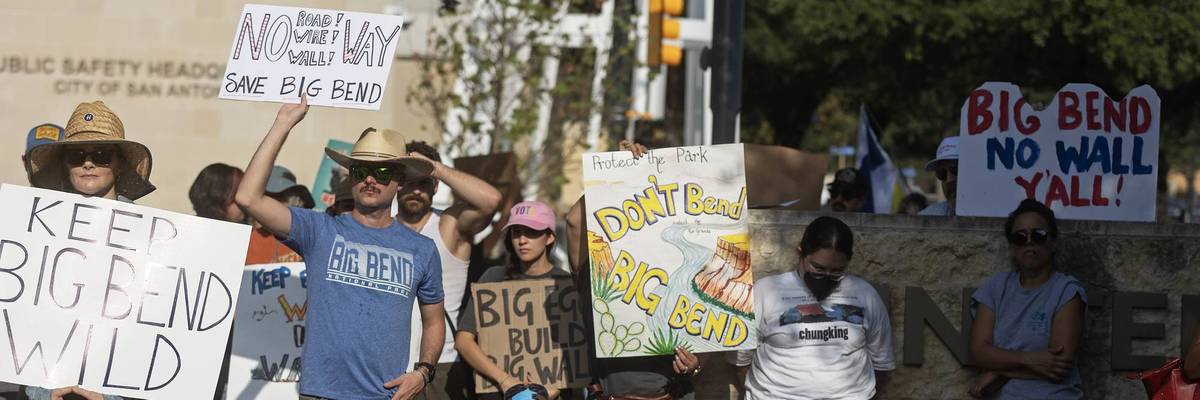
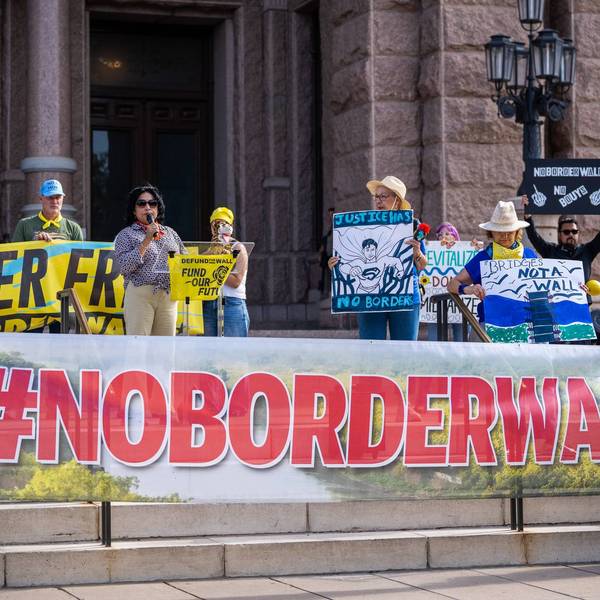
People gather in San Antonio, Texas on August 28, 2026 to oppose the Trump administration's border barrier construction in the Big Bend region.
"This fight is far from over," said one campaigner. "We won’t rest until Big Bend’s environmental protections are fully restored and the illegal waiver that allowed so much destruction is gone for good.”
A federal judge in El Paso on Friday temporarily blocked the Trump administration from continuing construction of border barriers, roads, and other infrastructure across the Big Bend region, a win for environmentalists, landowners, and other Texans from across the political spectrum who are united in their opposition to the project.
US District Judge Kathleen Cardone—who was appointed by former President George W. Bush—granted a preliminary injunction sought by the Center for Biological Diversity (CBD) and other plaintiffs.
"The court finds that plaintiffs are likely to succeed on the merits of at least one of the claims in [their] suit, that there is a likelihood that they will suffer serious, irreparable harm without an injunction, and that the balance of the equities and the public interest weigh in their favor," Cardone wrote in her two-page decision.
BIG WIN FOR BIG BEND!! A federal judge just issued an emergency injunction to block border barrier and road construction across the #BigBend region. The injunction will remain in place while the court considers a lawsuit challenging the federal government’s waiver to fast-track construction.
— Center for Biological Diversity (@biologicaldiversity.org) October 2, 2026 at 2:18 PM
Cardone's order immediately prohibits the Department of Homeland Security and its agencies from building “border barrier or related infrastructure” or engaging in “any construction or ground-disturbing activities” in the Big Bend Sector until they comply with applicable laws. It also stays the effect of three Trump administration waivers that had allowed officials to bypass numerous federal protections.
“This is a historic victory for Big Bend and everyone who loves this wild corner of Texas,” said Laiken Jordahl, CBD's national public lands advocate. “No administration has the right to destroy a crown-jewel national park for political theater."
"With a federal court ordering the bulldozers to stop, Big Bend gets to breathe," Jordahl added. "But this fight is far from over. We won’t rest until Big Bend’s environmental protections are fully restored and the illegal waiver that allowed so much destruction is gone for good.”
Clara Bensen, director of communications for No Big Bend Wall and a board member of Conserve Big Bend, also welcomed the ruling.
"For months we've watched the federal government send bulldozers into a national park that belongs to all of us. Today a federal judge told them to stop," she said in a statement.
"Since we learned the Trump administration planned to seize public and private land and destroy the Big Bend region as we know it, this community has come together across the political aisle to fight back," Bensen added. "The government tried to ignore the law to build unnecessary border infrastructure, and the court made clear it can't. This is a victory, but we are not letting our guard down."
🚨 BREAKING NEWS: A federal judge just HALTED the destruction of Big Bend.This is a massive victory for the landowners, local communities, and everyday Texans who stood up to protect one of our state's greatest treasures.The fight isn't over, but today, the people won.
[image or embed]
— Clayton Tucker (@claytontuckertx.com) October 2, 2026 at 2:16 PM
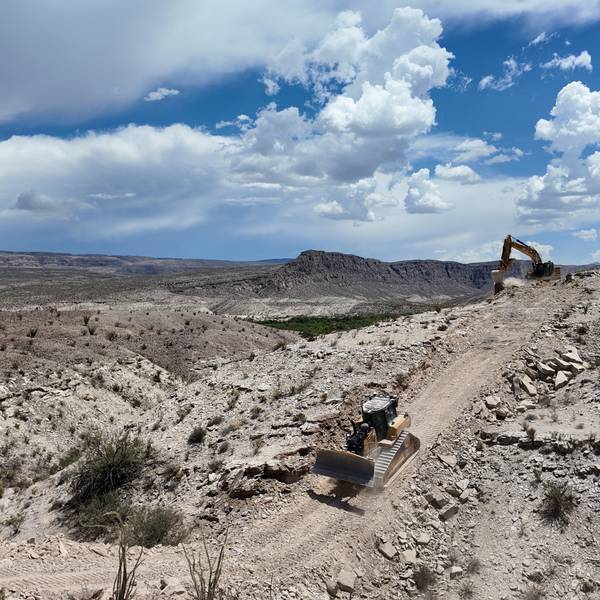
The ruling comes after contractors began bulldozing roads and building other infrastructure in and around Big Bend National Park in August, including near Santa Elena Canyon and Mariscal Mountain. US Customs and Border Protection (CBP) temporarily halted construction on August 17, but that pause expired earlier this week.
The Trump administration has argued that the project—which initially included plans for a 30-foot-high reinforced steel wall—is necessary to achieve what it calls “operational control” of the border. Plaintiffs in the case challenged the administration's determination under Section 102 of the Illegal Immigration Reform and Immigrant Responsibility Act of 1996 that the region is an area of “high illegal entry,” noting that the government's claim is contradicted by its own statistics.
The Big Bend Sector is among the least-trafficked portions of the southern border, accounting for roughly a quarter of the international boundary's length, but no more than 3% of annual migrant apprehensions. The sector recorded just 1.3% of total border apprehensions in 2025, according to CBP data.
Plaintiffs in the case argued that the administration unlawfully used extraordinary powers to waive environmental and other laws, including the Endangered Species Act, National Park Service Organic Act, and National Wild and Scenic Rivers Act. Indigenous groups alleged violations of the Native American Graves Protection and Repatriation Act and the Archaeological and Historic Preservation Act.
At Friday's hearing, Rio Grande river guide and landowner Danny William Miller described the prospect of a barrier cutting across his property and blocking access to the river as “a bullet to the head," according to The Big Bend Sentinel.
Miller testified that once the landscape is altered, it cannot simply be restored. His guide work, he said, would become “a tour of the military-industrial complex, rather than a tour of the wilderness.”
Another local resident, Bill Guerra-Addington, told the court, “They’re taking the river away from us, and it’s devastating.”
Friday's injunction is temporary. The underlying lawsuit will continue, and the broader legal battle over Trump's Big Bend border project—and the administration's legally dubious waivers—remains unresolved. On Wednesday, US District Judge Orlando Garcia, an appointee of former President Bill Clinton, rejected a request from an Indigenous group and business owners for a temporary restraining order in one of several separate cases seeking to halt work on the project.
Still, National Parks Conservation Association president and CEO Tiernan Sittenfeld called Cardone's order “a victory for Big Bend and for all of America’s national parks.”
"While national park advocates are grateful for this halt to border construction in Big Bend, the devastating toll it has already taken on this national park must be studied and remediated," she said. "The administration must repair the damage it has done to the beautiful, fragile desert ecosystems that make Big Bend National Park one of America’s most iconic places."
“The administration’s border plan at Big Bend has faced strong bipartisan opposition from local landowners, experienced local borderland sheriffs, and conservationists alike," Sittenfeld added. "Big Bend is no place for border barriers. It’s time for the administration to come to the table with the border communities that know Big Bend best, repair the damage from this ill-conceived project, and find new solutions.”
s
Dear Common Dreams reader, It’s been nearly 30 years since I co-founded Common Dreams with my late wife, Lina Newhouser. We had the radical notion that journalism should serve the public good, not corporate profits. It was clear to us from the outset what it would take to build such a project. No paid advertisements. No corporate sponsors. No millionaire publisher telling us what to think or do. Many people said we wouldn't last a year, but we proved those doubters wrong. Together with a tremendous team of journalists and dedicated staff, we built an independent media outlet free from the constraints of profits and corporate control. Our mission has always been simple: To inform. To inspire. To ignite change for the common good. Building Common Dreams was not easy. Our survival was never guaranteed. When you take on the most powerful forces—Wall Street greed, fossil fuel industry destruction, Big Tech lobbyists, and uber-rich oligarchs who have spent billions upon billions rigging the economy and democracy in their favor—the only bulwark you have is supporters who believe in your work. But here’s the urgent message from me today. It's never been this bad out there. And it's never been this hard to keep us going. At the very moment Common Dreams is most needed, the threats we face are intensifying. We need your support now more than ever. We don't accept corporate advertising and never will. We don't have a paywall because we don't think people should be blocked from critical news based on their ability to pay. Everything we do is funded by the donations of readers like you. When everyone does the little they can afford, we are strong. But if that support retreats or dries up, so do we. Will you donate now to make sure Common Dreams not only survives but thrives? —Craig Brown, Co-founder |
A federal judge in El Paso on Friday temporarily blocked the Trump administration from continuing construction of border barriers, roads, and other infrastructure across the Big Bend region, a win for environmentalists, landowners, and other Texans from across the political spectrum who are united in their opposition to the project.
US District Judge Kathleen Cardone—who was appointed by former President George W. Bush—granted a preliminary injunction sought by the Center for Biological Diversity (CBD) and other plaintiffs.
"The court finds that plaintiffs are likely to succeed on the merits of at least one of the claims in [their] suit, that there is a likelihood that they will suffer serious, irreparable harm without an injunction, and that the balance of the equities and the public interest weigh in their favor," Cardone wrote in her two-page decision.
BIG WIN FOR BIG BEND!! A federal judge just issued an emergency injunction to block border barrier and road construction across the #BigBend region. The injunction will remain in place while the court considers a lawsuit challenging the federal government’s waiver to fast-track construction.
— Center for Biological Diversity (@biologicaldiversity.org) October 2, 2026 at 2:18 PM
Cardone's order immediately prohibits the Department of Homeland Security and its agencies from building “border barrier or related infrastructure” or engaging in “any construction or ground-disturbing activities” in the Big Bend Sector until they comply with applicable laws. It also stays the effect of three Trump administration waivers that had allowed officials to bypass numerous federal protections.
“This is a historic victory for Big Bend and everyone who loves this wild corner of Texas,” said Laiken Jordahl, CBD's national public lands advocate. “No administration has the right to destroy a crown-jewel national park for political theater."
"With a federal court ordering the bulldozers to stop, Big Bend gets to breathe," Jordahl added. "But this fight is far from over. We won’t rest until Big Bend’s environmental protections are fully restored and the illegal waiver that allowed so much destruction is gone for good.”
Clara Bensen, director of communications for No Big Bend Wall and a board member of Conserve Big Bend, also welcomed the ruling.
"For months we've watched the federal government send bulldozers into a national park that belongs to all of us. Today a federal judge told them to stop," she said in a statement.
"Since we learned the Trump administration planned to seize public and private land and destroy the Big Bend region as we know it, this community has come together across the political aisle to fight back," Bensen added. "The government tried to ignore the law to build unnecessary border infrastructure, and the court made clear it can't. This is a victory, but we are not letting our guard down."
🚨 BREAKING NEWS: A federal judge just HALTED the destruction of Big Bend.This is a massive victory for the landowners, local communities, and everyday Texans who stood up to protect one of our state's greatest treasures.The fight isn't over, but today, the people won.
[image or embed]
— Clayton Tucker (@claytontuckertx.com) October 2, 2026 at 2:16 PM
The ruling comes after contractors began bulldozing roads and building other infrastructure in and around Big Bend National Park in August, including near Santa Elena Canyon and Mariscal Mountain. US Customs and Border Protection (CBP) temporarily halted construction on August 17, but that pause expired earlier this week.
The Trump administration has argued that the project—which initially included plans for a 30-foot-high reinforced steel wall—is necessary to achieve what it calls “operational control” of the border. Plaintiffs in the case challenged the administration's determination under Section 102 of the Illegal Immigration Reform and Immigrant Responsibility Act of 1996 that the region is an area of “high illegal entry,” noting that the government's claim is contradicted by its own statistics.
The Big Bend Sector is among the least-trafficked portions of the southern border, accounting for roughly a quarter of the international boundary's length, but no more than 3% of annual migrant apprehensions. The sector recorded just 1.3% of total border apprehensions in 2025, according to CBP data.
Plaintiffs in the case argued that the administration unlawfully used extraordinary powers to waive environmental and other laws, including the Endangered Species Act, National Park Service Organic Act, and National Wild and Scenic Rivers Act. Indigenous groups alleged violations of the Native American Graves Protection and Repatriation Act and the Archaeological and Historic Preservation Act.
At Friday's hearing, Rio Grande river guide and landowner Danny William Miller described the prospect of a barrier cutting across his property and blocking access to the river as “a bullet to the head," according to The Big Bend Sentinel.
Miller testified that once the landscape is altered, it cannot simply be restored. His guide work, he said, would become “a tour of the military-industrial complex, rather than a tour of the wilderness.”
Another local resident, Bill Guerra-Addington, told the court, “They’re taking the river away from us, and it’s devastating.”
Friday's injunction is temporary. The underlying lawsuit will continue, and the broader legal battle over Trump's Big Bend border project—and the administration's legally dubious waivers—remains unresolved. On Wednesday, US District Judge Orlando Garcia, an appointee of former President Bill Clinton, rejected a request from an Indigenous group and business owners for a temporary restraining order in one of several separate cases seeking to halt work on the project.
Still, National Parks Conservation Association president and CEO Tiernan Sittenfeld called Cardone's order “a victory for Big Bend and for all of America’s national parks.”
"While national park advocates are grateful for this halt to border construction in Big Bend, the devastating toll it has already taken on this national park must be studied and remediated," she said. "The administration must repair the damage it has done to the beautiful, fragile desert ecosystems that make Big Bend National Park one of America’s most iconic places."
“The administration’s border plan at Big Bend has faced strong bipartisan opposition from local landowners, experienced local borderland sheriffs, and conservationists alike," Sittenfeld added. "Big Bend is no place for border barriers. It’s time for the administration to come to the table with the border communities that know Big Bend best, repair the damage from this ill-conceived project, and find new solutions.”
s
A federal judge in El Paso on Friday temporarily blocked the Trump administration from continuing construction of border barriers, roads, and other infrastructure across the Big Bend region, a win for environmentalists, landowners, and other Texans from across the political spectrum who are united in their opposition to the project.
US District Judge Kathleen Cardone—who was appointed by former President George W. Bush—granted a preliminary injunction sought by the Center for Biological Diversity (CBD) and other plaintiffs.
"The court finds that plaintiffs are likely to succeed on the merits of at least one of the claims in [their] suit, that there is a likelihood that they will suffer serious, irreparable harm without an injunction, and that the balance of the equities and the public interest weigh in their favor," Cardone wrote in her two-page decision.
BIG WIN FOR BIG BEND!! A federal judge just issued an emergency injunction to block border barrier and road construction across the #BigBend region. The injunction will remain in place while the court considers a lawsuit challenging the federal government’s waiver to fast-track construction.
— Center for Biological Diversity (@biologicaldiversity.org) October 2, 2026 at 2:18 PM
Cardone's order immediately prohibits the Department of Homeland Security and its agencies from building “border barrier or related infrastructure” or engaging in “any construction or ground-disturbing activities” in the Big Bend Sector until they comply with applicable laws. It also stays the effect of three Trump administration waivers that had allowed officials to bypass numerous federal protections.
“This is a historic victory for Big Bend and everyone who loves this wild corner of Texas,” said Laiken Jordahl, CBD's national public lands advocate. “No administration has the right to destroy a crown-jewel national park for political theater."
"With a federal court ordering the bulldozers to stop, Big Bend gets to breathe," Jordahl added. "But this fight is far from over. We won’t rest until Big Bend’s environmental protections are fully restored and the illegal waiver that allowed so much destruction is gone for good.”
Clara Bensen, director of communications for No Big Bend Wall and a board member of Conserve Big Bend, also welcomed the ruling.
"For months we've watched the federal government send bulldozers into a national park that belongs to all of us. Today a federal judge told them to stop," she said in a statement.
"Since we learned the Trump administration planned to seize public and private land and destroy the Big Bend region as we know it, this community has come together across the political aisle to fight back," Bensen added. "The government tried to ignore the law to build unnecessary border infrastructure, and the court made clear it can't. This is a victory, but we are not letting our guard down."
🚨 BREAKING NEWS: A federal judge just HALTED the destruction of Big Bend.This is a massive victory for the landowners, local communities, and everyday Texans who stood up to protect one of our state's greatest treasures.The fight isn't over, but today, the people won.
[image or embed]
— Clayton Tucker (@claytontuckertx.com) October 2, 2026 at 2:16 PM
The ruling comes after contractors began bulldozing roads and building other infrastructure in and around Big Bend National Park in August, including near Santa Elena Canyon and Mariscal Mountain. US Customs and Border Protection (CBP) temporarily halted construction on August 17, but that pause expired earlier this week.
The Trump administration has argued that the project—which initially included plans for a 30-foot-high reinforced steel wall—is necessary to achieve what it calls “operational control” of the border. Plaintiffs in the case challenged the administration's determination under Section 102 of the Illegal Immigration Reform and Immigrant Responsibility Act of 1996 that the region is an area of “high illegal entry,” noting that the government's claim is contradicted by its own statistics.
The Big Bend Sector is among the least-trafficked portions of the southern border, accounting for roughly a quarter of the international boundary's length, but no more than 3% of annual migrant apprehensions. The sector recorded just 1.3% of total border apprehensions in 2025, according to CBP data.
Plaintiffs in the case argued that the administration unlawfully used extraordinary powers to waive environmental and other laws, including the Endangered Species Act, National Park Service Organic Act, and National Wild and Scenic Rivers Act. Indigenous groups alleged violations of the Native American Graves Protection and Repatriation Act and the Archaeological and Historic Preservation Act.
At Friday's hearing, Rio Grande river guide and landowner Danny William Miller described the prospect of a barrier cutting across his property and blocking access to the river as “a bullet to the head," according to The Big Bend Sentinel.
Miller testified that once the landscape is altered, it cannot simply be restored. His guide work, he said, would become “a tour of the military-industrial complex, rather than a tour of the wilderness.”
Another local resident, Bill Guerra-Addington, told the court, “They’re taking the river away from us, and it’s devastating.”
Friday's injunction is temporary. The underlying lawsuit will continue, and the broader legal battle over Trump's Big Bend border project—and the administration's legally dubious waivers—remains unresolved. On Wednesday, US District Judge Orlando Garcia, an appointee of former President Bill Clinton, rejected a request from an Indigenous group and business owners for a temporary restraining order in one of several separate cases seeking to halt work on the project.
Still, National Parks Conservation Association president and CEO Tiernan Sittenfeld called Cardone's order “a victory for Big Bend and for all of America’s national parks.”
"While national park advocates are grateful for this halt to border construction in Big Bend, the devastating toll it has already taken on this national park must be studied and remediated," she said. "The administration must repair the damage it has done to the beautiful, fragile desert ecosystems that make Big Bend National Park one of America’s most iconic places."
“The administration’s border plan at Big Bend has faced strong bipartisan opposition from local landowners, experienced local borderland sheriffs, and conservationists alike," Sittenfeld added. "Big Bend is no place for border barriers. It’s time for the administration to come to the table with the border communities that know Big Bend best, repair the damage from this ill-conceived project, and find new solutions.”
s