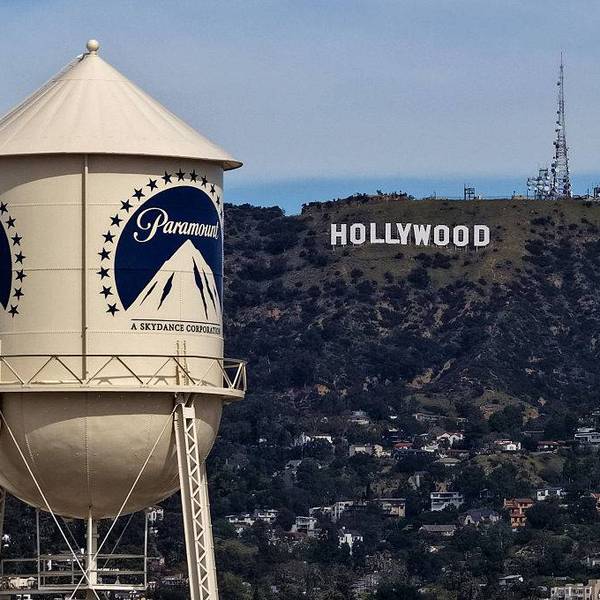
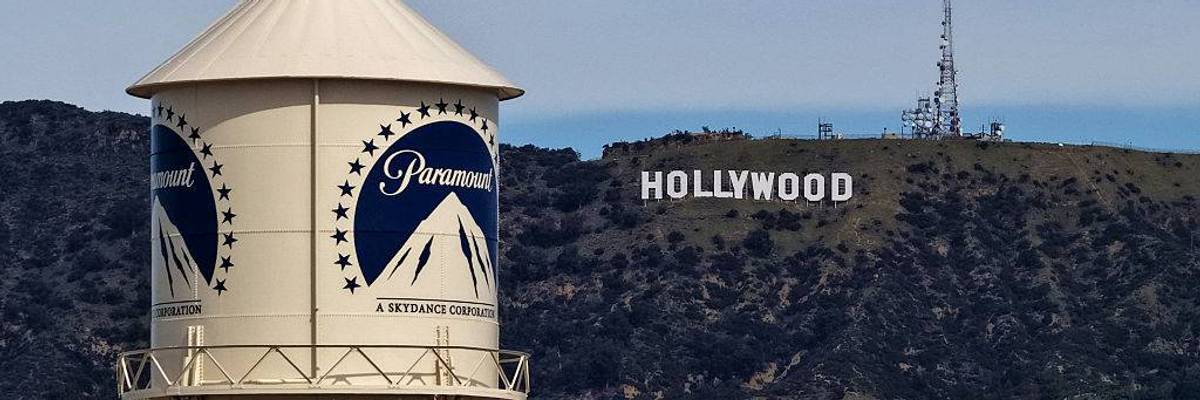
An aerial view of the Paramount logo on the water tower at Paramount Studios on February 23, 2026 in Los Angeles, California.
'Keep Up the Fight': Federal Judge Pauses Paramount-Warner Bros. Merger
"History tells the tale of what happens when a few people have great power over markets that are central to Americans' lives: fewer opportunities for more people, worse products and services for all people," said California Attorney General Rob Bonta.
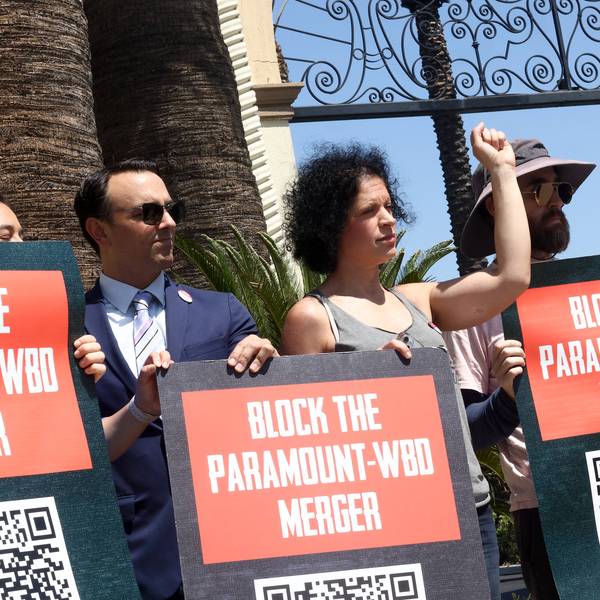
The $110 billion megamerger between Paramount and Warner Bros., widely criticized as a "disaster" by antitrust advocates, has been temporarily put on hold.
US District Judge Araceli Martínez-Olguín on Monday granted a temporary restraining order sought by several Democratic state attorneys general to pause the merger from going forward.
In her ruling, Martínez-Olguín found that the plaintiffs provided "compelling evidence that the combined firm resulting from the transaction will possess substantial market share in the wide-release theatrical distribution market," meaning that the merger between the two studios is "likely to violate antitrust laws."
The judge—appointed by former President Joe Biden—issued a 14-day restraining order on the merger, writing that "Paramount and Warner Bros. will continue to operate as separate, viable companies competing in the marketplace while they wait for the court to adjudicate this case."
The combination of Paramount and Warner Bros. has long been controversial because it would put control of CBS, CNN, HBO, TikTok, and other major media properties all under the control of David Ellison, the son of billionaire Larry Ellison, a major donor to President Donald Trump.
California Attorney General Rob Bonta, the lead plaintiff in the lawsuit against Paramount-Warner Bros. deal, hailed Martínez-Olguín's ruling as a "critical first win in our case to ensure this megamerger never sees the light of day."
"History tells the tale of what happens when a few people have great power over markets that are central to Americans' lives: fewer opportunities for more people, worse products and services for all people," he said. "With our lawsuit, we're fighting for a free and fair market and a thriving film and television industry that serves creatives and audiences alike."
New York Attorney General Letitia James, a co-plaintiff in the lawsuit, delivered a video statement calling the ruling "an important victory for consumers, for workers, and for fair competition."
"We are taking action to protect New Yorkers from the harms of unlawful corporate consolidation," James added, "and protecting democracy while we're at it."
We just won a court order stopping the merger of @ParamountPics and @warnerbros while our lawsuit continues.
We’re going to keep fighting to keep costs down for consumers, protect jobs, and stop this illegal merger. pic.twitter.com/yfcA0sOoLb
— NY AG James (@NewYorkStateAG) July 20, 2026
Sen. Elizabeth Warren (D-Mass.), a longtime critic of the merger, called the ruling "a WIN thanks to the state attorneys general who stood up and pushed back," and added, "Let's keep up the fight."
Rep. Becca Balint (D-Vt.) said the ruling was "welcome news," while warning that "we're not out of the woods yet."
"This merger would force prices up, bring wages down, and lead to people losing jobs—all to bring TikTok, CNN, and CBS under one roof," Balint observed. "Perhaps Paramount CEO David Ellison can't wine and dine his way through this one after all."
Attorney Norm Eisen, co-founder of Democracy Defenders Action, accused the Ellisons of trying to "rush" the merger over the finish line before courts could examine antitrust claims being made against it.
"Now the case gets decided on the merits," Eisen said.
We are at a crossroads
This country and this world are at a monumental crossroads. In a few short weeks, US voters will have an opportunity to beat back the forces of fascism and confront the billionaires who are rigging the economy, our media system, and our democracy, making it increasingly impossible for ordinary people to get by. We’re not just talking about the election. We’re talking about what must be done once these fascist elements are vanquished from power. We need a bolder set of solutions than what either major party has so far been willing to offer and a working-class movement ready to fight like hell for it. Trump didn't emerge from nowhere. The conditions that fueled MAGA authoritarianism were created by decades of radical neoliberal economic policies and a corrupt political system dominated by corporate interests. They slashed taxes on the super-rich, promising that the benefits would trickle down. They said giveaways to the corporate titans would make life more affordable for the rest of us. It was all bullshit. And when a bitter, betrayed populace searches for someone to blame, right-wing demagogues have little trouble finding scapegoats. People know when they're being lied to, but you won't hear any of this from the corporate media. Only independent journalism—powered and funded by people who believe in building a better world—can deliver truly trustworthy daily news. Our Fall Campaign is underway, and we need your help. To power our newsroom through the rest of the year, we need to raise $125,000 by midnight on October 31. So if you share our vision, please contribute whatever you can to sustain our work. |
The $110 billion megamerger between Paramount and Warner Bros., widely criticized as a "disaster" by antitrust advocates, has been temporarily put on hold.
US District Judge Araceli Martínez-Olguín on Monday granted a temporary restraining order sought by several Democratic state attorneys general to pause the merger from going forward.
In her ruling, Martínez-Olguín found that the plaintiffs provided "compelling evidence that the combined firm resulting from the transaction will possess substantial market share in the wide-release theatrical distribution market," meaning that the merger between the two studios is "likely to violate antitrust laws."
The judge—appointed by former President Joe Biden—issued a 14-day restraining order on the merger, writing that "Paramount and Warner Bros. will continue to operate as separate, viable companies competing in the marketplace while they wait for the court to adjudicate this case."
The combination of Paramount and Warner Bros. has long been controversial because it would put control of CBS, CNN, HBO, TikTok, and other major media properties all under the control of David Ellison, the son of billionaire Larry Ellison, a major donor to President Donald Trump.
California Attorney General Rob Bonta, the lead plaintiff in the lawsuit against Paramount-Warner Bros. deal, hailed Martínez-Olguín's ruling as a "critical first win in our case to ensure this megamerger never sees the light of day."
"History tells the tale of what happens when a few people have great power over markets that are central to Americans' lives: fewer opportunities for more people, worse products and services for all people," he said. "With our lawsuit, we're fighting for a free and fair market and a thriving film and television industry that serves creatives and audiences alike."
New York Attorney General Letitia James, a co-plaintiff in the lawsuit, delivered a video statement calling the ruling "an important victory for consumers, for workers, and for fair competition."
"We are taking action to protect New Yorkers from the harms of unlawful corporate consolidation," James added, "and protecting democracy while we're at it."
We just won a court order stopping the merger of @ParamountPics and @warnerbros while our lawsuit continues.
We’re going to keep fighting to keep costs down for consumers, protect jobs, and stop this illegal merger. pic.twitter.com/yfcA0sOoLb
— NY AG James (@NewYorkStateAG) July 20, 2026
Sen. Elizabeth Warren (D-Mass.), a longtime critic of the merger, called the ruling "a WIN thanks to the state attorneys general who stood up and pushed back," and added, "Let's keep up the fight."
Rep. Becca Balint (D-Vt.) said the ruling was "welcome news," while warning that "we're not out of the woods yet."
"This merger would force prices up, bring wages down, and lead to people losing jobs—all to bring TikTok, CNN, and CBS under one roof," Balint observed. "Perhaps Paramount CEO David Ellison can't wine and dine his way through this one after all."
Attorney Norm Eisen, co-founder of Democracy Defenders Action, accused the Ellisons of trying to "rush" the merger over the finish line before courts could examine antitrust claims being made against it.
"Now the case gets decided on the merits," Eisen said.
- 'Reeks of Corruption': Trump DOJ Bypassed Antitrust Staff to Approve Paramount-Warner Bros. Merger ›
- 'One Family Is About to Control CBS, CNN, HBO, and TikTok': Alarm Grows Over Paramount-Warner Bros. Merger ›
- 'No One Is Above the Law': 12 States Sue to Block Paramount-Warner Bros. Merger ›
- 'Huge Win for Consumers': Paramount Delays Warner Bros. Deal Over Court Fight | Common Dreams ›
- 'Outrageous': Sanders Slams FCC for Approving Saudi and UAE Ownership of Paramount-Warner Bros. | Common Dreams ›
The $110 billion megamerger between Paramount and Warner Bros., widely criticized as a "disaster" by antitrust advocates, has been temporarily put on hold.
US District Judge Araceli Martínez-Olguín on Monday granted a temporary restraining order sought by several Democratic state attorneys general to pause the merger from going forward.
In her ruling, Martínez-Olguín found that the plaintiffs provided "compelling evidence that the combined firm resulting from the transaction will possess substantial market share in the wide-release theatrical distribution market," meaning that the merger between the two studios is "likely to violate antitrust laws."
The judge—appointed by former President Joe Biden—issued a 14-day restraining order on the merger, writing that "Paramount and Warner Bros. will continue to operate as separate, viable companies competing in the marketplace while they wait for the court to adjudicate this case."
The combination of Paramount and Warner Bros. has long been controversial because it would put control of CBS, CNN, HBO, TikTok, and other major media properties all under the control of David Ellison, the son of billionaire Larry Ellison, a major donor to President Donald Trump.
California Attorney General Rob Bonta, the lead plaintiff in the lawsuit against Paramount-Warner Bros. deal, hailed Martínez-Olguín's ruling as a "critical first win in our case to ensure this megamerger never sees the light of day."
"History tells the tale of what happens when a few people have great power over markets that are central to Americans' lives: fewer opportunities for more people, worse products and services for all people," he said. "With our lawsuit, we're fighting for a free and fair market and a thriving film and television industry that serves creatives and audiences alike."
New York Attorney General Letitia James, a co-plaintiff in the lawsuit, delivered a video statement calling the ruling "an important victory for consumers, for workers, and for fair competition."
"We are taking action to protect New Yorkers from the harms of unlawful corporate consolidation," James added, "and protecting democracy while we're at it."
We just won a court order stopping the merger of @ParamountPics and @warnerbros while our lawsuit continues.
We’re going to keep fighting to keep costs down for consumers, protect jobs, and stop this illegal merger. pic.twitter.com/yfcA0sOoLb
— NY AG James (@NewYorkStateAG) July 20, 2026
Sen. Elizabeth Warren (D-Mass.), a longtime critic of the merger, called the ruling "a WIN thanks to the state attorneys general who stood up and pushed back," and added, "Let's keep up the fight."
Rep. Becca Balint (D-Vt.) said the ruling was "welcome news," while warning that "we're not out of the woods yet."
"This merger would force prices up, bring wages down, and lead to people losing jobs—all to bring TikTok, CNN, and CBS under one roof," Balint observed. "Perhaps Paramount CEO David Ellison can't wine and dine his way through this one after all."
Attorney Norm Eisen, co-founder of Democracy Defenders Action, accused the Ellisons of trying to "rush" the merger over the finish line before courts could examine antitrust claims being made against it.
"Now the case gets decided on the merits," Eisen said.
- 'Reeks of Corruption': Trump DOJ Bypassed Antitrust Staff to Approve Paramount-Warner Bros. Merger ›
- 'One Family Is About to Control CBS, CNN, HBO, and TikTok': Alarm Grows Over Paramount-Warner Bros. Merger ›
- 'No One Is Above the Law': 12 States Sue to Block Paramount-Warner Bros. Merger ›
- 'Huge Win for Consumers': Paramount Delays Warner Bros. Deal Over Court Fight | Common Dreams ›
- 'Outrageous': Sanders Slams FCC for Approving Saudi and UAE Ownership of Paramount-Warner Bros. | Common Dreams ›